
Will AI replace data analysts? What 2026 enterprise data says
Will AI replace data analysts? NASSCOM's October 2026 survey of 200 Indian firms found 78% limit AI agents to structured tasks. What changes for analysts.

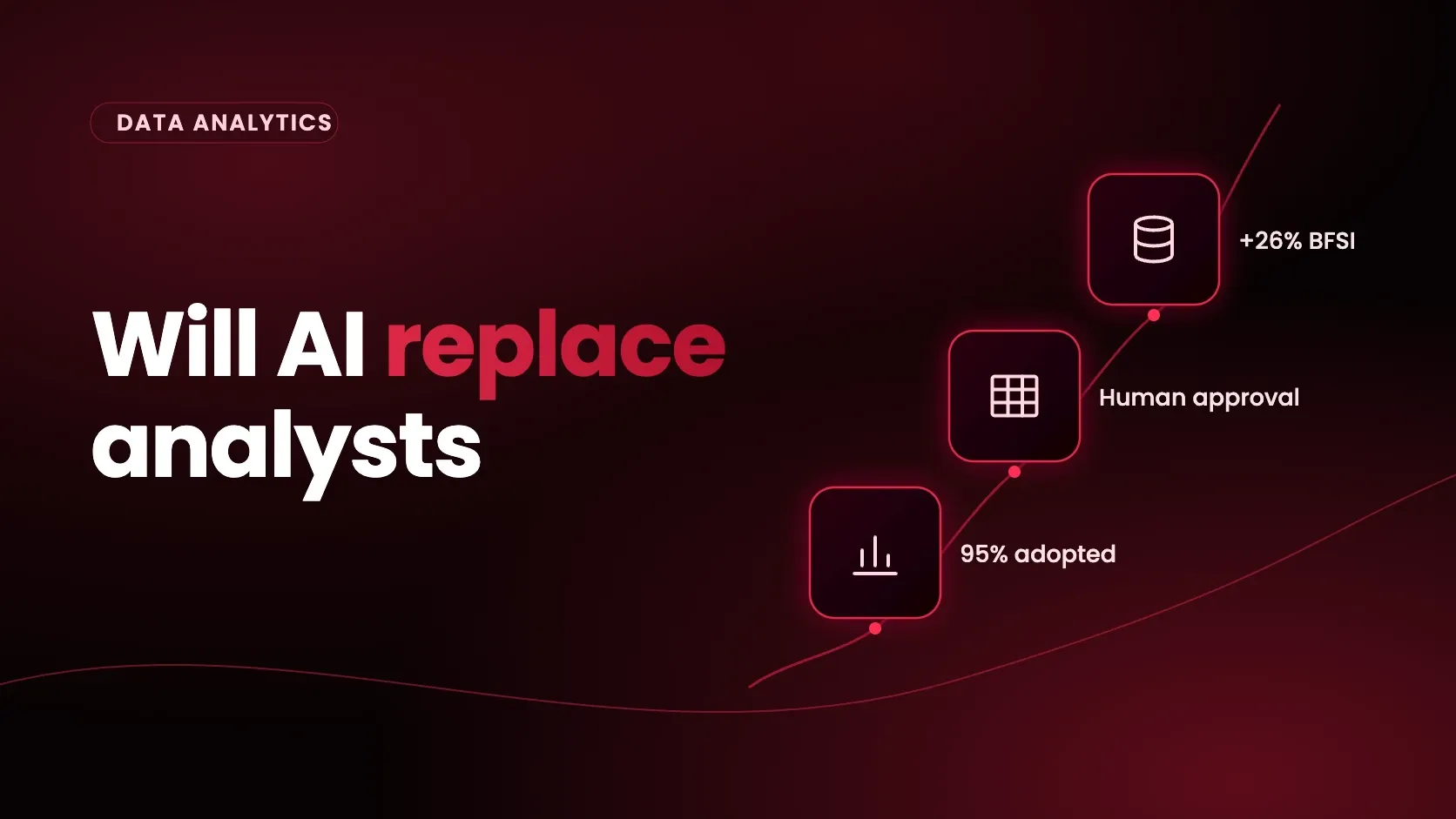
AI is changing what Indian data analysts are asked to do, but 2026 enterprise data does not show it replacing them. In NASSCOM's October 2026 survey of 200 India-headquartered enterprises, 95% had implemented agentic AI, yet 78% confined agents to structured tasks with clearly defined end points and the majority required 100% human approval before any agentic action.
How far have Indian enterprises got with AI agents?
NASSCOM's study Agentic AI Adoption in Indian Enterprises, published on 14 October 2026, surveyed 200 India-headquartered legal entities. Spending is nearly universal: 98% had a dedicated AI budget and 97% had set aside some money for agentic AI. Fewer had reached production-grade agentic AI, and the study describes scale as nascent.
Global data tells a similar story. Stanford's AI Index 2026, drawing on a McKinsey survey of 2025, found 88% of organisations using AI in at least one business function, up from 78% in 2024. Agents trailed well behind. In most business functions a majority of respondents reported no agent use at all, and scaled use stayed in single digits for nearly every function.
The exceptions sat in the technology sector, where scaled agent use reached 24% in software engineering, 22% in IT and 21% in service operations. The survey is self-reported, and the AI Index itself calls the results directional.
NASSCOM's Strategic Review 2026, dated 23 February 2026, describes 2025 as the year India's tech industry moved from AI experimentation to industrialisation, with agentic systems taking AI from a support role into execution. That is an industry body's framing of the whole sector, not a measure of analyst work. The October survey shows how much supervision still surrounds it.
Why does human approval still sit in front of most AI agents?
In the same NASSCOM survey, 78% of enterprises tightly confined agentic action to structured tasks with clearly defined end points, and 70% ran AI through central IT or AI centres of excellence. A majority required a person to approve every agentic action. NASSCOM's report text points to trust as the constraint on scale.
The concerns respondents named explain why. Poor data quality, model trust, safe data sharing, availability of skillsets and lack of integration with the existing tech stack were the top concerns, and 58% of enterprises ran agents on existing datasets. When agents work on the data a company already holds, its quality becomes a day-one problem. The skills respondents said they needed fit that picture: 71% named AI/ML and agent engineering capabilities, followed by 67% seeking data engineering skills.
The table sets adoption next to supervision, so the gap between the two is easy to see.
| Source and period | Who was measured | Adoption reading | Supervision or limit |
|---|---|---|---|
| NASSCOM, October 2026 | 200 India-headquartered enterprises | 95% implemented agentic AI; 98% have a dedicated AI budget | 78% confine agents to structured tasks; the majority require 100% human approval; 70% run AI through central IT or centres of excellence |
| Stanford AI Index 2026, McKinsey 2025 data | Organisations worldwide, self-reported | 88% use AI in at least one function | Most functions report no agent use; scaled use is 24% in software engineering, 22% in IT and 21% in service operations (technology sector) |
| Indeed via Storyboard18 (September 2025) and IANS (January 2026) | Indian job postings on Indeed | Almost 39% of data and analytics postings mentioned AI, then 40% | A mention shows what postings ask for, not jobs lost |
What has AI done to data analyst job descriptions?
Postings show where the change is most visible. Indeed data reported by Storyboard18 on 16 October 2025 found that almost 39% of data and analytics roles in India mentioned AI in September 2025, against 23% of software development postings. By January 2026 the analytics share was 40% and software development 29%, in Indeed's India report as covered by IANS on 10 March 2026. Indeed's India postings skew towards tech roles, so neither figure describes the whole economy.
Read plainly, those numbers measure how often a posting mentions AI. They do not count analysts laid off or roles cut, and they should not be used as a measure of automation.
Employers describe the change as redefinition. In the NASSCOM and Indeed report of 19 May 2026, 86% of employers said AI had already affected job roles and responsibilities, and 35% had seen significant redefinition or transformation of roles.
LinkedIn's Skills on the Rise 2026 for India, as reported by Storyboard18 on 24 February 2026, places querying, database optimisation, data storytelling and data-driven decision-making in its data and analytics cluster. Among the fastest-rising skills nationally it names prompt engineering, workflow automation, LLMOps, AutoML and API integration. LinkedIn measured growth between December 2024 and November 2025 against the year before.
Which analyst tasks are likely to be automated, and which are growing?
NASSCOM's finding that agents are confined to structured tasks with defined end points suggests where automation lands first: recurring reports and standard queries. The work that stays with people has no defined end point. It means choosing which question matters and judging whether the data can answer it. Explaining the answer to someone who has to act on it belongs there too, and it is the daily substance of the role described in what a data analyst does.
Employer surveys back that reading. The NASSCOM-Deloitte compensation survey of 2025 lists strategic thinking and analytical skills among the top skills sought, and in WEF's India profile 79% of surveyed employers call analytical thinking a core skill. Poor data quality was among the top concerns in NASSCOM's agent survey, which makes a person who can say whether a dataset is fit for use more useful as agents spread.
Regulation adds work of its own. India notified the Digital Personal Data Protection Rules on 14 November 2025 with an 18-month phased compliance timeline, so teams that handle personal data are building consent, purpose and audit practices.
Is demand for data analysts rising or falling in 2026?
Both, depending on the cut and the month. foundit's annual report named data analytics among the fastest-growing role areas of 2025, with its Hiring Index up 15% year on year in December 2025. By June 2026 its tracker showed online vacancies 9% below a year earlier and 5% lower month on month, a 12% slide over six months, with hiring narrowing to specialist, skill-led roles.
By experience, the June 2026 view had entry-level demand (0 to 3 years) down 6%, the 4 to 6 year band down 10% and the 7 to 10 year band up 6%, the only band growing.
Inside that softer market, analyst roles still appear among the growth areas. foundit's June 2026 Hiring Snapshot lists data analysts and BI developers (up 26% year on year) among trending roles in banking and financial services global capability centres (GCCs), next to risk and compliance analysts (up 32%) and AI/ML engineers (up 30%).
WEF's Future of Jobs Report 2025 projects net growth to 2030 of 54% for data analysts and scientists and 17% for business intelligence analysts among surveyed employers operating in India. The same profile gives 176% for AI and machine learning specialists. Those are employer projections, not vacancy counts.
NASSCOM's Strategic Review 2026 expects hiring to shift from volume to skill mix in FY27, which matches how foundit reads mid-2026. The saturation question gets a fuller treatment in is data analytics saturated in 2026, and data analytics versus AI and ML compares the two paths for students choosing between them.
Will SQL, Python, Power BI and Excel still be valuable as AI changes the job?
The early-career evidence still starts with the fundamentals. foundit's December 2025 Hiring Snapshot ranks Python (22% on foundit's own share measure) and SQL and databases (18%) first and second in its table of skills for 0 to 3 years of experience, ahead of Java (16%), cloud (12%) and data analysis (10%). CXOToday's coverage of the NASSCOM and Indeed report lists data analytics and visualisation among the skills in demand across industries, next to generative AI and large language models, including prompt engineering.
The base skills are still listed in the 2026 surveys, and an AI layer is being added on top. TeamLease Digital's Digital Skills and Salary Primer FY2026-27, built on 37,000 tech and digital roles across 18 cities, estimates that only 16% of IT professionals in India hold AI skills and that 39% of core digital skills will change by 2030.
An agent can write a query, but someone still has to know whether the query answers the question. The order in which to build the base is covered in SQL versus Python for data analysts.
One structured route into the AI layer is the Certification Program in Data Analytics with AI and Gen AI, an online programme from E&ICT Academy, IIT Roorkee, run with Masai as the implementation partner. It has live sessions and an optional campus immersion, covers SQL, Python, Google Sheets, prompt engineering, LLM tools and agentic workflows with LangChain and CrewAI, and ends in a capstone project. Its modules include Core Data Architecture and Analytical Foundations, and Architecting Agentic Systems and Automation.
Frequently asked questions
Will generative AI replace data analysts?
Not on the 2026 survey evidence. The NASSCOM and Indeed report of May 2026 found 86% of employers had seen some impact of AI on job roles and 35% a significant redefinition, but neither figure counts jobs removed. Postings are asking for AI familiarity instead: 40% of data and analytics postings referenced AI in January 2026, as reported by IANS.
Is data analytics a dying career?
The evidence is mixed rather than negative. foundit's June 2026 tracker had overall vacancies 9% below a year earlier and entry-level demand down 6%, so competition for first roles is real. The same tracker lists data analysts and BI developers up 26% in banking and financial services GCCs, and WEF's India profile projects 54% net growth for data analysts and scientists by 2030.
Which tech jobs are safe from AI?
The data shows where employers expect growth: WEF's India profile projects net growth to 2030 of 176% for AI and machine learning specialists, 54% for data analysts and scientists and 17% for business intelligence analysts. Those are employer projections from a limited set of roles, not promises about any individual job.
Do SQL and Python still matter if AI can write code?
Postings still list them first for early careers. foundit's December 2025 Hiring Snapshot puts Python and SQL at the top of its table of skills for 0 to 3 years of experience, and its 2025 AI report says entry-level AI hiring centred on foundational skills such as Python, SQL and ML basics. Judging whether an AI tool's query is right depends on knowing SQL.
Is it worth adding AI skills now?
LinkedIn's Skills on the Rise 2026 for India lists prompt engineering and workflow automation among its rising skills, and NASSCOM and Indeed found 65% of employees were still learning, lacked confidence or had no exposure to AI tools. AI practice is therefore still uneven. NASSCOM's 2026 AI-Native Talent Index adds that technical depth, mentorship and independent judgment remain essential.
Next step
The Certification Program in Data Analytics with AI and Gen AI, E&ICT Academy IIT Roorkee page sets out the curriculum and how to apply.