
IIM Ranchi’s executive program in product management: Fees, curriculum, certification & career Scope (2026)

Open any mid-to-senior job listing at a funded Indian startup right now. Product Manager. Senior PM. Associate PM. Growth PM. The titles keep multiplying. So does the hiring budget behind them.
But here's the part that doesn't make it into job descriptions: most companies aren't struggling to find people who want the title. They're struggling to find people who can actually do the job someone who understands what engineers are building, knows why customers aren't converting, and can walk into a leadership meeting and defend a roadmap decision with data, not instinct.
That gap between what companies desperately need and what most candidates can actually deliver is one of the defining hiring problems of India's tech economy in 2026. And it's getting worse, not better. AI has accelerated product cycles. Timelines are shorter. Stakeholder expectations are higher. The bar for what "good PM" means has moved, and most existing education hasn't caught up.
The professionals who are winning these roles aren't necessarily the ones with the most experience. They're the ones who learned product management the right way with structure, with real practice, and from people who've done it at scale.
What is Product Management?
Product management is the discipline of looking after a specific product within a business. According to Product Focus, it sits at the very heart of an organization, responsible for balancing the need to deliver value to the company with what customers want and what's technically and operationally possible.
That means a product manager is responsible for three things simultaneously: deciding what to build, working with teams to build it, and figuring out how to bring it to market. They're the bridge between engineering, design, business, and the customer, a role that requires technical fluency, strategic clarity, and genuine communication skills.
It's one of the fastest-growing roles in India's tech economy and one of the hardest to fill.
Why is product management a career worth pursuing in 2026?
The demand for product managers isn't new. But what's changed is the urgency and the scope.
AI has reshaped how companies build products. Companies now have more engineering capability than ever, but they still struggle with the most fundamental question: what should we actually build for our users? That's a product management problem, not a technical one.
Here's what makes this career particularly compelling in 2026:
The salary trajectory is strong. Entry level PM roles in India start around ₹12-18 LPA. Senior product managers at funded startups and established tech companies earn ₹18-25 LPA and beyond. The progression from associate PM to Director of Product is one of the clearest career ladders in the tech industry.
The role exists across every industry. Product managers work in fintech, healthtech, edtech, e-commerce, SaaS, enterprise software, and beyond. The skill set transfers. You're not betting on a single sector.
AI literacy is now a product management superpower. Companies are no longer short of AI tools they're short of people who know which tool to use, when, and why. PMs who can integrate AI workflows into product thinking are becoming disproportionately valuable.
It opens leadership doors. Product management is one of the clearest paths to becoming a Chief Product Officer, VP of Product, or even a founding role at a startup. Many of India's most influential startup founders came from PM backgrounds.
The IIM Ranchi executive program in product management:
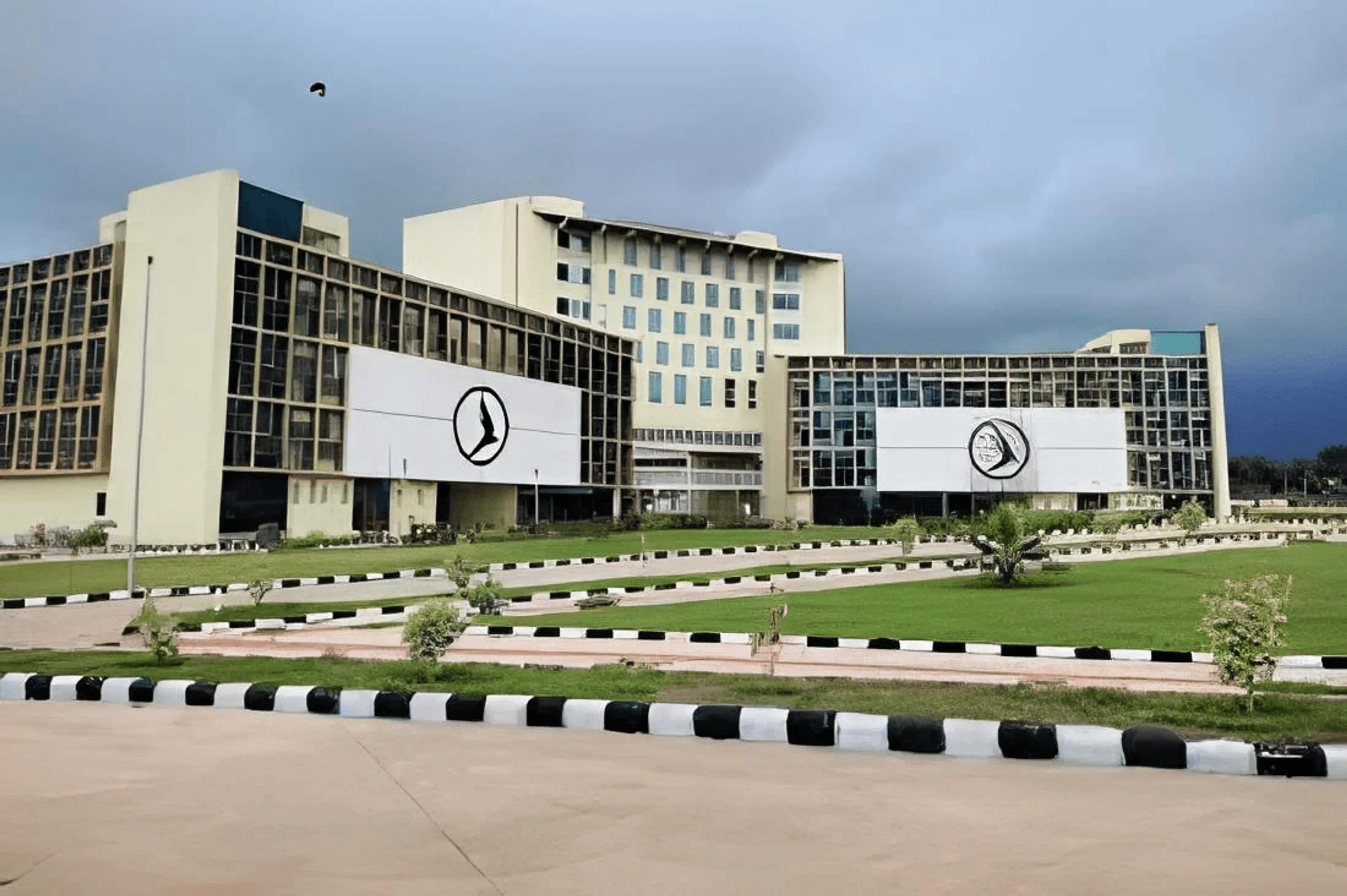
This is a 12-week offline program delivered at IIM Ranchi's Hyderabad campus, designed for professionals who want to build genuine product management skills not just a certificate on their LinkedIn.
The program is taught by IIM Ranchi faculty, supported by industry mentors from companies like Microsoft, and structured around a real capstone project built on actual Indian brand problem statements.
Here are the key details:
What you'll learn: The 12-week journey?
The curriculum is structured around the full product management lifecycle from discovery to measurement with no fluff and no filler.
Week 1 Foundations You start with what the PM role actually involves: vocabulary, customer-centricity, and the critical difference between outcomes and outputs. Most early PMs confuse these. Week 1 is designed to reset that thinking.
Weeks 2-3 Discovery You'll learn how to conduct user interviews, derive personas from real insights, and apply Jobs to be done and opportunity solution frameworks to turn observations into testable hypotheses. This is where product intuition begins to form.
Weeks 4-5 Strategy Product vision, differentiation, value propositions for Indian brands. RICE, ICE, and MoSCoW prioritization frameworks. Roadmap planning. You'll leave knowing how to make defensible product decisions, not just preferences.
Week 6 Industry Mentor Sessions A hands-on Figma workshop, an Indian app product breakdown, and the formation of capstone groups. This is where classroom learning starts colliding with real-world practice.
Weeks 7-9 Build & Execute Writing Product Requirements Documents with user stories and acceptance criteria. Sprint planning. Backlog management. Stakeholder communication. And critically AI tools like ChatGPT to accelerate PRD drafting and research.
Weeks 10-11 Measure Defining your North Star metric, KPIs, and counter-metrics. Analyzing funnels, activation, and retention. Designing A/B experiments. This is where product management becomes science, not intuition.
Week 12 Industry Mentor Sessions A GenAI-PRD workshop, metrics driven product breakdown, and capstone progress reviews.
Week 13 Final Exam A three-hour case-based offline exam covering discovery, strategy, execution, and metrics. It's rigorous by design.
Week 14 Capstone Day Group capstone presentations defended live before a panel of IIM Ranchi faculty and industry practitioners. You present real product solutions to real problem statements from Indian companies.
Total: 72 hours of instruction 60 from IIM Ranchi faculty, 12 from industry mentors.
Who teaches this program?
The faculty composition is what separates this program from most product management courses on the market.
Prof. Tamal Samanta is an Assistant Professor of Marketing at IIM Ranchi with an MBA from IIM Nagpur and a PhD from IIM Lucknow. His research on bottom of the pyramid marketing and consumer behavior brings a sharp, India specific lens to product discovery and market research.
Dr. Shipra Mathur is an Assistant Professor of Marketing at IIM Ranchi with a PhD from IIT Roorkee. Her research focuses on consumer psychology, brand authenticity, and how communication cues shape perception in digital environments directly applicable to building products that users actually trust.
Arun Nandewal is a Senior Product Manager at Microsoft with over eight years of experience building and scaling AI powered products. He's presented at Google I/O and Microsoft Ignite. His sessions bridge the gap between theoretical PM frameworks and the actual decisions a senior PM makes at scale.
What skills you'll build?
The program is designed around practical skill development, not theory comprehension. By the end of 12 weeks, you'll have built genuine capability in:
Product discovery and user research knowing how to find out what users actually need, not what they say they want.
Product strategy and roadmap planning making prioritization decisions that your engineering, design, and business teams can rally around.
Execution skills PRDs, agile workflows, sprint planning, stakeholder management. The operational core of what a PM does daily.
Product analytics and experimentation defining success metrics, building dashboards, running experiments, and making data-backed decisions.
AI-powered product workflows using generative AI tools to accelerate research, drafting, and decision-making within a product process.
Tools you'll work with: Figma, Notion, Jira, Mixpanel, ChatGPT, and others the actual toolkit used by product teams at India's leading companies.
Who is this program for?
The program is explicitly designed for three kinds of people:
Aspiring product managers professionals currently in sales, operations, marketing, or customer support who want to transition into product management. You don't need a PM background; you need ambition and a willingness to learn the craft seriously.
Engineers, designers, and analysts technical professionals who want to move from execution to strategy. Learning product management skills positions you to lead features, collaborate more effectively with PM teams, or transition fully within 12–18 months.
Final-year students and freshers early-career professionals exploring product management as a career direction. No prior experience required.
What you'll walk away with
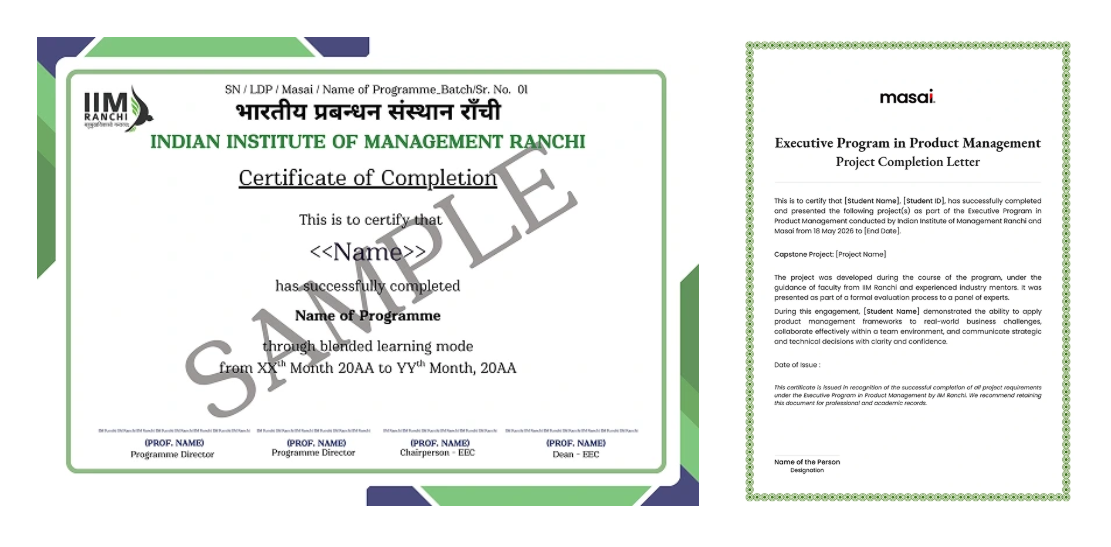
An IIM Ranchi Certificate of Completion, a recognized institutional credential from one of India's top management institutes. It carries weight in interviews, on resumes, and in conversations with hiring managers who understand what it means to have trained at an IIM.
A Masai Project Completion Letter documenting your capstone project and the real work you produced during the program. Proof of what you can actually do, not just what you studied.
An IIM Network 12 weeks of immersive learning alongside faculty and a campus community is a professional network investment that compounds over time.
A portfolio-ready capstone a product solution built on real Indian company problem statements, spanning discovery, strategy, PRDs, and metrics. Something you can take directly into an interview.
Is this program worth it?
Let's be direct: ₹75,499 is a meaningful investment. The question isn't whether it's expensive. The question is whether the return justifies it.
Here's how to think about it. An associate PM role in India typically starts at ₹8-12 LPA. A transition into product management from a lower-compensated role in operations or marketing could represent a salary delta of ₹4-8 LPA or more in the first year alone. The break-even math isn't complicated.
But beyond salary, what this program offers is structured credibility. The product management market in India has a trust problem: there are thousands of online certificate programs, and hiring managers have learned to be skeptical of most of them. An IIM Ranchi credential, delivered offline, with a live capstone defense, signals something different. It signals commitment, rigor, and the willingness to do the actual work.
For anyone seriously pursuing a product management career in 2026, that signal matters.
How to apply?
The admission process is designed to be clear and accessible:
Step 1 - Apply. Pay the ₹499 application fee and fill out the application form.
Step 2 - Interview. Shortlisted candidates complete a personal interview. Successful candidates receive an acceptance letter.
Step 3 - Confirmation. Pay the ₹5,000 seat booking fee, complete onboarding, and receive your provisional ID and admission letter.
Program starts: 18 July 2026
Fee structure:
- Application fee: ₹499
- Seat booking fee: ₹5,000
- Program fee: ₹70,000 (+GST)
- Total: ₹75,499 (inclusive of GST)
Flexible payment plans are available you can choose to pay upfront or in two instalments.
For queries: WhatsApp +91 87929 74750 | iimranchiprograms@masaischool.com
Also Read
Service Company vs Product Company: The ultimate beginner’s guide
to choosing your Tech Career Path
How to become a Product Manager without an MBA: A complete guide
The 6 AI skills that will make you irreplaceable by 2027