
Leap by Masai: India's Best Co-Founder & Builder Program Explained

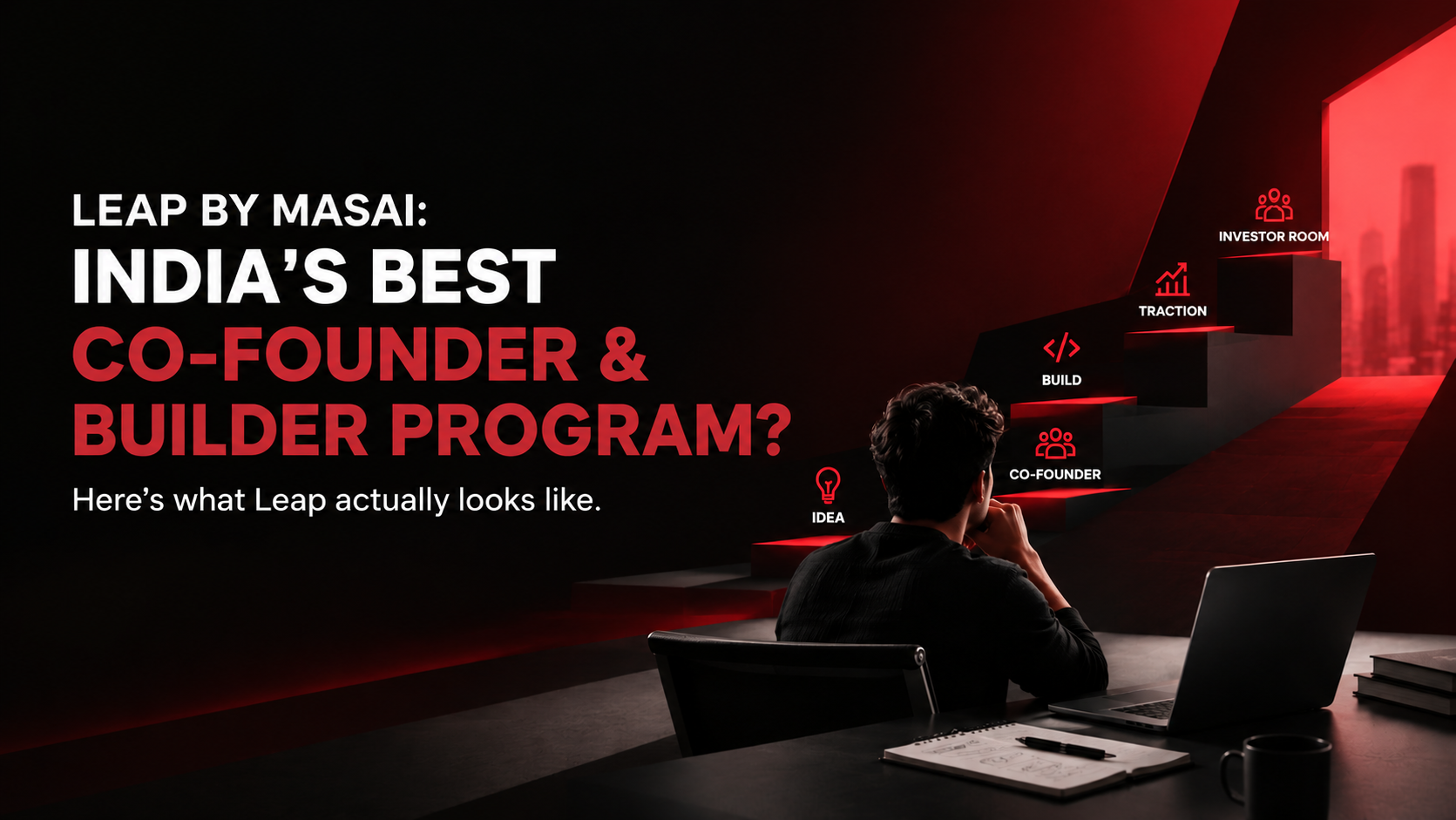
Most upskilling programs end with a certificate. You attend, you learn, you collect a piece of paper that says you know something.
Then the real test arrives. Someone is depending on what you built: a customer, a client, an investor. By then you're on your own, with no mentor in the room and no cohort behind you.
Leap by Masai is built on the opposite bet: the test should happen inside the program. You face it while a mentor is still there, your cohort has your back, and the structure is designed to catch you before things go wrong, not after.
Leap isn't one course. It's three programs under Masai School, each for a different person at a different stage:
- Someone with a business idea and no proof that it works.
- Someone who can prompt an AI tool but can't yet ship a real product.
- Someone who can already code but has never had to defend their work to a paying client.
This guide covers what each program is, how it runs, what it costs and which one (if any) is meant for you.
Why Leap exists
Masai School built its name on coding bootcamps that turn career-changers into software engineers. Leap asks the next question: once someone can build, how do they cross the much harder gap between building something and building something that survives a real user, a real client or a real investor?
Every Leap program follows the same four-part shape, even though the content differs completely.
| Stage | What happens |
|---|---|
| 1. Residency | A short, intense stint away from home (Goa, Sri Lanka or Vietnam, depending on the track). No distractions. The cohort forms and everyone commits to one specific thing to build. |
| 2. Online build phase | Six to ten weeks of structured weekend learning, taught by working practitioners, with weekly milestones instead of an open-ended syllabus. |
| 3. The Gate | A qualifying bar, published upfront, that decides who moves to the final stage. |
| 4. Real-world finish in Bangalore | You pitch real investors, or ship a solution to a real partner company under deadline. You do it for real, not as a simulation. |
No Leap program guarantees funding, a job or a particular score. What they do guarantee is structure, access to people who have done the thing you're learning, and a final moment most programs never include.
The three programs at a glance
| Founders' Cohort | AI Residency | Forward Deployed Engineer | |
|---|---|---|---|
| For | Aspiring founders with an idea | People who use AI tools but can't build or trust what they make | Engineers who code but have never worked in a client's system |
| Residency | Goa | Sri Lanka (5 days) | Vietnam (5 days) |
| Online phase | 6 weeks | 6 weeks | 10 weeks |
| Finale | Investor pitch, Bangalore | 3-day partner hackathon + AI conference, Bangalore | 3-day partner hackathon, Bangalore |
| Qualifying bar | Traction targets (see below) | 45% evaluation score, 65% attendance | 45% evaluation score, 65% attendance |
| Prerequisite | None stated | No coding experience needed | At least 1 year of hands-on technical experience |
| Fee | ₹1,50,000 + GST (solo) or ₹1,25,000 + GST per founder (pair) | ₹1,75,000 + GST | ₹1,95,000 + GST |
| Next start | See program page | 6 January 2027 | 6 December 2026 |
1. Founders' Cohort: Goa → Build → Bangalore Pitch
Built for people who want to start something of their own but haven't yet proven it's real.
This is Leap's original and best-known track.
Goa residency. Up to 100 founders spend three days in one room working through problem discovery. They hear directly from investors before writing a single line of their pitch. If you arrive solo, you go through a structured co-founder matching process. Everyone leaves Goa committed to one idea and one team.
Six weeks online, on weekends. Each week has one milestone:
- Ship a live MVP.
- Talk to twenty real users.
- Find one working distribution channel.
- Ask people to pay.
- Read the resulting data.
- Get investor-ready.
You learn through practitioner masterclasses, hands-on labs and small mentor pods. The founders teaching have collectively raised well over $2 billion, and include Ankush Sachdeva (ShareChat), Amit Agarwal (NoBroker) and Abhishek Goyal (Tracxn).
The Gate. Not every team reaches Bangalore. To qualify, you clear a published, category-specific bar:
- Consumer startups: 1,000 users and 50 paying customers.
- B2B startups: five active users and one paid pilot.
- Both: validated unit economics.
Bangalore. Teams that clear the Gate spend two days rehearsing and pressure-testing their pitch. Then they present to active investors from India Quotient, Capria Ventures and Prana Ventures.
The fee model. Masai takes 0% equity and 0% revenue share. The programme fee funds the operation, not a slice of your company.
Explore the Founders' Cohort →
2. AI Residency: Sri Lanka → Build → Bangalore Hackathon
Built for people who are "still just prompting."
You can get an AI tool to produce something that looks like a working product. But you don't know how it works underneath. When it breaks, you can't fix it, secure it or trust it. This program exists for you. No coding experience is required.
Sri Lanka residency (5 days). You ship a live product in a pod on day two. You spend a day understanding how the web actually works under the tools you've been using. By the end, you've committed to a capstone project to carry into the online phase.
Six weeks online. The curriculum is layered on purpose:
- How software and LLMs really work.
- Why "vibe coding" fails, and what disciplined prompting and planning look like.
- Turning an idea into a real spec and a running application, using tools like Claude Code, Cursor and Codex, backed by a real database.
- Building multi-agent systems and automations.
- Grounding your product in real data with RAG and MCP.
- Testing, securing and deploying to a public URL.
The Gate. An overall evaluation score of at least 45% and attendance of at least 65% across live and recorded sessions.
Bangalore. Three days solving a real partner company's problem in a hackathon, followed by an AI conference.
Details. 8 weeks in total, ₹1,75,000 + GST. The next cohort starts 6 January 2027.
3. Forward Deployed Engineer: Vietnam → Build → Bangalore Hackathon
Built for engineers who can code well but have only worked inside systems they built themselves.
A forward deployed engineer walks into someone else's messy, unfamiliar codebase, makes it work and defends every decision to a client under deadline. This track trains for that. You need at least one year of hands-on technical experience to apply.
Vietnam residency (5 days). You cover what sets the forward-deployed role apart. You spend a day shipping a live product in a pod, and sit a session on writing production-grade Python. Then you commit to the capstone system you'll build over the next ten weeks.
Ten weeks online. This is the most technically dense of the three tracks:
- Data pipelines and versioned APIs, secured with OAuth and role-based access.
- Connecting to legacy databases and deploying on AWS or Azure.
- Containers and CI/CD.
- Understanding and choosing between LLMs.
- Retrieval systems and tool-using agents, with proper guardrails.
- Security, monitoring and cost control.
Running alongside the technical curriculum is a thread most engineering programs skip. Client and business engagement sessions cover stakeholder management, handling objections, compliance conversations, and pricing and negotiation. These are the skills the role needs on top of the code.
The faculty leans on practitioners from companies deploying AI in production, plus data and engineering leaders from Microsoft, Google, PayPal, Intuit, Thomson Reuters and the Aditya Birla Group.
The Gate. The same as the AI Residency: 45% evaluation score and 65% attendance.
Bangalore. Three days taking on a real company's problem statement as a team, then presenting your results directly to that company.
Details. 12 weeks in total, ₹1,95,000 + GST. The next cohort starts 6 December 2026.
Explore the Forward Deployed Engineer program →
How applying works (same for all three)
- Apply for ₹999. This is non-refundable and puts you in the review pool.
- Individual review. A person reads your application. There is no automated filter. If you're shortlisted, you get a counselling call.
- Reserve your seat for ₹5,000. This is adjusted against your total fee, not added on top.
- Pay the balance before the program starts. You then get cohort access and pre-reading material.
- Learn from people doing the job today. Every track is taught by practitioners, not full-time instructors.
- Finish with something real. That means an investor pitch or a client-facing hackathon deliverable, not a certificate ceremony.
Which Leap program is right for you?
- You want to build a company, not just a product. Choose the Founders' Cohort. It's the only track built around business validation, traction and an investor pitch.
- You can use AI tools but can't build, or trust, what they produce. Choose the AI Residency. It takes you from prompting to shipping and owning a product, with no coding background assumed.
- You already code, but have never worked inside someone else's system under client pressure. Choose Forward Deployed Engineer. It assumes technical fluency and builds toward legacy systems, client management and production AI engineering.
If none of these describes you yet, be honest about that before you apply. Each program's Gate exists to keep the final stage meaningful for the people who clear it.
Frequently asked questions
Is Leap one program or three? Three separate programs under one umbrella. Each has its own curriculum, fee, duration and qualifying criteria. You apply to one specific track, not to "Leap" as a whole.
Can I apply to more than one? Nothing stops you from applying to different tracks in different cohorts. Each has its own application, fee structure and start date, and they're evaluated independently.
Do I need to travel outside India? For two of them, yes. The AI Residency starts in Sri Lanka and Forward Deployed Engineer starts in Vietnam. The Founders' Cohort starts in Goa. All three finish in Bangalore.
What if I don't clear the Gate? You stay in the program's community and keep building and learning. You just don't take part in the Bangalore finale for that cohort.
Do I need my own laptop and tools? Yes. You bring your own laptop and setup. Cloud credits, hosting, APIs and paid tools used during the build phase are your responsibility.
Can I do this while working? Yes, for the online phases. They run on weekends. The opening residency and the Bangalore finale do require you to take that time off in full.
Is there a placement guarantee? No. The Forward Deployed Engineer and AI Residency build technical readiness and real-world exposure, not a placement outcome. The Founders' Cohort is equally clear that an investor pitch slot is not a funding guarantee. The decision stays with the investor.
Do I need travel insurance or a medical certificate? For the Sri Lanka and Vietnam residencies, yes. You arrange and pay for a medical fitness certificate and personal travel and medical insurance before you go.
Is the ₹999 application fee refundable? No, regardless of outcome. The ₹5,000 seat-reservation fee is also non-refundable once paid, but it's adjusted against your total fee if you proceed.
How is Leap different from a bootcamp or online course? The ending. Most courses finish with a certificate. Every Leap program finishes with a real, unscripted situation, whether that's pitching active investors or delivering to a client under deadline. To get there, you have to clear a published bar.
Ready to take the real test?
Every application is reviewed personally.