
Service Company vs Product Company: The ultimate beginner’s guide to choosing your Tech Career Path

If you’ve ever scrolled through placement WhatsApp groups, LinkedIn discussions, or participated in career talks, you’ve likely encountered the classic debate: service company vs product company.
Someone gets an offer from TCS or Infosys and the response is, “Yeah, but that’s a service company.” Mention Google or Flipkart and the tone shifts completely.
Yet, most people echoing this debate don’t fully grasp the core differences. They’ve absorbed an industry hierarchy without understanding the real impact on your salary, learning curve, work environment, and career trajectory. This distinction matters but not always in the way you might expect.
This guide demystifies the whole debate: what these companies really do, how they differ across key factors, the real pros and cons, and how to decide which path aligns best with your career goals.
What is a product based company?
Product-based companies create and own software, hardware, or digital platforms that they build once and sell repeatedly to a wide customer base. Their products are independent, scalable, and continuously improved.
Examples include Google Search, Microsoft Office, Flipkart’s e-commerce platform, and Zomato’s app. The company controls the product lifecycle, from ideation to development to user experience, with revenue tied directly to product adoption and usage.
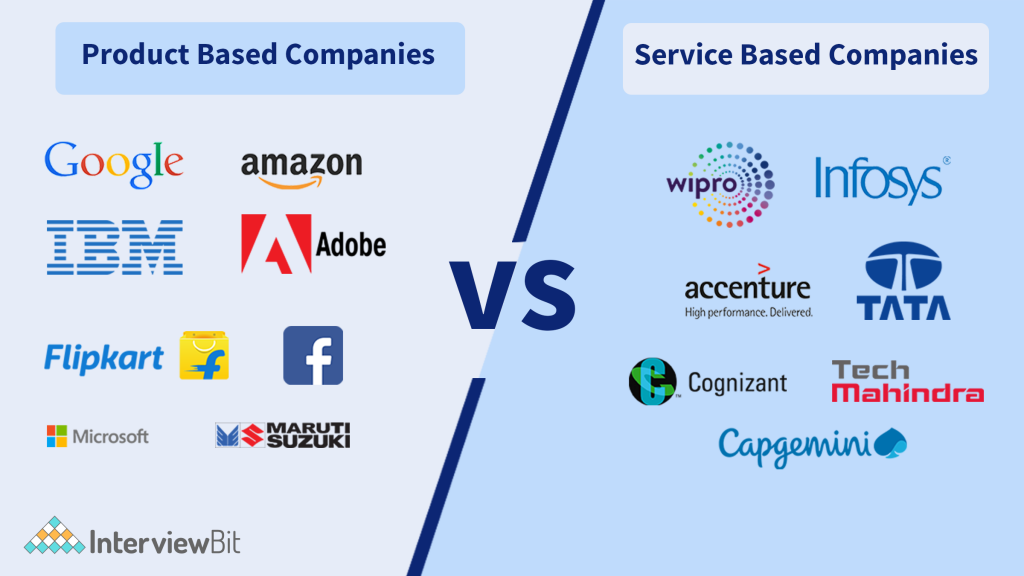
In India, top product companies include Google, Microsoft, Adobe, Flipkart, Swiggy, Zomato, and Razorpay.
What is a service-based company?
In contrast, service-based companies don’t sell a single product. Instead, they offer specialized expertise, time, and execution to other businesses needing custom solutions.
Think of IT consulting firms building banking software or digital agencies running campaigns for retail brands. Clients define the requirements, and service companies deliver, often juggling multiple diverse projects simultaneously.
India’s largest service firms TCS, Infosys, Wipro, Cognizant, Accenture, and Tech Mahindra are among the biggest employers, especially for freshers recruited en masse through campus drives. This isn't a small or shrinking pipeline either: TCS and Infosys alone committed to hiring 42,000 and 20,000 fresh engineering graduates respectively in a single final year, even during a period of otherwise cautious IT hiring a scale that no single product company comes close to matching.
Service company vs product company: Key differences that matter
Here’s a clear, factor-by-factor comparison to help you understand how working in these companies differs:
What skills do these companies really look for?
Understanding hiring priorities clears up many misconceptions:
- Product companies seek depth: strong problem solving skills, expertise in data structures, algorithms, and system design. Their rigorous interviews test your ability to own and shape impactful features.This isn't an exaggeration: at Google specifically, the acceptance rate sits at around 0.2%, with candidates typically facing multiple rounds of data structures, algorithms, and system design before a hiring committee even reviews their case.
- Service companies value breadth and trainability: a solid foundation, adaptability to learn new technologies quickly, and flexibility to work across diverse projects and industries. Their interview bar is calibrated for potential and learning ability.
Neither is inherently easier they simply evaluate different strengths.
Salary and career growth: What the data says
- Entry-level salaries tend to be higher in product companies due to selectivity and direct product impact.
- Service companies traditionally offer lower starting pay but are narrowing the gap by building advanced digital and AI capabilities.
- Mid-career growth in product companies can be rapid for strong contributors because promotions correlate with product success. Service companies offer steadier, more predictable career paths tied to roles and grades.
Job security & work culture: The overlooked trade-off
- Product companies’ fate hinges on product performance, market conditions, and funding. Layoffs can be abrupt during downturns or pivots.
- Service companies enjoy more diversified revenue streams across clients, offering greater job stability even if one contract ends.
This trade-off reflects your priorities: faster growth with higher risk vs. steadier growth with more security.
Which path should you choose?
Ask yourself:
- Choose a product company if: You want deep technical ownership, enjoy building products used by millions, thrive in challenging interviews, and aim for senior technical or product leadership roles.
- Choose a service company if: You prefer broad exposure across industries, value structured growth and job stability, want flexibility before specializing, or are starting your tech journey and need a solid entry point.
Many successful engineers start in service companies to build strong fundamentals, then transition to product roles. These paths are often complementary, not mutually exclusive.
Are You Truly Ready for Either Path?
The biggest challenge isn’t choosing between a product or service company it’s being fully prepared for the interview process itself. This is especially true for candidates from non-CS backgrounds or tier-2 and tier-3 colleges, where mastering the core skills these companies seek data structures, problem-solving, full-stack development, and hands-on project experience can be the real hurdle.
This is where Masai’s institute-backed certification programs make a difference. Developed in collaboration with prestigious institutes like IITs, IIMs, and BITSoM, Masai’s Software Development Engineering track focuses precisely on the skills hiring teams at both product and service companies prioritize. The program delivers this in a focused, job-relevant format, bolstered by the credibility of a recognized institute’s certification.
Ultimately, the product-vs-service decision becomes meaningful only once you’re equipped to choose confidently. The first and most important step is gaining the right skills and earning the credibility that opens doors.