
How to become a Data Scientist: A beginner's roadmap

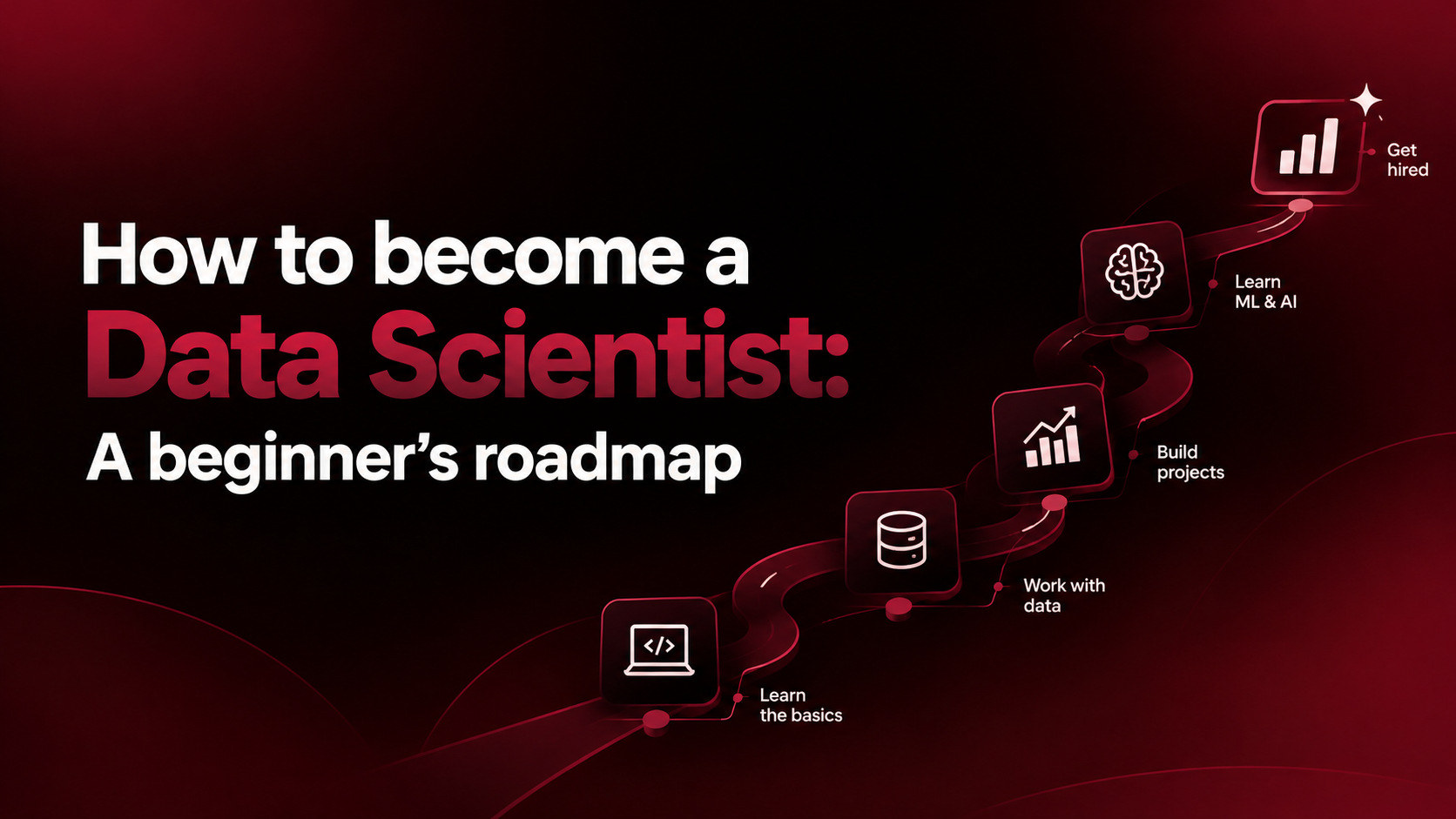
To become a data scientist in 2026, you need five core pillars in this order: Python and SQL foundations, data analysis and visualization skills, applied statistics, machine learning with software engineering fundamentals, and a practical portfolio of real projects. You don't need a PhD or a computer science degree to start. You need a focused path, consistent practice, and proof of work. This data science roadmap for beginners shows what to learn, in what sequence, and how long each stage takes.
A data scientist turns raw, messy data into decisions. That means cleaning datasets, finding patterns, building predictive models, and explaining the results so a business can act on them. The same skills drive recommendation engines, churn prediction, fraud detection and demand forecasting. They are also the base for anyone moving toward machine learning or AI role.
Step 1: Learn python and data foundations (Months 1-2)
Python for data science. Start with variables, data types, conditionals, loops, functions and core data structures. Then move to the tools that matter in practice: Jupyter or Google Colab notebooks for running and documenting experiments.
Working with real data formats. Learn to read and write CSV and JSON files, validate them, and fix missing values, wrong types and inconsistent formats. Learn to pull data from REST APIs, including authentication keys, status codes and pagination.
Set up version control early: learn basic Git and GitHub workflows (commits, branches, pull requests) and virtual environments (venv or conda) so your code is reproducible from day one
New to coding? Warm up with our Python project ideas.
Step 2: Master data analysis with NumPy and pandas (Months 2-3)
This is where data science starts to feel real. Learn:
- NumPy: arrays and vectorized operations for fast numeric work.
- pandas: filtering, sorting, grouping, aggregation, joins, pivots and date/time handling.
- Data cleaning: repeatable workflows for missing values, duplicates, outliers and messy text.
- Exploratory data analysis (EDA): asking structured questions, computing key metrics and spotting patterns before you model anything.
Most of a data scientist's day is spent here, so don't rush it.
Step 3: Add SQL, visualization and storytelling (Months 3-4)
SQL for data analysis. Learn joins, aggregations, subqueries and filters, then window functions for rankings, running totals and cohort-style analysis. SQL is the skill most often tested in data science interviews.
Data visualization. Learn to choose the right chart, avoid misleading visuals, and build plots with Matplotlib that answer a real question.
Data storytelling. Analysis only matters if people act on it. Practise turning findings into a clear narrative: context, evidence, insight, recommendation.
Step 4: Build your statistics and math foundation (Months 4-5)
You don't need abstract theory. You need the applied subset:
- Probability and distributions: how randomness and variability show up in real data.
- Sampling and estimation: why samples mislead and how to judge reliability.
- Hypothesis testing and A/B testing: the logic of experiments and how to avoid false conclusions.
- Correlation vs causation: how misleading relationships form and how to communicate limits honestly.
- Linear algebra basics: vectors, scaling and similarity, which underpin most ML models.
Step 5: Learn machine learning (Months 5-7)
Now you can build models. Learn the full ML workflow, from framing a business question as a modeling problem to defining success metrics and splitting data correctly.
- Regression and classification: build models and evaluate them with error metrics, precision, recall, F1 and confusion matrices.
- Tree-based models: decision trees, random forests and gradient boosting.
- Feature engineering and pipelines: reusable preprocessing and modeling workflows with scikit-learn.
- Debugging models: detecting data leakage, handling class imbalance, tuning and error analysis.
- Production basics: saving and loading models (Joblib/Pickle), wrapping models into a lightweight API using FastAPI or Flask, and containerizing with Docker.
Start with the beginner tier of our 15 machine learning project ideas.
Step 6: Get current with GenAI for data science (Months 7-8)
While not every data science role requires Generative AI, having familiarity with modern LLM tooling expands the kinds of unstructured data problems you can solve. Learn:
- Prompt engineering and LLM APIs: structured outputs, handling failures, clean input-output design.
- Embeddings and vector search: turning text into numbers so you can search by meaning.
- Retrieval-augmented generation (RAG): building grounded Q&A over your own documents while reducing hallucinations.
- Unstructured data to insights: extracting themes and summaries from PDFs, support tickets and policy documents.
Step 7: Build a portfolio and get hired (Months 8-10)
- Publish 4-5 strong projects on GitHub with clear READMEs, covering EDA, a classical ML model, an SQL-driven analysis and one GenAI/RAG project.
- Deploy at least one project as an API or simple app.
- Document trade-offs. Hiring panels love a model card or a short write-up on why you chose a metric.
- Write about your work. A short post per project builds communication skills and your search footprint.
- Prepare for interviews: SQL, statistics, ML concepts, a take-home case study and a project walkthrough.
The data science roadmap:
This 8-10 month timeline is strictly indicative, not guaranteed, actual mastery depends heavily on your prior math/coding background, weekly consistency, and depth of practice. At 8-10 hours a week alongside college or work, self-paced learners often take 12-15 months, while structured programs can accelerate the core phases.
Data scientist skills checklist
- Python, NumPy, pandas, Matplotlib, Jupyter/Colab
- SQL, including joins and window functions
- Applied statistics, hypothesis testing and A/B testing
- Machine learning with scikit-learn (regression, classification, tree-based models)
- Feature engineering and model debugging
- GenAI basics: LLM APIs, embeddings, RAG
- Data storytelling and a public portfolio
Do you need a degree to become a data scientist?
No, but you do need proof of skill. A related degree helps, but employers increasingly hire on portfolios, case studies and demonstrated problem-solving. A structured, mentor-led program adds accountability, feedback and placement support, which is where most self-learners get stuck.
Frequently asked questions
How long does it take to become a data scientist? Timelines vary by individual: an 8-10 month full-time or 12-15 month part-time runway is an indicative guideline rather than a fixed guarantee. A structured 6-month program at 8-10 hours a week can get you to a strong foundation and a capstone project.
Can I become a data scientist without a coding background? Yes. Start with Python and SQL, then build up to ML. Many data scientists come from commerce, engineering, operations and analytics backgrounds.
Which programming language is best for data science? Python is the standard, with SQL alongside it for working with databases.
Is data science a good career in 2026? Yes. Companies in every industry rely on data-driven decisions, and AI adoption is increasing the demand for people who can work with data and models.
What is the difference between a data scientist and a machine learning engineer? Data scientists focus on analysis, experimentation and modeling to answer business questions. ML engineers focus on building and deploying models in production. The foundations overlap heavily, so data science is a strong first step toward ML engineering. Read our ML engineer roadmap for the next stage.
Want to follow this roadmap inside a structured program? Explore Masai's Certification in Data Science and Artificial Intelligence from E&ICT Academy, IIT Roorkee: a 6-month online program (8-10 hours a week) covering Python, SQL, ML and GenAI, with a capstone project and placement assistance for eligible students.