
Data analyst career path after three years in the role
Data analyst career path after three years: foundit's June 2026 tracker shows demand down 10% for 4-6 years and up 6% for 7-10 years. Four routes compared.

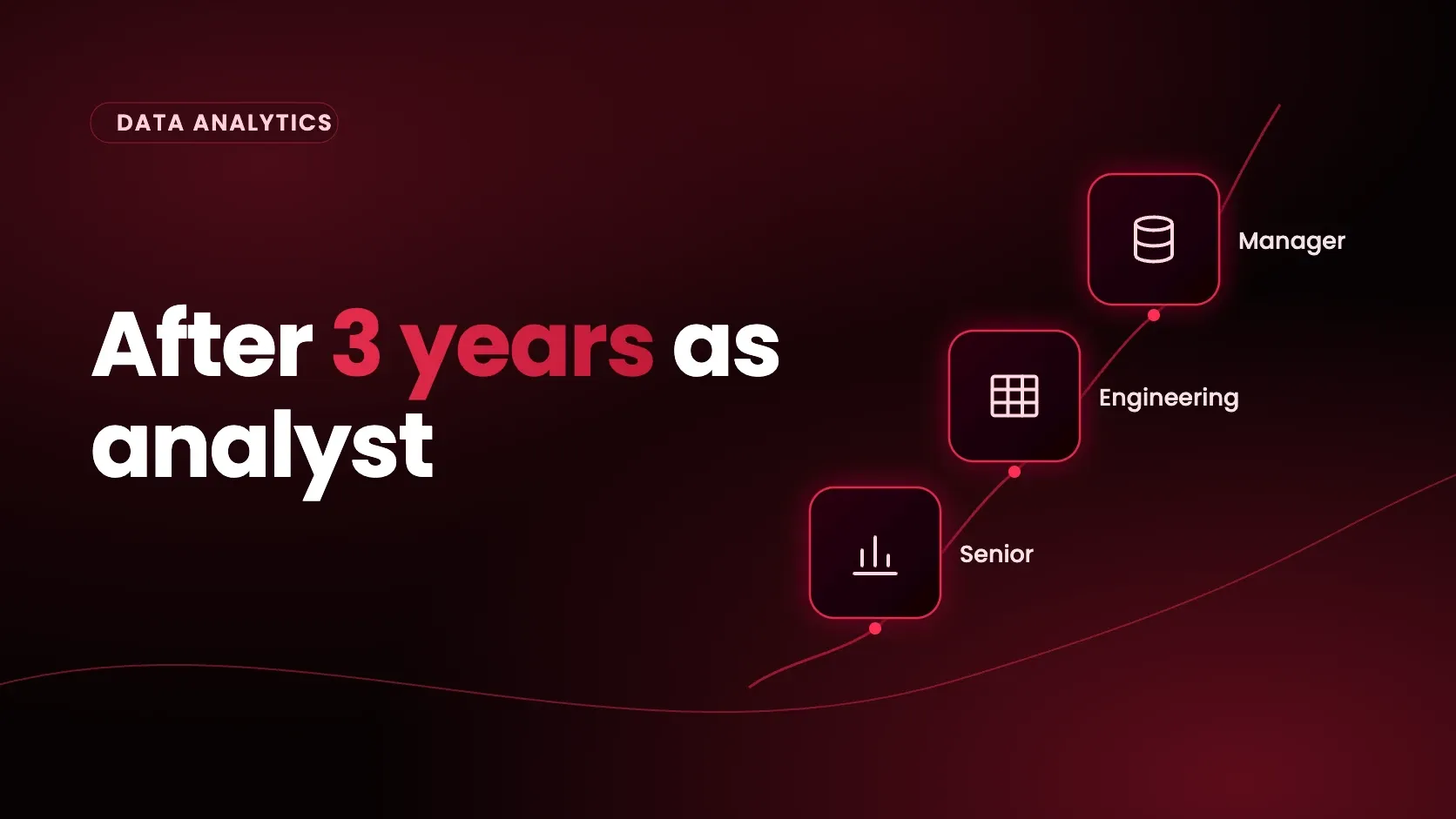
After about three years, a data analyst's career path becomes a four-way fork: senior analyst or analytics manager, BI developer or analytics engineer, data engineer, or a data science and AI role. In its June 2026 tracker, foundit put demand for 4-6 years of experience down 10% and for 7-10 years up 6%, the only band growing, so the choice of route matters.
Where does a data analyst career path fork after three years?
Titles differ between companies, but the routes are recognisable. The ownership route leads to senior analyst, lead analyst or analytics manager, where the job shifts from producing reports to owning a set of metrics and the decisions built on them. The modelling route leads to BI developer or analytics engineer, where the work is building the clean, tested tables and semantic layers that other people's dashboards sit on.
The pipeline route leads to data engineering, which moves and stores data at scale. The fourth route leads to data science and AI roles, which add statistical modelling and machine learning to the analyst base. None of these is a promotion in the narrow sense, so the sections below read the demand signals for each route.
Why are analysts with three or more years barely getting interview calls?
The experience-band data offers a plausible reason. In June 2026, foundit's experience-level view showed demand for 0-3 years of experience down 6% after companies pulled back on bulk graduate intake, and demand for 4-6 years down 10%. The 7-10 years band, up 6%, was the only one growing. An analyst at the three-to-four-year mark sits at the edge of the two weakest bands.
The wider reading is similar. foundit's tracker had online vacancies in June 2026 down 9% on a year earlier and 12% over six months, and said hiring was narrowing to specialist, skill-led roles. NASSCOM's Strategic Review 2026 expects hiring in FY27 to shift from volume to skill mix. A generalist profile of SQL, dashboards and weekly reporting competes with every fresher who has the same stack, which is why the next skill needs to be specific. A post on analyst demand by sector, GCC and city shows where hiring is actually rising.
What does the market say about each route?
The table sets one market signal against each route, with the caveat that goes with it.
| Route | What the data shows | Publisher and period | Caveat |
|---|---|---|---|
| Senior analyst or analytics manager | Analytical thinking a core skill for 79% of employers; data analysts and scientists projected to grow 54% to 2030 | WEF, January 2025 (India profile) | Employer-survey projections, not vacancies |
| BI developer or analytics engineering | Data analysts and BI developers up 26% in banking and financial services GCCs; BI analysts projected to grow 17% to 2030 | foundit, June 2026; WEF, January 2025 | Posting growth inside one GCC sector |
| Data engineering | Data engineers up 32% in IT GCCs; 67% of surveyed enterprises seek data engineering skills | foundit, June 2026; NASSCOM, 14 October 2026 | 200 enterprises, not a vacancy count |
| Data science and AI | AI and ML roles up 20%; 71% of enterprises need AI/ML and agent engineering; AI and ML specialists projected to grow 176% | Naukri, September 2026; NASSCOM, 14 October 2026; WEF, January 2025 | Small bases and survey projections |
Senior analyst or analytics manager
This route rewards judgment about data. In WEF's India profile, 79% of surveyed employers list analytical thinking as a core skill, and the NASSCOM-Deloitte compensation survey for 2025 puts strategic thinking and analytical skills among the top skills sought. LinkedIn's Skills on the Rise 2026 for India, as reported by Storyboard18 on 24 February 2026, places data storytelling and data-driven decision-making in its data and analytics skill cluster. A post on data literacy for managers covers what leaders expect from the people they promote.
BI developer and analytics engineering
The modelling route builds on the querying and database skills that LinkedIn's Skills on the Rise 2026 for India, as reported by Storyboard18, places in its data and analytics cluster. foundit's June 2026 snapshot listed data analysts and BI developers up 26% in banking and financial services GCCs, while WEF's India profile projects a smaller 17% net growth for business intelligence analysts to 2030.
Data engineering, and whether most analysts end up there
The demand signals are strong. foundit's June 2026 snapshot listed data engineers up 32% in IT GCCs, and NASSCOM's October 2026 study of 200 India-headquartered enterprises found 67% seeking data engineering skills, with poor data quality the first-named concern. Strong demand for the role does not mean most analysts move into it. The route suits analysts who enjoy fixing the data rather than reading it.
Data science and AI roles from an analyst base
foundit counted about 290,000 AI job postings in India in 2025 and projected around 382,000 for 2026, and it found machine learning in 34% of AI postings and generative AI and LLMs in 22%. Those are AI-linked postings, not analyst vacancies. Naukri's September 2026 JobSpeak had AI and ML roles up 20% while its overall index rose 2%. NASSCOM's study found 71% of enterprises need AI/ML and agent engineering capabilities, and LinkedIn's India list includes prompt engineering, workflow automation, LLMOps and AutoML among rising skills.
A post on the generative AI skills analyst postings list covers that layer, and a post on whether AI will replace data analysts weighs the risk. An earlier comparison of analyst, scientist and engineer roles sets the three jobs side by side.
How does analyst pay move with experience in market data?
AmbitionBox's 2026 page for data analysts in India shows an average of Rs 6.8 lakh a year, built from 1.5 lakh employee-reported salaries. By experience, it reads Rs 4.3 lakh at 0-1 year, Rs 5.5 lakh at 1-3 years, Rs 7.6 lakh at 3-6 years and Rs 9.5 lakh at 6-9 years. The figures are self-reported and the page carries no day-level date.
Indeed India's page, updated 19 October 2026, shows an average base salary of Rs 6,25,285 a year for data analysts, from 526 salaries taken from job postings over the previous 36 months, across all experience levels. Both figures describe the analyst role itself, not engineers, managers or scientists. These are market figures for the analyst role, not what any course graduate earns.
Which route should an analyst choose, and which skills should come next?
The choice follows the work an analyst already enjoys. An analyst who likes owning a metric and explaining it to leaders fits the ownership route and should add experimentation, stakeholder writing and the habit of questioning data quality. One who likes building clean tables fits the modelling route and should add data modelling and version control.
One who likes pipelines fits data engineering and should add Python and workflow orchestration. One drawn to prediction fits the science and AI route and should add statistics and machine learning.
A hypothetical analyst in Hyderabad with a four-year reporting background could pick one route, build a single portfolio piece in it, and take a few small internal projects that point the same way. Skills tied to a route read as specific, which is what the narrowing market is asking for. The earlier piece on what kind of analyst job a person can get lists the specialisations in more detail.
Where a structured programme fits
Some analysts want a taught route to the next skill. Analytics in the Age of AI is a live online programme by "Vishlesan i-Hub Foundation, IIT Patna", with Masai as its ed-tech and implementation partner and an optional campus immersion at IIT Patna. It covers SQL, Python, BI tools, applied machine learning, generative AI workflows and agentic analytics through hands-on projects and a capstone, in modules such as AI-Native Analytics and Experimentation, BI & Executive Communication.
Frequently asked questions
What is the typical data analyst career path?
It usually starts at junior analyst, moves to analyst and senior analyst, and then forks into management, BI and analytics engineering, data engineering or data science. Titles vary by company. foundit's June 2026 tracker had demand at 7-10 years of experience up 6%, the only band growing, which suggests seniority and a specific skill both count.
What is the next career path after data analyst?
The common routes are senior analyst or analytics manager, BI developer or analytics engineer, data engineer, and data scientist or AI specialist. The market signals differ: foundit listed data engineers up 32% in IT GCCs, and WEF's India profile projects 54% net growth to 2030 for data analysts and scientists, as an employer-survey projection.
Should a data analyst become a data engineer?
It depends on what the analyst enjoys. Demand signals are real: foundit listed data engineers up 32% in IT GCCs, and 67% of enterprises in NASSCOM's October 2026 survey seek data engineering skills. Demand for the role is real, but a move across is a fit decision rather than a proven step up.
How much does a data analyst earn after three to six years?
As market data, AmbitionBox's 2026 page shows an average of Rs 7.6 lakh a year at 3-6 years and Rs 9.5 lakh at 6-9 years, from self-reported salaries. Indeed India's average base salary was Rs 6,25,285 a year across all experience levels as of 19 October 2026, from 526 salaries. Pay varies by city, employer and skills.
Does experience still help when hiring is weak?
Partly. foundit's June 2026 tracker showed 7-10 years of experience as the only band growing, while 4-6 years was down 10% and overall vacancies were 9% below a year earlier. Experience helps most when it comes with a specific skill, because hiring is narrowing to specialist, skill-led roles.
Next step
The Analytics in the Age of AI, Vishlesan i-Hub IIT Patna page sets out the curriculum and how to apply.