
10 highest paying entry level finance jobs in India


If you've searched for the highest paying entry level finance jobs, you've probably already hit five articles with five different numbers. One says financial analysts start at ₹3 LPA. Another says ₹10 LPA. A third says CAs walk in at ₹18 LPA. All of them can't be right and honestly, most of them aren't wrong either. They're just quoting different slices of the same market.
This guide pulls those slices together. You'll get realistic 2026 salary bands for the highest paying entry level finance jobs in India, what each role actually involves day to day, and more importantly which one fits you, not just which one pays the most on paper.
What highest paying role actually means for a fresher
Before the list, three things worth knowing, because they change how you read every number below.
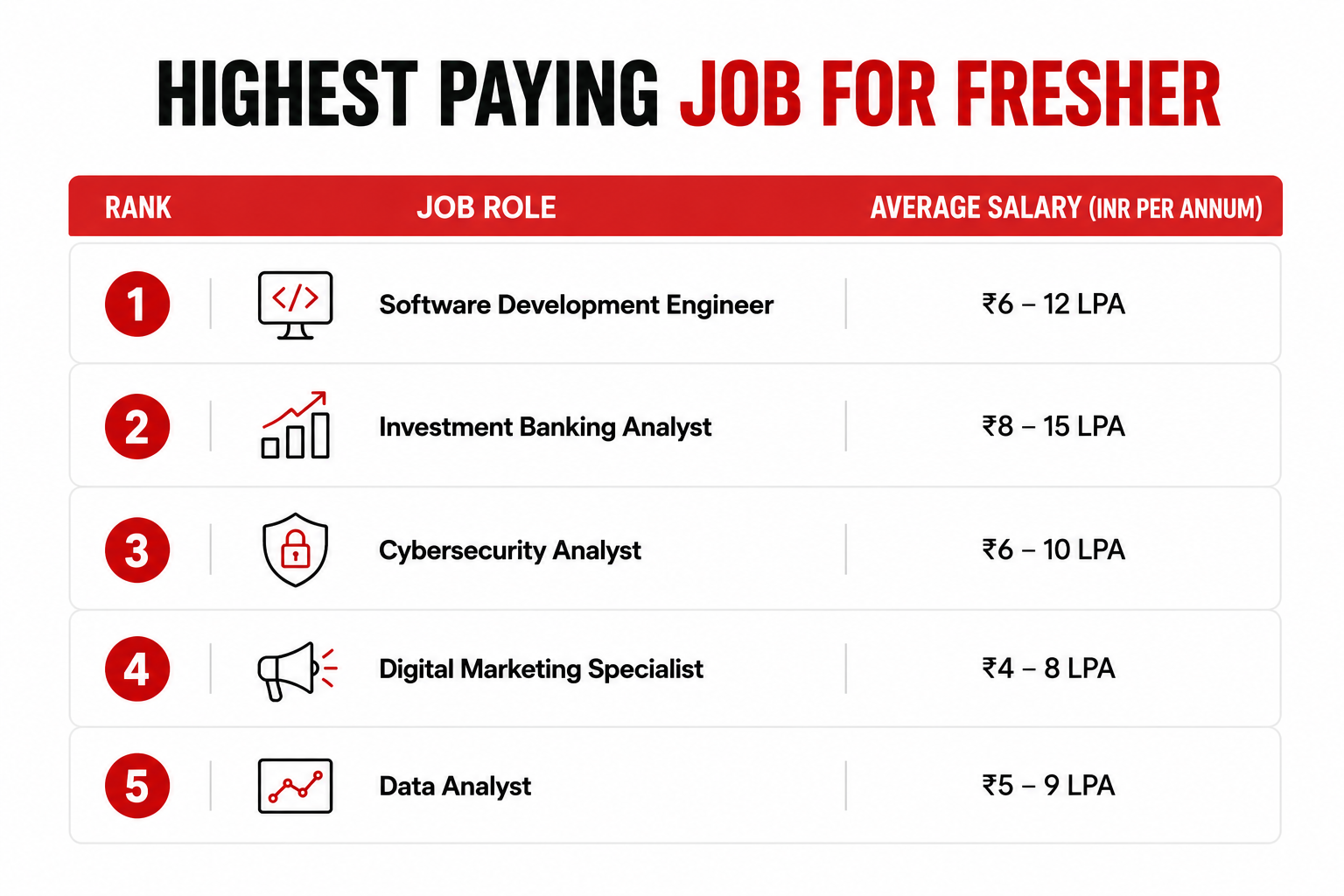
CTC is not take-home. A ₹10 LPA package after tax and PF deductions is closer to ₹65,000-₹70,000 a month, not ₹83,000. Keep that gap in mind whenever you see a headline salary.
"Fresher" isn't one bracket. A B.Com graduate with only a degree, and a BCom graduate who's spent six months building financial models and reading balance sheets, are not competing for the same salary even for the identical job title.
Skills move the number more than the degree name does. This shows up again and again in the data below: two people with the same qualification can land offers ₹3–5 LPA apart, purely because one of them can build a working Excel model and the other can't.
Market snapshot: India's financial services industry is growing at a projected 14% CAGR from FY24-FY30, and BFSI alone is set to add over 2,50,000 new permanent jobs by 2030 a big part of why entry-level finance hiring keeps expanding even as other sectors slow down. (Source: IBEF, Adecco India Workforce Report 2025)
That growth curve is exactly why the entry point matters so much right now there's more hiring happening, but also more competition for the roles that pay well from day one. This Gap can be filled by Certification in Finance and Financial Analysis Programme, delivered with SPJIMR ranked India's #1 business school by the Financial Times Global Rankings 2024 is built to close. The program's own data points track closely with what you'll see across this guide: financial analyst salaries in India ranging ₹10-16 LPA by experience (Glassdoor India, April 2026), and organisations across banking, fintech, and consulting including PwC and EY hiring from this pipeline. It takes learners from core financial statements and business math through Excel-based reporting and investment evaluation, into a specialization covering fintech, risk, and GenAI-for-finance workflows, ending in a portfolio-grade capstone: a finance analysis dossier built on a real Indian company case and defended to SPJIMR faculty.
The 10 highest paying entry level finance jobs in India (2026 data)
1. Investment Banking Analyst ₹8-18 LPA
The one everyone's heard of, and the highest paying entry level finance job on this list by a clear margin. IB analysts support mergers, acquisitions, and capital-raising deals, building valuation models, pitch decks, and due-diligence material. Fresher packages at bulge-bracket and top domestic banks run ₹8-18 lakh a year depending on the firm and city.
The catch is real: 70-90 hour weeks aren't an exaggeration during deal season. Entry usually requires an MBA from a top B-school or a CA with strong technical skills, plus working financial modelling ability before you even interview.
2. FP&A Associate (Financial Planning & Analysis) ₹7-15 LPA
FP&A is where finance stops being about reporting the past and starts being about planning the future budgeting, forecasting, variance analysis, and sitting in the room when leadership decides where money goes next. Fresher and early-career FP&A roles typically start at ₹7-10 LPA, with CA freshers at global banks and GCCs sometimes landing closer to ₹11 LPA.
It's one of the better work-life-balance options on this list, and it's a role hiring managers increasingly value because it sits close to actual business decisions, not just number-crunching.
3. US CPA / Global Reporting Analyst ₹6-15 LPA
If you're aiming at Global Capability Centres (GCCs), Big 4 delivery centres, or US-focused KPOs in Bengaluru, Hyderabad, or Delhi-NCR, a US CPA credential opens roles in US GAAP reporting, SOX compliance, and international finance. Fresher CPA roles in India start around ₹6-12 LPA, with the Big 4 and large GCCs anchoring the upper end.
This path is worth knowing about because it's less crowded than the "everyone applies to IB" route, and demand keeps growing as more global companies set up finance operations out of India.
4. Chartered Accountant (CA) ₹7-12 LPA
Despite what outdated blog posts claim, most fresher CA packages land in the ₹7-12 LPA range, not the inflated ₹20+ LPA numbers you sometimes see quoted. That said, promotions come fast many CAs cross ₹15 LPA within two to three years, especially if they move into FP&A or specialised advisory work rather than staying purely in audit.
5. Financial Analyst ₹4-12 LPA
The broadest, most common entry point into corporate finance analysing financial statements, building reports, and supporting investment or budgeting decisions. The honest range for freshers is wide: plain-degree candidates often start around ₹3-5 LPA, while candidates who walk in with financial modelling, ratio analysis, and Excel dashboard skills push into the ₹8-12 LPA band at the same companies.
This is the role where skill genuinely outweighs pedigree a strong portfolio of real financial models can matter more than which college you attended.
6. Risk Analyst ₹6-10 LPA
Banks and NBFCs are leaning harder on data for credit scoring and fraud detection, and risk analysts who can pair financial understanding with basic Python or SQL are in real demand. Entry pay sits around ₹6-10 LPA, with hikes coming quickly for analysts who can actually build or interpret risk models rather than just run existing ones.
7. Credit Analyst ₹5-9 LPA
Credit analysts evaluate whether a business or individual can be trusted with a loan reading financial statements, payment history, and cash flow patterns. It's a strong foundation role for anyone eyeing a future in lending, NBFCs, or corporate banking, with entry salaries generally in the ₹5-9 LPA range.
8. Equity Research Analyst ₹6-12 LPA
Equity research analysts study companies and sectors to recommend whether a stock is worth buying a role that blends financial modelling with genuine sector knowledge. Entry-level pay typically runs ₹6-12 LPA at brokerages and asset managers, and it's one of the more intellectually engaging entry points if you enjoy following markets and industries, not just spreadsheets.
9. Fintech / Data-Driven Finance Analyst ₹5-11 LPA
As lending, payments, and digital banking scale up, fintech companies are hiring finance analysts who are also comfortable with data tools Power BI, SQL, and increasingly GenAI-assisted reporting. Entry salaries run ₹5-11 LPA, and this is one of the fastest-growing categories on this list because fintech hiring hasn't slowed down even as some other sectors have.
10. MIS Analyst / Finance Reporting Analyst ₹6-8 LPA
Often the quietest entry point, but a genuinely useful one: MIS analysts build the dashboards and reports that every other finance team relies on. It's a strong first job for building Excel and reporting fluency fast, and it's a common stepping stone into FP&A or financial analyst roles within 12-18 months.
Did you know? Two financial analysts with identical degrees can end up ₹5-10 LPA apart in the same city the gap almost always comes down to who can actually build a working financial model and who can only describe one.
Salary comparison table
Ranges reflect fresher packages across major Indian metros; non-metro and Tier-2 offers typically run 15–20% lower.
Sources: Glassdoor India, AmbitionBox, Indeed India (2026 data).
Why finance salaries are climbing right now
This isn't a random spike three forces are pushing entry-level finance pay up across India.
Fintech and digital lending are scaling fast. Payments, lending, and digital banking companies need finance talent who understand both the numbers and the underlying business model, and they're competing with traditional banks for the same fresher pool.
AI has changed what finance skills means. Banks now use AI for credit scoring and fraud detection, which means risk and credit roles increasingly want candidates who can work alongside these tools, not just process spreadsheets manually. The Masai x SPJIMR Finance & Financial Analysis program builds this in directly its final module covers using GenAI tools for financial research, ratio interpretation, and reporting, which is exactly the skill gap employers are hiring for right now.
GCCs are relocating global finance work to India. Global Capability Centres in Bengaluru, Mumbai, Hyderabad, and Pune are absorbing FP&A, reporting, and analysis work that used to sit overseas and they pay competitively for candidates who can hit the ground running.
The skills that actually decide your salary
Across every role on this list, the same five skills show up as the difference between the bottom and top of the salary band:
- Reading financial statements fluently - income statement, balance sheet, cash flow, without needing to look up what each line means
- Building financial models in Excel - budgets, forecasts, NPV/IRR-based investment evaluation
- Reporting and dashboarding - turning raw data into something a manager can act on in 30 seconds
- Basic data tools - Power BI, SQL, or even confident Google Sheets for data-heavy roles like risk or fintech analysis
- GenAI-for-finance fluency - using tools like ChatGPT or Claude to speed up research, ratio interpretation, and first-draft reporting, which is increasingly expected rather than optional
Expert insight: Hiring managers rarely ask which certificate you hold. They ask whether you can open a real dataset and produce something usable in an hour. That's the gap most finance courses don't close and it's the gap that decides whether you land at ₹4 LPA or ₹10 LPA for the same job title.
Three mistakes freshers make chasing the highest number
Chasing the title over the skill. Applying only to "Investment Banking Analyst" postings while skipping the Excel and modelling practice that actually gets you shortlisted is the single most common mistake. The title doesn't get you hired the model you can build in the interview does.
Ignoring take-home reality. A ₹10 LPA offer and a ₹8 LPA offer with better hours and faster skill-building can leave you in a very similar place a year later sometimes the "lower" number is the smarter first job.
Skipping the AI-tooling gap. Employers are actively hiring for candidates who can use GenAI tools inside finance workflows research, variance commentary, first-draft reporting and most college finance courses simply don't teach this yet, leaving a real, closeable gap between candidates who know it and candidates who don't.
How to actually break in
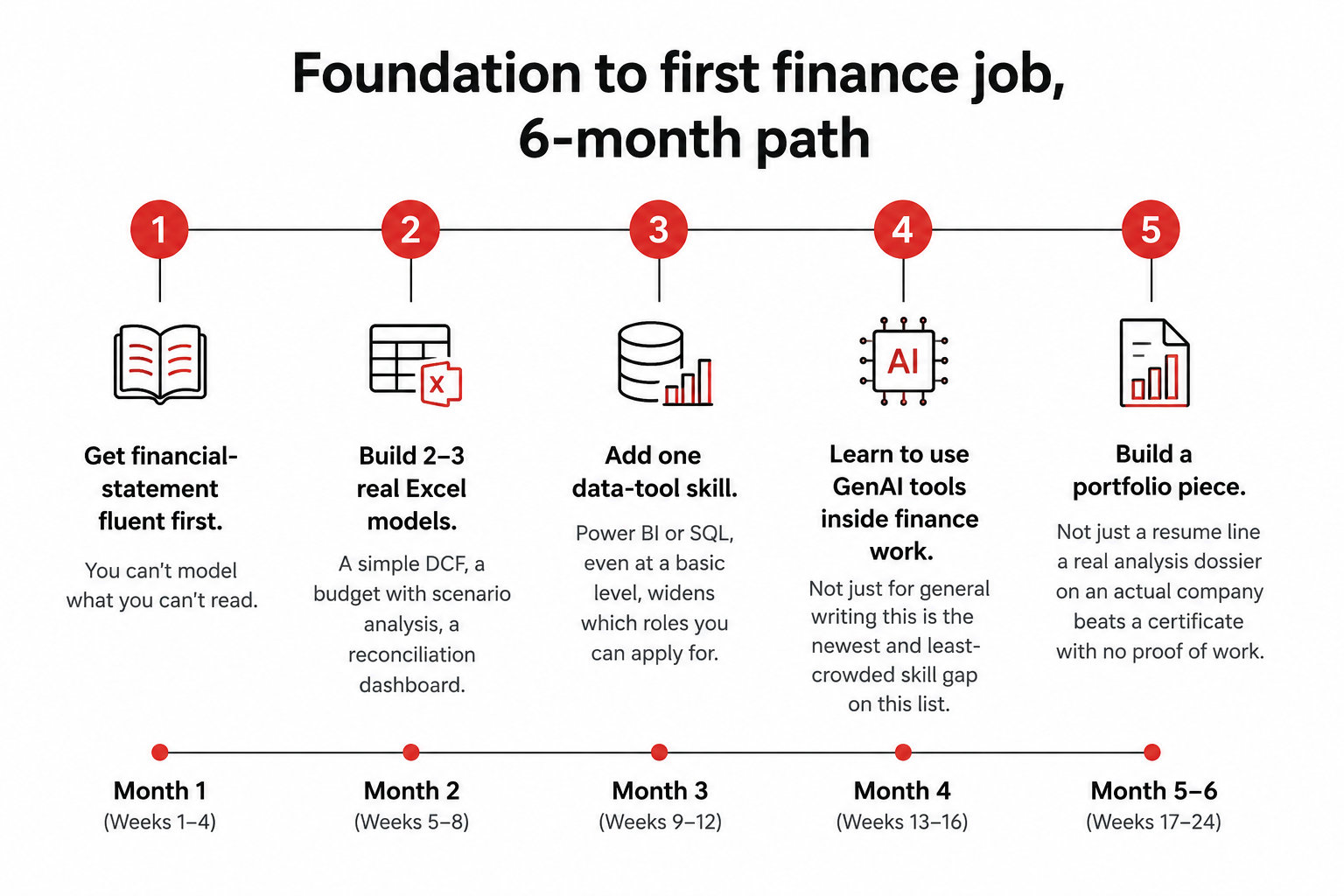
- Get financial-statement fluent first. You can't model what you can't read.
- Build 2–3 real Excel models a simple DCF, a budget with scenario analysis, a reconciliation dashboard.
- Add one data-tool skill Power BI or SQL, even at a basic level, widens which roles you can apply for.
- Learn to use GenAI tools inside finance work, not just for general writing this is the newest and least-crowded skill gap on this list.
- Build a portfolio piece, not just a resume line a real analysis dossier on an actual company beats a certificate with no proof of work.
FAQs
Which finance job pays the highest salary for freshers in India? Investment Banking Analyst roles pay the most at entry level, with fresher packages typically ₹8-18 LPA at bulge-bracket and top domestic banks though the hours are demanding.
Do I need an MBA to get a high paying finance job? No. Roles like Financial Analyst, Risk Analyst, Credit Analyst, and MIS Analyst are open to any finance-related degree, and skills often matter more than the degree itself.
Is financial analyst a good career for freshers? Yes it's one of the most accessible highest paying entry level finance jobs, with a wide salary range (₹4-12 LPA) that scales sharply based on modelling and reporting skills rather than pedigree alone.
What skills do I need for a high paying finance job with no experience? Financial statement reading, Excel-based modelling, reporting/dashboarding, basic data tools, and increasingly, GenAI-for-finance fluency.
Can a non-finance graduate get into finance jobs? Yes, particularly for MIS Analyst, Data/Fintech Analyst, and some Financial Analyst roles a strong Excel and analytical skill set can outweigh the degree background.
CA vs CFA vs MBA which pays more at entry level? CA freshers typically start around ₹7-12 LPA with fast growth; CFA Level 1-plus candidates often move into equity research or IB support; MBA graduates from top B-schools can access the highest IB and FP&A packages, but all three converge more on skill than credential beyond the first couple of years.
What is the highest paying finance job without an engineering degree? Investment Banking Analyst, FP&A Associate, and Equity Research Analyst are all open to commerce, economics, and management backgrounds without requiring an engineering degree.
How much does a financial analyst earn in India in 2026? Realistic fresher pay ranges from ₹4-12 LPA depending on skills and employer, with the national average closer to ₹4.5-6 LPA and the top end reserved for candidates with strong modelling ability.
Is FP&A a better first job than investment banking? For many freshers, yes FP&A offers ₹7-15 LPA with significantly better work-life balance than IB's ₹8-18 LPA, making it a strong "smart first job" pick rather than a purely highest-number pick.
Do fintech companies pay well for entry-level finance roles? Yes, fintech finance analyst roles pay ₹5-11 LPA at entry level and are among the fastest-growing categories as digital lending and payments scale in India.
Conclusion
The highest paying entry level finance jobs in India aren't a mystery Investment Banking, FP&A, and CPA-track roles top the list with fresher packages from ₹7 LPA to ₹18 LPA. But the number on the offer letter is only half the decision. The role that pays well and builds skills that compound modelling, reporting, and now GenAI-for-finance fluency is the one that actually sets up a strong finance career, not just a strong first paycheck.
Start with the skills, not the salary number, and the right offer tends to follow.
Also Read
What is the Meaning of Vibe Coding? Full Guide - 2026