Pay After Placement
Pay the remaining programme fee only after securing an eligible job offer.

MICA Certificate + Placement Support MICA Certificate + Placement Support
26-Week Mastery-Based Progression Industry-Relevant Analytics Skills Mastery-Based Progression Industry-Relevant Analytics Skills
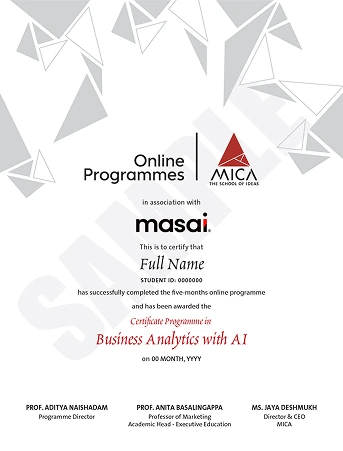
Master the complete analytics stack and turn data into actionable business decisions.
Learn from experienced MICA faculty members and industry mentors from Masai through live, application-focused sessions.
Collaborate with a diverse cohort of professionals, graduates, early-career builders and working professionals through group activities and peer reviews.
The programme follows a learner-first model: students pay only a registration fee to enroll, with the remaining fee payable after securing placement.
The curriculum spans across nine Units covering Python, SQL, Statistics, Excel, Power BI, and business case-solving.
The programme incorporates hands-on projects, case studies, guesstimates, and KPI analysis to prepare learners for real-world analytics and business problem-solving.
Participants may choose to visit the MICA campus for curated academic interactions and experiential sessions, concluding with a formal valedictory ceremony.
Learn from experienced MICA faculty members and industry mentors from Masai through live, application-focused sessions.
Collaborate with a diverse cohort of professionals, graduates, early-career builders and working professionals through group activities and peer reviews.
The programme follows a learner-first model: students pay only a registration fee to enroll, with the remaining fee payable after securing placement.
The curriculum spans across nine Units covering Python, SQL, Statistics, Excel, Power BI, and business case-solving.
The programme incorporates hands-on projects, case studies, guesstimates, and KPI analysis to prepare learners for real-world analytics and business problem-solving.
Participants may choose to visit the MICA campus for curated academic interactions and experiential sessions, concluding with a formal valedictory ceremony.
Certificate Eligibility: Learners must achieve a minimum assessment threshold of 60% in each unit

The Pay After Placement (PAP) Business Analytics with AI Programme is a structured, application-first learning journey designed to prepare college students and freshers for entry-level careers in business analytics. Spanning into different levels such as Foundation, Core, and Applied Analytics, the curriculum equips learners with in-demand skills in AI, Excel, Python, SQL, Power BI, statistics, machine learning, and AI-powered analytics through hands-on projects, real-world business case studies, and industry-relevant workflows. By the end of the programme, learners build a job-ready portfolio and the practical competencies required for roles such as Business Analyst, Marketing Analyst, Product Analyst, and such others.





From foundations to applied analytics, an outcome-driven roadmap built for real-world careers.
Business mindset and the basic technical toolkit every analyst needs from day one. Builds the conceptual scaffolding (P&L thinking, KPI logic, sector literacy, problem framing) before introducing Excel and Python as the first working tools.
Develop practical Excel and Python skills to work with business data. Learn advanced Excel functions, Pivot Tables, Power Query and dashboards, along with Python programming, data structures, control flow, functions, file handling and data cleaning through hands-on mini projects.
Advance your analytical skills by working with larger datasets using Pandas and NumPy. Learn data transformation, aggregation, visualisation, cohort analysis and build interactive Power BI dashboards using data modelling, DAX and visualisation best practices to support business decision-making.
Apply statistical techniques and business analytics to solve real-world problems. Learn hypothesis testing, A/B testing, marketing and product analytics, customer segmentation, funnel analysis, unit economics, and data-driven decision-making through business case studies.
Leverage machine learning and AI to enhance business analytics. Build predictive models with scikit-learn, evaluate model performance, and use AI-powered tools to accelerate data analysis, coding, and business insights while applying critical validation techniques.
The Elevate unit is designed to prepare learners for placement opportunities. Learners who meet the required evaluation benchmarks throughout the programme will progress to this stage, which includes resume building, LinkedIn profile optimisation, mock interviews, interview preparation, communication skills training, and access to relevant opportunities through Masai’s hiring network. The Elevate Unit will be conducted offline in Bengaluru by Masai, and attendance is mandatory. The in-person format enables face-to-face interviews with hiring managers, direct feedback on interview performance, and focused training to help learners strengthen their placement readiness.
To be eligible, learners must successfully meet the programme's evaluation criteria, including:
Attendance: 90% or above
Assignments: 80% or above
Assessments: 60% or above
Successful completion of projects
Adherence to academic integrity and the programme's code of conduct
*Note: An additional fee of ₹5,000 is payable at the beginning of this unit. Food, accommodation, and travel expenses are not included in the fee and must be arranged by the learner
Note: The curriculum outlined here is indicative and may be updated periodically to reflect evolving industry, marketing, and hiring trends. For the detailed curriculum, please refer to the programme brochure.

Prof. Aditya Naishadam
Faculty, MICA Programme Director
Prof. Aditya Naishadam is a Purdue University graduate and a Gold Medallist from MICA's PGDM-C programme in Market Research & Analytics. He brings over six years of industry experience in predictive analytics, machine learning and marketing analytics. He has been associated with MICA as a faculty member, contributing to teaching and course design in the areas of data science and analytics. Prof. Aditya currently teaches Machine Learning and Marketing Analytics at MICA, integrating industry practice with academic learning. He also continues to work on AI and analytics projects while mentoring aspiring data professionals and promoting an application-driven approach to data science.

Prof. Sunita Mall
Associate Professor, Business Management
Dr Sunita Mall holds a PhD and M.Phil. in Statistics from Utkal University, along with an M.Sc. in Statistics. She has also completed the Executive Programme in Business Analytics from IIM Calcutta and a Certificate Programme in Digital Marketing with Applied Analytics. She specialises in quantitative techniques and data analytics and serves as Programme Director for MICA’s executive online programme in Digital Strategy and Marketing Analytics. She teaches across MICA’s MBA, FPM and online programmes, as well as at select IIMs. With prior consulting experience across insurance, banking and startups, her expertise includes fraud analytics, credit scoring, anomaly detection and business analytics. Her research spans fraud, credit scoring, cross-selling, insurance penetration, stock market volatility and neobanking, with publications in ABDC-rated journals and presentations at international conferences.

Dr Ashutosh Yadav
Assistant Professor of Finance
Dr Ashutosh Yadav is a finance and financial analytics academic specialising in BFSI, FinTech, financial markets, financial econometrics, and data-driven decision-making. His teaching experience spans banking, corporate finance, financial reporting, security analysis, portfolio management, accounting, and business analytics. His research focuses on financial markets, market microstructure, SME finance, digital transformation, sustainability, and emerging-market financial systems. He brings an applied approach to understanding business models, P&L structures, financial and operating KPIs, risk, customer economics, and analytical problem framing across contemporary sectors including BFSI and FinTech.
Note: The faculty profiles displayed represent the pool of faculty associated with the programme.
Sessions may be delivered by selected faculty members from this pool, subject to availability.
Fee Model
Curriculum Depth
Outcome Orientation
Campus Exposure
Practical Application
Offline Placement Support
Peer Network
Mastery-Based Progression

A structured pathway from qualification to outcome-based learning
Important: Students who do not meet the Foundation unit requirements or fail the Foundation unit Assessment will not continue in the programme.
Qualifier Test Fee
(Non Refundable)
₹99
Secure Seat Fee
(Non Refundable)
₹10,000
+GST
₹3.00 LPA – ₹4.99 LPA
₹1,80,000
₹6,944/month x 36 months
₹5.00 LPA and Above
₹2,50,000
₹9,722/month x 36 months
GST is applicable
1*
Week 1 – Week 5
Non Refundable
2
Week 6 – Week 10
₹50,000
3
Week 11 – Week 15
₹1,00,000
4
Week 16 – Week 20
₹1,50,000
5
Week 20 Onwards
₹1,80,000
* Note: GST shall be charged as applicable. All fees, including the Enrollment Fee, PAP Fee, and Drop-out Fee, once paid, are non-refundable and
non-transferable. These drop-out clauses also apply if you breach the Student Code of Conduct.


Become a job-ready Business Analyst with AI, real skills and real placement support.

Build end-to-end Business Analytics capability across programming, databases, statistics and business intelligence.
How This Course Benefits You?
Upgrade from functional reporting to advanced data-driven decision-making using structured analytics frameworks.
How This Course Benefits You?
Transition into Business Analytics through structured foundations, technical depth and real-world business application.
How This Course Benefits You?
USD 196.5 Billion
Business analytics market projected to nearly double from ~ USD 96.6 Billion in 2024 to ~ USD 196.5 Billion by 2033
Source: McKinsey Global Survey
“The goal of business intelligence is to turn data into information, and information into insight”

Carly Fiorina (former CEO, Hewlett-Packard)
70%
of organizations rely on analytics platforms and predictive insights to support decision-making and operational goals
Source: The Economic Times

Established in 1991, MICA, located in Ahmedabad, Gujarat is dedicated to creating leadership in Strategic Marketing and Communication. MICA, an autonomous, non-profit institution, offers a wide range of academic programmes including residential and online programmes. MICA's spirit lies in its grasping of contemporary trends and sensibilities, addressing the needs of an ever-changing environment. The MICA brand assures effective delivery of Strategic Marketing and Communication solutions to the industry, government and community. Today, it is the alma mater of professionals serving in leadership positions in some of the best-known companies in India and the world in marketing, brand management, research & analytics, advertising, media, digital and other related businesses.
Reduce your upfront financial commitment and focus on building in-demand Business Analytics skills. Pay the remaining programme fee only after securing an eligible placement, subject to the programme terms
Build industry-relevant Business Analytics skills through hands-on learning, practical assignments, case studies, and real-world business problem-solving to prepare for analytics roles
Receive structured career support with resume reviews, mock interviews, communication skills training, and interview preparation to help you confidently pursue analytics roles
Participate in hands-on industry projects guided by distinguished instructors and top experts, ensuring practical and relevant skills development
Get personalised assistance, prompt query resolution and continuous feedback through live interactive sessions with experts
Mayuri comes from Navsari, near Surat in Gujarat. As a child, she showed promise and attended an English medium school, where she consistently ranked among the top students. After scoring exceptionally well in her 12th-grade exams, Mayuri received widespread recognition in her district, with her achievements featured in local newspapers. She chose to pursue commerce after high school. To support her family, she provided tuition to neighbourhood kids while also aspiring to become a Chartered Accountant. Unfortunately, her dream of becoming a CA didn't materialize despite several attempts at the exams. Facing pressure to marry, Mayuri felt trapped and kept her desire for a different career path hidden. To delay marriage, she pretended to have completed a course in banking and government exams, all while working in low-paying jobs. Her life took a turn when a friend suggested Masai. Even though Mayuri was sceptical of the pay-after-placement model, she was determined to pursue a career in tech. After convincing her parents, she saw Masai as her last chance before agreeing to an arranged marriage. Mayuri excelled in the Masai School Admission Test (MSAT) and thrived in Masai's intense 11-11-6 routine and updated curriculum, mastering Java and improving her English skills. Her hard work paid off when she landed a position as a JAVA Developer at LogwinTech Pvt. Ltd. Today, Mayuri is progressing rapidly in her career, engaging in public speaking and contributing her industry insights to the Masai alumni network. Her journey is a testament to her determination and resilience, proving that with the right opportunity and hard work, anyone can rewrite their story. Mayuri's journey is a tale of transformation, fuelled by Masai's spirit. It proves that where one starts doesn't determine one's fate. Effort, learning, and courage can change one's destiny.

Fresher to SDE1 at LogWinTech Pvt. Ltd.
Pratham, from a quiet town in Dehradun, Uttarakhand surrounded by hills, always had a passion for coding. He loved numbers and science since he was young and wanted to pursue Computer Science Engineering after school. However, his family couldn't afford it. So, Pratham took matters into his own hands. He worked at the Survey of India during the day and pursued a degree in Mathematics at night. Amidst this, he found Masai—a chance to learn software engineering without financial strain. His family wanted him to aim for a secure government job, but Pratham's heart was set on tech. It took time, but eventually, his mom supported his decision to join Masai. In July 2022, Pratham joined Masai. The atmosphere was charged with the same goals—code, career, change. His IA, Chetan, helped ease his mom's worries in the beginning. He remembered a friend who cracked IIT and guided him into backend development. "No big degrees needed," his friend had said. Pratham dove into Java basics and web development. The 9-9-6 routine felt like boot camp with code. Switching between backend and frontend assignments fried his brain, but Masai's spirit and tutors kept him going. Communication classes turned him from a fumbling introvert into a confident speaker. Isha Kataria and other soft skills instructors helped him express his ideas. From student to professional, the transition brought growth. In his first tech job at Cure Foods Pvt Ltd (Eatfit), he combined backend and user experience, creating seamless digital experiences. His manager guided him, and he was surrounded by logical and creative techies. Now a full-stack developer, Pratham's thirst for knowledge remains unquenched. Java, Spring Boot, and other languages beckon. Though his time at Masai has ended, his journey in tech is just beginning.

GIS Analyst to Full Stack Engineer at Curefoods
Hassan's journey with Masai started in the very early days of the first batch "The Vikings". After joining Masai, Hassan became one of the first individuals to complete their Income Share Agreement (ISA, now Pay After Placement - PAP). Reflecting on his initial scepticism about the ISA model, his dissatisfaction with his current job and his desire for change overshadowed his concerns. His persistent inquiries to the Masai team, coupled with their patient and sincere responses, convinced him to take the leap of faith into joining the Vikings batch. Support from Hassan's family played a crucial role in his decision. Despite initial doubts, his father encouraged him to pursue his aspirations, eventually recognizing Masai's potential through his dedication and the efforts of the Masai team. Transitioning from Masai to his role as a Software Engineer at Sharechat, Hassan found himself surrounded by colleagues from prestigious backgrounds. As an intern, he keenly observed his seniors' work ethic, realizing their success stemmed from relentless dedication. This realization, coupled with his experiences at Masai, provided a solid foundation for his career growth. Comparing the traditional educational model with Masai's ISA-based approach, Hassan highlighted the latter's emphasis on accountability. Unlike traditional systems where success feels uncertain, Masai's model instilled hope by aligning the institution's success with that of its students. Expressing his support for implementing ISAs on a national scale in India, Hassan believed it would create a more participative learning environment. By holding educational institutions accountable for their students' success, the ISA model could motivate educators to align their efforts with student outcomes. Hassan exemplifies how an ISA can transform one's educational prospects. With his extensive knowledge and skills, Hassan is now a consultant serving Growble, poised for further career growth with improved salary packages.

Workshop Trainee to SDE 2 at Sharechat
Shashank grew up in a family that struggled to make ends meet. Money was tight, especially after his father faced some difficulties. To continue his education after the 10th grade, Shashank had to rely on his savings and his elder brother's earnings. When it was time for college, Shashank wanted to pursue engineering, but the high fees of private colleges were beyond his family's means. Instead, he opted for a BSc degree, hoping it would lead to a better future. His dream of studying engineering had to be put on hold due to financial constraints. He started his BSc but found it wasn't the right fit for him. After two years, he dropped out and decided to pursue a diploma, believing it could be equivalent to a B.Tech if he completed his MCA afterward. To pay for his diploma, Shashank worked part-time jobs and saved every penny. However, even with his efforts, it was challenging to support himself and sometimes his siblings. Amidst the struggles, a friend from Masai, Ankush, showed him a new path. Ankush had already secured a job, giving Shashank hope. After hearing about Masai from other friends like Atin and Vivek, he saw it as an opportunity worth pursuing. Masai's unique feature of not requiring upfront fees was perfect for Shashank. It offered a ray of hope, allowing him to pursue his dreams without the burden of financial pressure. His experience at Masai was transformative. The rigorous classes, comprehensive learning of full-stack development, and mastering new programming languages expanded his knowledge and opened new doors. Shashank's life changed significantly after he landed an SDE-I role at STREAMS Solutions Pvt. Ltd. He worked hard, overcame his fear of English, and honed his technical skills. Although job interviews were challenging, he persevered and eventually landed a good job where he could communicate effectively and continue to grow. For Shashank, it's not just about the pay check; it's about being in an environment that fosters continuous learning and growth. With gratitude to Masai for providing him with the tools to build a better life, he looks forward to a future filled with bigger dreams and opportunities.

Fresher to Assoc. Software Engineer at STREAMS Solutions
Aman Kashyap was born in Kanpur, Uttar Pradesh. He had a keen interest in computers since his school days. Aman decided to turn this spark into a roaring fire and bravely chose computer science as an optional subject in 12th grade, while attending OSVN Inter College, a state board school. However, life threw curveballs at Aman. As much as he wanted to soar into the sky of technology, financial constraints anchored his family to the ground. He longed to study at IIT, but his dreams collided with reality. To support his family, he slung a bag over his shoulder, not filled with books, but with food parcels, becoming a delivery executive for Swiggy. The shadow of COVID-19 loomed, halting his educational goals further. Aman found himself working in leather factories, scrutinizing products for quality before they made their way to the eager hands of customers. Yearning for stability, he joined a Government Polytechnic College, but his heart wasn't in textile technology – it was in computing. Looking for better career paths, Aman came across Masai. His schoolmate, Arpit Sachan, told him about an institute that offered a coding course with a "pay after placement" mode. Aman did his homework and discovered Masai's success testimonials on social media platforms. His determination blazed; he joined Masai, setting forth on a journey that would challenge him to the core. With no technical background, Aman had to work harder than others in the initial phases of his Masai journey, sometimes needing to repeat units to solidify his understanding. But he grew, and he enhanced his skills day by day. The pedagogical prowess of his mentors sculpted the raw clay of his skills, and he left Masai not just with improved technical acumen but with soft skills and the ability to communicate confidently in English. The cherry on top? Aman conquered the odds and landed a job as a Software Developer at Swiggy. The journey was arduous, but the rewards were sweet. Aman's transformation from a delivery executive at Swiggy to an assistant SDE, also at Swiggy, is a cornerstone of Masai's "Impact Book." Stories like his ripple through villages and cities and inspire hopes of rising after hitting rock bottom and winning against all odds.

Swiggy Delivery Partner to SDE1 at Swiggy

Note: The success stories featured here are from earlier Masai PAP programs conducted independently and do not represent outcomes associated from this partnership.
Pay After Placement (PAP) is an outcome-driven education model in which learners pay a registration fee of Rs 10,000 upfront and defer the remaining programme fee until they secure an eligible placement, as defined in the programme terms. It aligns the learning outcomes with career success, so the programme's success is tied to yours.
To be eligible for this program, you must have completed your graduation or hold a higher qualification and be between 20 and 28 years of age. Laptop Mandatory
Across three phases: Foundation, Core and Applied Analytics, you'll build in-demand skills in Excel, Python, SQL, Power BI, Statistics, Machine Learning and AI-powered Analytics through hands-on projects, real-world case studies and industry-relevant workflows, culminating in a job-ready portfolio for roles such as Business Analyst, Marketing Analyst and Product Analyst.
The programme will be conducted live and online.
Around 25 hours per week.
To qualify and advance to Unit 02 i.e the main PAP Programme, learners must clear the Foundation Unit test (Unit 01 assessment), hold a CIBIL score of 700 or above, Sign and submit the PAP (Pay After Placement) agreement along with any other required onboarding documents.
The programme is designed for approximately six months of structured learning and may extend up to ten months, depending on your individual pace and mastery of modules.
Yes, campus immersion at the MICA campus is available at an additional cost, and it's optional for learners.
Food and accommodation are not included in the campus immersion. Campus immersion carries an additional cost of ₹5,000 per participant per day, and travel and accommodation expenses must be borne by the participant.
You must achieve a minimum threshold of 60% in each module to be eligible for the certificate.
You'll receive structured learning support alongside career services such as resume building, interview preparation, career coaching, and access to hiring opportunities through our industry partners.
If you choose to discontinue the programme, stop participating, or are removed for non-compliance with the minimum attendance, assignment, or academic requirements, a Drop-Off Fee may apply. The fee depends on the stage at which you exit:
| Stage of Withdrawal | Drop-Off Fee |
|---|---|
| During Trial Period (Week 2) | No Payment |
| Week 2 – Week 5 | ₹10,000 |
| Week 6 – Week 20 | ₹50,000 |
| Week 21 Onwards | ₹1,80,000 |
These drop-out clauses also apply if you breach the Masai Student Code of Conduct.
The Foundation Unit is a structured, five-week phase at the start of the programme (Unit 1). It helps you understand the programme while assessing your commitment, consistency, attendance, assignment completion, and overall readiness for a rigorous learning journey.
You take the Foundation Test. Students who clear the Foundation Test and meet the programme requirements proceed to the main PAP programme.
You will not be able to proceed with the PAP programme. Depending on whether you meet the participation criteria, you'll receive a participation letter or certificate.
You'll receive it if you have completed all assignments and appeared for the Foundation Test but did not clear it, or if you appeared for the test and either did not clear it or cleared it but chose not to proceed with PAP.
No, the registration fee is non-refundable. However, you'll receive a participation certificate if you meet the eligible participation criteria.
You need to meet all of the following to continue in the PAP programme and receive a completion certificate
Yes, the fee payable after placement is linked to your placement CTC:
| Placement CTC | PAP Fee Payable |
|---|---|
| ₹3 LPA – ₹5 LPA | ₹1,80,000 |
| Above ₹5 LPA | ₹2,50,000 |
GST is applicable as per programme terms.
You can pay either upfront as a one-time payment, or through EMI. Subvention cost and GST are applicable in addition to the fee amount, depending on your payment option.
Yes. EMI options are available through our NBFC partners. Interest and any associated charges are borne by the student, as per the lender's terms.
No, all fees under the programme, including the qualifier test fee and the registration fee, are non-refundable.
No. If you've met all the eligibility criteria, appeared for placements, have no Code of Conduct violations, and we're unable to place you in an eligible role, the PAP fee is not triggered.
You're assessed weekly through quizzes, assignments, projects, and other learning activities, each carrying a defined weightage. A consolidated performance review is then conducted at the end of every stage, considering your evaluation scores, attendance, assignment completion/participation, and academic integrity.
You're promoted when you meet the required performance threshold and fulfil the attendance and assignment requirements during the review cycle.
Learners who do not meet the required performance, attendance, or assignment criteria will be removed from the PAP programme. A dropout fee may be charged on a case-by-case basis.
You may be discontinued if you fail to meet the required performance threshold again after already being on Repeat status, are found involved in plagiarism or academic misconduct, or fail to meet the minimum attendance, assignment, or participation requirements.
An eligible placement is a job offer that meets or exceeds the minimum CTC threshold defined in your programme agreement, typically starting from ₹3 LPA based on the applicable fee slab structure.
Placement preparation typically begins towards the end of the learning phase, running in parallel with final assessments and completion of programme modules, and continues once you complete the programme and enter the placement-readiness stage. This includes resume building, interview preparation, mock interviews and engagement with hiring partners.
The placement window opens after programme completion, once you become eligible to participate in hiring opportunities through the placement support system. Placement activity then continues over a staggered period, with eligible students receiving interview opportunities and outcomes across multiple hiring cycles.
No. Placements happen in a staggered manner over multiple months after programme completion, depending on individual readiness and hiring cycles.
No, any timeline shared is only illustrative. Actual placement timing varies based on your performance, interview readiness, hiring partner demand, and prevailing market conditions.
No, you cannot reject an eligible placement offer under the programme terms.
The PAP fee is triggered regardless, as if you had accepted the offer.
No, location and company preferences are not accepted or guaranteed as part of the placement process.
The PAP fee is triggered only after you secure an eligible job offer and join the organisation, as per the programme terms. It is linked strictly to a successful employment outcome, not to interviews or being shortlisted.
No. The fee is not triggered when placement preparation or interviews begin, and not at the selection stage either. It is triggered only after 1 month of joining the job.
Your payment obligation begins after joining an eligible job, following the post-joining trigger period specified in your programme agreement (for example, 30 days after joining).
Yes, if the reason is not behavioural or performance-related on your part, but is due to the company shutting down, a layoff, or a pay cut, we provide placement support for 6 months from the date of your placement/graduation.
Yes. The salary-based fee still applies. Masai is not a placement agency charging a fee for a job introduction; the fee is for the teaching and upskilling delivered through the programme, regardless of how the placement is secured.
This is governed by the drop-out clause in your signed agreement (see the Drop-Off Fee table below), which sets out the fee applicable depending on the stage at which you exit the programme or opt out.
An offer below the minimum eligible CTC does not qualify as an "eligible placement" under the PAP terms, so the placement-linked fee is not triggered on that offer. The specific treatment is governed by your signed programme agreement — please raise this with the programme team before accepting any offer below the threshold, so they can guide you on the right path.
For any queries, you can Whatsapp us at
For any queries, you can contact us at
Get started
Join the Program
Copyright © Nolan Edutech Private Limited. All rights reserved
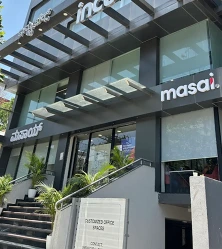
Address :- Incubex HSR21, 5th Main Rd, Sector 6, HSR Layout, Bengaluru, Karnataka 560102.