
Certification in Agentic AI Program

1.8K+ students have already registered
Enter the following details to continue
Choose Your Path to Agentic AI
Certification in Applied Agentic AI
Build and deploy practical Agentic AI applications.
What's included:
- Learn and build with Agentic AI
- Python, ML & LLM foundations
- Agentic AI, ReAct & tool use
- RAG, LangChain & LangGraph
- Memory & agent orchestration
- Evaluation, testing & FastAPI deployment
Advanced Certification in Agentic AI Engineering
Learn to engineer production-grade AI systems.
What's included:
- Become an Agentic AI engineer
- Everything in Certification
- Advanced orchestration & retrieval
- Production services, Docker & CI/CD
- MCP & multimodal agents
- Multi-agent systems & A2A
- Security, observability & advanced evaluation
*Placement assistance eligibility: 7+ CGPA and 65% attendance.
Why choose this course?
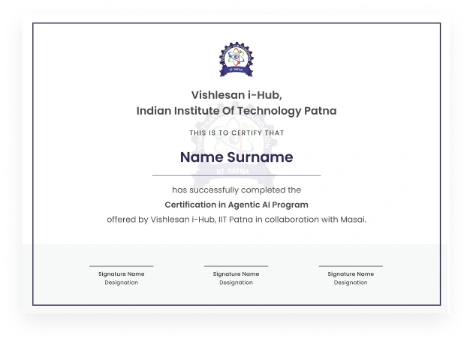
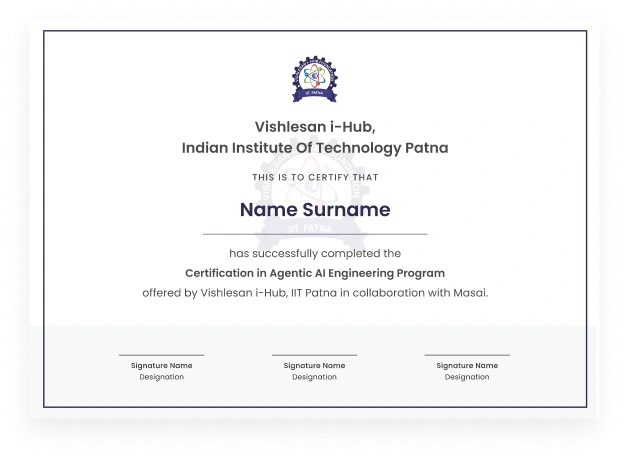
Prestigious certification from Vishlesan i-Hub, IIT Patna
Capstone projects aimed at solving real challenges
Expert faculty and industry insights
Placement assistance for 1 year, plus resume review and interview coaching sessions facilitated by Masai. (Eligibility: 7+ CGPA and 65% attendance)
*Certificate Eligibility: Minimum 65% overall attendance and 30% marks in cumulative evaluation score
What will you learn?
Go from zero to job-ready in AI/ML with beginner-friendly, industry-aligned curriculum from I-Hub IIT Patna, taught in English — covering Python, data analysis, machine learning, and generative AI with hands-on projects. Built for beginners, designed to get you building real things fast.









Meet our Instructor Team

Abhinandan S P
Asst. Professor at IIT Palakkad


Venkatesh
Senior Machine Learning Engineer | PayPal


Aswath Rao V S
AI / ML Engineer at Ford Motors, Ex- PayPal and Pine Labs

Abhinandan S P
Asst. Professor at IIT Palakkad
Venkatesh
Senior Machine Learning Engineer | PayPal
Aswath Rao V S
AI / ML Engineer at Ford Motors, Ex- PayPal and Pine Labs
*Note: Instructors teaching your batch may change based on specific module expertise, or circumstances such as personal emergencies, unavailability etc.
Course Details
Module 1: Python Programming and Developer Skills
Python Programming:
Build fluency in variables, data types, conditions, loops, collections, functions and modules so learners can solve problems and write reusable programs independently.
Files, Errors and Type-Safe Code:
Work with files, exceptions and type hints while learning to structure programs that are easier to understand, validate and maintain.
Debugging and Testing:
Use systematic debugging, assertions and introductory automated tests to identify failures rather than relying on trial-and-error coding.
Developer Workflow:
Set up notebooks, VS Code and the command line, and use Git and GitHub to manage code, changes and reproducible technical work.
Tools
Module 2: APIs, Data and Machine Learning Foundations
APIs and Data Acquisition:
Understand HTTP, REST and JSON, and use Python requests, environment variables and API credentials to work safely with external data sources.
Data Preparation:
Use NumPy, Pandas and basic SQL to inspect, clean, transform and combine data before it enters a machine learning or AI workflow.
Machine Learning Fundamentals:
Understand supervised and unsupervised learning, features and targets, regression and classification, and how real questions become measurable learning tasks.
Tools
Module 3: LLM Foundations and Application Development
Transformer and LLM Foundations:
Build a high-level mental model of tokenisation, embeddings, positional information, self-attention and decoder-only transformers, without entering unnecessary mathematical detail.
Pre-Training and LLM Limitations:
Connect next-token pre-training and instruction tuning to hallucination, prompt sensitivity, context limits, stale knowledge and non-determinism, establishing why LLM systems require evaluation and control.
LLM APIs and Prompt Design:
Call language models through APIs and structure instructions, messages, context and examples while decomposing complex tasks into manageable steps.
Structured Outputs and Reliability:
Generate schema-constrained outputs, validate responses, handle failures and balance quality against context, latency and cost.
Tools
Module 4: Agentic AI from First Principles
Agentic Workflow Design:
Understand degrees of autonomy, task decomposition and the difference between deterministic workflows and systems that dynamically decide their next action.
Tools and Structured Actions:
Implement tools as typed Python functions with validated inputs, outputs and error handling before introducing any agent framework.
Reason + Act (ReAct):
Build the reasoning-action-observation loop in raw Python so an agent can select a tool, use its result, iterate and stop under explicit conditions.
Reflection and Planning:
Introduce generator-critic, evaluator-optimizer and plan-and-execute patterns for controlled iteration, feedback and replanning.
Early Agent Evaluations:
Define success criteria, create representative test cases and use basic error analysis to compare agent behaviour across system versions.
Tools
Module 5: RAG, LangChain, LangGraph and Memory
Embeddings, Retrieval and RAG:
Represent meaning with embeddings and build grounded LLM responses over chunked documents using semantic retrieval, metadata, source evidence and citations.
RAG Quality:
Recognise chunking, retrieval and grounding failures and apply introductory checks for retrieval relevance and answer faithfulness.
LangChain Essentials:
Use model, prompt, structured-output, retriever and tool abstractions to rebuild first-principles LLM and agent workflows with reusable components.
LangGraph and Stateful Orchestration:
Represent execution through nodes, edges, state and conditional routing, with introductory checkpointing and human intervention.
Agent State and Memory:
Distinguish context, state and memory while introducing short-term and long-term memory, persistence, summarisation, context trimming and basic privacy considerations.
Tools
Module 6: Applied Agent Orchestration
Workflow Orchestration:
Use LangGraph state, routing and conditional edges to combine retrieval, structured tools and model decisions in controlled multi-step workflows.
Memory and Persistence:
Add conversation memory, persistent checkpoints, context management and resumable execution to support reliable multi-turn interactions.
Reliability and Human Control:
Introduce retries, fallbacks, tool-error handling, approval steps and basic protection against prompt injection.
Tools
Module 7: Agent Evaluation, Testing and Deployment
Evaluation and Automated Testing:
Create representative test cases and use pytest, structured assertions and mocked tools to check outputs, tool use, retrieval, memory and failure paths.
FastAPI Services:
Expose an agent through typed FastAPI routes using Pydantic request and response models, validation, configuration, error handling and basic streaming.
Deployment Basics:
Add structured logging, request identifiers, a simple interface and a deployable configuration that takes the application beyond a notebook.
Tools
Capstone Project

Nykaa-inspired: Beauty Signal
Thousands of customer reviews can hide early warnings about packaging defects, shade mismatches, irritation concerns or declining product satisfaction. By the time the average rating falls, valuable time to investigate may already have been lost.
What you'll build
An evidence-grounded review intelligence agent that uses ReAct, RAG and LangGraph to identify emerging issues, retrieve supporting customer feedback and recommend an appropriate human follow-up. The solution includes conversational memory, agent evaluations and a FastAPI service.
Final outcome
A weekly Product Attention Board ranking products that may require investigation. Every alert includes the emerging issue, supporting review trends and quotations, confidence level and a recommended action such as investigate, monitor or contact the seller.
IndiGo Passenger Recovery Copilot
When a flight is delayed, cancelled or results in a missed connection, the passenger's available options depend on the itinerary, disruption conditions and applicable policy. Finding the correct answer can require navigating multiple rules while already under stress.
What you'll build:
A source-grounded agent that checks a simulated itinerary, flight status, alternative flights and passenger policies before recommending the permitted recovery options. It remembers passenger preferences, explains its reasoning with evidence and escalates uncertain cases.
Final Outcome
A personalised recovery packet containing the verified disruption, ranked rebooking or refund options, relevant policy citations, missing information and a ready-to-review resolution request.

Please Note :- "Due to the evolving nature of the industry expectations and partner institute feedback, some syllabus aspects may change. Any updates will be communicated during the Inauguration Session(s) or at the start of the relevant module"
Admission Process
Submit Application
Complete application form to showcase your motivation and goals


Complete Counselling
Only shortlisted candidates go through the counselling process


Start Learning
Learn from India's top educators and stand out from the crowd


Submit Application
Complete application form to showcase your motivation and goals
Complete Counselling
Only shortlisted candidates go through the counselling process
Start Learning
Learn from India's top educators and stand out from the crowd
How is the Certification in Agentic AI Program with Vishlesan i-Hub, IIT Patna Different?
Fee structure
Application Fee
Non-refundable.
Registration Fee
₹4,000
Program Fee
₹23,000
Total Fee
₹27,000
+Gst
Pay your Program Fee, your way
Upfront Payment
Pay once, save more.
₹27,860
EMI via NBFC Partners
Spread the cost over 3 months.
*Inclusive of GST

About Vishlesan i-Hub IIT, Patna
Vishlesan i-Hub at IIT Patna is part of a national mission, advancing AI in speech, video, and text analytics for sectors like health, education, and security.
Premier Technical Institute
IIT Patna is one of India's top engineering institutes, known for its cutting-edge research and strong academic foundation.
Strong Industry & Research Ecosystem
With active collaborations, incubators, and innovation hubs, IIT Patna bridges academia and industry to drive real-world impact
How will Masai help you?

How will Masai help you?
Placement Assistance
Eligible students will receive 1 year of placement assistance, along with resume review and interview coaching sessions facilitated by Masai. (Eligibility: 7+ CGPA and 65% attendance)
Real-Time Learning Ecosystem
Experience a constantly evolving curriculum with live classes and instant academic assistance, designed to keep pace with industry advancements.
Industry Integration and Projects
Participate in hands-on industry projects guided by distinguished instructors from IIT and top experts, ensuring practical and relevant skills development.
Contact Us
Get started
Join the Program
Copyright © Nolan Edutech Private Limited. All rights reserved
Address :- Incubex HSR21, 5th Main Rd, Sector 6, HSR Layout, Bengaluru, Karnataka 560102.