
Which career has more scope in the future: Tech, management or Both?

Here's a number that should worry every student about to pick a degree: according to the State of Working India 2026 report by Azim Premji University, 67% of India's unemployed youth are graduates. Not dropouts. Not people without qualifications. Graduates people who did everything they were told to do, and still ended up stuck.
Dig a little further and it gets more uncomfortable. India adds roughly 5 million graduates to the workforce every year, but only about 2.8 million graduate-level jobs are created in that same period. Less than 7% of male graduates land a permanent, salaried job within a year of finishing their degree. A college degree, on its own, has quietly stopped being a guarantee of anything.
So when someone asks which career has more scope in the future tech, management, or something else the honest answer isn't a simple either-or. It's that the entire question of which career matters less than most people think. What actually decides your future scope is what kind of thinking your degree trains you in and the data on that point is far clearer than most people realize.
Why so many graduates are stuck, despite doing everything right
This isn't a story about lazy graduates or oversaturated job markets alone. It's a structural mismatch, and it shows up everywhere once you start looking for it.
- The skill gap is real and well documented. The India Skills Report shows employability meaning how job-ready a graduate actually is varies dramatically by degree type: MBA graduates around 71%, B.Tech graduates around 60%, and Bachelor of Arts graduates around 45%. A degree alone doesn't guarantee employability; what's taught inside it does.
- AI is quietly reshaping entry-level work first. Routine, single-skill, easily-automatable tasks basic coding, data entry, repetitive analysis are exactly the jobs AI tools are absorbing fastest. The World Economic Forum estimates 92 million jobs globally will be displaced by automation by 2030, while 170 million new ones emerge in their place but those new roles look nothing like the old ones.
- Qualification inflation is squeezing every level. Even low level government and entry roles are now attracting overqualified engineering and postgraduate applicants, simply because there aren't enough mid-tier roles to absorb everyone.
- The mismatch isn't about effort. Graduates are applying to dozens, sometimes hundreds, of roles. The problem sits upstream in what they were trained to do versus what the market actually needs done.
If this sounds familiar a relative, a senior, maybe your own situation you're not imagining the problem. It's measurable, it's national in scale, and it's getting worse before most degree structures catch up to it.
It's not about Tech or Management it's about how many things you can do well
Here's where most career advice goes wrong. It frames the decision as picking a lane: are you a tech person or a management person? Should you chase engineering because that's where the money supposedly is, or business because that's safer?
That framing made sense a decade ago. It doesn't hold up well against what's actually happening to graduate outcomes today.
A narrow, single skill specialization whether that's a purely technical degree with no business exposure, or a purely theoretical commerce/management degree with no technical fluency leaves you vulnerable in a specific way: you're only as valuable as the demand for that one narrow skill, in that one moment in time. When that skill gets automated, oversaturated, or simply falls out of fashion, you have very little to fall back on.
An adaptable, cross disciplinary skill set the ability to understand a technical system and the business reasoning behind it, to read both a product roadmap and a budget sheet holds up differently. It doesn't get displaced by a single shift in technology, because it isn't tied to one narrow skill in the first place. It evolves alongside whatever the market does next.
This is the actual answer to which career has more scope: not tech, not management, but the combination and specifically, your ability to move fluently between the two, rather than being boxed into either.
What this looks like in real numbers
It's worth being concrete about why this combination holds up so well economically, rather than just asserting it.
- Professionals who can operate across both technical and business contexts are consistently among the fastest growing, best compensated segments of India's job market not because the roles are flashy, but because very few people are trained to do both well, while almost every growing company needs someone who can.
- Compensation in these hybrid-skill roles routinely outpaces single-track specialist roles at comparable experience levels the premium isn't for knowing more, it's for being able to connect what the technical side is building to what the business side actually needs.
- These roles also tend to be the most resistant to the kind of automation displacing entry level, single skill work because the job is fundamentally about judgment, translation, and decision-making across domains, not the repetitive execution AI tools are best at replacing.
None of this requires a rare, unicorn level talent. It requires the right training, early enough, before you've already specialized into a single narrow lane.
So what should you actually look for in a degree?
If the goal is future scope rather than just a credential, here's a practical checklist worth running any degree engineering, commerce, management, or otherwise through before committing four years and a meaningful chunk of money to it:
- Does it teach you to think across disciplines, or only within one? A curriculum that only goes deep in one direction (pure coding, or pure theory) is the exact structure producing today's underemployed graduates.
- Does it build applied skills or just theoretical knowledge? The India Skills Report's employability gap exists precisely because many degrees still prioritize content delivery over job-readiness.
- Does it stay current with how fast the market is actually moving? A curriculum locked in place from a decade ago can't prepare you for a job market reshaped by AI in the last two years alone.
- Does it give you flexibility if your plans change? A four-year, all-or-nothing commitment carries more risk than a structure that lets you walk away with something real at every stage.
- Does it carry credibility employers actually recognize? Skills matter, but a respected institutional name still meaningfully shortens the distance between qualified and hired.
Most degrees, if you're honest, fail at least two or three of these checks.
Where a degree built around this actually exists
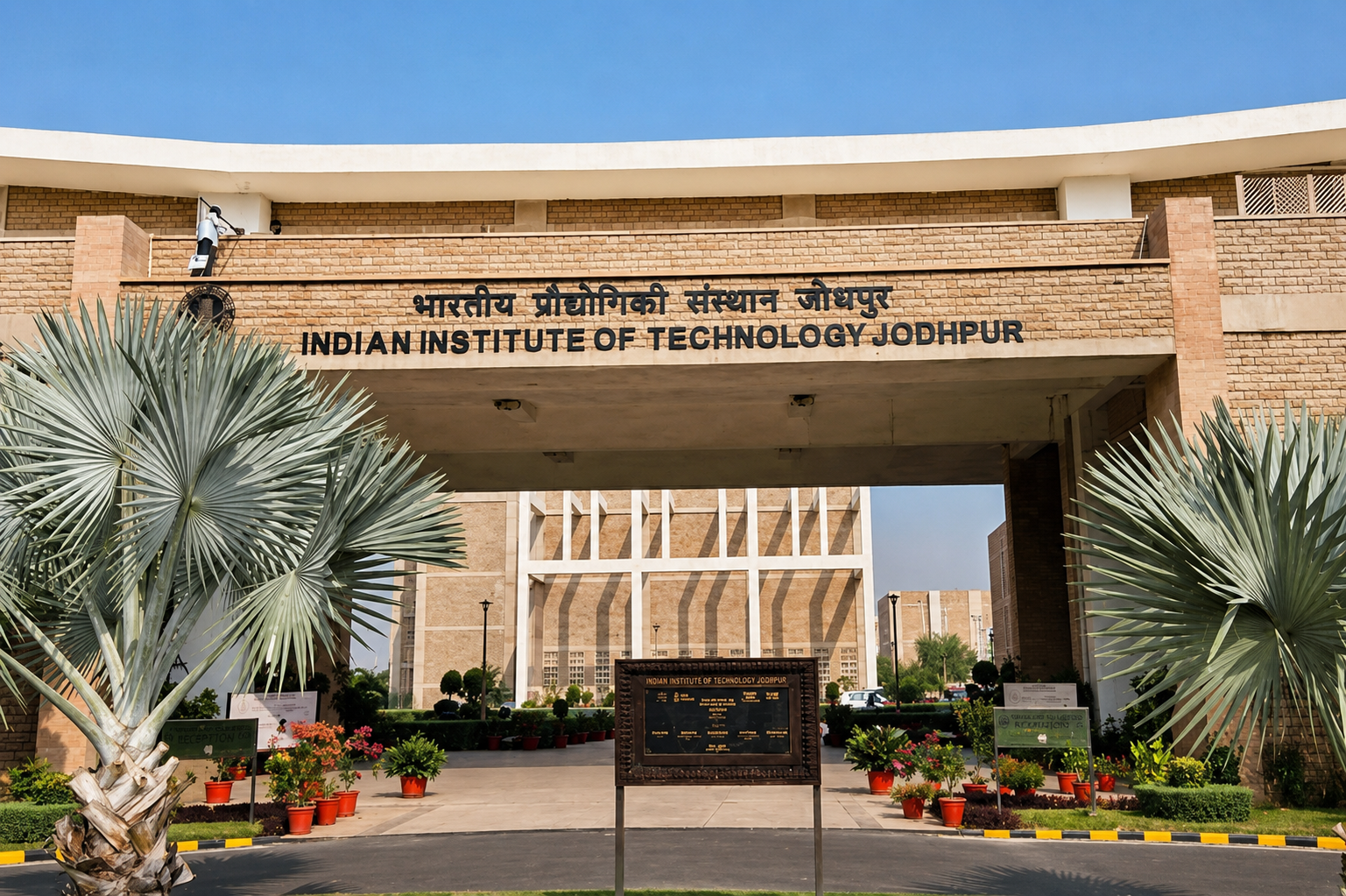
This is precisely the gap IIT Jodhpur's B.S. Degree in Management and Technology is designed to close and it's worth understanding on its own terms, not as an abstract solution, but as a concrete answer to the checklist above.
It's a full four-year undergraduate degree, 141 credits across 47 courses, delivered by IIT Jodhpur's School of Management and Entrepreneurship. Instead of treating business and technology as separate tracks, the curriculum integrates them from day one:
- Year 1 builds foundations across economics, statistics, accounting, and computing accessible regardless of your Class 12 stream.
- Year 2 moves into machine learning in business, AI applications, and core management subjects like organisational behaviour and the digital economy.
- Year 3 goes deeper into Generative and Agentic AI in Business, Big Data and Cloud Computing, and Industry 4.0, alongside strategy, operations, and HR.
- Year 4 closes with corporate governance, FinTech, supply chain management, and a dedicated course on Human-AI Collaboration at Work.
A few details matter especially given everything above:
- No JEE required. Admission runs through a 60% aggregate eligibility bar and an aptitude-based qualifier test, open to any stream science, commerce, or arts.
- Built in flexibility. A multiple-exit structure means you exit with a Certificate after Year 1, a Diploma after Year 2, and the full B.S. degree with IIT Jodhpur alumni status by Year 4 so a four-year bet doesn't have to feel like an all-or-nothing one.
- Institutional credibility. A genuine degree and alumni status from IIT Jodhpur, which addresses exactly the "credibility employers recognize" gap most hybrid-skill courses and bootcamps can't offer on their own.
Graduates are positioned for roles spanning business analysis, digital marketing, operations, product and strategy functions, with the option to pursue an MBA or specialised master's afterward or build a venture with IIT backed mentorship.
If the real lesson from the unemployment numbers at the start of this piece is that a narrow degree is a structural risk, not just a personal one then the practical response isn't to panic about which single career to chase. It's to look for a degree actually built around the kind of adaptable thinking the job market has already started rewarding.
Frequently Asked Questions
Is tech or management a better career choice in 2026? Neither, on its own, is clearly better the data points toward roles and degrees that combine both being the fastest-growing and best-compensated segment of the job market, rather than either specialization alone.
Why are so many Indian graduates unemployed despite having degrees? According to the State of Working India 2026 report, India adds about 5 million graduates a year but creates only around 2.8 million graduate-level jobs, creating a structural mismatch between graduate supply and job availability compounded by a skills gap between what's taught and what employers need.
Will AI replace tech or management jobs first? AI is displacing routine, single-skill tasks fastest basic coding, data entry, repetitive analysis regardless of whether that task sits in a "tech" or "business" role. Roles requiring judgment across both domains are comparatively more resistant.
Do I need a technical background to pursue a degree like IIT Jodhpur's B.S. in Management and Technology? No. The programme is open to students from any stream science, commerce, or arts after Class 12, with admission through an aptitude-based test rather than JEE or a subject-specific entrance exam.
What if I'm not sure this path is right for me halfway through? The degree follows a multiple-exit structure, so you exit with a recognised credential a Certificate after Year 1, a Diploma after Year 2 rather than walking away with nothing if your plans change.