
MongoDB vs MySQL: differences, use cases and how to choose
MongoDB vs MySQL compared on data model, schema, joins, transactions and scaling, with 3 orders modelled both ways and a decision guide by use case.

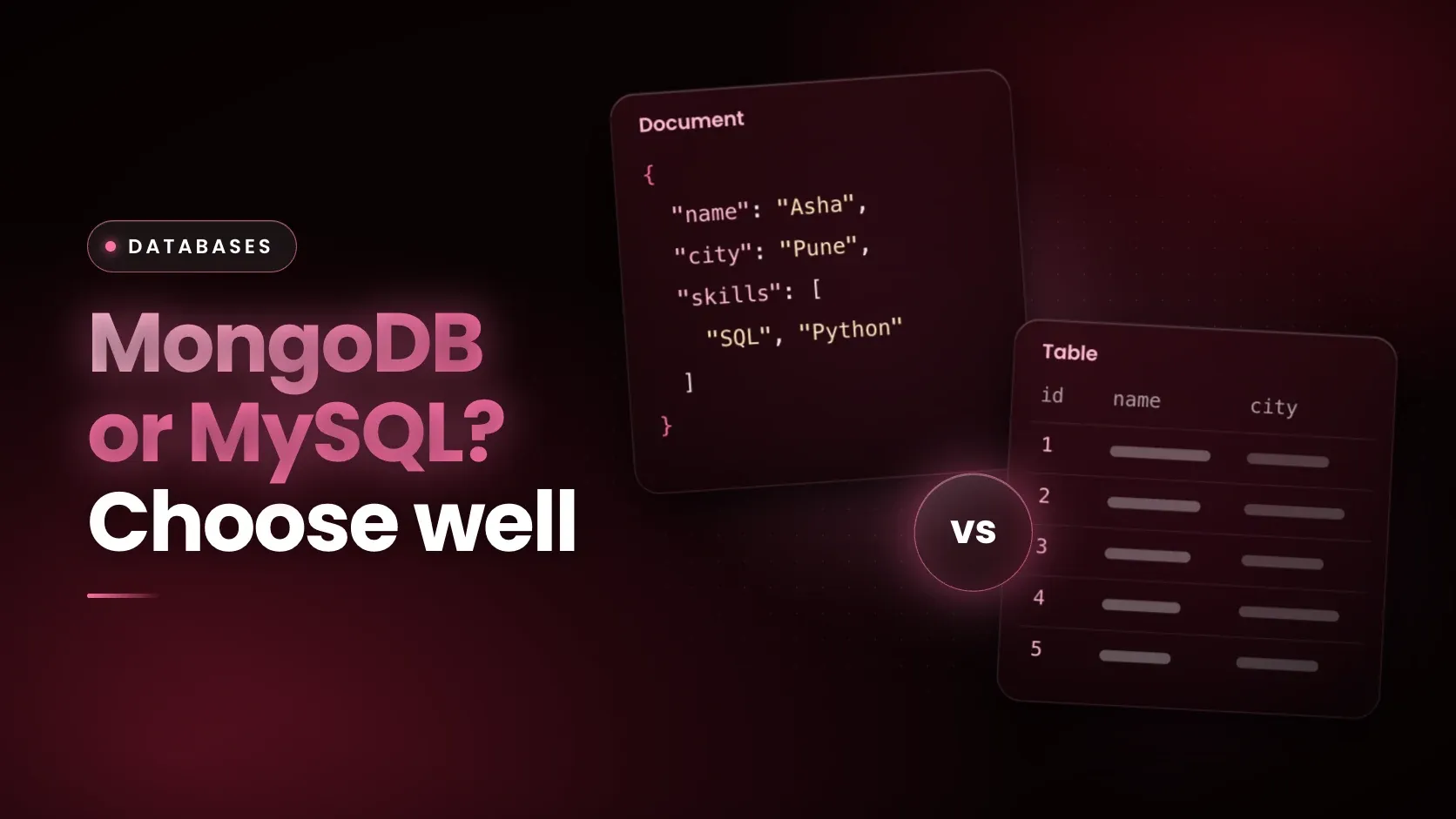
MongoDB is a document database that stores flexible JSON-like documents, while MySQL is a relational database that stores rows in tables with declared columns and is queried with SQL. Neither is better in general: the choice depends on whether the data is naturally one self-contained document or several related tables. Both support ACID transactions, and both offer replication to keep copies of data on more than one server.
How do MongoDB and MySQL differ at a glance?
The two systems differ most in data model and schema. The table below sets them side by side on the criteria that usually decide a choice, using each vendor's own manual.
| Criterion | MongoDB | MySQL |
|---|---|---|
| Data model | Documents in collections, stored as BSON | Rows in tables |
| Schema | Flexible by default, with optional validation rules | Columns and data types declared when the table is created; a JSON column type is available |
| Relationships | Embed related data or reference it; $lookup is a left outer join | Foreign keys and joins (INNER, LEFT, RIGHT, CROSS) |
| Transactions | Single-document writes are atomic; multi-document ACID transactions are supported | InnoDB, the default engine, follows ACID with commit and rollback |
| Scaling | Replica sets for availability; sharding to distribute data across machines | Replication from a source to replicas, with reads spread across them |
| Query language | find() and aggregation pipelines | SQL |
| Licence | Server source under the Server Side Public License, version 1 | GPL for the community software, with a commercial licence available |
| Version, 7 November 2026 | 9.0 is the current stable series | 8.4 and 9.7 are LTS series; later releases use calendar numbers such as 26.7 |
What is MongoDB and when does it fit?
MongoDB is a document database. Its manual says it stores data in flexible, JSON-like documents, where a record is a set of field and value pairs and the values can be other documents or arrays. Documents live in collections, which are similar to relational tables but do not enforce a rigid, pre-defined schema. Internally, MongoDB stores documents as BSON, a binary form of JSON with extra data types.
That fits data that is read and written as a unit, such as a product with its own attributes, or a user with nested preferences. MongoDB's data modeling guidance says to embed related data when it is queried together, updated together, or forms a has-a relationship, and to reference it from another collection when the child side has high cardinality, grows without bound or exists on its own. An earlier post covers the basics in what is MongoDB.
Schema flexibility is a default, not an absence of rules. MongoDB's schema validation lets teams add rules for allowed data types and value ranges once the structure of an application is established. The MongoDB server source is published under the Server Side Public License, version 1, dated 16 October 2018.
What is MySQL and when does it fit?
MySQL is a relational database management system. Its manual describes it as developed, distributed and supported by Oracle Corporation, and says a relational database stores data in separate tables rather than in one big storeroom. SQL, the language used to query it, is described as the most common standardized language for accessing databases. The community software uses the GPL, and a commercially licensed version exists for embedding in commercial applications.
That fits data whose pieces reference each other, such as customers, orders and payments. In MySQL 8.4, InnoDB is the default storage engine. The manual says its DML operations follow the ACID model, with commit, rollback and crash recovery, and that it supports FOREIGN KEY constraints so that inserts, updates and deletes are checked for consistency across related tables. Each column is declared with a data type when the table is created, and analysts' SQL skills, including SQL joins and window functions, apply directly.
MySQL's release numbering has changed. Its manual says 9.7 is the final release line under the sequential model and later releases use calendar versions in YY.M form, so 26.7 is the July 2026 release. The difference between SQL the language and MySQL the product is covered in SQL vs MySQL.
How does the same data look in each model?
A relational design splits data across tables and joins them on read, while a document design embeds related data in one record. The hypothetical shop below has two customers and three orders.
| customer_id | name | order_id | amount |
|---|---|---|---|
| 1 | Asha | 101 | 2500 |
| 1 | Asha | 102 | 1800 |
| 2 | Bilal | 103 | 3200 |
In MySQL-style SQL, customers and orders sit in separate tables linked by a foreign key, and a join with GROUP BY answers a question such as total order value per customer. Run on SQLite 3.54.0, it returned the following.
SELECT c.name, COUNT(o.order_id) AS orders, SUM(o.amount) AS total
FROM customers c JOIN orders o ON o.customer_id = c.customer_id
GROUP BY c.customer_id, c.name;| name | orders | total |
|---|---|---|
| Asha | 2 | 4300 |
| Bilal | 1 | 3200 |
In MongoDB, the same data is usually one document per customer with the orders embedded as an array.
{"customer_id": 1, "name": "Asha", "orders": [{"order_id": 101, "amount": 2500}, {"order_id": 102, "amount": 1800}]}
{"customer_id": 2, "name": "Bilal", "orders": [{"order_id": 103, "amount": 3200}]}
Reading Asha and all her orders is one document read, with no join. Summing the embedded amounts gives the same totals, 4300 and 3200. The cost shows up on updates and cross-cutting questions. MongoDB's manual says duplicating data can remove the need for joins and speed reads, but that frequently updating duplicated data can cause heavy workloads. When data has to be combined across collections, the $lookup stage performs a left outer join, and the manual warns that unindexed or correlated-subquery lookups on large collections can slow queries.
Relational constraints behave differently too. With foreign keys switched on in SQLite, inserting an order for customer 99, who does not exist, failed with "FOREIGN KEY constraint failed". MySQL's InnoDB engine supports the same kind of check. A document database leaves such checks to validation rules or to application code.
Does MongoDB support transactions?
Yes. MongoDB supports multi-document ACID transactions across operations, collections, databases, documents and shards, and the manual says they are available in all supported versions. An operation on a single document is atomic in any case, and embedding related data in one document reduces how often a multi-document transaction is needed.
The manual adds a caution: in most cases a distributed transaction costs more in performance than single-document writes, and transactions should not replace effective schema design. MySQL's InnoDB engine, the default in 8.4, follows the ACID model with commit and rollback for ordinary multi-row work.
A bank-style transfer between two accounts shows the difference in practice. In a relational design, the two balances are rows updated inside one InnoDB transaction. In a document design, both balances can be fields in one document, which is atomic by itself, or separate documents, which need a multi-document transaction. Either way the transfer can be made safe, and the design choice decides how much machinery it takes.
How do MongoDB and MySQL scale?
MongoDB documents sharding as its method for distributing data across multiple machines, while MySQL's manual describes replication for spreading reads. MongoDB's sharding page says it supports very large data sets and high throughput, at the trade-off of more complexity in infrastructure and maintenance. A replica set, a group of processes maintaining the same data set, provides redundancy and high availability.
MySQL replication copies data from one source server to one or more replicas, asynchronously by default. The manual's scale-out description puts writes and updates on the source and spreads reads across replicas. It also lists data security, analytics and long-distance data distribution as advantages.
These are mechanisms, not speed comparisons. Neither manual gives a benchmark, and no performance figures are given here. Other ways of scaling MySQL exist and were not compared here.
Which should you choose for your situation?
Choose by the shape of the data and the access pattern, not by the label SQL or NoSQL. The table below states the criterion behind each lean.
| Situation | Lean toward | Criterion |
|---|---|---|
| Orders, payments and stock where records reference each other and integrity matters | MySQL | Foreign key checks, ACID transactions and joins are built into InnoDB |
| A catalogue whose items have different attributes | MongoDB | Documents in one collection can have different fields |
| Records always read and updated together, such as a profile with nested settings | MongoDB | Embedded documents and atomic single-document writes |
| Analysts querying across many tables with SQL and BI tools | MySQL | SQL is the standardised language, with joins and window functions |
| Mostly structured data with a few flexible fields | MySQL with a JSON column | JSON columns are validated and stored in an optimised format |
| One data set that must be distributed across machines | Check both | MongoDB documents sharding; MySQL documents replication for reads |
The middle ground is real. MySQL's native JSON type validates documents and, though JSON columns are not indexed directly, an index can be created on a generated column that extracts a value. MongoDB offers optional schema validation and multi-document transactions. That is why a project's query patterns, team skills and consistency needs matter more than the category.
What are the limits of this comparison?
This comparison covers mechanisms described in the vendors' manuals, which means it has several limits.
- No performance numbers are given, because the manuals describe design, not benchmark results, and speed depends on indexes, hardware and queries.
- The data is tiny. The shop example has two customers and three orders and says nothing about behaviour at scale.
- Only the SQL ran, on SQLite 3.54.0. The MongoDB document is shown as JSON and described from the manual.
- Versions and licences change. MongoDB's manual lists 9.0 as the current stable series on 7 November 2026, and MySQL has moved to calendar version numbers.
- The licence rows describe where each project's source or software is published, not legal advice about using it.
How does this fit a data science programme?
Choosing a database is part of working with data. The Certification in Data Science and Artificial Intelligence is an online programme from E&ICT Academy, IIT Roorkee, run with Masai as the implementation partner, with live online sessions and an optional campus immersion at IIT Roorkee. It covers Python, data analysis, SQL, statistics, machine learning and generative AI, and its listed topics include SQL fundamentals, applied SQL for analytics and working with CSV and JSON.
Frequently asked questions
Is MongoDB better than MySQL?
Neither is better in general. MongoDB suits data that is read and updated as self-contained documents and that changes shape. MySQL suits related tables where foreign keys, joins and ACID transactions matter. The criterion is the shape of the data and how it is accessed, so test both against a real query pattern.
When should you use NoSQL instead of SQL?
Use a document database such as MongoDB when records are naturally nested, items vary in their attributes, and data is mostly read and updated as one unit. Stay with SQL when records reference each other, integrity checks matter, or analysts need joins across tables. A JSON column in MySQL covers some middle cases.
Does MongoDB support transactions?
Yes. MongoDB supports multi-document ACID transactions across collections, databases and shards, available in all supported versions. Writes to a single document are atomic by default. The manual notes that multi-document transactions usually cost more than single-document writes, so embedding related data is often the better design.
What is MongoDB?
MongoDB is a document database that stores data in flexible, JSON-like documents, grouped in collections that do not enforce a fixed schema. A document is a set of field and value pairs, and values can be other documents or arrays. Data is queried with find() and aggregation pipelines instead of SQL.
Can MySQL store JSON documents?
Yes. MySQL has a native JSON data type that validates documents on insert and stores them in an optimised format for quick reads. JSON columns are not indexed directly, but an index can be created on a generated column that extracts a value from the document.
Is MongoDB faster than MySQL?
The vendors' manuals give no general answer, and speed depends on the workload, indexes and design. Embedding can avoid joins in MongoDB, while well-indexed joins are routine in MySQL. A fair test uses the real queries and data volume on both systems.
Next step
Model one small dataset from a project of your own both ways, as tables and as documents, and note which questions get easier and which get harder. The Certification in Data Science and Artificial Intelligence covers SQL, Python and statistics for readers who want a structured path through data work. For the SQL side in depth, read the posts on SQL joins and window functions.