
How to write a business plan: lean canvas and a one-page plan
How to write a business plan: pick a format, fill the 9-box Lean Canvas and test unit economics, with a hypothetical Pune tuition example in Python.

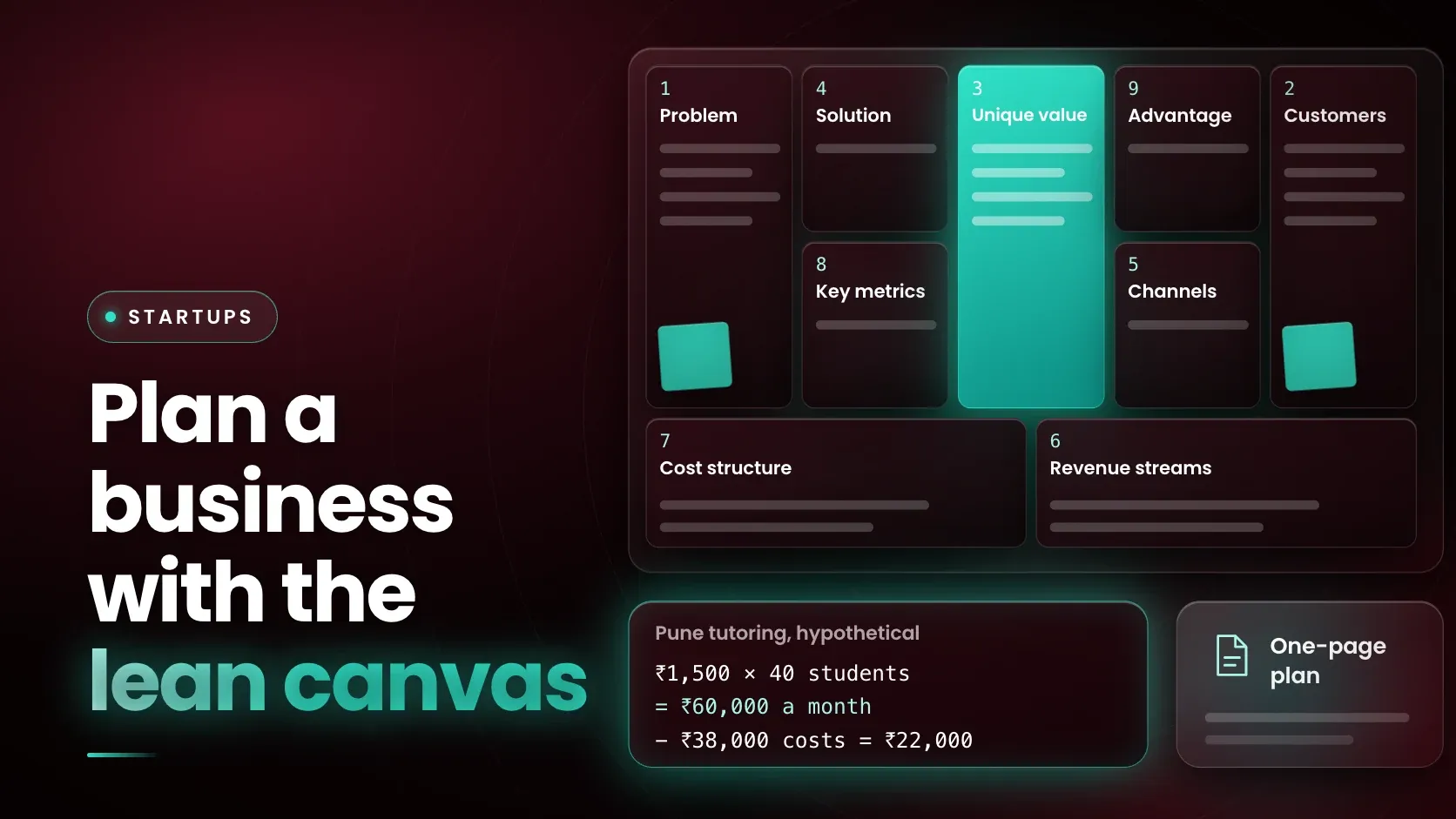
To write a business plan, choose the format first. A traditional plan has many sections and can run to dozens of pages, a lean startup plan is typically one page, and the Lean Canvas, created by Ash Maurya in 2010, fits a business model into nine boxes on one page. Then fill the boxes, check the unit economics with arithmetic, and revise the plan as customer evidence arrives.
Last updated: 11 November 2026.
What is a business plan, and which format should you use?
A business plan is a document that works as a roadmap for how to structure, run and grow a business, according to the US Small Business Administration (SBA). The SBA says there is no right or wrong way to write one and that most plans fall into two categories, traditional or lean startup. The table adds the Lean Canvas, a one-page business model rather than a plan in the traditional sense.
| Format | Typical length | Best for | Source |
|---|---|---|---|
| Traditional plan | Can be dozens of pages | Lenders and investors, who commonly request it | US Small Business Administration |
| Lean startup plan | Typically one page | Explaining a simple business quickly, or a plan that will change often | US Small Business Administration |
| Lean Canvas | One page, sketched in less than 20 minutes | Breaking an idea into assumptions to test | Ash Maurya |
The SBA also warns that some lenders and investors may ask for more information than a lean plan holds. A one-page plan is therefore a starting point, and a longer document may follow when a lender or investor asks.
What is a Lean Canvas?
A Lean Canvas is a one-page business modelling tool created by Ash Maurya in 2010 as an adaptation of Alexander Osterwalder's Business Model Canvas. Maurya says he found the Business Model Canvas too company-centric, so he replaced four boxes (key partnerships, key resources, key activities and customer relationships) with problem, solution, key metrics and unfair advantage to make it more entrepreneur-focused.
His 7 September 2024 article gives the working rules: sketch the first version in less than 20 minutes, leave a box blank if unsure, and treat the canvas as a snapshot, not a finished plan.
The count of boxes needs a note. Lean Stack's current Lean Canvas page lists twelve blocks, adding existing alternatives, early adopters and a high-level concept, and also refers to nine boxes. Maurya's own article treats existing alternatives as part of Problem, early adopters as part of Customer Segments and the high-concept pitch as part of the value proposition, so those three read as prompts inside three of the nine boxes.
The SBA's lean startup plan is a different template. Its nine components are key partnerships, key activities, key resources, value proposition, customer relationships, customer segments, channels, cost structure and revenue streams, which are the Business Model Canvas blocks, not the Lean Canvas blocks.
What goes in each of the nine Lean Canvas boxes?
Maurya says there is no right order for sketching the canvas, and recommends starting with Customer Segments and ending with Unfair Advantage. The table follows his order and summarises his guidance for each box.
| Box | What to write |
|---|---|
| Customer Segments | Who pays; separate customers from users, and name early adopters |
| Problem | The top one to three problems, plus existing alternatives |
| Unique Value Proposition | What it is for and who it is for, in a short headline |
| Solution | The simplest thing that addresses each problem |
| Channels | How the first customers will be reached |
| Revenue Streams | Pricing, decided early |
| Cost Structure | Costs for the next three to six months |
| Key Metrics | The top three to five outcome numbers |
| Unfair Advantage | Something that cannot easily be copied or bought |
Maurya made the Solution box smaller than one-ninth of the canvas on purpose, because the solution is rarely the riskiest part. He also notes that passion, lines of code and features do not count as unfair advantages.
How do you write a business plan step by step?
The steps below move from a sketch to a document a reader can act on.
- Choose the format: canvas, one-page plan or traditional plan.
- Sketch the canvas quickly, leaving unknown boxes blank.
- Test the Problem and Customer Segments boxes with real people, as in how to validate a startup idea and product discovery interviews.
- Write the money side as arithmetic: price, costs, acquisition cost, customer lifetime.
- Pick three to five key metrics with targets, using OKRs vs KPIs and CAC and LTV formulas.
- Write the one-page plan, one short paragraph per box.
- Expand only when a reader asks, and revise as evidence changes.
Worked example: a hypothetical tuition business in Pune
Take a hypothetical after-school maths tuition business in Pune for Class 9 and 10 students. Every figure below is invented for the example, and no figure describes a real business.
What does the canvas look like?
| Box | Hypothetical entry |
|---|---|
| Customer Segments | Parents of Class 9 and 10 students in one part of Pune; early adopters are parents whose child is already behind in maths |
| Problem | Large classes give no individual attention; parents learn a child is struggling only at exam time; existing alternatives are large coaching classes, private tutors and video lessons |
| Unique Value Proposition | Small-batch maths classes with a weekly progress report for parents |
| Solution | Batches of 8 students, a weekly short test, a progress message to each parent |
| Channels | Demo sessions near schools, parent messaging groups, referrals |
| Revenue Streams | Rs 2,400 per student per month |
| Cost Structure | Tutor pay Rs 9,600 per batch per month, materials Rs 150 and admin Rs 50 per student, fixed costs Rs 20,000 per month |
| Key Metrics | Students enrolled, monthly churn, cost to acquire a student, contribution per student |
| Unfair Advantage | None proven yet, left blank |
What do the unit economics show?
Unit economics ask whether one customer earns more than they cost. Break-even is the point where total cost equals total revenue, as the SBA defines it, and investors want to know when a return arrives. The calculation below adds the cost of acquiring each student, which a simple break-even leaves out.
price = 2400                  # Rs per student per month (hypothetical)
batch_size = 8
tutor_pay = 9600              # Rs per batch per month
materials, admin = 150, 50    # Rs per student per month
fixed = 20000                 # Rs per month: classroom share, software, tools
cac = 1500                    # Rs: 15,000 of marketing brought 10 students
months_stay = 6               # average months a student stays

variable = tutor_pay / batch_size + materials + admin
contribution = price - variable
churn = 1 / months_stay
print(f"contribution per student : Rs {contribution:,.0f} ({contribution / price:.1%} of price)")
print(f"break-even, ignoring CAC : {fixed / contribution:.1f} students")
print(f"break-even with CAC      : {fixed / (contribution - churn * cac):.1f} students")
ltv = contribution * months_stay
print(f"LTV (contribution basis) : Rs {ltv:,.0f}; LTV to CAC {ltv / cac:.1f}")
print(f"CAC payback              : {cac / contribution:.1f} months")
for students in (24, 32):
    profit = contribution * students - fixed - students * churn * cac
    print(f"{students} students -> monthly profit Rs {profit:,.0f}")
contribution per student : Rs 1,000 (41.7% of price)
break-even, ignoring CAC : 20.0 students
break-even with CAC : 26.7 students
LTV (contribution basis) : Rs 6,000; LTV to CAC 4.0
CAC payback : 1.5 months
24 students -> monthly profit Rs -2,000
32 students -> monthly profit Rs 4,000The result changes the plan. Ignoring acquisition, 20 students cover the fixed costs. A student stays 6 months on average, so about one in six must be replaced every month at Rs 1500 each, and the true break-even rises to 26.7 students. At 24 students the business loses Rs 2,000 a month, and at 32 it earns Rs 4,000.
The model has limits. It treats tutor pay as a per-student cost, which holds only while every batch is full, and 32 students make exactly 4 batches. A real plan would also test the 6-month stay and the Rs 1500 acquisition cost against customer data, because both are assumptions.
What do investors and lenders ask for in a plan?
Requirements vary by reader. The SBA says lenders and investors commonly request a traditional plan, with sections from executive summary, company description and market analysis through organization and management, service or product line and marketing and sales to funding request and financial projections. The funding request explains how much funding is needed over the next five years and what it will be used for.
India's Startup India Seed Fund Scheme guidelines from the Department for Promotion of Industry and Internal Trade say applicants may be asked about team profile, problem statement, product or service, business model, customer profile, market size, the funds needed and a projected plan for using them. Evaluation covers need, feasibility, potential impact, novelty, team and the fund utilisation plan.
The first eligibility condition is a startup recognised by DPIIT and incorporated not more than 2 years ago; recognition itself has separate criteria, set out in the post on DPIIT startup recognition. The guidelines describe a scheme's questions; they do not say a plan secures funding.
For bank credit, MUDRA's FAQ says MUDRA is a refinancing institution that does not lend directly, and that an Indian citizen with a business plan for a non-farm income generating activity and a credit need up to Rs 20 lakh can approach a bank, microfinance institution or NBFC, subject to that lender's terms and conditions. The funding routes are compared in how startups get funding in India.
What mistakes spoil a business plan?
The first mistake is writing a long plan before talking to customers. Maurya describes the canvas as a snapshot to be tested, and the validation posts linked above give the testing methods. CB Insights' report of 5 March 2026 found unsustainable unit economics cited in 19% of 385 venture-backed shutdowns with identifiable reasons since 2023, and poor product-market fit in 43%. Companies often cited several reasons, and the sample is not a failure rate for all startups.
Listing many problems blurs the pitch, so Maurya asks for the top one to three. Deferring pricing is another error: Maurya argues price is part of the product and that getting paid is the first form of validation.
A simple break-even is a numerical mistake, as the example shows: 20 students against 26.7 once acquisition and churn are counted. Mixing templates is a documentation mistake, because a plan labelled a Lean Canvas that lists key partnerships and key activities is using the Business Model Canvas.
Stage mismatch is the last. Maurya advises a cost structure covering the next three to six months, while the SBA asks a funding request to look five years ahead. Write the short view for a canvas and the long view for a lender.
Where does a business plan fit in the Founders Cohort?
The Founders Cohort is a Leap by Masai programme for aspiring founders that moves from an in-person start in Goa through an online build phase to an in-person pitch event in Bangalore for teams that meet the benchmarks, covering problem discovery, building a live MVP, talking to users, finding distribution, pricing and investor pitching, with sessions led by founders and practitioners. A canvas drafted from the steps above is a set of assumptions that those topics test.
Frequently asked questions
What should a business plan include?
A traditional business plan includes an executive summary, company description, market analysis, organization and management, service or product line, marketing and sales, funding request and financial projections, according to the US Small Business Administration. A lean plan keeps only the key elements, such as customer segments, value proposition, channels, cost structure and revenue streams.
What is a Lean Canvas?
A Lean Canvas is a one-page business model template created by Ash Maurya in 2010. It adapts Alexander Osterwalder's Business Model Canvas. The classic canvas has nine boxes: customer segments, problem, unique value proposition, solution, channels, revenue streams, cost structure, key metrics and unfair advantage. Lean Stack's current page also lists existing alternatives, early adopters and a high-level concept, for twelve blocks.
How long should a business plan be?
Length depends on the reader. The US Small Business Administration says a traditional plan can be dozens of pages, while a lean startup plan is typically one page and can take as little as one hour to make. Some lenders and investors may ask for more information than a one-page plan contains.
What is the difference between a business plan and a Lean Canvas?
A business plan describes the business in detail for a reader such as a lender, while a Lean Canvas is a one-page snapshot of assumptions to test. Maurya says the canvas aims at a snapshot and not perfection. A plan can grow out of a canvas once customer evidence has tested the assumptions.
Do banks and investors require a business plan in India?
Each Indian lender or scheme sets its own requirements for a business plan. MUDRA's FAQ refers to people with a business plan for a non-farm activity approaching a bank, NBFC or microfinance institution, and the Startup India Seed Fund Scheme guidelines say applicants may be asked about team, problem, business model, market size and fund use.
Next step
Draft a Lean Canvas in 20 minutes, then write the unit-economics arithmetic for one customer and check whether break-even still holds once acquisition cost is included. The Founders Cohort page lists the discovery, MVP, distribution and pitching topics for people who want structured support while testing the plan.