
OKRs vs KPIs: differences, examples and how to use both
OKRs vs KPIs: OKRs drive change with 3 to 5 key results, KPIs track ongoing health. Differences, three worked examples with arithmetic and mistakes.

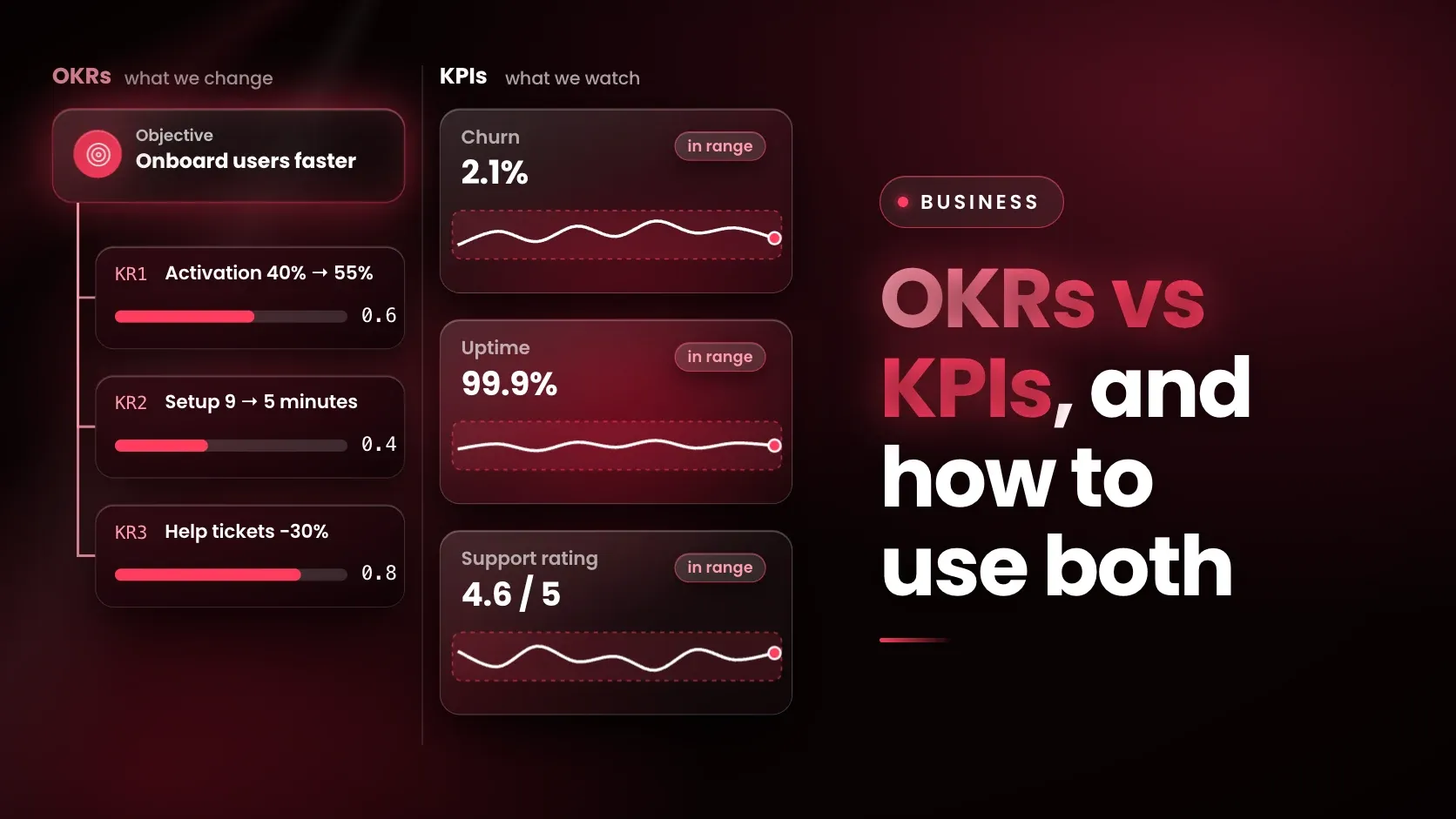
An OKR (Objectives and Key Results) is a goal-setting method that pairs an ambitious objective with measurable key results, usually for a quarter, to drive change. A KPI (key performance indicator) is a metric tracked over time to show whether something is healthy. WhatMatters.com, the site built around John Doerr's book Measure What Matters, puts the split briefly: OKRs measure change, KPIs measure health.
Last updated: 11 November 2026.
What is the difference between OKRs and KPIs?
OKRs and KPIs differ in purpose, structure and timing. The table sets them side by side, using the definitions published by WhatMatters.com, Google's re:Work guide, Asana and Atlassian.
| Dimension | OKR | KPI |
|---|---|---|
| Purpose | Drive change toward an ambitious goal | Track the health of ongoing performance |
| Structure | One objective with typically 3 to 5 key results | One quantitative metric that tracks one measurable value |
| Time frame | A set period, typically a quarter | Ongoing, measured over time |
| Scoring | Each key result graded, at Google on a 0.0 to 1.0 scale, then averaged | Reported as a current value, as a leading or lagging indicator |
| Example | Raise day-7 retention from 22% to 30% by quarter end | Day-7 retention |
Atlassian's guide draws the same line: KPIs track steady-state performance, while OKRs drive change within a set timeframe. Asana adds that the two overlap, because a KPI becomes part of a key result once it is given a target and a deadline.
What is an OKR, and where did it come from?
An OKR has two parts. According to WhatMatters.com, an objective is what is to be achieved, and key results benchmark and monitor how the team gets there, with the check typically made at the end of a quarter. OKRs are typically written with an objective at the top and 3 to 5 key results below it.
WhatMatters.com says Andy Grove created the method at Intel and taught it to John Doerr, and that OKRs differ from the earlier management by objectives in being quarterly and kept apart from compensation. The year Doerr brought OKRs to Google is given differently: WhatMatters.com says 1999, while Google's re:Work guide dates the introduction to early 2000.
Google's re:Work guide (originally published in 2016) describes key results as measurable and easy to grade with a number on a scale of 0 to 1.0. Its sweet spot for an overall grade is 60% to 70%, and a consistently perfect score suggests the goals are not ambitious enough. WhatMatters.com separates committed OKRs, which are expected to pass, from aspirational ones, which are stretch goals.
What is a KPI, and what kinds are there?
Asana defines a key performance indicator as a quantitative metric of how a team or organisation is progressing toward important business objectives, designed to measure performance over time. Asana also separates leading KPIs, which help predict success, from lagging KPIs, which measure results after the fact.
A KPI tracks ongoing performance, so it is usually a standing measure and not tied to one quarter. An on-time dispatch rate, a customer retention rate and a monthly active user count are all KPIs of this kind. What makes a number a KPI is its role as a recurring health check, not its size.
How do OKRs and KPIs look in practice? Three hypothetical examples
Each example below is invented, with the arithmetic checked in Python. The scoring rule used throughout is progress = (actual minus start) divided by (target minus start), capped between 0 and 1. It is a simple convention that matches re:Work's example, where a key result of launching six features with three launched grades 0.5. It is not a Google formula.
A product team
Take a hypothetical product team at a budgeting app in Bengaluru. It tracks day-7 retention, onboarding time and bank-link rate as standing KPIs, and sets one objective for the quarter: make the first week easier. The retention and activation metrics behind this are explained in the north star metric and AARRR post.
| Key result | Start | Target | Actual | Score |
|---|---|---|---|---|
| Raise day-7 retention, % | 22 | 30 | 27 | 0.625 |
| Cut median onboarding time, minutes | 6 | 4 | 4.5 | 0.750 |
| Raise bank-link rate within 24 hours, % | 35 | 50 | 44 | 0.600 |
def progress(start, target, actual):
    p = (actual - start) / (target - start)   # works for "raise" and "cut" targets
    return max(0.0, min(1.0, p))

krs = [("Day-7 retention, %", 22, 30, 27),
       ("Onboarding time, minutes", 6, 4, 4.5),
       ("Bank linked in 24 hours, %", 35, 50, 44)]
scores = [progress(s, t, a) for _, s, t, a in krs]
for (name, *_), sc in zip(krs, scores):
    print(f"{name}: {sc:.3f}")
print(f"objective score: {sum(scores) / len(scores):.3f}")
Day-7 retention, %: 0.625
Onboarding time, minutes: 0.750
Bank linked in 24 hours, %: 0.600
objective score: 0.658The objective scores 0.658, inside the 0.6 to 0.7 band that re:Work calls the sweet spot for stretch goals.
A marketing team
Take a hypothetical snack brand in Hyderabad. Its KPIs are website sessions, conversion rate and customer acquisition cost (CAC), the sales and marketing spend divided by new customers. The CAC, LTV, ROAS and CTR post defines each formula.
| Key result | Start | Target | Actual | Score |
|---|---|---|---|---|
| New customers from search and email, per month | 300 | 450 | 390 | 0.60 |
| Blended CAC, Rs | 1800 | 1500 | 1620 | 0.60 |
| Repeat purchase within 90 days, % | 18 | 24 | 21 | 0.50 |
The CAC start value comes from Rs 3,60,000 of spend across 200 new customers, which is Rs 1800 each. Reaching Rs 1500 needs either spend cut to Rs 3,00,000 for the same 200 customers or 240 customers for the same spend. The objective scores 0.57, just under the band, and re:Work advises treating a low grade as data for refining the next OKRs.
An operations team
Take a hypothetical fulfilment centre in Pune that ships 12,000 orders a month. On-time dispatch is its standing KPI. The quarter's objective is to ship every order on the promised day, written as a committed OKR, one expected to pass.
| Key result | Start | Target | Actual | Score |
|---|---|---|---|---|
| Raise on-time dispatch, % | 88 | 95 | 94.5 | 0.93 |
| Cut mispicked orders, % | 1.8 | 0.8 | 0.9 | 0.90 |
| Cut order-to-dispatch time, hours | 26 | 18 | 19 | 0.88 |
At 12,000 orders, moving on-time dispatch from 88% to 95% means late orders fall from 1440 to 600, which is 840 fewer. Cutting mispicks from 1.8% to 0.8% takes them from 216 to 96, which is 120 fewer. The objective scores 0.90, the kind of result a committed OKR is expected to reach.
How do OKRs and KPIs work together?
KPIs show where performance is weak, and OKRs choose what to change this quarter. In each example the KPI existed before the quarter began. The OKR then took that KPI, added a starting value, a target and a deadline, and so turned a health check into a goal, which is how Asana describes a KPI becoming a key result.
The reverse also holds. A key result can be something no dashboard tracks, such as launching a campaign, and Asana notes that KPIs often overlap with OKRs but that OKRs do not have to be quantifiable measures. So a KPI can be a key result, and a key result need not be a KPI. Metrics a team should keep healthy while it chases a goal stay on the KPI dashboard, and queries that produce those numbers are covered in the SQL interview questions post.
A new business can use the same split. The key metrics box of the Lean Canvas, which the business plan and lean canvas post explains, lists the few KPIs the business will watch.
How many OKRs should a team have?
A team should have three to five objectives, with about three key results for each, according to Google's re:Work guide, which warns that more can overextend a team and diffuse effort. WhatMatters.com gives 3 to 5 key results per objective. At the re:Work figures a team carries roughly 9 to 15 key results.
The shared principle is focus. WhatMatters.com lists focus first among the benefits of OKRs, describing it as rallying a team behind a small set of carefully chosen priorities.
What mistakes do teams make with OKRs and KPIs?
Starting too many objectives is one trap, and re:Work's remedy is to pick just three to five. A related error is writing key results as activities. The re:Work guide says words such as consult, help, analyze and participate describe activities, and asks for the outcome those activities should produce.
The re:Work guide also names business-as-usual OKRs, written from what the team can already achieve, and sandbagging, where a team meets every OKR without needing its full capacity. Both come from setting targets that are safe, not stretching.
Treating a KPI as a target is a different failure. Marilyn Strathern wrote in a 1997 paper that when a measure becomes a target, it ceases to be a good measure. A hypothetical support team told to maximise tickets closed per hour can raise the number by closing tickets without solving them. Pair a KPI target with a quality check, or use it as a key result only with a clear outcome behind it.
Tying OKRs to pay without care is the last common problem. WhatMatters.com describes the original design as divorced from compensation, and re:Work says OKRs are not synonymous with performance evaluation. Because stretch goals are expected to land at 0.6 to 0.7, a bonus tied to the grade would invite low targets, which defeats the stretch.
Finally, a key result without a starting value cannot be scored. Asana's guide asks for a starting value, a target and a deadline on every key result.
Where does this fit in an executive MBA?
The Executive MBA Technology is a postgraduate management degree from IIT Jodhpur for working professionals, taught in live online sessions by IIT Jodhpur faculty with on-campus immersions, covering core management, AI in business, and specialisation pathways in Analytics and AI or Digital Product Management. Its first-year courses include Business Statistics, Operations Management and Strategic Management.
Frequently asked questions
What is the difference between OKRs and KPIs?
OKRs are a goal-setting method that pairs an ambitious objective with measurable key results for a set period, usually a quarter, to drive change. KPIs are metrics tracked over time to show the health of ongoing performance. WhatMatters.com summarises it as OKRs measuring change and KPIs measuring health.
How many OKRs should a team have?
Google's re:Work guide suggests three to five objectives with about three key results each, because more can overextend a team. WhatMatters.com writes OKRs with an objective and 3 to 5 key results beneath it. Both point to a small, focused set rather than a long list.
Can a KPI be an OKR key result?
Yes. Asana says a KPI becomes part of a key result when it is given a target and a deadline. Attendance rate is a KPI, and raising it from 40% to 60% by 31 December is a key result. A key result can also be something no existing KPI tracks.
What is a good OKR score?
Google's re:Work guide grades each key result from 0.0 to 1.0 and calls 60% to 70% the sweet spot for stretch goals, since consistently perfect scores suggest goals that are not ambitious enough. WhatMatters.com adds that committed OKRs are expected to pass, while aspirational OKRs are stretch goals.
Should OKRs be tied to pay or performance reviews?
Published OKR guidance leans against a direct link between OKRs and pay. WhatMatters.com describes the original OKR design as divorced from compensation, and Google's re:Work guide says OKRs are not synonymous with employee evaluations. They can summarise what a person worked on and what impact it had, but they are not a full evaluation.
Who created OKRs?
Andy Grove created OKRs at Intel and taught them to John Doerr, according to WhatMatters.com. Doerr then introduced them to Google, where re:Work calls them a cornerstone method for setting goals. The year differs by source: WhatMatters.com gives 1999 and Google's re:Work guide says early 2000.
Next step
Choose one team, write one objective with three key results that each have a starting value, a target and a deadline, and list the KPIs that must stay healthy while the quarter runs. The Executive MBA Technology page lists the management, statistics and analytics courses for working professionals.