
IIM Mumbai MBA-PGPM for working professionals: Fees, Eligibility, Admission & is it worth it? (2026)

Quick answer: The MBA-PGPM at IIM Mumbai is a 2-year, weekend MBA in General Management for working professionals, delivered in person across six learning centres, IIM Mumbai's campus plus outreach centres in Pune, Chennai, Bengaluru, Hyderabad and Delhi, all with the same curriculum, faculty and degree. You need a graduate degree with 60% marks and at least 2 years of work experience. Admission runs through the IMAT or a valid CAT/GRE/GMAT score, followed by an interview. Total fees range from about ₹14.86 lakh to ₹19 lakh. Unlike IIM Trichy's and IIM Bangalore's flagship PGP/PGPM programmes, which are full-time and residential, IIM Mumbai's MBA-PGPM is built specifically so you don't have to leave your job.
Somewhere around year three or four of your career, a quiet realisation shows up.
You're good at your job. Your manager says so. Your appraisals say so. But the conversations you want to be part of, about strategy, budgets, pricing, and where the business goes next, keep happening one level above you. And the people in those rooms often have three letters after their names.
The usual answer is "do an MBA." The usual objection is "I can't quit my job for two years, and I can't move to another city for a residential campus programme."
That second objection is exactly the gap the IIM Mumbai MBA-PGPM was built to close. This guide covers what it is, what you'll study, where you can study it, what it costs, how it stacks up against India's more traditional full-time IIM MBAs, and whether it's worth it.
What is the IIM Mumbai MBA-PGPM?
PGPM stands for Post-Graduate Programme in Management. At IIM Mumbai, it's a general management programme designed around a working schedule, not a career pause.
The word that matters here is offline. This isn't a recorded-lecture programme. You sit in a classroom with faculty and a cross-industry cohort of working professionals, which is where much of the value of an MBA lives, without giving up your salary or your city.
The credibility behind the name: why IIM Mumbai specifically
It's fair to ask what you're actually paying ₹15-19 lakh for. Three things stand behind the MBA-PGPM.
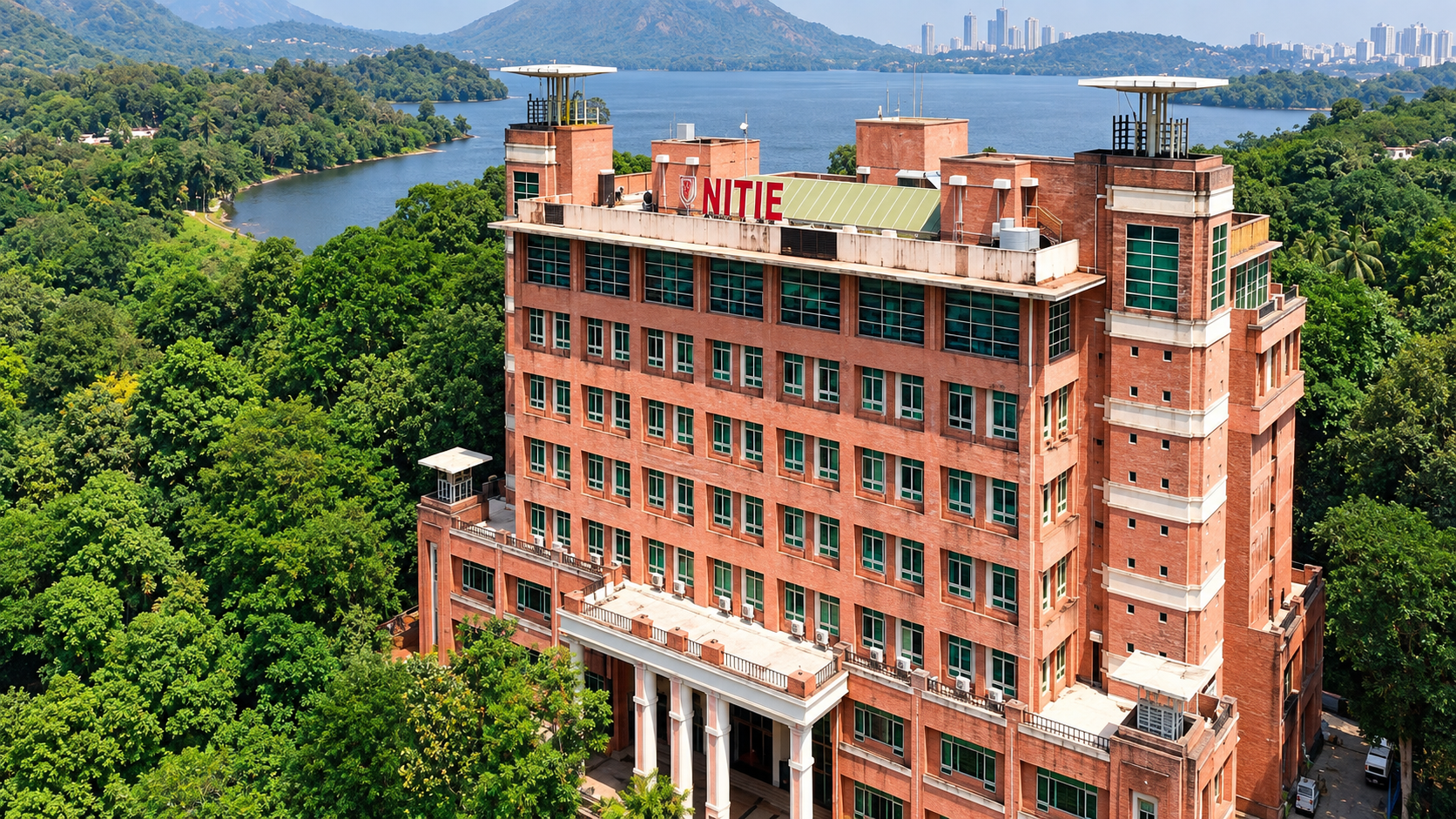
A 60-year institutional legacy. IIM Mumbai was established as NITIE and carries over six decades of history in management education, based out of India's financial capital. That location matters practically too: Mumbai is where a large share of India's finance, consulting and corporate leadership functions are headquartered, which shapes the guest faculty, the industry interactions and the kind of peer network you build.
A recognised national ranking. IIM Mumbai is ranked among the top institutes in the NIRF management rankings, a government-backed, third-party ranking framework, not a marketing claim. That's a meaningful data point when you're comparing options, because it means the institute's academic quality has been independently assessed, not just self-reported.
A specific academic identity. Unlike generalist B-schools that teach the same core everywhere, IIM Mumbai has a recognised strength in operations, supply chain and industrial management, built from its NITIE lineage. That shows up directly in the MBA-PGPM curriculum: Data Science for Managerial Decisions and ESG Analytics sit alongside classic MBA subjects like Strategic Management and Corporate Finance, which is a more contemporary, analytically grounded mix than a purely case-study-based general MBA.
Put together: this isn't a new, unproven executive programme borrowing an IIM's name. It's a full IIM building a format around a real gap, working professionals who want rigour without giving up their career.
Six cities, one degree: How the multi-centre model actually works
This is one of the more underappreciated details of the MBA-PGPM, and it deserves more than a passing mention.
Most working-professional MBAs that claim to be "flexible" solve the problem with online or recorded content. IIM Mumbai has taken a different route: it has extended its in-person, weekend classroom model to five outreach centres, in addition to the IIM Mumbai campus itself.
The centres:
- IIM Mumbai Campus - the main campus, for those based in or near Mumbai
- Pune Centre
- Chennai Centre
- Bengaluru Centre
- Hyderabad Centre
- Delhi Centre
Here's why that structure matters more than it might look at first glance:
It's the same programme everywhere, not a diluted version. IIM Mumbai is explicit that the curriculum, faculty and degree are identical whether you attend on the Mumbai campus or at an outreach centre. You're not choosing between "IIM Mumbai" and "IIM Mumbai-lite." A finance professional in Chennai and a product manager in Delhi go through the same 16 core courses, the same electives and the same capstone structure.
It solves the real bottleneck for working professionals: relocation. A residential, full-time MBA solves for depth by asking you to move to campus. A recorded online MBA solves for flexibility by removing the classroom entirely. IIM Mumbai's outreach model solves for both at once, you get in-person, faculty-led weekend classes without needing to relocate to Mumbai, provided you're based in or can reach one of these five other cities.
It reflects where India's mid-career professional base actually sits. Pune, Chennai, Bengaluru, Hyderabad and Delhi aren't arbitrary choices, they're five of India's largest employment hubs for IT, manufacturing, financial services and consulting. Running the same weekend programme in each city means a working professional's postcode doesn't determine which quality of MBA they get access to.
If you're evaluating this programme, your first practical question shouldn't be "should I do this MBA," it should be "which of these six centres is realistically commutable for me on a Saturday and Sunday, for two years." That answer will shape your experience more than almost any other factor.
What will you study?
The curriculum is split into 6 modules across 2 years, with 16 core courses, 8 electives, a Year 1 group project and a two-stage Year 2 capstone.
The core builds your general management foundation:
- Marketing, finance, operations and strategy: Marketing Management, Financial Reporting & Accounting, Corporate Finance, Operations Management, Strategic Management, Business-to-Business Marketing
- Economics and decision sciences: Microeconomics for Managers, Macroeconomics, Optimization & Decision Techniques
- People and communication: Managerial Communication, Organisation Behaviour & HRM
- Data and responsibility: Data Science for Managerial Decisions, ESG Analytics, Digital Marketing
- Execution skills: Supply Chain Management, Managing Negotiations
The electives let you specialise. From Module 4 onwards, you choose from Finance, Marketing, Operations, Analytics and HR electives, so Year 2 bends toward the career you want next, not a generic one.
The capstone makes it real. In Stage 1 and Stage 2 you take a business problem through research and strategic execution. For a working professional, this is the piece that can turn into a genuine workplace project.
Who is this MBA for (and who should skip it)?
It's a strong fit if you:
- Have 2+ years of experience and want to move from individual contributor to manager
- Come from engineering, tech, finance, operations or another specialist background and want business breadth
- Live in, or can commute to, one of the six centres and want an IIM MBA without relocating
- Are aiming at general management, strategy, product, operations or analytics leadership roles
- Value a classroom cohort and a professional network, not just a credential
It may not be right if you:
- Have less than 2 years of work experience (you won't meet eligibility)
- Can't commit to weekend classes, since attendance below 75% affects your grades
- Are set on a residential, campus-immersion experience with a full break from work, in which case a full-time programme, discussed below, is the more natural fit
Admission process: IMAT, CAT, GRE or GMAT
The process has three steps.
Step 1: Apply. Register with the ₹3,000 non-refundable application fee and your documents. Pick your preferred learning centre.
Step 2: Selection. Either book the home-proctored IMAT (IIM Mumbai's own admission test) or submit a valid CAT, GRE or GMAT score. Shortlisted candidates then attend a personal interview.
Step 3: Admission. Receive your offer letter, secure your seat with the seat-securing payment and complete the fee formalities.
Key dates for the January 2027 batch:
No CAT score? You're not shut out. The IMAT route means you don't need a CAT, GRE or GMAT score to be considered.
IIM Mumbai MBA-PGPM fees
Fees are inclusive of taxes. The ₹3,000 application fee is separate. Outreach centres also carry a ₹50,000 refundable caution deposit. A ₹1,00,000 seat-securing fee is part of the total, not an add-on. Withdrawing before sessions begin refunds what you paid minus ₹1,000, but there's no refund after sessions start (only caution money is returned), so decide before you pay the balance.
Notice that outreach-centre fees run lower than the Mumbai campus fee for the same degree, faculty and curriculum, which is a real, practical advantage if you're based outside Mumbai and were assuming a "branch" programme would compromise on either quality or cost. Here it doesn't, on quality, and actually helps you, on cost.
Is it worth it? A practical way to think about ROI
At ₹15-19 lakh, this is a serious financial decision. Instead of asking "is it worth it?", ask three sharper questions:
- Is there a role two levels up that needs skills I don't have yet? If your next promotion depends on strategy, finance or cross-functional judgment, the curriculum targets exactly that.
- Will I use it immediately? Weekend learning compounds when you can test it at work by Monday.
- Do I value the network? A 300-seat cohort of experienced professionals from different industries, and across six cities, can be as valuable as the coursework, and it comes with IIM Mumbai alumni status.
Be realistic too. An MBA opens doors; it doesn't walk you through them. What you get out depends on how you use the cohort, the electives and the capstone.
Frequently asked questions
Is the IIM Mumbai MBA-PGPM only for working professionals? Yes. It requires a minimum of 2 years of relevant post-graduation work experience, and the weekend format is designed around a job.
What is the eligibility for the IIM Mumbai MBA-PGPM? A first-class graduate degree (minimum 60% or UGC equivalent, with relaxation for SC/ST candidates) and at least 2 years of work experience.
Do I need a CAT score? No. You can take the home-proctored IMAT or submit a valid CAT, GRE or GMAT score.
How long is the programme, and when are classes? Two years, with classes every Saturday and Sunday.
Where are classes held? At the IIM Mumbai campus, or at outreach centres in Pune, Chennai, Bengaluru, Hyderabad and Delhi, all with the same curriculum, faculty and degree.
Is the outreach centre degree different from the Mumbai campus degree? No. IIM Mumbai delivers the same programme, faculty and credential across all six centres.
Is IIM Mumbai a credible institute? Yes. IIM Mumbai, formerly NITIE, has over six decades of history and is ranked among the top institutes in the NIRF management rankings, with recognised strength in operations, supply chain and analytics.
How many seats are there? 300, across all centres combined.
Is attendance compulsory? Yes, 75% minimum. Below that, grades are downgraded, and below 50% you're debarred from the exam.
How are students evaluated? 40% continuous evaluation (assignments, quizzes, cases, participation, projects), 20% mid-term and 40% module-end exam.
Do I get IIM Mumbai alumni status? Yes, MBA-PGPM graduates receive IIM Mumbai alumni status.
The bottom line
Careers don't stall for lack of talent. They stall when the next level asks for a skill set you were never in a position to build, and when the only path to build it seemed to require quitting your job and moving to another city.
The IIM Mumbai MBA-PGPM removes both of those obstacles. It's a structured, IIM-backed programme, credible on its own terms, with a genuine institutional legacy, and delivered identically across six centres, so geography stops being the reason you didn't apply.
If you have the experience, the weekends and a clear next role in mind, it deserves a serious look.