
How to Run a Product Sprint Review That Gets Useful Stakeholder Feedback

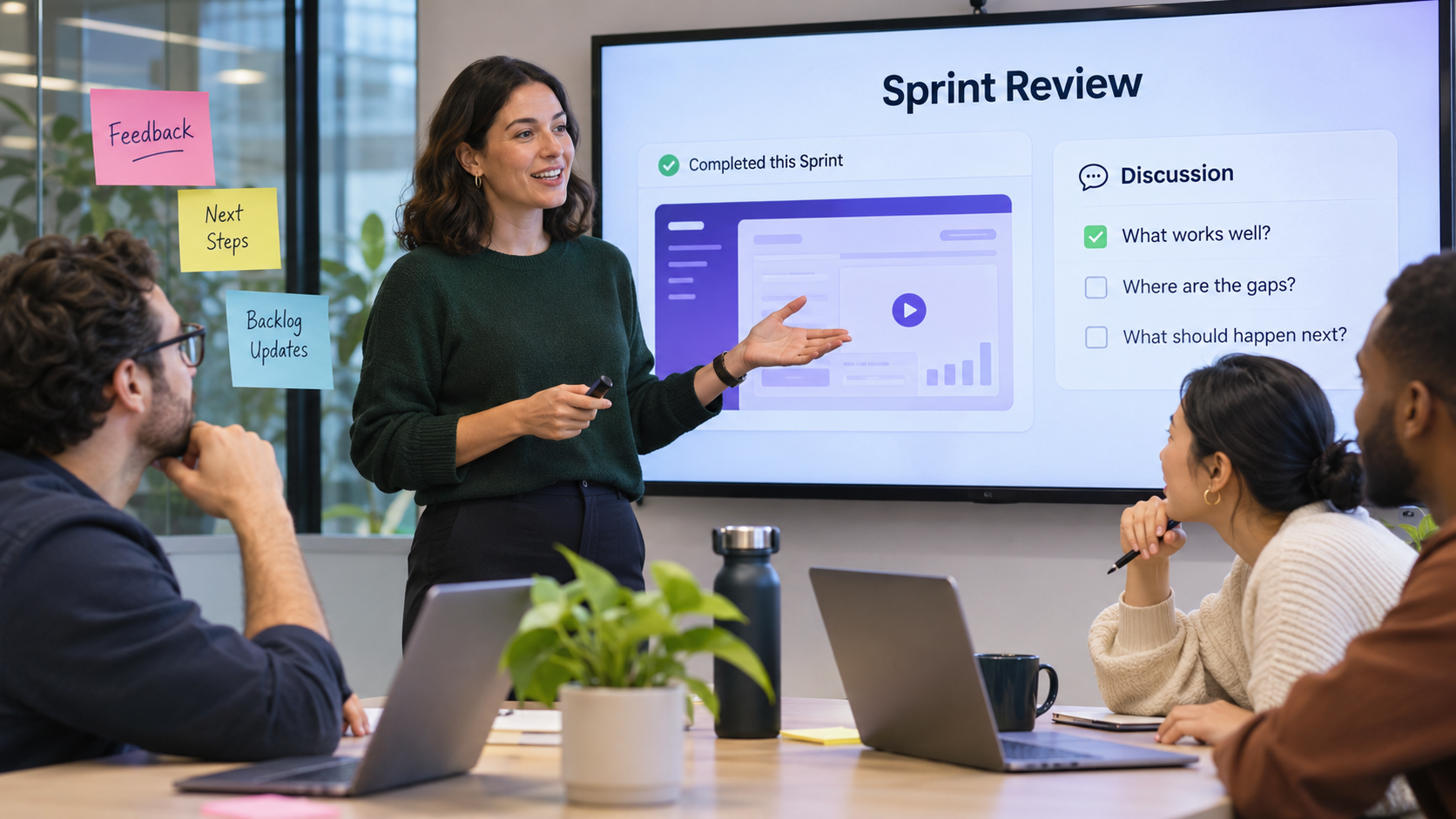
A Sprint Review can look successful right up until the team asks what it actually learned. The feature was demonstrated, stakeholders commented, and everyone left on time, yet none of the discussion affected what the team plans to do next.
At its best, the review is a working session around completed product work. Stakeholders inspect what changed, bring information the team may not have, and challenge assumptions while there is still room to respond.
That requires more preparation than polishing a demo. The team has to know what it wants to learn and create a discussion where the answers are useful enough to influence a product decision.
What do you need to learn from this review?
Starting with a list of everything completed during the Sprint usually produces a status meeting. A stronger starting point is the uncertainty the team wants stakeholder input on.
Perhaps a new workflow functions correctly, but the team isn't sure how it will fit an enterprise customer's approval process. Maybe an internal feature removed manual work while creating a new problem for operations. Those uncertainties give the review a reason to exist beyond showing what was built.
Write down the question before deciding what belongs in the demo. Once the learning goal is clear, it becomes easier to leave irrelevant work out and spend more time on the areas where stakeholders can contribute something the team doesn't already know.
Context changes the quality of feedback
A stakeholder seeing a feature for the first time may judge the screen in front of them without understanding the problem that shaped it.
A short explanation of the user situation and any important constraint gives the group a better frame. If one part of a longer journey changed, include enough of the surrounding flow for the new behaviour to make sense.
Keep that setup brief. Long explanations encourage people to review the presentation instead of the product. The useful context is whatever prevents avoidable misunderstandings and gets the group to the real question faster.
It also helps stakeholders understand which decisions are still open. There is little value in spending ten minutes debating an area fixed by a regulatory requirement or an earlier product decision that isn't being reconsidered.
Inspection beyond the presenter's happy path
A screen-shared demo gives one person control over the route, timing, and examples. The presenter naturally follows the path they know works, so awkward moments outside that route can remain invisible.
Customer-facing experiences deserve a tougher review. Consider a team assessing an AI-driven product demo before launch. A scripted walkthrough covers only the questions the presenter anticipated, while testing a buyer demo agent with realistic questions exposes more of what a prospect might encounter independently.
The review can then focus on whether the right product information appears at the right moment, where answers become weak, and when the experience needs a human handoff. Product, sales, and marketing are reacting to an actual interaction rather than discussing a description of one.
The same principle applies elsewhere. Whenever practical, stakeholders need enough exposure to the feature for unexpected friction to surface.
Better questions expose uncertainty
"Any thoughts?" places most of the work on the stakeholder. They have to decide what matters, what kind of response the team wants, and whether their comment is relevant to the current decision.
Specific prompts create a clearer boundary for the conversation.
A product manager reviewing an account-management flow could ask where the process would fail for a larger customer's approval structure. If two follow-up improvements are under consideration, the discussion might focus on which problem creates the greater operational cost.
This gives the facilitator a reasonable way to park unrelated ideas too. A useful suggestion can be captured for later without turning the Sprint Review into an unrestricted feature-request session.
Independent reactions before group debate
Open discussion has a social weakness. Once a senior or particularly confident stakeholder gives an opinion, later responses can become reactions to that view.
For decisions where independent judgement matters, collect an initial response first. A poll can reveal whether the room actually agrees, while a ranking exercise can expose priorities the team did not expect.
Much of the material for that interaction may already exist in sprint notes, a presentation, or another source document. A session content builder can turn that material into draft activities for the facilitator to review before the meeting, reducing the amount of setup required for a poll or knowledge check.
The activity only earns its place if the response affects the discussion. Adding interaction for its own sake creates more ceremony without producing better information.
A comment still needs interpretation
Stakeholder feedback is an input to a product decision. Treating every request as immediate backlog work gives the loudest or most recent opinion too much influence.
Suppose a sales leader asks for an additional approval step because an enterprise prospect expects one. That could indicate a requirement shared by an important segment, or it could be peculiar to a single deal.
The next questions matter more than the request itself. What triggered the concern? How frequently does the situation occur? Has the team seen the same issue elsewhere?
With that context, the Product Owner has something useful to weigh against existing evidence and priorities. Sometimes the review changes the backlog. In other cases, it identifies a question that needs research before the team commits to anything.
Where the decisions live afterward
A strong discussion can still disappear if its outcome remains buried in meeting notes.
By the end of the review, the team needs clarity on which points affected a decision and which require follow-up. Comments that changed the team's understanding but require no action can stay as context rather than becoming unnecessary tickets.
Actual decisions belong wherever the team normally manages product work. Someone returning a week later should be able to understand what changed without reconstructing the conversation from memory.
There is also value in referring back to previous review input. When stakeholders see that an earlier concern led to investigation or a change in direction, future participation becomes more thoughtful because the connection between feedback and product work is visible.
The next Sprint reveals the value of the review
The quality of a Sprint Review is easier to judge after the meeting than during it.
Look at what happened next. Perhaps the team investigated a constraint it had overlooked, changed a priority, or gained stronger evidence for an existing direction. Those downstream effects tell you more than whether the meeting itself felt smooth.
If several reviews pass without influencing a decision or opening a worthwhile line of investigation, polishing the demo probably isn't the answer. The questions may be too broad, the relevant stakeholders may be joining too late, or the work may already be too settled for their input to matter.
A review earns its place in the development cycle when the team leaves knowing something useful that it didn't know before.