
How to get your first 100 customers: An entrepreneur's playbook

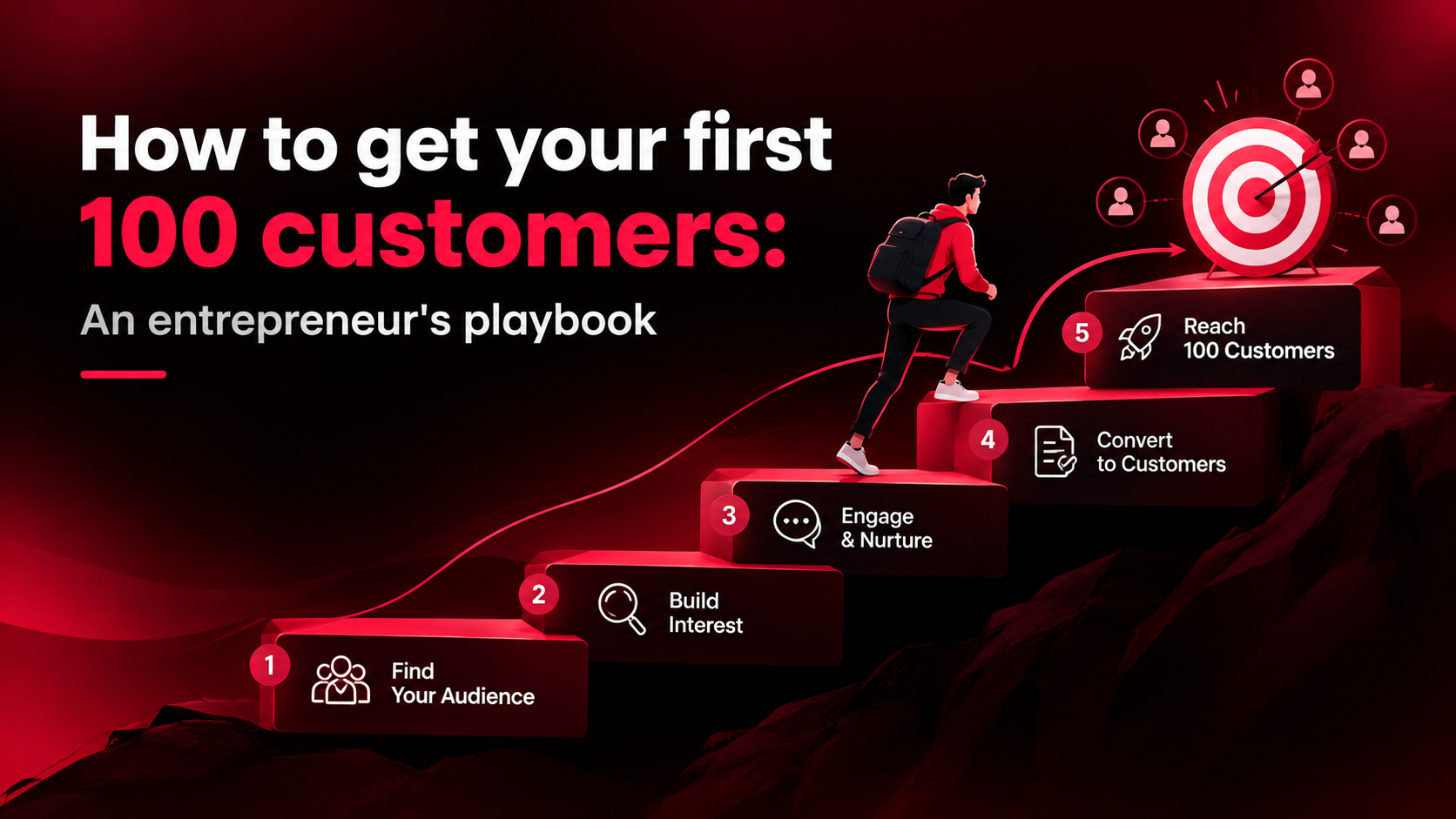
To get your first 100 customers, work in three stages. Win your first 10 through your network and direct outreach. Repeat whichever channel worked for customers 10 to 50. Then use referrals and simple systems to reach 100. Charge from day one, meet buyers where they already gather, and track why each person said yes.
Your first 100 customers are more than a revenue milestone. They tell you who your product is really for, what to fix, and which channel is worth scaling. This playbook covers each stage, plus a section on India that most guides skip.
How long does it take and what does "first 100" mean?
It takes longer than building. One founder-focused guide notes that building takes weeks while the first handful of paying customers takes months.
The first 100 is really three different problems:
Y Combinator's advice follows the same pattern: the first three customers usually come from personal connections, and customers four to ten need high-touch effort such as in-person visits or personalised research.
Step 1: Define who your first 100 are
Pick one narrow group. "Small businesses" isn't a customer. "Independent gym owners in Bengaluru who chase unpaid memberships" is. A narrow group tells you where to find them, what language to use and what to say.
Step 2: Start with people who already know you
Your network is your highest-converting channel. Most founders underuse it, and referrals from people you know can get 5 to 10 times the response of cold outreach.
One caution from founder-focused resources: treat your network as people to learn from first, not a list to sell to. If you burn trust you spent years building, you can't get it back.
A message you can copy:
Hi [Name], I'm building [one-line description] for [who]. I'm not selling yet. I'm trying to understand how you handle [problem] today. Could I ask you three questions on a 15-minute call this week? If it's relevant, I'd love to show you what I've built.
Step 3: Go where your customers already gather
Reddit, Quora, Slack groups, Discord servers, LinkedIn groups and WhatsApp communities all work. The rule is the same everywhere: help first, pitch second.
Razorpay's founders did this early on. They joined WhatsApp and Facebook startup groups and answered questions about payments rather than pitching. Another startup's team spent its first couple of years answering questions on Quora and Reddit.
Reddit users dislike self-promotion, so give real answers and let your profile do the rest.
Step 4: Use cold outreach, done personally
Cold outreach has a bad reputation because most of it is lazy. Typical first-reply rates are around 1 to 3%, rising to 5 to 15% when messages are personalised. Keep emails under 100 words and make it obvious you didn't use a template.
Pick one channel and run 100 actions before judging it. Jumping between channels every week teaches you nothing.
AI helps with list-building and first drafts. Add one line that proves you looked at their business.
Step 5: Charge from day one
It feels safer to offer a free trial. It usually backfires. As one founder resource puts it, "Free users tell you polite lies", while paying customers tell you the truth.
For B2B, a short paid pilot works well. Charge upfront and credit that fee toward the full contract, so the buyer commits without feeling they paid twice. One startup's first paying customer paid a small fraction of today's deal value. The founder's view: "even that first dollar is super important."
Step 6: Turn your first 10 into the next 90
Ask every early customer one question: "Who else has this problem?" One founder summed up their growth in a single line: "The first 100 were friends of the first 10."
Reward early customers with status, not discounts. Give your first 100 something later customers won't get, such as a founder note, early access or a shareable code.
What most guides miss
1. The funnel maths is brutal, so use it. As an illustration, if 10% of personalised messages get replies and a third of those become paying customers, you need about 300 messages for 10 customers. That's why warm introductions come first.
2. In India, WhatsApp is often the channel. Indian SMB selling stays high-touch, and founder-led conversations and in-person meetings move deals more than automated funnels. Put every early buyer on a WhatsApp list from day one. Platform sources report open rates of roughly 70 to 90%, though treat those as vendor-adjacent figures.
3. Plan for negotiation and late payments. In many Indian B2B deals, negotiation and delayed payment are part of the culture, so build them into your pricing and cash planning.
4. Chase customers others ignore. Razorpay went after small businesses that payment incumbents weren't serving. Asian Paints built a network of about 130 small shopkeepers and sold paint in small, affordable packs.
5. Keep a "why they said yes" log. This is our recommendation, not a finding from the research. For each customer, record where they came from, your first message, their objection and their reason for buying. By customer 20, patterns appear that no guide can give you.
6. Don't automate too early. Only after validating your value proposition and landing a small base should you move to automation tools like Apollo or Clay.
Common Mistakes
- Counting polite friends as validation. If your first five customers signed up to be nice, you haven't learned much yet.
- Running free pilots indefinitely. Usage you gave away proves nothing about willingness to pay.
- Looking where you hang out. Your customers may not be on Reddit or LinkedIn. One Indian founder selling to small jewellers found his buyers were nowhere near those platforms.
- Buying ads too soon. Paid acquisition rarely works until you know who buys and why.
Frequently Asked Questions
How long does it take to get your first 100 customers? There's no fixed timeline. The first 10 often take months, because each one is won by hand. Customers 10 to 100 usually move faster once you find a repeatable channel.
How do I get my first customers with no audience or money? Start with your network, then join communities where your buyers gather and help before you pitch. Direct, personalised outreach costs time, not money.
Should I charge my first customers? Yes, even a small amount. Payment is the strongest proof that you've solved a real problem. For B2B, a paid pilot credited toward the full contract works well.
What's the fastest way to get first customers? Personal introductions and direct conversations. Scalable channels like SEO and ads come later.
How do I get my first customers in India? Combine founder-led selling with WhatsApp. Plan for price negotiation and slower payments, and look for underserved segments that bigger players ignore.
Practise It with other founders
Reading about this is easier than doing it. The hard part is the discipline: talking to real people every week, asking for money, and reading the results honestly.
Masai's Founders Cohort is built around this loop. Over six online weeks, founders speak to 20 real users, choose a distribution channel and get their first users, then set a price, go live with checkout and make their first real ask for payment. The Bangalore pitch is gated by benchmarks. Consumer startups need 1,000 users and 50 paying customers, and B2B startups need 5 companies using the product and 1 paid pilot.
It begins with three days in Goa, runs mostly on weekends, and ends with a pitch in Bangalore. The next cohort starts on 20 November 2026. Funding isn't guaranteed, and Masai takes no equity.
Whichever route you take, start the same way: pick one narrow customer group, have ten real conversations this week, and ask for a payment.