
Full stack developer roadmap for 2027: what to learn and in what order
A full stack developer roadmap in nine stages, from HTML and JavaScript to APIs, databases, testing and deployment, with Stack Overflow 2026 survey data.

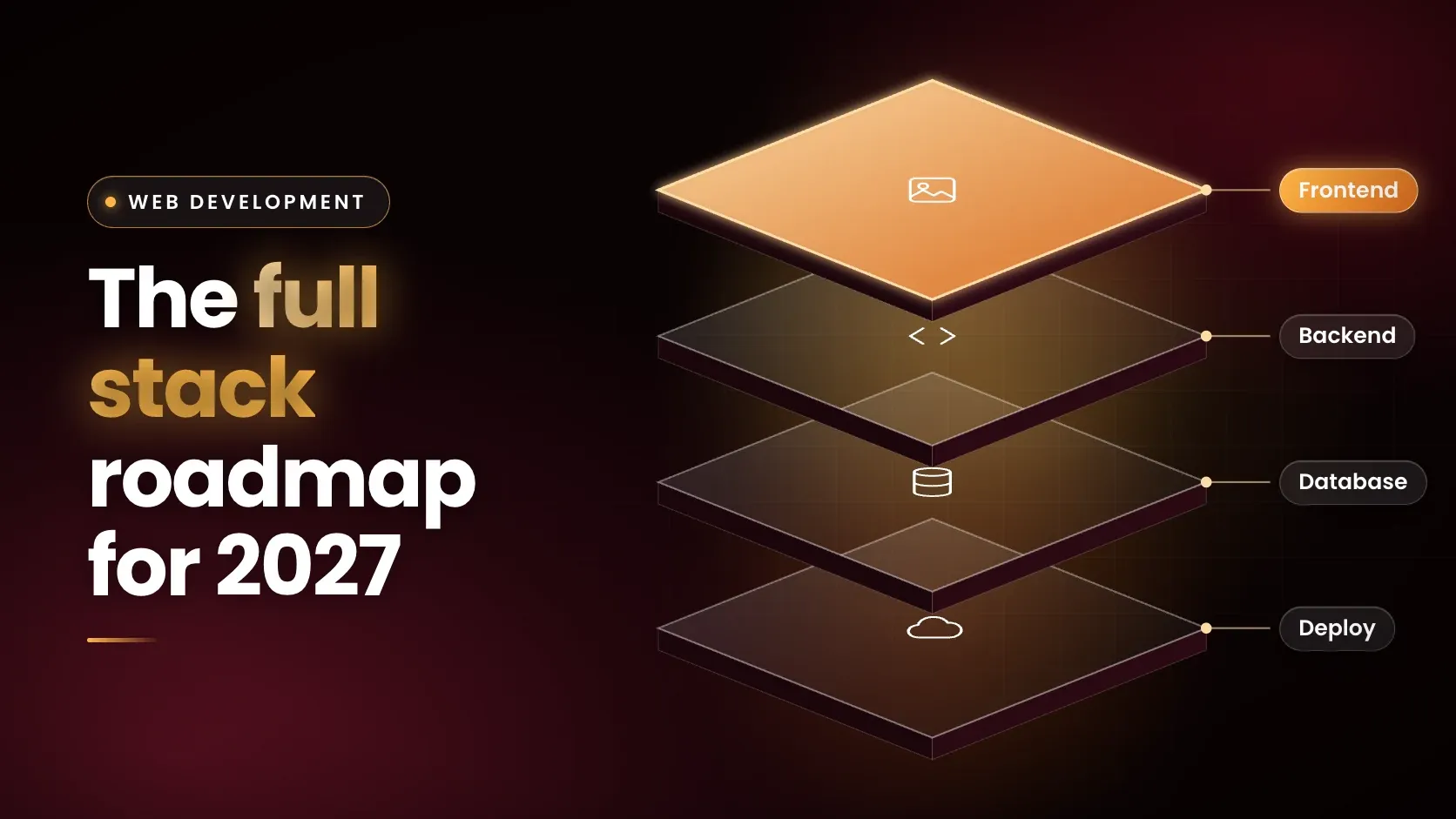
A full stack developer roadmap has nine stages: web basics, JavaScript, a frontend framework, a backend with APIs, a database, Git, testing, deployment and AI-assisted development. Each stage ends with something built and shown. The Stack Overflow Developer Survey 2026 ranked JavaScript first for the 12th year in a row, at 62.0%, which is one reason this roadmap starts with it and stays in it through the backend.
Which skills does a full stack developer need, and in what order?
A full stack developer builds the part of a web application that people see and the part that stores and serves the data. The order below moves from what a browser shows to what a server does, and each row names a project and a test of readiness. The projects and proofs are suggestions, not requirements from any vendor.
| Stage | What to learn | What to build | Proof you can move on |
|---|---|---|---|
| Web basics | HTML, CSS layout, accessibility | A personal page with a responsive layout | The page works on a phone and with a keyboard alone |
| JavaScript | The core language, asynchronous code, fetch | A quiz or to-do app in the browser | It loads data from a public API without a framework |
| Frontend framework | React, components, state, then TypeScript | A multi-page app with forms | State lives in one place and components stay small |
| Backend and APIs | Node.js, Express, HTTP, JSON, REST | An API with create, read, update and delete routes | Someone else can use it from its README alone |
| Database | SQL with PostgreSQL, or MongoDB | The API's data moved from memory into tables | Data survives a server restart |
| Git and GitHub | Commits, branches, pull requests | Every project in a repository with history | A pull request reviewed by another person |
| Testing and security | The Node.js test runner, the OWASP Top 10 | Tests for every API route | Tests run on each pull request |
| Deployment | Static hosting, a server host, CI/CD | A live full stack app | A fresh clone deploys by following the README |
| AI-assisted development | Prompting, reviewing and testing generated code | One feature built with an assistant | Every generated line can be explained |
Stages 1 and 2: how do web basics and JavaScript fit together?
MDN's Learn web development area is designed to take learners from "beginner" to "comfortable", not from "beginner" to "expert". Its core modules run in this order: HTML, CSS styling and layout, JavaScript, JavaScript frameworks and libraries, accessibility, design for developers and version control with Git and GitHub. Its extension modules add asynchronous JavaScript, client-side web APIs, server-side programming and testing.
JavaScript carries the roadmap. In the Stack Overflow Developer Survey 2026, SQL (58.4%), HTML/CSS (58.2%), Python (58.0%) and TypeScript (43.8%) followed JavaScript among the most used languages. TypeScript is JavaScript with syntax for types, and its site lists TypeScript 7.0 as available on 7 November 2026. It is best added after plain JavaScript feels comfortable.
Stage 3: which frontend framework should come first?
React is the usual first framework. Its site calls it the library for web and native user interfaces, and a React app is built from components, which are JavaScript functions that return markup. In the Stack Overflow Developer Survey 2026, React was used by 41.5% of respondents answering the web frameworks question, second only to Node.js at 46.4%.
React's own documentation recommends starting a new app or website with a framework. Next.js, a React framework for building full-stack web applications, was used by 20.6% of respondents in the same survey. Plain React with a small project, such as one of the beginner React projects, comes before a framework, so the framework's conventions have something to attach to.
Stages 4 and 5: which backend and database should a beginner learn first?
A beginner can stay in JavaScript for the backend. Node.js is an asynchronous event-driven JavaScript runtime designed to build scalable network applications, and Express describes itself as a fast, unopinionated, minimalist web framework for Node.js; Express 5.3.0 is the current version on its site. Node.js's release page lists v26, v24 and v22 with LTS status, and says production applications should use an Active or Maintenance LTS release, so a learner should install an LTS version.
The backend exists to receive HTTP requests and answer them, and MDN explains that a dynamic website generates some of its response only when needed, usually from a database. A guide to REST APIs, methods and status codes covers what those requests and responses contain.
For the database, the survey data points to PostgreSQL. In the Stack Overflow Developer Survey 2026 it was the most used database at 57.9%, ahead of SQLite (42.1%), MySQL (35.1%) and MongoDB (19.0%). MongoDB describes MERN as MongoDB, Express, React and Node. Swapping MongoDB for PostgreSQL keeps JavaScript end to end and teaches SQL, which is the second most used language in the survey. Python is another backend route: FastAPI was used by 18.5% of respondents in the web frameworks question.
Stages 6 and 7: why do Git and testing come before deployment?
Git stores a project as a series of snapshots of a miniature filesystem, according to the Pro Git book, which is why a commit can be restored later. Basic commands are covered in a guide to essential Git commands. GitHub Actions is a continuous integration and continuous delivery (CI/CD) platform that can build and test every pull request, so tests written at this stage pay off at the next one.
Node.js ships a test runner: the node:test module, run with node --test, has been stable since v20.0.0. This small server and its test were run on Node.js 24.
// server.mjs
import { createServer } from 'node:http';

const todos = [{ id: 1, title: 'Read MDN on HTTP', done: false }];

export const server = createServer((req, res) => {
  const send = (status, body) => {
    res.writeHead(status, { 'Content-Type': 'application/json' });
    res.end(JSON.stringify(body));
  };
  if (req.method === 'GET' && req.url === '/todos') return send(200, todos);
  send(404, { error: 'not found' });
});

if (process.argv[1] === new URL(import.meta.url).pathname) {
  server.listen(3000, () => console.log('listening on 3000'));
}
// server.test.mjs
import { test, after } from 'node:test';
import assert from 'node:assert/strict';
import { server } from './server.mjs';
server.listen(0);
const base = () => `http://127.0.0.1:${server.address().port}`;
after(() => server.close());
test('GET /todos returns the list', async () => {
const res = await fetch(`${base()}/todos`);
assert.equal(res.status, 200);
assert.equal((await res.json()).length, 1);
});
test('unknown path returns 404', async () => {
const res = await fetch(`${base()}/nope`);
assert.equal(res.status, 404);
});Running node --test prints one line per test and a summary. The first lines of that output were:
✔ GET /todos returns the list (18.991083ms)
✔ unknown path returns 404 (2.117042ms)
ℹ tests 2
ℹ suites 0
ℹ pass 2
ℹ fail 0
Security belongs in the same stage. The OWASP Top 10 is a standard awareness document for developers and web application security, and the most current version on 7 November 2026 is the OWASP Top 10 2025.
Stages 8 and 9: how do deployment and AI-assisted development fit in?
Deployment starts with a static site. GitHub Pages is a static site hosting service that publishes HTML, CSS and JavaScript from a repository, optionally after a build, so a finished frontend can go live without a server. The API needs a host that runs Node.js or a container. Docker and Docker Compose were the most used cloud development and infrastructure tools in the Stack Overflow Developer Survey 2026, at 59.1% of 10,889 respondents, so containers are worth learning once a first deployment works.
AI-assisted development is the last stage because it rewards people who can already read code. In the same survey's AI chapter, respondents who use AI tools most often used them to generate code in a familiar area (69.3%) and to debug or refactor (63.8%), and 58.1% used them to write or improve tests, while 48% said they trust AI when they can easily validate the answers. The pattern matches the stage: use the assistant where the output can be checked.
What are the limits of any roadmap?
A roadmap is an order of study, not a promise about a job. These limits apply to this one.
- The survey figures describe respondents to the Stack Overflow Developer Survey 2026, a global sample, not hiring in India or any single city.
- Versions change. Node.js 27 is an alpha release, TypeScript is at 7.0 and Express at 5.3.0 as of 7 November 2026, so a tutorial older than a year can describe commands that have moved.
- There is no fixed duration for becoming a full stack developer. Time depends on weekly hours and prior experience, so stages completed with working projects are a better measure than months.
- Employers differ on what they test. Data structures and algorithms are not a stage here, and whether a given employer asks for them is found in its job descriptions and interview format, not in a roadmap.
- Most projects on this roadmap are single deployable apps. Martin Fowler wrote in 2015 that the majority of software systems should be built as a single monolithic application, and the trade-offs are covered in microservices vs monolith.
Where does the programme fit after these stages?
The Forward Deployed Engineer (FDE) Cohort is a Leap by Masai programme for engineers with hands-on technical experience, run as an in-person start in Goa, an online build phase and an in-person hackathon in Bangalore for qualifying participants, covering production Python, APIs, cloud deployment, LLMs, retrieval, agents, security and client engagement. Its page asks for comfort writing code, so it follows the stages above rather than replacing them.
Frequently asked questions
How long does it take to become a full stack developer?
There is no fixed duration. MDN describes its curriculum as taking a learner from beginner to comfortable, not to expert. The time depends on weekly study hours and prior experience, so progress is better measured by stages finished with a working, deployed project each time.
Which stack should a beginner learn first?
A beginner can learn JavaScript end to end: HTML and CSS, JavaScript, React, Node.js with Express, and a database. In the Stack Overflow Developer Survey 2026, Node.js (46.4%) and React (41.5%) were the two most used web frameworks and PostgreSQL (57.9%) was the most used database.
Do full stack developers need to know DSA?
The nine stages above do not depend on data structures and algorithms. Whether a given employer tests them differs by company and role. A candidate should read the job descriptions and interview formats of target employers and add DSA practice only where they ask for it.
What does MERN stand for?
MERN stands for MongoDB, Express, React and Node, according to MongoDB's own description, and it is one of several variations of the MEAN stack. In the Stack Overflow Developer Survey 2026, MongoDB was used by 19.0% of respondents against 57.9% for PostgreSQL, so many developers pair Node.js and React with a relational database instead.
Should a beginner use AI coding tools while learning?
Yes, with checks. In the Stack Overflow Developer Survey 2026, 48% of respondents said they trust AI when they can easily validate the answers. A beginner can ask an assistant to explain or draft code, then run it, test it and read every line before it goes into a project.
Next step
Finishing the nine stages gives a deployed project, a test suite and a repository with history. Engineers who want to carry that into client-facing production work can read about the Forward Deployed Engineer (FDE) Cohort.