
Business analyst career path in India, from analyst to manager
Business analyst career path in India: AmbitionBox's 2026 data shows average pay rising from Rs 7.3 lakh at 1-3 years to Rs 14.4 lakh at 9-12 years.

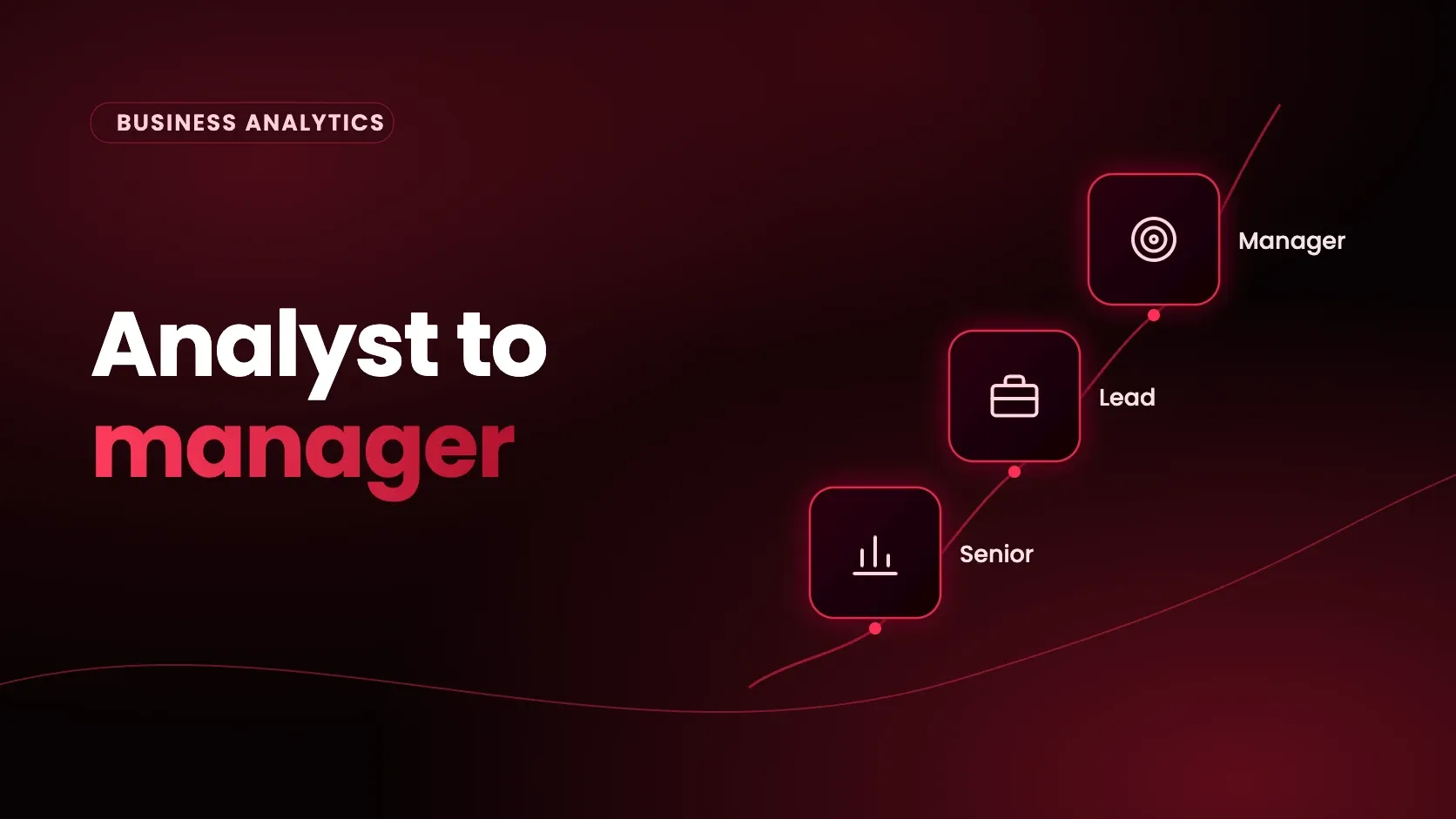
The business analyst path in India usually runs from analyst to senior analyst, then to lead or manager roles, with side routes into consulting, product management and analytics leadership. AmbitionBox's 2026 data, self-reported by employees, averages Rs 7.3 lakh at 1-3 years of experience and Rs 14.4 lakh at 9-12 years. It is market data for the role and not an outcome of any route.
What does the business analyst career path look like in India?
Titles differ between employers, but the ladder has a recognisable shape. An analyst gathers requirements, maps processes and produces analysis for a defined area. A senior analyst owns a domain or a set of metrics and often guides newer colleagues. A lead or manager sets priorities across several stakeholders and carries responsibility for the team's output and for what leadership hears.
The role is an established one. IIBA's 2026 survey of 2,120 business analysis professionals in 122 countries found that 81% say business analysis is formally recognised in their organisation, a figure that has held for three consecutive years. In the same survey communication ranks first among skills for the third year running, with critical thinking second and problem-solving, listening and stakeholder engagement completing the top five.
That ranking says something about the climb. The skills at the top are mostly about working with people, and the share of a manager's week spent on them grows with scope. IIBA does not break the ranking down by seniority, so this is an inference and not a survey result.
For demand at the entry end, see the post on where business analyst jobs in India are growing and the blog's guide to what a business analyst does.
Feeling stuck after five to seven years? What do the experience bands show?
Market pay data cannot explain why a particular analyst has stalled, but it shows where the steps are. AmbitionBox's business analyst page, titled "Updated 2026", draws on 1.5 lakh employee-reported salaries and gives an overall average of Rs 10.2 lakh a year. Indeed India's page, updated on 16 October 2026, shows an average base salary of Rs 8,90,431 from 631 salaries taken from job postings over 36 months, across all experience levels.
Both are averages. They hide the spread between employers and cities, and AmbitionBox's figures are self-reported. Neither is a fresher figure or a statement of what anyone will earn.
The table sets AmbitionBox's bands next to a common title for each stage. The titles are typical and vary by employer.
| Experience band | AmbitionBox average, 2026 | Common title, varies by employer |
|---|---|---|
| 1-3 years | Rs 7.3 lakh | Business analyst |
| 3-6 years | Rs 9.2 lakh | Senior business analyst |
| 6-9 years | Rs 12 lakh | Lead analyst or analytics manager |
| 9-12 years | Rs 14.4 lakh | Manager or head of analytics |
The average rises with every band, and the 3-6 year band sits well below the 6-9 year band. Analysts at five to seven years straddle that boundary. What the data cannot show is whether the step between the bands comes from time served, a change of scope or a move between employers.
Where can a business analyst branch: consulting, product or analytics leadership?
Consulting is the branch with a clear MBA hiring signal. GMAC's Corporate Recruiters Survey 2025, which drew on 1,108 recruiters in 46 countries, found 86% of consulting employers planning some level of MBA hiring, and 93% of responding technology companies planning to hire MBA graduates in 2025. That is a global early-2025 plan and not an Indian hiring count. The United States Bureau of Labor Statistics adds context for the occupation closest to consulting-style business analysts: management analysts, projected to grow 10% from 2025 to 2035 from 1,077,100 jobs in 2025, with about 94,100 openings a year. Its 2025 median pay for that American occupation was $101,860, and that figure is not an Indian benchmark.
Product management is a second branch, and the skills carry over: stakeholder engagement, prioritisation and writing requirements. The blog's guide to becoming a product manager without an MBA covers that route in detail.
Analytics leadership is the third. WEF's India economy profile projects net growth for 2025 to 2030 of 17% for business intelligence analysts, 54% for data analysts and scientists and 176% for AI and machine learning specialists among surveyed employers operating in India. Those are employer projections off small bases and not promises of jobs. They do suggest that an analyst who adds data and AI skills is positioned closer to the faster-growing roles than one who stays within reporting alone. The post on how much machine learning a business analyst needs sets out what that addition involves.
Which credentials matter as an analyst moves up?
Credentials work differently at each stage. IIBA's 2026 survey found 94% of certified business analysis professionals would recommend certification to a colleague and 76% saw tangible benefits within the first year. IIBA awards these credentials, and the respondents were its own certified community, so the figures describe satisfaction among holders and not outcomes for everyone. The same survey found CBAP holders earning 19% more than non-certified peers, and because CBAP is held by experienced practitioners, part of that gap may reflect seniority and not the credential.
On the employer side, 40% of employers in the NASSCOM and Indeed report of 19 May 2026 preferred demonstrable AI skills or certifications over a degree, and WEF found 30% of employers operating in India expect to remove degree requirements, against 19% globally. GMAC's figures show that the degree still counts for consulting and technology recruiters.
TeamLease Digital's Digital Skills and Salary Primer for FY2026-27, built on 37,000 tech and digital roles across 18 cities, estimates that only 16% of IT professionals in India hold AI skills. On one reading of these figures, a scarce skill that can be demonstrated is the more practical credential for a mid-career analyst. How the analyst title differs from the wider field of analytics is covered in business analytics vs business analyst.
How are AI and skill-mix hiring reshaping senior analyst roles?
NASSCOM's Strategic Review 2026, published on 23 February 2026, expects FY27 to mark the maturation of AI spending, with technology spending range-bound at 5-7% year on year and hiring shifting from volume to skill mix. For senior analysts that means fewer roles defined by headcount and more defined by what a person brings. In the NASSCOM and Indeed report, 86% of employers had seen some impact of AI on job roles and responsibilities, and 35% had seen significant redefinition of roles.
IIBA's 2026 survey found 69% of business analysis professionals saying AI is positively affecting their careers, down from 74% in 2025, with 5% reporting a negative view. The most common AI uses were drafting and formatting (28%), communication and documentation (25%) and idea generation or problem-solving (22%). Those are tasks at the edge of the analysis and not the analysis itself.
NASSCOM's October 2026 study of 200 India-headquartered enterprises found the majority require 100% human approval before any agentic action, and 78% confine agentic action to structured tasks. The work that stays with people is framing the problem, handling stakeholders and deciding what a result means.
Where does an executive programme in business analytics and AI fit?
Executive Certificate Programme in Business Analytics and AI for Aspiring Managers is an online programme from IIM Ranchi, run with Masai as the implementation partner, taught in live online classes with an optional campus immersion at IIM Ranchi. Its modules include Data Visualisation and Storytelling for Managers, Managerial Statistics and Quantitative Thinking, Machine Learning for Business, and Advanced Analytics, AI Applications and Leadership. It is a certificate programme and not a degree, and it does not replace the experience that the later bands on the ladder depend on.
Frequently asked questions
What is the next step after business analyst?
Most paths run to senior business analyst, then lead or manager, with branches into consulting, product management and analytics leadership. AmbitionBox's 2026 bands run from 1-3 years to 9-12 years, with averages rising at each step. Titles and scope differ between employers, so the job description matters more than the label.
Which is the better branch, product management or analytics leadership?
Neither is better in general. Product management draws on stakeholder engagement and prioritisation, which IIBA's 2026 survey ranks among the top five analyst skills. Analytics leadership draws on data and AI skills, and WEF's India profile projects 54% net growth for data analysts and scientists by 2030 among surveyed employers. The choice follows interest and strengths.
Do business analysts need an MBA to reach management?
GMAC's 2025 survey found 86% of consulting employers plan some MBA hiring, so the degree helps for some routes, while 40% of employers in the NASSCOM and Indeed report prefer demonstrable AI skills or certifications over a degree. Analysts at the manager level often have either.
How much do business analysts earn at different experience levels in India?
AmbitionBox's 2026 data averages Rs 7.3 lakh at 1-3 years, Rs 9.2 lakh at 3-6 years, Rs 12 lakh at 6-9 years and Rs 14.4 lakh at 9-12 years. Indeed India's page, updated on 16 October 2026, shows Rs 8,90,431 across all levels. These are self-reported or posting-based averages, not offers.
Will AI change senior business analyst roles?
It is changing the task mix. In the NASSCOM and Indeed report, 35% of employers had seen significant redefinition of roles, and in IIBA's 2026 survey 69% of analysts said AI was positively affecting their careers. NASSCOM's October 2026 study found most enterprises still require human approval for agentic action, so judgement stays central.
Next step
The Executive Certificate Programme in Business Analytics and AI, IIM Ranchi page sets out the curriculum and how to apply.