
Pay after placement business analytics course: How PAP works

Quick Answer
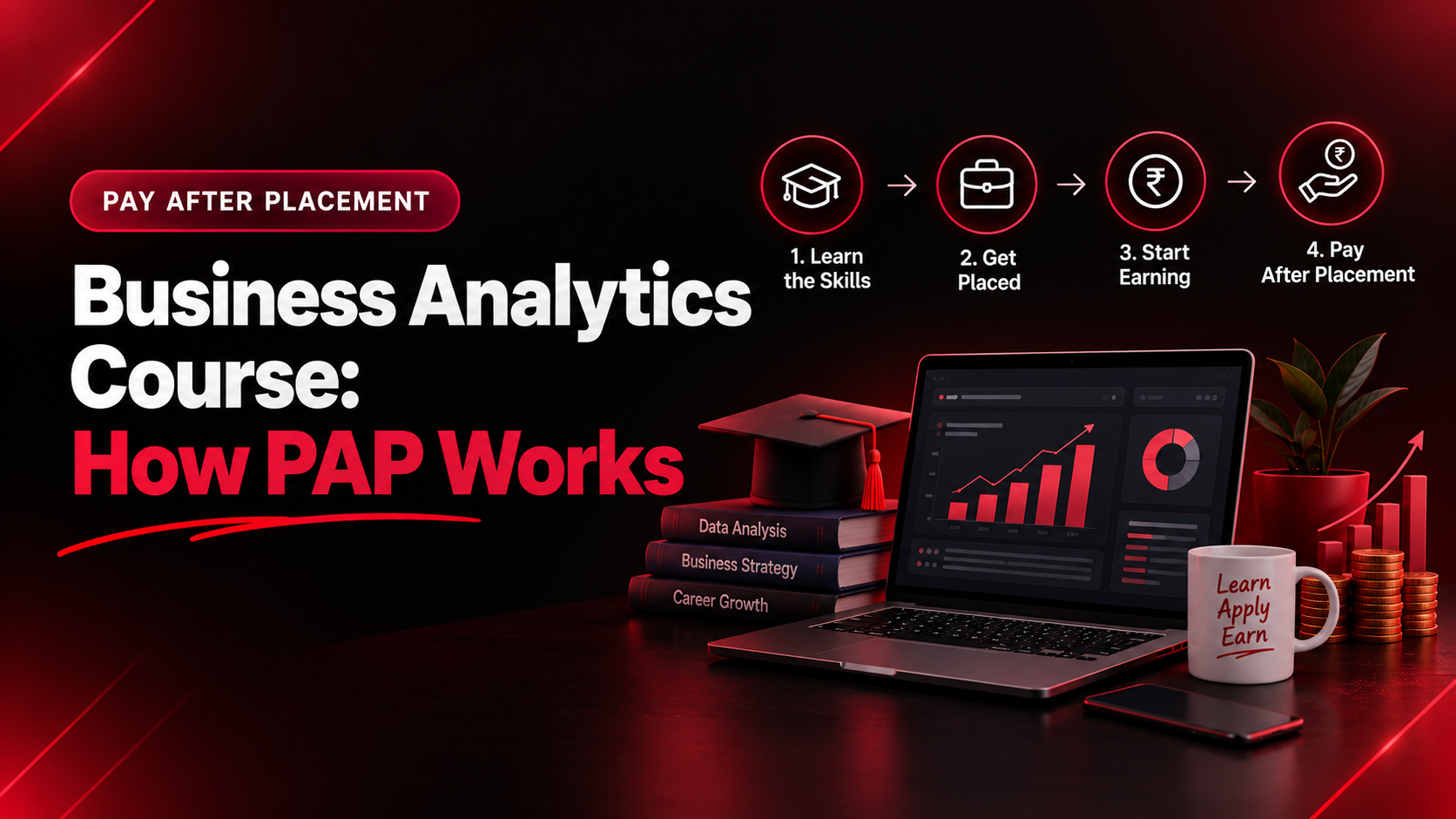
A pay after placement (PAP) course lets you start learning with a small upfront payment and defer the bulk of the fee until you land an eligible job. In the MICA x Masai Certificate Programme in Business Analytics with AI, you pay a ₹99 qualifier test fee and a ₹10,000 (+GST) seat fee, clear a mandatory 5-week Foundation Unit, sign a PAP agreement, complete the programme, and pay the remaining fee (₹1.8 lakh or ₹2.5 lakh, plus GST, depending on your starting CTC) only after you join a qualifying job.
The model lowers your financial risk, but it is not a free or guaranteed-job course. Strict attendance, assignment and assessment rules apply, and a drop-out fee applies if you leave midway.
1. What is a Pay After Placement Course?
A pay after placement course is an education model where the learner's major financial commitment is tied to a career outcome. Instead of paying the full tuition before the first class, you pay a small amount to secure a seat, learn, and settle the larger fee once you start working in a qualifying role.
You may also see this called an Income Share Agreement (ISA), deferred-fee model, or outcome-linked fee model. The idea is the same everywhere: the institute earns most of its revenue only if you get hired, which is meant to keep both sides focused on employability.
Why PAP courses are trending in India
- Rising demand for job-ready analytics and AI skills among freshers and career switchers
- Upfront fees of high-quality programmes are a barrier for many graduates
- Learners increasingly want proof of outcomes, not just certificates
- Skills like SQL, Python, Power BI and AI-assisted analysis are now listed in a large share of entry-level analyst job descriptions
2. How the PAP model works (the general framework)
While every provider has its own terms, most pay after placement programmes follow the same six-stage lifecycle.
Three principles hold across most PAP models:
- Eligibility is earned. Placement support usually unlocks only if you meet attendance, assignment and assessment benchmarks.
- The fee is triggered by a job, not by enrolment. Payment begins only after you join an eligible role.
- Exit costs exist. Leaving later in the programme usually costs more, because the institute has invested more in you.
Keep this framework in mind. The next section maps it onto the real programme.
3. How PAP works in the MICA x Masai business analytics with AI programme
The programme is offered by Masai in collaboration with MICA (Ahmedabad) as a certificate programme. Here is the journey exactly in the order you would experience it.
Step 1: Register and qualify
Pay the ₹99 qualifier test fee and take the Masai Qualifier Test. If you clear it, you are invited to a mandatory webinar and then receive an information email with the terms, FAQs, brochure, success story links and an acceptance letter. A one-on-one counselling session follows.
Step 2: Reserve your seat
If you decide to enrol, sign the Acceptance Agreement and pay the ₹10,000 (+GST) registration fee. This amount is non-refundable.
Step 3: Complete the 5-week Foundation Unit (Unit 1)
This mandatory phase covers business foundations, the analyst mindset and SQL, and it doubles as an assessment of your consistency, attendance, assignment completion and readiness. Learners who do not meet the Foundation requirements or fail the Foundation assessment do not continue.
Step 4: Qualify for PAP
Clear the Foundation Test and meet the performance criteria. You also need a CIBIL score of 700 or above and must submit the required onboarding documents.
Step 5: Sign the PAP agreement
You receive the Placement Agreement after clearing the Foundation Test. Sign it to join the main programme from Unit 2. If you clear the test but choose not to sign, you exit and the ₹10,000 is not refunded, though you may receive a Foundation participation certificate.
Step 6: Learn, get assessed and progress
You progress unit by unit, and you advance only after clearing each unit-end assessment (mastery-based progression).
Step 7: Placement readiness (Elevate Unit)
Eligible learners move to an in-person placement readiness unit in Bengaluru (details in Section 8).
Step 8: Get placed, then pay
The PAP fee is triggered only after you secure an eligible job offer and join the organisation. Per the programme FAQ, the obligation begins after a post-joining period (for example, about one month after joining), as specified in your agreement. You can pay in one go or choose EMI through NBFC partners.
4. Programme at a Glance
5. Curriculum: Unit-by-unit breakdown
The curriculum is indicative and may be updated to reflect industry and hiring trends. Download the latest brochure for the detailed syllabus.
Unit 1 (Foundation): Business mindset and the SQL toolkit
Builds the thinking layer first: P&L logic, KPI logic, sector literacy and problem framing.
- Business Foundations and Analyst Mindset
- SQL for Analysts
- Mini Project
Unit 2: Excel and Python foundations
Advanced Excel functions, Pivot Tables, Power Query and dashboards, plus Python programming, data structures, control flow, functions, file handling and data cleaning.
- Excel for Analysts
- Python Foundations
- Mini Project
Unit 3: Python for data analysis and Power BI
Work with larger datasets using Pandas and NumPy: transformation, aggregation, visualisation and cohort analysis. Then build interactive Power BI dashboards using data modelling, DAX and visualisation best practices.
- Python for Data Analysis
- Dashboarding with Power BI
- Mini Project
Unit 4: Statistics, A/B testing and business analytics
Hypothesis testing, A/B testing, marketing and product analytics, customer segmentation, funnel analysis, unit economics and decision-making through case studies.
- Statistics and A/B Testing
- Marketing and Product Analytics
- Mini Project
Unit 5: Machine learning and AI for the modern analyst
Predictive models with scikit-learn, model evaluation, and AI-powered tools that speed up analysis, coding and insight generation, with an emphasis on critically validating AI output.
- Applied ML and AI for the Modern Analyst
- Mini Project
Unit 6: Placement Readiness (Elevate)
Resume building, LinkedIn optimisation, mock interviews, communication training and access to Masai's hiring network. Conducted offline in Bengaluru.
Career roles this prepares you for: Business Analyst, Marketing Analyst, Product Analyst and related entry-level analytics roles.
Skills you will walk away with: SQL querying and database design, Excel and Power Query, Python (Pandas, NumPy), Power BI with DAX, inferential statistics (Z-tests, T-tests, Chi-Square, ANOVA), A/B testing, KPI analysis, guesstimates, scikit-learn basics and AI-assisted analytics.
6. Performance rules you must meet
In a PAP model, your performance decides whether the model stays available to you. The programme page lists these requirements for continuing and for placement readiness:
What happens if you fall short? Learners who miss the required performance, attendance or assignment criteria can be removed from the PAP programme, and a drop-out fee may apply case by case. Repeat status exists, but failing again while on Repeat, plagiarism or repeated attendance failures can lead to discontinuation.
7. Fee structure, EMI and drop out clause explained
Upfront costs
Fee payable after placement
GST is applicable. Interest and charges on EMI are borne by the student under the lender's terms.
A quick calculation worth doing. The EMI figures multiply out to roughly ₹2.5 lakh (₹6,944 x 36) and ₹3.5 lakh (₹9,722 x 36). That suggests financing or subvention costs sit on top of the base fee. If you plan to use EMI, ask for the exact total repayable in writing. Paying in one go avoids this difference.
Illustrative total cost (before GST and any financing cost):
- Placed at ₹3 to ₹4.99 LPA: ₹99 + ₹10,000 + ₹5,000 + ₹1,80,000 = about ₹1.95 lakh
- Placed at ₹5 LPA and above: ₹99 + ₹10,000 + ₹5,000 + ₹2,50,000 = about ₹2.65 lakh
Drop-out clause (as shown in the fee section)
These clauses also apply if you breach the Student Code of Conduct. All fees are non-refundable and non-transferable.
Important: the programme's FAQ section shows a simpler drop-off schedule (no payment during a Week 2 trial, ₹10,000 for Weeks 2 to 5, ₹50,000 for Weeks 6 to 20, ₹1,80,000 from Week 21). The page also describes the lower slab as ₹3 to ₹5 LPA in the FAQ versus ₹3.00 to ₹4.99 LPA in the fee table. Treat your signed agreement as the final authority and ask the programme team to confirm which schedule applies to your batch.
8. Placement support and the elevate unit
What Elevate includes: resume building, LinkedIn profile optimisation, mock interviews, interview preparation, communication skills training and access to opportunities through Masai's hiring network. The in-person format allows face-to-face interviews with hiring managers and direct feedback.
Key facts to know:
- Held offline in Bengaluru; attendance is mandatory
- Open only to learners who meet the evaluation benchmarks
- Costs ₹5,000, paid at the start; food, stay and travel are your responsibility
- It prepares you and opens doors, but it does not guarantee placement
How placement under PAP behaves in practice
9. Who is this programme for?
Fresh graduates. You get structured, end-to-end analytics capability across programming, databases, statistics and BI, with a portfolio to show employers.
Working professionals. If you are stuck in functional reporting, this builds independent data extraction (SQL), statistical validation of decisions and executive-ready dashboards with Power BI and DAX.
Career switchers. The programme starts from programming fundamentals and business basics, then builds towards case studies, guesstimates, KPI analysis and dashboards.
Not ideal if: you cannot commit around 25 hours a week, do not have a laptop, are outside the 20 to 28 age band, or have a CIBIL score below 700.
10. Faculty and the MICA connection
About MICA: Established in 1991 in Ahmedabad, MICA is an autonomous, non-profit institution focused on strategic marketing and communication, with alumni across marketing, brand management, research and analytics, advertising, media and digital.
Faculty pool (sessions are delivered by selected members, subject to availability):
- Prof. Aditya Naishadam (Programme Director): Purdue graduate and MICA PGDM-C gold medallist with 6+ years in predictive analytics, machine learning and marketing analytics; teaches Machine Learning and Marketing Analytics at MICA.
- Prof. Sunita Mall: PhD in Statistics, with IIM Calcutta business analytics training; specialises in quantitative techniques, fraud analytics and credit scoring.
- Dr Ashutosh Yadav: Assistant Professor of Finance focused on BFSI, FinTech, P&L structures and financial KPIs.
Optional campus immersion: Learners can visit the MICA campus for curated sessions and a valedictory ceremony. It is optional and costs ₹5,000 per participant per day, with food, stay and travel extra.
11. PAP vs upfront-fee courses
12. Honest pros and cons
Pros
- Very low upfront commitment compared with typical analytics programmes
- Placement-linked fee aligns the provider's incentives with yours
- MICA-branded certificate plus a tool stack employers actually list (SQL, Python, Excel, Power BI)
- Mastery-based progression prevents foundation gaps
- AI-powered analytics built into the curriculum, not bolted on
- Dedicated, in-person placement readiness unit
Cons and risks
- Strict gating: 90% attendance and 80% assignments leave little room for a busy schedule
- Seat fee, test fee and drop-out fees are non-refundable, and drop-out fees rise sharply after Week 10
- Total cost can be higher than some upfront-fee alternatives once the deferred fee and any EMI cost are added
- No guaranteed placement, and you cannot pick the company or location or reject an eligible offer
- The PAP fee applies even if you find a job on your own
- Elevate needs you to be in Bengaluru, with your own travel and stay costs
- The success stories on the page come from earlier Masai programmes and, as the page itself notes, do not represent outcomes of this partnership
13. Fine Print to read before you sign
- Which drop-off schedule applies? The fee table and FAQ show different versions. Get it confirmed in writing.
- CTC slab boundary. Confirm whether the lower slab ends at ₹4.99 LPA or ₹5 LPA, and how CTC is defined (fixed versus variable).
- Trigger date. Confirm exactly when the payment obligation starts after you join.
- EMI total. Ask for the full repayable amount, interest, subvention and GST, not just the monthly figure.
- Offer rejection rules. Understand that rejecting an eligible offer still triggers the fee.
- Below-threshold offers. Ask what happens if your only offer is under ₹3 LPA.
- Credit check. A CIBIL score of 700+ is required to move into the main programme.
14. Is it right for you? A quick self-check
Answer yes or no:
- Can I study around 3 hours a day, 5 days a week, plus assignments, for about 6 to 10 months?
- Can I maintain 90% attendance and 80% assignment completion?
- Am I comfortable accepting a reasonable analyst offer without choosing the company or city?
- Can I afford the ₹10,000 seat fee as a possible loss if I do not continue?
- Do I understand and accept the drop-out fee schedule?
- Do I have a laptop and a CIBIL score of 700 or above?
If most answers are yes, the model is likely a good fit. If several are no, consider whether a self-paced or upfront-fee option suits you better.
15. Frequently asked questions
What is a pay after placement course? A course where you pay a small registration fee upfront and the larger remaining fee only after you secure and join an eligible job.
How much do I pay upfront in the MICA x Masai programme? ₹99 for the qualifier test and ₹10,000 (+GST) to reserve your seat. Both are non-refundable.
How much is the PAP fee after placement? ₹1,80,000 for placement CTC of ₹3.00 to ₹4.99 LPA and ₹2,50,000 for ₹5 LPA and above, plus GST, payable in one go or through 36-month EMI.
Is placement guaranteed? No. The programme provides placement preparation and access to Masai's hiring network, but not a guarantee.
Do I pay if I am not placed? If you met all eligibility criteria, appeared for placements, had no Code of Conduct violations and were not placed in an eligible role, the PAP fee is not triggered.
What is the Foundation Unit? A mandatory 5-week first unit that teaches business foundations and SQL while assessing your commitment and readiness. Clearing its test is required to continue.
Who can apply? Graduates and above aged 20 to 28, with a laptop.
How long is the programme? About six months, extendable up to ten depending on pace and mastery.
Is the programme online? Yes, live and online, except the Elevate placement readiness unit, which is offline in Bengaluru.
Do I get a certificate? Yes, a MICA certificate, provided you score at least 60% in each unit and meet the programme criteria.
Is campus immersion mandatory? No, it is optional and paid separately.
16. Final Verdict
Pay after placement courses solve a real problem: strong analytics education is expensive, and many graduates cannot take that risk upfront. The MICA x Masai Business Analytics with AI programme follows the PAP lifecycle closely: a low-cost qualifier, a 5-week Foundation filter, an agreement, unit-by-unit mastery, a placement readiness unit and a fee triggered by a job.
It rewards disciplined learners who can meet strict attendance and assignment targets and who are open to the offers that come. It is less suited to people who need flexibility in company or location, cannot commit about 25 hours a week, or want the lowest possible total cost.
Read the brochure, ask the programme team to clarify the discrepancies listed in Section 13,and decide only after you have seen the signed-agreement terms.
Official Contact
- Contact: WhatsApp +91 87929 74750 or mica.programs@masaischool.com