
Best UX research and prototyping tools in 2027: ten compared
UX research tools and prototyping tools checked on vendor pages on 11 November 2026: ten compared, plus the current status of Adobe XD and Hotjar.

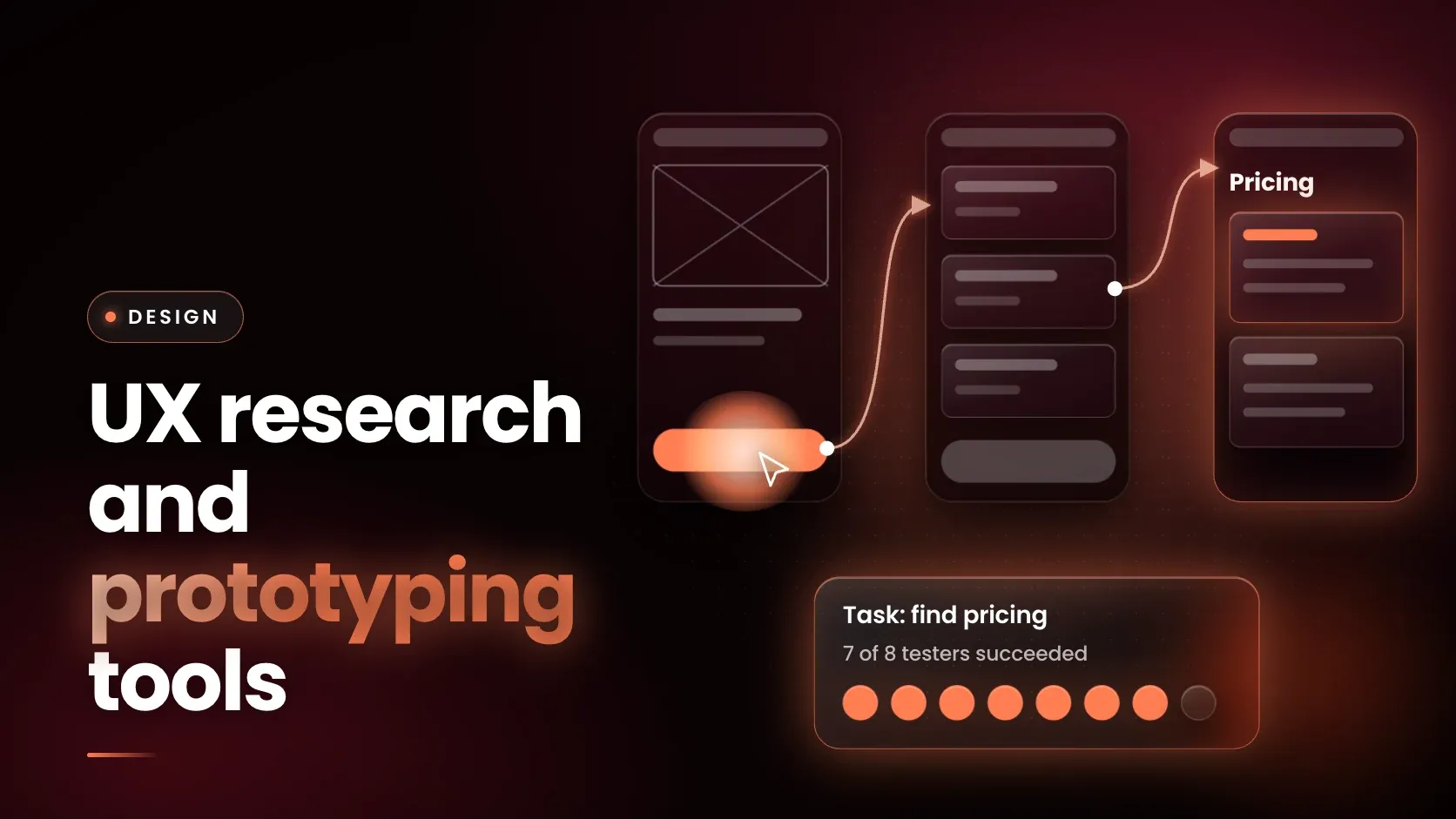
UX research tools show what users do and why, and prototyping tools let a team test an idea before building it. Ten tools are checked on vendor pages as of 11 November 2026: Figma, Penpot, Framer and ProtoPie for design and prototypes, and Maze, Lookback, Optimal Workshop, Dovetail, Microsoft Clarity and Miro for research and workshops. Adobe XD is in maintenance mode, and Hotjar is now Contentsquare.
Last updated: 11 November 2026.
Which tools design and prototype?
Figma, Penpot, Framer and ProtoPie build wireframes and prototypes, from open-source design files to interaction-heavy prototypes.
Figma
Figma is a collaborative design tool whose own page lists Figma Design for designing and prototyping in one place, plus FigJam, a digital whiteboard, and Dev Mode. Its prototyping tools build high-fidelity, no-code, interactive prototypes with interactions such as on click, while hovering and during scroll. A designer can link screens into a clickable flow for a test session. Figma's pricing page lists a free option with limited access to Figma products, and limits change.
The limit that matters is scope. Figma builds the prototype, and recruiting participants and analysing results fall to a research tool such as Maze or Optimal Workshop, which both import Figma designs.
Penpot
Penpot is an open-source design platform: its own page describes wireframes, interactive prototypes and CSS Grid and Flex layouts, and its repository carries the Mozilla Public License 2.0. A team that wants design files on its own servers can self-host it, and the README lists Docker and Kubernetes installs. The limit is operations: a self-hosted install is run and updated by the team, while the README points to a paid enterprise offering for advanced governance and administration.
Framer
Framer is a website builder with a design agent, according to its home page, which says sites publish with hosting, CMS, analytics, SEO and AEO built in. A designer can build a clickable landing page and put it in front of test users as a live link. The limit is purpose: Framer's home page describes site building and does not mention usability testing, so findings come from a separate research tool.
ProtoPie
ProtoPie is a prototyping platform that its home page calls AI-driven and that is built for dynamic interactions using logic, variables and formulas, with multi-device prototyping, native device sensors and voice interactions. A designer testing a form that validates an email address can model that behaviour rather than fake it with screens. The limit is that it sits beside a design tool: its menu lists plugins for Figma, Sketch and Adobe XD, so screens are usually drawn elsewhere and imported.
Which tools run user research and workshops?
Maze, Lookback, Optimal Workshop, Dovetail, Microsoft Clarity and Miro cover testing, interviews, session recordings, research notes and workshops.
Maze
Maze is a research platform whose home page lists card sorting, tree testing, surveys, moderated interviews, prototype testing, live website testing and mobile testing. Its FAQ says it tests prototypes built in Figma and Axure, and AI-generated ones from Figma Make, Lovable, Bolt and Replit, and one study can compare up to five design variants. A designer can send a Figma prototype to participants and read first-click results. The limit is the supported-tool list: a prototype from any other tool sits outside it.
Lookback
Lookback is a remote user-testing tool with moderated and unmoderated research, and its home page describes a live stakeholder view in which observers watch, chat and take notes. A researcher can run an interview while a product manager observes without joining the call. The limit is participants: Lookback points to a User Interviews integration or the team's own participants for recruitment.
Optimal Workshop
Optimal Workshop is a UX research platform that lists card sorting, tree testing, first-click testing, prototype testing, surveys and interviews. A content designer can run a tree test on proposed menu labels before any screen exists, and prototype testing can import designs from Figma. The limit is scope: card sorting and tree testing concern how content is grouped and found, so visual design and interaction need another method.
Dovetail
Dovetail is a research repository that now calls itself a customer intelligence platform. Its home page describes turning sales calls, support tickets and user interviews into context for agents, and lists Research Repository as a use case for turning studies and transcripts into shared customer intelligence. A researcher can keep interview transcripts and themes in one place. The limit is positioning: the page leads with customer data from many sources, so a small design team should check that the research workflow it needs is still the centre of the product.
Microsoft Clarity
Microsoft Clarity is a behavioral analytics tool with session recordings, heatmaps, funnels and Copilot summaries, and Microsoft Learn describes it as a free service. A UX researcher can watch where visitors stop on a live checkout page before deciding what to test. Clarity also has AI Visibility reports, which the post on AI visibility tools covers. The limit is time and age: playback data is kept for 30 days, and Microsoft says Clarity should not be used on sites that target users under 18.
Miro
Miro is a shared canvas whose home page is titled AI Innovation Workspace and whose use cases include Research Synthesis, Prototypes and Wireframes and Design Workshops. A team can cluster interview notes into themes on one board during a synthesis workshop. FigJam, which Figma lists as its digital whiteboard, is the alternative for teams already in Figma. The limit is that a whiteboard organises evidence but does not collect it: recruiting, testing and recording happen in other tools.
How do the ten UX research and prototyping tools compare?
The table sets each tool's stage, best use and main limit side by side, as checked on 11 November 2026.
| Tool | Stage | Best for | Main limit |
|---|---|---|---|
| Figma | Design and prototype | Clickable flows in one file | Does not recruit or analyse tests |
| Penpot | Design and prototype | Open-source, self-hosted design | Team runs the install |
| Framer | Prototype and publish | A live landing page to test | No usability testing listed |
| ProtoPie | Prototype | Logic, sensors, voice, multi-device | Screens imported from design tools |
| Maze | Test | Prototype tests and card sorts | Supported prototype tools only |
| Lookback | Test | Moderated sessions with observers | Recruitment via integration or own list |
| Optimal Workshop | Test | Card sorts and tree tests | Structure, not visual design |
| Dovetail | Synthesise | Research notes and transcripts | Positioning now wider than research |
| Microsoft Clarity | Observe | Recordings on a live site | Recordings kept for 30 days |
| Miro | Workshop | Synthesis and design workshops | Organises evidence, does not collect it |
What is the difference between prototyping and wireframing?
A wireframe is a basic blueprint of a screen's layout, menu bars and components, usually without visual design, while a prototype is a version of the design that users can try. Figma's wireframing guide calls a wireframe the skeleton of an app or website and says low-fidelity wireframes use lorem ipsum text and simple boxes.
Nielsen Norman Group calls a prototype a hypothesis, a candidate design solution, and says the most direct way to test it is to watch users work with it. It adds that prototypes range from hand-sketched to realistic and from static to clickable, and that ripping up a prototype is not expensive whereas ripping up code is. The post on how to write a PRD covers the written spec that wireframes and prototypes support.
Which research method fits which question?
Nielsen Norman Group sorts methods along two axes: attitudinal versus behavioral, which is what people say versus what they do, and qualitative versus quantitative. It says qualitative methods suit why and how-to-fix questions, and quantitative methods suit how many and how much questions.
| Question | Method | Tools from this list |
|---|---|---|
| Why did testers fail at this task | Moderated usability test | Lookback, Maze interviews |
| Which of several screens earns the right first click | Unmoderated prototype test | Maze, Optimal Workshop |
| How do users group these topics | Card sort | Optimal Workshop, Maze |
| Can users find a page in this menu | Tree test | Optimal Workshop, Maze |
| Where do visitors stop on the live site | Analytics and recordings | Microsoft Clarity |
| What themes repeat across interviews | Research synthesis | Dovetail, Miro |
The number of testers per round has a documented rule of thumb. Nielsen Norman Group's article says the best results come from testing no more than 5 users and running as many small tests as affordable, using 31% as the typical share of problems that one user finds. The script below applies the Nielsen and Landauer form of the model, 1 - (1 - L) ** n, with L = 0.31.
L = 0.31  # typical share of problems one test user finds, per Nielsen Norman Group
for n in range(1, 9):
    print(n, round(1 - (1 - L) ** n, 3))
Running it with Python 3.9.6 printed one line per number of users.
1 0.31
2 0.524
3 0.671
4 0.773
5 0.844
6 0.892
7 0.926
8 0.949
Five users give 0.844, in line with the 85% the article states for a first study. The model is not a measurement, and it assumes comparable users: the article recommends 3 to 4 users per group when there are two distinct groups.
Which tools were renamed, retired or left out of the ten?
Adobe XD is in maintenance mode. Adobe's XD help page, in a copy archived on 1 November 2026, still carries that notice, and the earlier XD support page, archived on 1 June 2026, says Adobe is not investing in ongoing development or shipping new features, will keep fixing bugs and security or privacy issues for existing customers, and will determine the right time to end support with a significant notice period.
Hotjar's own site says Hotjar is now Contentsquare and that new accounts can no longer be created on Hotjar. FigJam is part of Figma, not a separate vendor. Useberry's home page lists card sorting, tree tests, first-click tests, 5 second tests and preference tests, and was checked but is not one of the ten.
What limits apply to UX research tools?
A UX research tool runs a study but does not choose the question, and a clean dashboard can hide a weak question. Lookback's page says its AI suggestions are always labelled and tells researchers to validate them, which is a fair rule for every tool that now offers AI summaries.
Recordings and transcripts hold personal data, and a team should read how the Digital Personal Data Protection Act, 2023 applies to them; the post on email marketing and automation tools summarises the consent wording. Tools also cannot replace talking to customers, which the post on product discovery and customer interviews covers. Free tiers change, so the vendor's current page decides what an account can do.
Where does the product management programme fit?
Readers who want structured practice with prototyping and roadmapping can look at Certificate Programme in Product Management in the Agentic AI Era. It is a live online programme from IIM Tiruchirappalli (IIM Trichy), run with Masai as the implementation partner, covering product foundations, platform strategy, AI for product managers, agentic AI and a team capstone to design and pitch an agentic-AI-powered product. Its modules include Tools for Digital Product Management and the capstone, Design & Pitch a Digital Product Powered by Agentic AI.
Frequently asked questions
Which tool is best for user testing?
The best tool for user testing depends on the method. Lookback suits moderated sessions with observers, Maze and Optimal Workshop suit unmoderated prototype tests, card sorts and tree tests, and Microsoft Clarity shows behaviour on a live site through recordings. Match the tool to the question first, because each vendor's page describes different methods.
What is the difference between prototyping and wireframing?
Wireframing sketches the layout, menu bars and components of a screen, often with placeholder text and boxes. Prototyping builds a version of the design that users can click through and test. Figma describes a wireframe as the skeleton of an app, and Nielsen Norman Group describes a prototype as a hypothesis best tested by watching users.
Is Figma free?
Figma's pricing page lists a free option described as limited access to Figma products, alongside paid plans. Limits and plan terms change, so the current pricing page decides what a free account can do. Penpot is an open-source alternative whose repository carries the Mozilla Public License 2.0.
What is the status of Adobe XD?
Adobe XD is in maintenance mode, as Adobe's XD help page still said in a copy archived on 1 November 2026. Adobe's XD support page, archived on 1 June 2026, says Adobe is not investing in ongoing development or shipping new features and will keep fixing bugs and security issues for existing customers. The page gives no end-of-support date and says support will end with a significant notice period.
How many users does a usability test need?
Nielsen Norman Group's article says the best results come from testing no more than 5 users and running as many small tests as affordable, because the first study with five participants finds 85% of the usability problems. It recommends 3 to 4 users per group when there are two distinct groups of users.
Is there an open-source alternative to Figma?
Penpot describes itself as the open-source design platform for teams, with wireframes, interactive prototypes and CSS Grid and Flex layouts. Its repository carries the Mozilla Public License 2.0, and its README describes self-hosting with Docker or Kubernetes. A self-hosted install is run and updated by the team that installs it.
Next step
Pick one design question, such as whether users find the right menu item, and run a small test with five people before choosing a tool. For structured practice with prototyping, roadmapping and an agentic-AI capstone, the Certificate Programme in Product Management in the Agentic AI Era page lists the programme's modules and how it is delivered. A wider list sits in an earlier post on AI tools for product managers.