
Best product analytics tools in 2027: Mixpanel, Amplitude, PostHog
Product analytics tools checked on vendor pages on 11 November 2026: ten tools, their event models, one limit each and which publish code on GitHub.

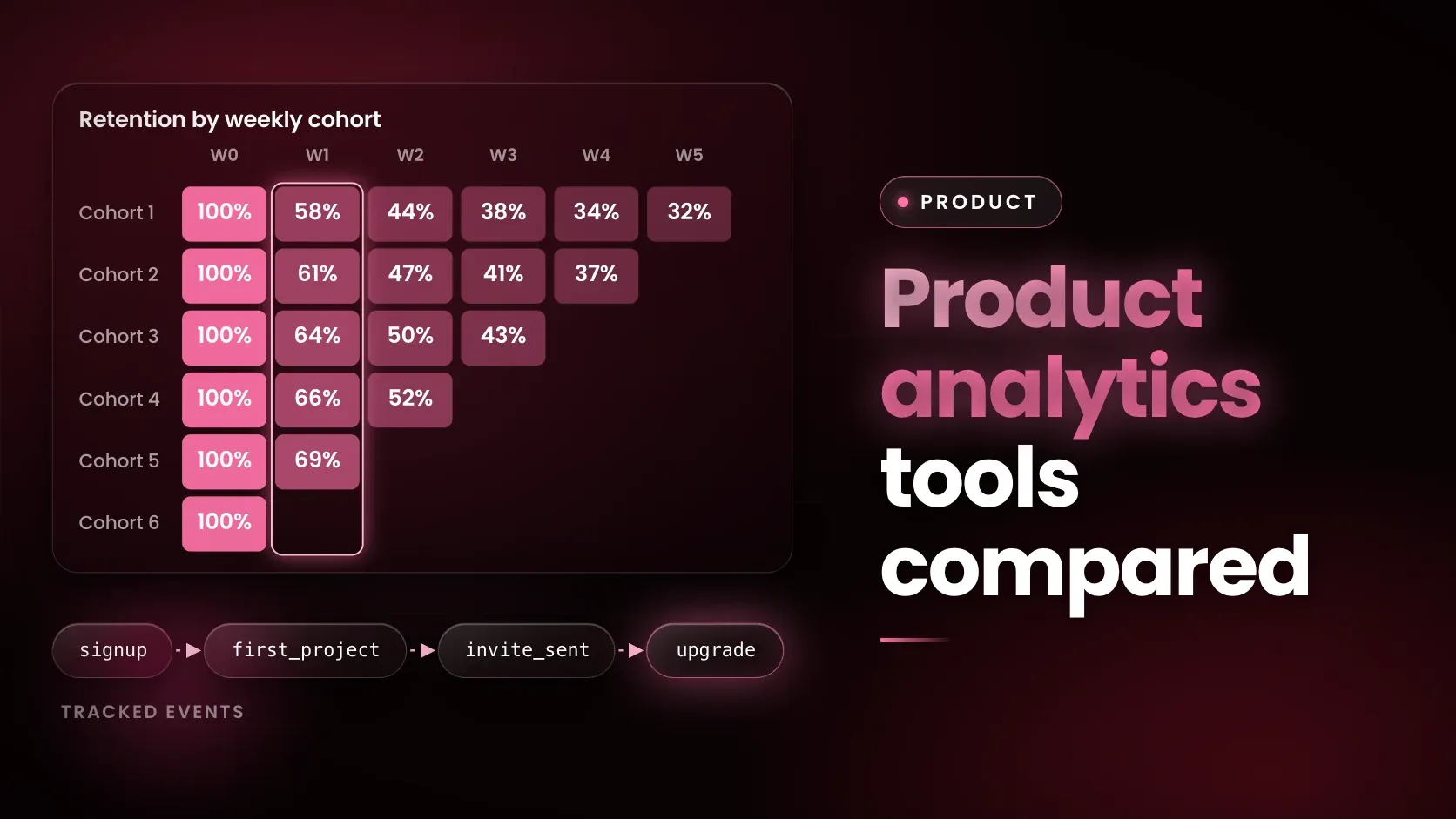
Product analytics tools record what users do inside an app or website as events, such as a signup or a checkout, and report funnels, retention and paths from them. Ten are checked here on vendor pages as of 11 November 2026: Mixpanel, Amplitude, PostHog, Google Analytics 4, Heap, Pendo, Contentsquare (formerly Hotjar), Microsoft Clarity, Twilio Segment and Metabase. PostHog and Metabase also publish their code on GitHub for teams that self-host.
Last updated: 11 November 2026.
Which tools analyse events inside a product?
Mixpanel, Amplitude, PostHog, Google Analytics 4, Heap and Pendo record and analyse events, as their own documentation describes them.
Mixpanel
Mixpanel is a product analytics platform built on three concepts that its documentation names: events, users and properties. An event is expected to carry a name, a timestamp and a Distinct ID, and properties describe it further. A product team can send a signup_completed event and an order_placed event and build a funnel between them. The documented limit is the number of names: Mixpanel sets a soft limit on distinct event names, and names beyond it are ingested but not indexed or shown in autocomplete.
Amplitude
Amplitude is an AI analytics platform that, according to its documentation, tracks user actions on an event-based model with events, event properties, users, user properties and sessions. A team can compare how often paying and free users repeat an action, because the plan type sits on the user and the action sits on the event. The limit Amplitude states is identity: counting unique users is trickier than it sounds, because people log in and out, browse anonymously and switch devices.
PostHog
PostHog is an event-based platform whose repository lists product analytics, web analytics, session replay, feature flags, experiments and surveys in one product. Its client-side SDKs can autocapture events, and the repository is MIT-licensed apart from its ee directory. A small team can read traffic on the web analytics dashboard and funnels in product analytics without a second vendor. The limit is self-hosting: the README gives a monthly event volume for open source deployments beyond which it recommends PostHog Cloud, and says PostHog does not provide customer support for them.
Google Analytics 4
Google Analytics 4 (GA4) is the analytics platform that Google's help pages describe as collecting data from websites and apps. It records events of four kinds: automatically collected, enhanced measurement, recommended and custom. A marketer can mark purchase as a key event and see which channels lead to it. The limit for product analysis is that custom events do not show up in most standard reports, so they need custom reports or explorations.
Heap
Heap is a product analytics tool whose home page says it has joined forces with Contentsquare. Heap's developer documentation says it virtualizes data, so events can be renamed or grouped retroactively after autocapture has collected the interactions. A team that forgot to track a button click can define it afterwards and see its history back to installation. The limit, in Heap's own blog, is that Snapshot properties, which add custom values to autocaptured events, are not retroactive.
Pendo
Pendo is a product experience platform whose own FAQ says it unifies product analytics, user feedback and in-app guidance. Its help centre divides events into Pages, Features and Track Events, and says Page and Feature data are collected retroactively, so tags can be changed later. A product manager can tag a settings page, read past usage and show an in-app guide to people who never opened it. The limit is that Track Events are sent from code, need a developer and are not captured retroactively.
Which tools add behaviour replay and data pipelines?
Contentsquare, Microsoft Clarity, Twilio Segment and Metabase cover what an event table leaves out: what a visitor saw, how data moves between tools and where it is queried.
Contentsquare
Contentsquare is the experience analytics platform that Hotjar now belongs to: Hotjar's own site states that Hotjar is now Contentsquare and that new accounts can no longer be created on Hotjar. The menu lists session replay, heatmaps, funnels, product analytics and surveys. A designer can watch recordings of people abandoning a signup form. The limit is naming: older guides still say Hotjar, while new sign-ups go through Contentsquare.
Microsoft Clarity
Microsoft Clarity is a behavioral analytics tool from Microsoft with session recordings, heatmaps, funnels and smart events, and Microsoft Learn describes it as a free service. A growth team can install the tracking code and watch recordings of a checkout without defining events first, because insights can start without configuring dashboards, goals or custom events. The limit is retention: playback data is kept for 30 days and favorited sessions for 9 months. Microsoft also says Clarity should not be used on sites that target users under 18.
Twilio Segment
Twilio Segment is a customer data platform whose documentation defines a spec of six calls: Identify, Track, Page, Screen, Group and Alias. A team can send one Track call from an app and let Segment pass it to destinations such as Google Analytics. Segment routes data rather than analysing it, and its documentation says events are subject to defined product limits.
Metabase
Metabase is an open-source business intelligence tool: its repository says the Open Source edition is released under the AGPL, with commercial editions under a separate licence. It connects to a database or warehouse, offers a SQL editor and lets people ask questions without SQL. A product team that already loads events into a warehouse can chart retention there. The limit is that Metabase queries data that already exists and does not collect events.
How do the ten product analytics tools compare?
The table sets each tool's documented model and main limit side by side, as checked on 11 November 2026.
| Tool | Best for | Model as documented | Main limit |
|---|---|---|---|
| Mixpanel | Funnels on named events | Event name, timestamp, Distinct ID, properties | Soft limit on distinct event names |
| Amplitude | Behaviour across users | Events, event properties, users, user properties, sessions | Identity across devices |
| PostHog | Analytics, replay and flags in one product | Events with distinct_id and properties, autocapture | Self-hosting scale and support |
| Google Analytics 4 | Website and app traffic by channel | Events of four kinds | Custom events need custom reports |
| Heap | Defining events after the fact | Autocapture and virtual events | Snapshot properties not retroactive |
| Pendo | Analytics with in-app guidance | Pages, Features, Track Events | Track Events not retroactive |
| Contentsquare | Replays and heatmaps | Session replay, heatmaps, funnels | New accounts only through Contentsquare |
| Microsoft Clarity | Behaviour review on a live site | Recordings, heatmaps, smart events | Recordings kept for 30 days |
| Twilio Segment | Routing one event to many tools | Six spec calls | Documented product limits |
| Metabase | Charting events held in a warehouse | SQL over a database or warehouse | Does not collect events |
What is an event in product analytics?
An event in product analytics is a record of one user action, stored with a name, a time and an identifier for the user, plus properties that describe it. Mixpanel expects a name, a timestamp and a Distinct ID. PostHog's events carry an event name, a distinct_id, a timestamp and properties. Segment's Track call answers what a user is doing.
A tracking plan is the written list of events and properties a team agrees to send. Amplitude's documentation says a taxonomy defines which events and properties are tracked, what they are named and how they fit together, and warns that Song Played and song played are two separate events. Mixpanel says the same about sign_up_completed and Sign_Up_Completed, recommends snake_case and advises against dynamic names such as Purchase (11-01-2019).
Take a hypothetical food-delivery app in Pune with a two-event plan: signup_completed needs plan_type, and order_placed needs order_id and amount. The check below rejects names and properties that do not match the plan.
import re

PLAN = {"signup_completed": {"plan_type"}, "order_placed": {"order_id", "amount"}}
SNAKE = re.compile(r"^[a-z]+(_[a-z]+)+$")
events = [
    {"event": "signup_completed", "props": {"plan_type": "free"}},
    {"event": "Order Placed", "props": {"order_id": "A17", "amount": 450}},
    {"event": "order_placed", "props": {"order_id": "A18"}},
    {"event": "purchase_2026_11_11", "props": {"amount": 300}},
]
for e in events:
    name, problems = e["event"], []
    if not SNAKE.match(name):
        problems.append("name is not snake_case letters")
    elif name not in PLAN:
        problems.append("not in tracking plan")
    elif PLAN[name] - e["props"].keys():
        problems.append("missing " + ", ".join(sorted(PLAN[name] - e["props"].keys())))
    print(("OK   " if not problems else "FAIL ") + name + "".join(": " + p for p in problems))
Running it with Python 3.9.6 printed the output below. Order Placed fails on naming, order_placed fails because amount is missing, and purchase_2026_11_11 shows why dates belong in a property and not in a name.
OK   signup_completed
FAIL Order Placed: name is not snake_case letters
FAIL order_placed: missing amount
FAIL purchase_2026_11_11: name is not snake_case letters
The events in a plan are what metrics are built from. Amplitude's North Star Playbook defines a north star metric as a single critical rate, count or ratio that represents product strategy, and the post on the north star metric and AARRR shows how to choose one.
What is the difference between product analytics and web analytics?
Web analytics measures traffic to a website, such as page views, bounce rate and top traffic sources, while product analytics measures what specific users do inside a product. PostHog's documentation puts it this way: web analytics is a single pre-built dashboard for small teams and marketers, and product analytics offers custom insights and any custom event for engineering, product and data teams.
Google Analytics 4 sits between the two, because it collects events from websites and apps. The post on Google Analytics 4 for marketers covers its reports. As a rule of thumb, a marketer asking where visitors come from starts with GA4, and a product manager asking whether new users come back starts with an event tool.
Which product analytics tool is best for a startup?
No single product analytics tool is best for every startup, and the criterion decides the choice. The situations below follow what each vendor's own pages describe.
- A team that wants code it can inspect or self-host can look at PostHog or Metabase.
- A team that cannot define every event in advance can look at Heap or PostHog, which both autocapture.
- A team that wants named events and a documented naming convention can look at Mixpanel or Amplitude.
- A business-to-business product that wants analytics and in-app guides together can look at Pendo.
- A content or marketing site that needs channel reports can start with GA4 and add Microsoft Clarity for recordings.
Mixpanel, Amplitude and PostHog each advertise a free start on their pages, and limits change, so the current terms are worth reading before a team commits. For research methods that sit beside analytics, the post on UX research and prototyping tools lists ten more tools.
What limits apply to every product analytics tool?
Product analytics data is only as good as the tracking plan behind it. Names that drift, identities that split across devices and events that were never sent each distort the numbers, and Heap and Pendo differ in what can be recovered afterwards. Retention differs too: Clarity keeps recordings for 30 days unless they are favorited.
Vendors also change owners. June's own site carries a post dated 8 August 2025 saying June is joining Amplitude, so it is not a current choice. Heap joined Contentsquare, and Hotjar is now Contentsquare.
Privacy is the other limit. Amplitude's documentation lists IP Address among the user properties its SDKs track by default. The Digital Personal Data Protection Act, 2023 defines personal data as any data about an individual who is identifiable by or in relation to such data, so a team should read how that definition applies to its own events. The post on email marketing and automation tools summarises the consent wording in the Act.
Where does the product management programme fit?
Readers who want structured practice with product metrics can look at Product Management with AI. It is an online certification from BITS School of Management (BITSoM), offered in partnership with Masai, taught in live online classes with an optional campus workshop, covering product discovery, design and MVPs, building with agentic AI, Agile execution, go-to-market and product metrics. Its modules include Design & MVP and Data, Metrics & Decision Making.
Frequently asked questions
What is the difference between product analytics and web analytics?
Web analytics tracks traffic to a website, such as page views, bounce rate and traffic sources, in a pre-built dashboard. Product analytics tracks what individual users do inside a product, using events and properties that a team defines. PostHog's documentation frames web analytics as built for marketers and product analytics as built for engineering, product and data teams.
What is an event in product analytics?
An event in product analytics is a record of one user action, such as a signup or an order, stored with a name, a timestamp and an identifier for the user. Properties add detail, for example a plan type or an amount. Mixpanel and PostHog document events with a name, a timestamp and a user identifier, and Amplitude defines an event as an action a user has taken.
Which product analytics tool is best for a startup?
The best product analytics tool for a startup depends on the criterion. Teams that want self-hosting can look at PostHog, teams that cannot plan every event can look at Heap or PostHog autocapture, and teams that want a documented naming convention can look at Mixpanel or Amplitude. Each vendor's free terms change, so the current page decides.
Is PostHog open source?
PostHog's repository on GitHub is available under the MIT expat licence except for its ee directory, which has its own licence. PostHog also points to a posthog-foss repository that is purged of proprietary code. The PostHog README gives a monthly event volume for open source deployments beyond which it recommends PostHog Cloud, and says PostHog does not provide customer support for them.
Which of these tools have been renamed, merged or retired?
Hotjar's own site says Hotjar is now Contentsquare and that new accounts can no longer be created on Hotjar. Heap's home page says Heap has joined forces with Contentsquare. A tool outside the ten, June, announced on 8 August 2025 that it was joining Amplitude, so it is no longer a separate choice.
Is Microsoft Clarity free?
Microsoft Learn describes Microsoft Clarity as a free service with no obligation to upgrade to a paid version. The same documentation says playback data is kept for 30 days and favorited sessions for 9 months. Terms can change, so the current Microsoft page is the reference before a team relies on it.
Next step
Pick one question the product has to answer, write the two or three events behind it in a tracking plan, and test the plan with a script like the one above before choosing a tool. For structured practice with product metrics and experiments, the Product Management with AI page lists the programme's modules and how it is delivered. A wider reading list sits in an earlier post on AI tools for product managers.