
Best email marketing and automation tools in 2027
Email marketing tools checked on vendor pages on 11 November 2026: ten compared, plus Google's sender rules and the status of India's DPDP Act, 2023.

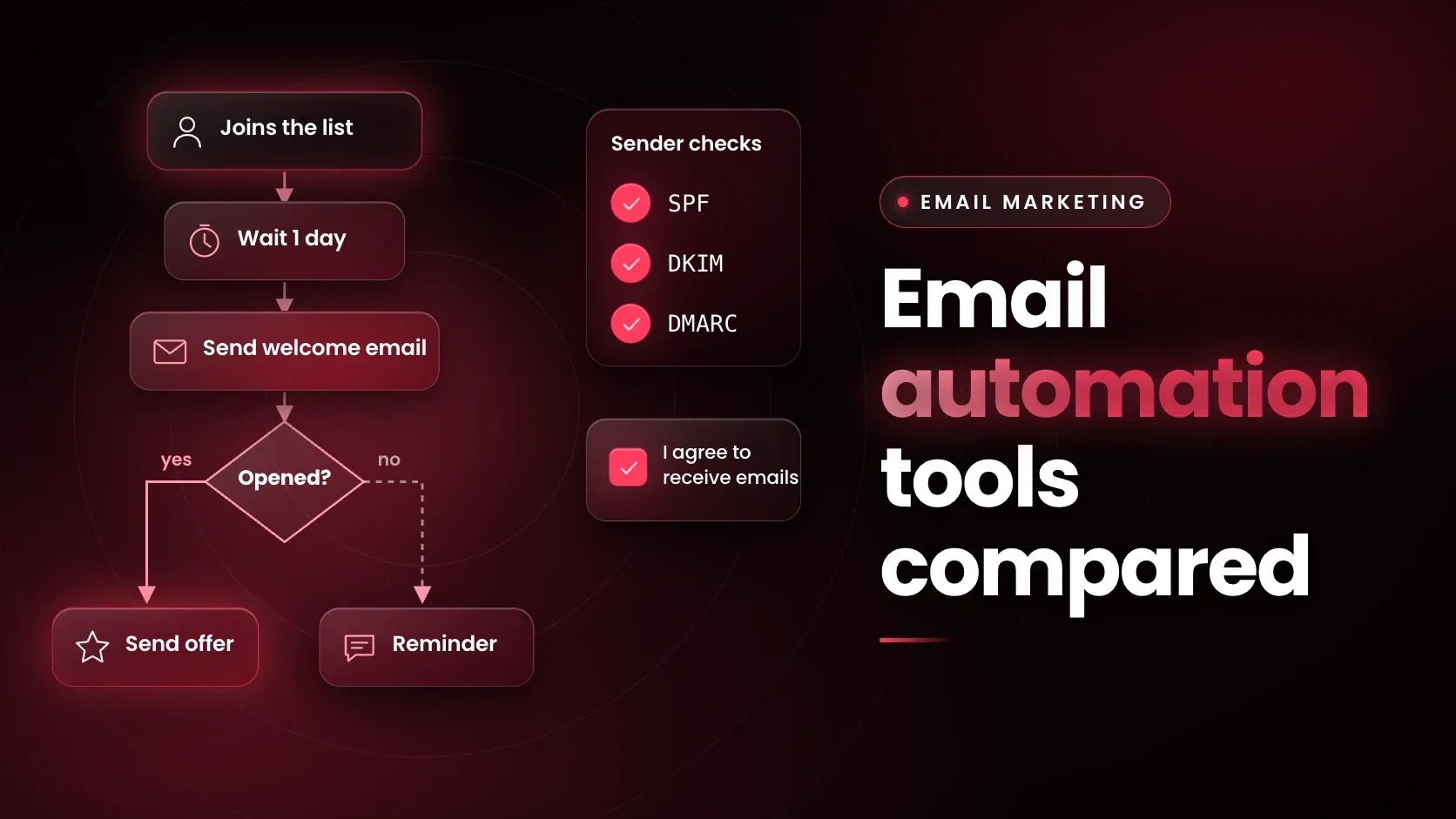
Email marketing tools send campaigns and automated messages to a subscriber list, and in India they sit under Google's sender rules and the Digital Personal Data Protection Act, 2023. Ten tools are checked on vendor pages as of 11 November 2026: Mailchimp, Brevo, HubSpot Marketing Hub, Klaviyo, ActiveCampaign, Zoho Campaigns, MailerLite, Kit, Beehiiv and Amazon SES. Six list SMS or WhatsApp alongside email, and four are email-first.
Last updated: 11 November 2026.
Which email marketing tools also list SMS or WhatsApp?
Mailchimp, Brevo, HubSpot Marketing Hub, Klaviyo, ActiveCampaign and Zoho Campaigns list SMS or WhatsApp alongside email on their own pages, so the channel list matters before the feature list.
Mailchimp
Mailchimp is an email and SMS marketing platform, according to its home page title, and its automation page describes email and SMS automations. A shop can send a welcome automation when someone joins a list. The home page mentions a free option, and limits change. The limit for India is SMS: Mailchimp says SMS is an add-on to paid plans in select countries and needs application and approval before purchase, so availability has to be confirmed.
Brevo
Brevo is a marketing and CRM platform, called Sendinblue until a rebrand announced on 4 May 2023. Its home page says it sends real-time email, SMS and WhatsApp messages triggered through SMTP relay and an API. A team can send order updates on WhatsApp and promotions by email from one account. The limit is WhatsApp set-up: Brevo's own guide from 1 September 2022 says a WhatsApp Business account must be created and verified before campaigns, and the steps may have changed since.
HubSpot Marketing Hub
HubSpot Marketing Hub is the marketing product of HubSpot. HubSpot's page says its email marketing software is part of Marketing Hub and can be started for free, that email automation personalises messages with CRM data, and the marketing page mentions reaching contacts on WhatsApp and SMS. A business that keeps contacts in HubSpot's CRM can email a segment without exporting a list. The limit is tiering: HubSpot says more advanced features to automate and scale marketing sit in paid editions.
Klaviyo
Klaviyo describes itself as the autonomous B2C CRM and AI marketing platform that unifies customer data and automates email, SMS, RCS, WhatsApp and mobile push. Its flows page offers pre-built templates and a drag-and-drop builder. An online store can trigger a flow from customer behaviour in the shop. The limit is focus: the B2C positioning and the native Shopify integration suit retail data, and a business-to-business newsletter may fit better elsewhere.
ActiveCampaign
ActiveCampaign is a marketing automation platform whose menu lists WhatsApp messaging and SMS marketing next to automation. A coaching business can send a follow-up sequence to contacts who opened an email but did not reply. The limit applies to any sender: ActiveCampaign's own guide of 8 February 2024 tells senders to stop using @gmail.com addresses in the sender field and move to a domain they own, because of the Google and Yahoo authentication changes.
Zoho Campaigns
Zoho Campaigns is Zoho's email marketing product, and its page describes email, SMS and WhatsApp marketing, with workflows that bring WhatsApp into the same workflow as email and SMS. A business already on Zoho CRM can use the integration the page lists. The limit is SMS coverage: the page says SMS can now reach more countries without listing them, so India coverage should be confirmed with Zoho.
Which tools suit newsletters, creators and sending infrastructure?
MailerLite, Kit, Beehiiv and Amazon SES are email-first, and their pages describe email only.
MailerLite
MailerLite is an email marketing platform whose automation page describes triggers, date-based triggers and a drag-and-drop builder, with several triggers allowed for one automation. A newsletter writer can send a birthday email on a date trigger. The limit is channels: the page describes email automation and does not list SMS or WhatsApp.
Kit
Kit, formerly ConvertKit, is an email marketing and newsletter platform that calls itself the email platform for creator business owners. Its automations page describes triggers when someone signs up, clicks a link or buys, plus email sequences and tags. A creator can send a welcome sequence to new subscribers. The limit is channels: the page mentions only email.
Beehiiv
Beehiiv, styled beehiiv, is a newsletter platform, and its FAQ calls it an email-focused publishing platform. Its automation page describes automations based on user behaviour, custom events and time delays. A publisher can send a follow-up after a reader clicks a link. The limit is stated in its FAQ: Beehiiv cannot send SMS natively, though its API or webhooks can connect third-party services.
Amazon SES
Amazon Simple Email Service (Amazon SES) is an AWS email platform for sending and receiving email with a team's own addresses and domains, for marketing, transactional and newsletter messages, through an SMTP interface, an API or an AWS SDK. A developer can send order confirmations from an app. The limit is the sandbox: AWS says new accounts start there, per Region, and can send only to verified addresses and domains, under daily and per-second sending caps, until production access is granted.
How do the ten email marketing tools compare?
The table lists the channels each vendor's page names, with the best use and the main limit, as checked on 11 November 2026.
| Tool | Channels the page lists | Best for | Main limit |
|---|---|---|---|
| Mailchimp | Email, SMS | Small shops starting automations | SMS add-on by country, with approval |
| Brevo | Email, SMS, WhatsApp | Multichannel sending with a CRM | WhatsApp Business account to verify |
| HubSpot Marketing Hub | Email, WhatsApp, SMS | Teams whose contacts sit in HubSpot | Advanced automation in paid editions |
| Klaviyo | Email, SMS, RCS, WhatsApp, push | Online stores | B2C and retail focus |
| ActiveCampaign | Email, SMS, WhatsApp | Automation-led small businesses | Needs an owned, authenticated domain |
| Zoho Campaigns | Email, SMS, WhatsApp | Businesses already on Zoho | SMS countries not listed |
| MailerLite | Newsletters and simple automations | No SMS or WhatsApp on the page | |
| Kit | Creators and newsletters | Email only on the page | |
| Beehiiv | Newsletter publishing | No native SMS | |
| Amazon SES | Developers sending from apps | Sandbox limits on new accounts |
Do you need consent to email customers in India?
India's Digital Personal Data Protection Act, 2023 says personal data may be processed only for a lawful purpose, either with the person's consent or for certain legitimate uses. It defines personal data as any data about an individual who is identifiable by or in relation to such data, which is the definition a subscriber list has to be read against.
Where consent is the basis, section 6 says it must be free, specific, informed, unconditional and unambiguous with a clear affirmative action, limited to the personal data necessary for the specified purpose. A request for consent must be accompanied or preceded by a notice (section 5), and the person may withdraw consent with ease comparable to giving it (section 6(4)).
In a dispute, the Data Fiduciary must prove that notice was given and consent obtained (section 6(10)). Section 7(a) lists a legitimate use for the specified purpose for which a person voluntarily provided data, unless she has indicated that she does not consent.
The rules are not yet fully in force. The Digital Personal Data Protection Rules, 2025 were published on 13 November 2025. Rules 1, 2 and 17 to 21 took effect on publication, Rule 4 takes effect one year after publication, on 13 November 2026, and Rules 3, 5 to 16, 22 and 23, which include the notice rule, take effect eighteen months after publication, around May 2027.
A Press Information Bureau release of 5 August 2026 still describes an eighteen-month transition. This describes the published text and is not legal advice, so a business with a large list should take advice on its own set-up.
What are SPF, DKIM and DMARC?
SPF, DKIM and DMARC are three DNS-based checks that let a receiving mail server confirm who sent a message. SPF, defined in RFC 7208 (April 2014), lets a domain's administrators publish which hosts may send for the domain. DKIM, defined in RFC 6376 (September 2011), lets a signing domain take responsibility for a message with a cryptographic signature that receivers check against a public key.
DMARC lets the owner of the From domain state what receivers should do with messages that fail those checks and request reports. It is now defined in RFC 9989 (May 2026), which obsoletes RFC 7489, so older articles cite the older number.
Google's Email sender guidelines say that from 1 February 2024 all senders to personal Gmail accounts need SPF or DKIM, valid forward and reverse DNS records, TLS and a spam rate below 0.3% in Postmaster Tools. Senders of more than 5,000 messages a day to Gmail accounts also need SPF, DKIM and DMARC, with a DMARC policy that may be none, a From domain aligned with the SPF or DKIM domain, and one-click unsubscribe with a visible link in marketing messages.
Google's FAQ counts close to 5,000 messages or more in 24 hours from one primary domain as bulk, says the status is permanent once reached, and says enforcement increased from November 2025, with temporary and permanent rejections for non-compliant mail. Yahoo's Sender Hub sets a similar pattern from February 2024 and says unsubscribe requests should be processed within 2 days. Both ask for a DKIM key of at least 1024 bits, and Google recommends 2048 bits.
The script below reads the SPF and DMARC records of a domain and prints the policy. The example.com domain is reserved for examples, and the other two records are hypothetical.
import subprocess

def txt(name):
    out = subprocess.run(["dig", "+short", "TXT", name], capture_output=True, text=True).stdout
    return [line.strip('"') for line in out.splitlines()]

def records(domain):
    spf = next((r for r in txt(domain) if r.startswith("v=spf1")), "")
    dmarc = next((r for r in txt("_dmarc." + domain) if r.startswith("v=DMARC1")), "")
    return spf, dmarc

def report(label, spf, dmarc):
    tags = dict(t.strip().split("=", 1) for t in dmarc.split(";") if "=" in t)
    print(label, "| SPF:", spf or "missing", "| DMARC p:", tags.get("p", "missing"), "| rua:", tags.get("rua", "none"))

report("example.com (live DNS)", *records("example.com"))
report("hypothetical sender", "v=spf1 include:_spf.esp.example ~all", "v=DMARC1; p=none; rua=mailto:dmarc@example.in")
report("hypothetical no DMARC", "v=spf1 include:_spf.esp.example ~all", "")
Running it with Python 3.9.6 on 11 November 2026 printed the lines below. The script leaves DKIM to the sending tool's own set-up, for example Amazon SES's Easy DKIM.
example.com (live DNS) | SPF: v=spf1 -all | DMARC p: reject | rua: none
hypothetical sender | SPF: v=spf1 include:_spf.esp.example ~all | DMARC p: none | rua: mailto:dmarc@example.in
hypothetical no DMARC | SPF: v=spf1 include:_spf.esp.example ~all | DMARC p: missing | rua: none
Which email marketing tool is best for beginners?
The best choice for a beginner depends on channels, list size and who writes the emails. The situations below follow what each vendor's pages describe.
- A small business starting simple automations can look at MailerLite, Zoho Campaigns or Mailchimp.
- A creator or newsletter writer can look at Kit or Beehiiv.
- A shop with customer and order data can look at Klaviyo.
- A team that already keeps contacts in a CRM can look at HubSpot Marketing Hub or Zoho Campaigns.
- A team that needs SMS or WhatsApp next to email can look at Brevo, ActiveCampaign, Klaviyo, HubSpot Marketing Hub or Zoho Campaigns, after checking country coverage.
- A developer sending order confirmations or newsletters from an app can look at Amazon SES.
The post on CAC, LTV, ROAS and CTR explains how to tie campaigns to cost and revenue, and the post on content marketing strategy covers what the emails should say. Events behind triggers are the subject of the post on product analytics tools.
What limits apply to email marketing tools?
Email deliverability depends on the sender's domain and list as much as on the tool. Google's threshold is a spam rate below 0.3%, and ActiveCampaign's guide says the sender address should sit on a domain the sender owns.
AI features need review. Mailchimp's page says its Intuit Intelligence feature, in beta, can make mistakes and that the user is responsible for reviewing and approving AI-generated content before sending. Free plans and vendor limits change, so the current vendor page decides. For a wider list of marketing assistants, see an earlier post on AI tools for digital marketers, and for tracking how assistants mention a brand, see the post on AI visibility tools.
Where does the digital marketing programme fit?
Marketers who want structured practice with email, automation and analytics can look at Certification Program in Digital Marketing with Applied AI. It is an online programme from IIM Ranchi, run with Masai as the implementation partner, taught in live online classes with an optional campus immersion at IIM Ranchi, covering SEO, social media, email, paid ads, analytics and generative AI tools such as ChatGPT, with a capstone project. Its modules include Measuring Success and Automating Emails and Making Sense of Data and Predicting Trends.
Frequently asked questions
Which email marketing tool is best for beginners?
The best email marketing tool for a beginner depends on the channels needed. MailerLite, Zoho Campaigns and Mailchimp describe simple automations, Kit and Beehiiv are built for creators and newsletters, Klaviyo targets online stores, and Amazon SES suits developers. Each vendor's free terms change, so the current page decides what an account includes.
Do you need consent to email customers in India?
India's Digital Personal Data Protection Act, 2023 requires consent that is free, specific, informed, unconditional and unambiguous when consent is the basis for processing, and it lists certain legitimate uses. Most obligations under the 2025 Rules start eighteen months after publication, around May 2027. This describes the text and is not legal advice.
What are SPF, DKIM and DMARC?
SPF lists the hosts allowed to send email for a domain, DKIM adds a cryptographic signature that receivers verify with a public key in DNS, and DMARC tells receivers how to treat messages that fail those checks and where to send reports. Gmail requires SPF or DKIM from all senders and all three from bulk senders, which Google puts at about 5,000 messages a day or more.
What did Gmail and Yahoo require from bulk senders?
From February 2024, Gmail and Yahoo asked bulk senders to authenticate mail with SPF, DKIM and DMARC, keep spam complaints below 0.3% and support one-click unsubscribe. Google's FAQ says Gmail ramped up enforcement from November 2025, with temporary and permanent rejections for non-compliant mail, and that bulk sender status does not expire.
Which email marketing tools were renamed?
Brevo was called Sendinblue until a rebrand announced on 4 May 2023, and Kit was called ConvertKit. Both vendors state the former names on their own pages. The other eight tools keep the names they carry in the list above.
Is Amazon SES an email marketing tool?
Amazon SES is an AWS email platform for sending and receiving email, and its documentation lists marketing emails, transactional emails and newsletters as uses. It is reached through an SMTP interface, an API or an AWS SDK, so it suits developers, and new accounts start in a restricted sandbox.
Next step
List the channels the business needs, check that its sending domain has SPF, DKIM and DMARC set up, and write down how each subscriber consented before choosing a tool. For structured practice with email, automation and analytics, the Certification Program in Digital Marketing with Applied AI page lists the programme's modules and how it is delivered.