
Autonomous vehicle technology in India: Skills, career opportunities & best courses in 2026

India's autonomous vehicle (AV) market was valued at roughly $2.6 billion and is projected to grow at a rapid 24-27% compound annual growth rate (CAGR) through 2030 making it one of the fastest-growing segments in deep tech.
Yet, the talent pipeline feeding this industry remains remarkably thin. This guide breaks down what autonomous vehicle technology involves, where blockchain fits into the equation, which Indian institutes are actively training engineers, and what the demand curve looks like.
What is Autonomous Vehicle Technology?
Autonomous vehicle technology (AVT) is the combined stack of hardware and software that lets a vehicle sense its environment, make driving decisions, and control its movements with little or no human input. Rather than a single standalone skill, it operates as a deeply layered system:
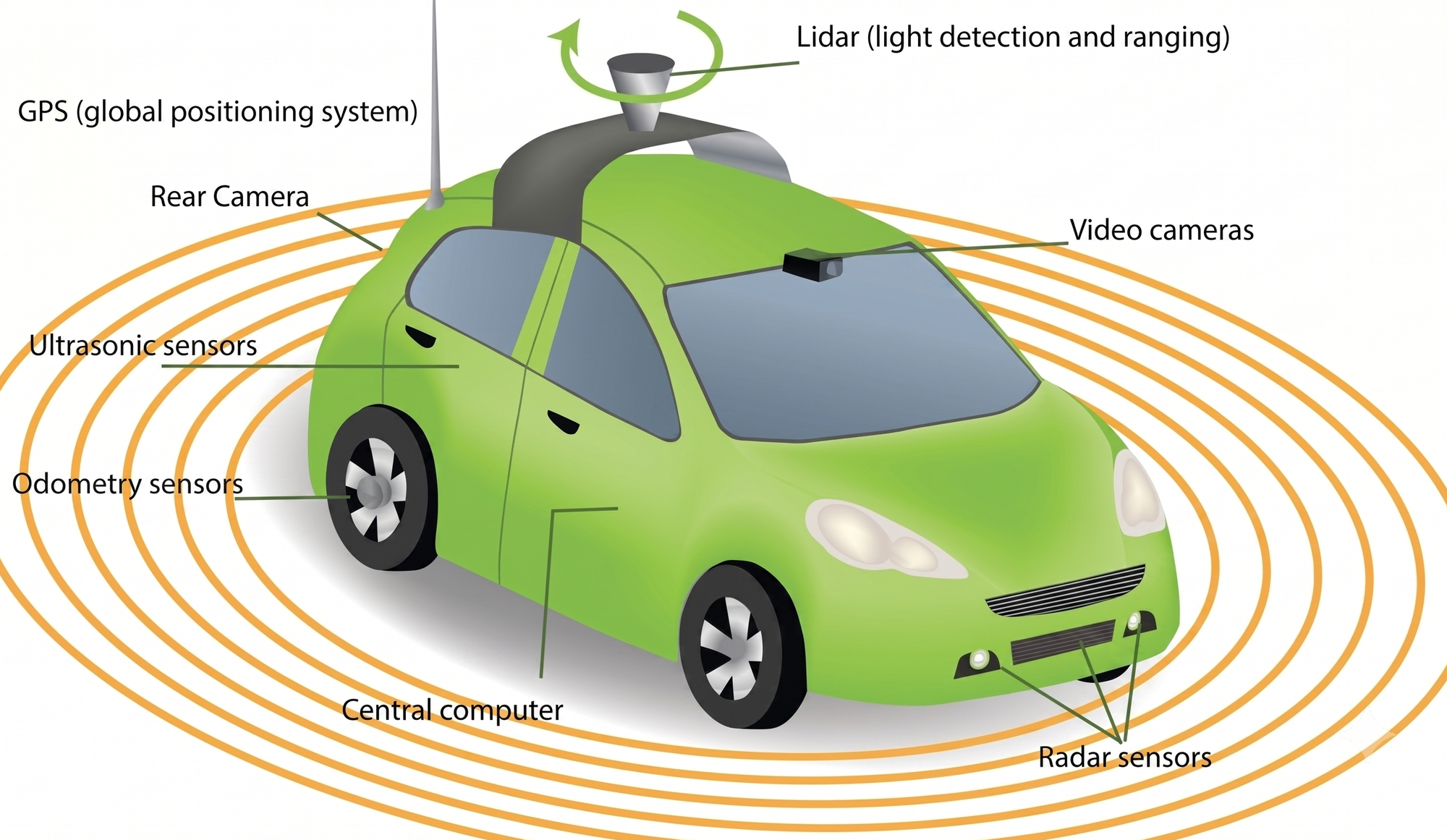
- Perception: Cameras, LiDAR, and RADAR systems feed raw environmental data about the road, obstacles, and pedestrians into the vehicle's onboard computer.
- Sensor Fusion: This process combines data from multiple distinct sensors into one reliable, real-time 3D map of the surroundings.
- Localization and Mapping (SLAM): Short for Simultaneous Localization and Mapping, this pinpoints exactly where the vehicle is positioned on its real-time map.
- Path Planning: AI models analyze data to calculate the safest, most efficient route and immediate tactical actions (like braking, steering, or accelerating).
- Control Systems: These systems translate software decisions into mechanical steering, throttle, and braking movements, usually via drive-by-wire hardware.
- V2X Connectivity: Vehicle-to-Everything communication allows cars to actively share data with traffic signals, road infrastructure, and other vehicles nearby.
The industry categorizes these systems using the SAE levels of autonomy, scaling from Level 1 (basic driver assistance like adaptive cruise control) to Level 5 (complete autonomy with no steering wheel required). Most advanced features on Indian roads today sit firmly at Level 1 or Level 2. Full Level 4 and Level 5 systems are currently confined to dedicated testing facilities and pilot zones.
Where blockchain fits into Autonomous Vehicles
Blockchain serves as a vital security and data-integrity layer underneath connected networks rather than anything related to cryptocurrency. Because autonomous vehicles constantly exchange safety-critical data over V2X networks such as location, speed and hazard alerts maintaining unmanipulated communication is paramount.
Key applications include:
- Tamper-Resistant Communication Logs: A decentralized ledger verifies that messages originate from legitimate vehicle or infrastructure nodes, preventing identity forgery.
- Decentralized Trust Management: By distributing trust across the network of vehicles and roadside units, the system avoids relying on a single, vulnerable central server.
- Forensic Auditability: The immutable nature of blockchain records provides a reliable audit trail for post-incident investigations.
- Hybrid AI Security: Recent research pairs blockchain with machine learning-based intrusion detection to protect 5G and 6G networks from malicious network attacks.
The core AVT skill stack
Because AVT spans both hardware and software, the required competencies vary based on your area of focus. The core curriculum across major training paths generally aligns into four major categories:
Who is Teaching Autonomous Vehicle Technology in India?
Educational programs in India generally specialize in different slices of the AV stack. Depending on your background, three distinct institutional routes offer targeted training:
1. TiHAN, IIT Hyderabad
TiHAN is India’s first government-backed testbed for autonomous navigation. Operating under the Department of Science and Technology, it features a dedicated autonomous campus shuttle and an India-specific navigation dataset spanning over 10,000 kilometers of sensor-fused data.
- Focus: Leans heavily toward AI, deep learning, computer vision for perception, and generative AI applications.
- Best For: Software engineers and data scientists looking to build the AI models that power vehicle decision-making.
Explore the programme: Specialized Program in Artificial Intelligence and Machine Learning
2. Skill-Lync
Skill-Lync offers hands-on technical programs focusing closely on embedded systems and control architecture, frequently partnering with institutes like IIT Jammu and IIT Roorkee.
- Focus: ADAS development (Levels 1 to 3), path planning using C++ and ROS, and MATLAB/Simulink modeling for active lane-keeping and cruise control.
- Best For: Electrical, electronics, and mechanical engineers aiming to work directly with vehicle controls and embedded hardware.
3. ARAI, Pune
As India’s premier automotive R&D and testing body, ARAI hosts executive certificate programs tailored specifically for the professional industry.
- Focus: Structured overviews of safety standards, compliance, regulatory frameworks, and practical system validation.
- Best For: Practicing automotive engineers who want to specialize their existing domain knowledge without completing a long-term software bootcamp.
Why this skill set is highly valuable
AVT sits at the precise intersection of two major talent shortages: the broader industry demand for AI professionals, and the specialized need for engineers who understand real-time, safety-critical physical systems.
- Rapid Market Scaling: The Indian AV sector is scaling towards an estimated $11.3 billion valuation by 2030.
- Strong Government Backing: R&D initiatives are well-supported by NITI Aayog's regulatory frameworks and dedicated national funding for cyber-physical systems.
- Premium Compensation: Due to the severe scarcity of talent capable of deploying computer vision and sensor fusion models, specialists routinely command substantial salary premiums over general software roles in major tech hubs like Bengaluru, Hyderabad, and Pune.
Demand Outlook
The market demand for these specialized skills shows no signs of slowing down. As global engineering centers in India transition from basic software support to managing full Level 4 vehicle system design, expertise in perception and applied machine learning is rapidly becoming a key expectation for senior roles in smart mobility.
If your goal is to work within the software, vision, and AI layer of the autonomous stack, pursuing structured programs that emphasize computer vision, machine learning deployment, and practical testbed exposure offers a clear, direct path into this high-growth field.