
SLM vs LLM: what the cost, speed and accuracy data actually show

For most of the last three years, SLM vs LLM wasn't really a debate, it was assumed that bigger meant better, and every roadmap defaulted to the largest model a budget could afford. That assumption is now costing companies real money. In 2026, small language models are running on smartphones, powering regulated healthcare and finance workloads on-premise, and in several documented cases, matching large language model accuracy on domain-specific tasks at a fraction of the inference cost. The gap between the two hasn't closed because SLMs got lucky, it's closed because the entire industry ran out of patience for paying LLM-level compute bills for tasks that never needed LLM-level reasoning in the first place.
This piece breaks down what actually separates a small language model from a large language model, what the cost and latency numbers really look like in 2026, and how to decide which one your use case actually needs, without defaulting to whichever one is trending on LinkedIn.
Why this comparison looks different in 2026
Early SLM vs LLM comparisons were mostly theoretical: small models existed, but the performance gap versus GPT-4-class LLMs on any real task was wide enough that most teams didn't bother. That gap has narrowed dramatically. Industry estimates now put the performance difference between fine-tuned SLMs and general-purpose LLMs on domain-specific tasks as low as 2%, down from roughly 20% just a couple of years ago.
That single number is why the conversation shifted from "SLMs are a cheaper, weaker alternative" to "SLMs are the default, and LLMs are the exception you reach for when the task actually needs broad reasoning." Enterprise buyers are no longer asking which model is smarter, they're asking which model is the right size for the job, because running a trillion-parameter model to classify a support ticket was never a good use of anyone's budget.
What is a large language model (LLM)?
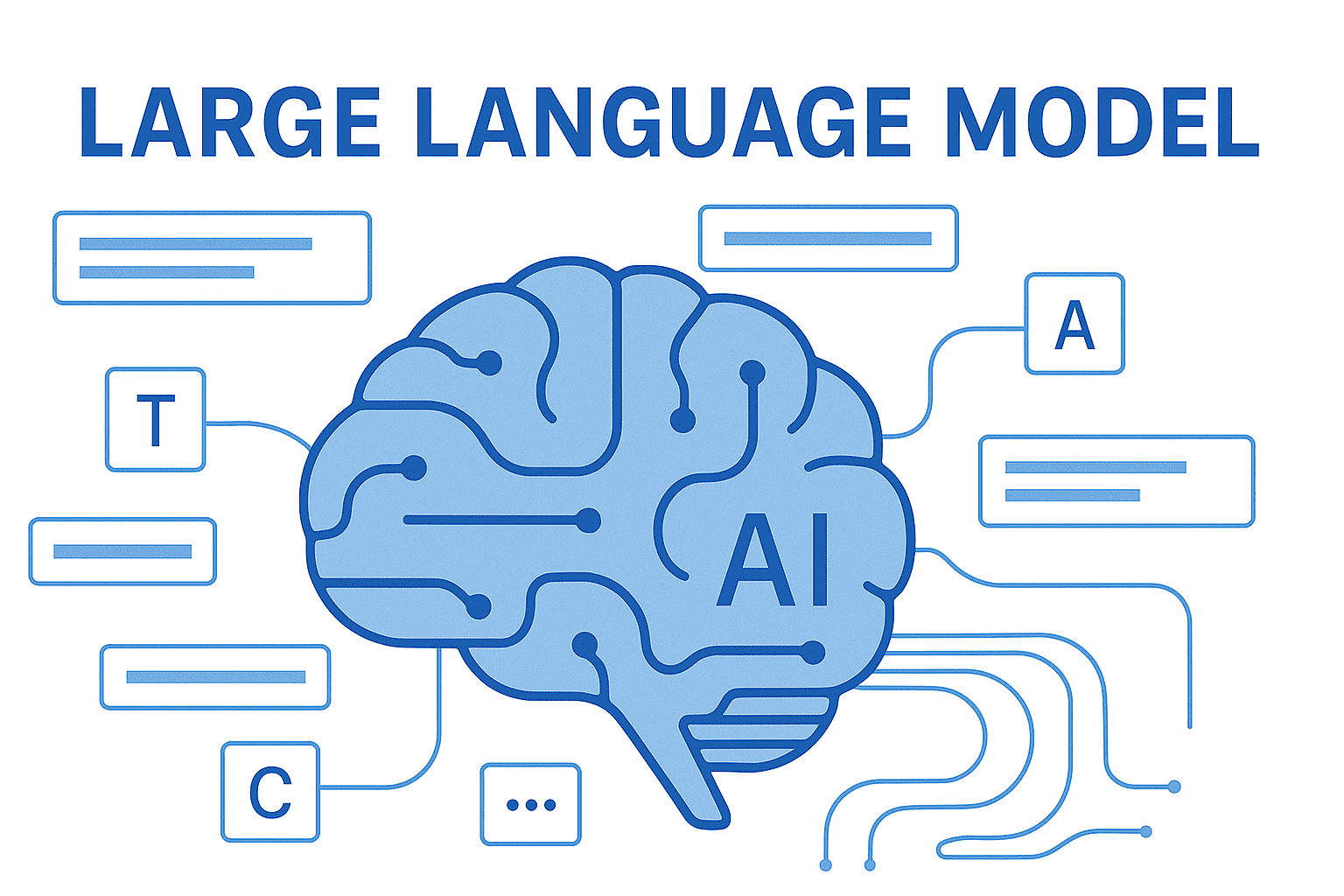
A large language model is a deep learning model trained on massive, general-purpose datasets, often scraped from a huge slice of the public internet, and built with anywhere from tens of billions to over a trillion parameters. Parameters are the internal variables a model learns during training, and the sheer number of them is what gives LLMs their broad, flexible reasoning ability.
Key characteristics of LLMs:
- Massive scale - models like GPT-4, Claude, and Gemini run into the hundreds of billions or trillions of parameters
- General-purpose reasoning - capable of writing, coding, translating, and multi-step problem-solving without task-specific training
- Broad world knowledge - trained on diverse data spanning nearly every domain and industry
- High compute cost - training can run into tens or hundreds of millions of dollars, and inference requires powerful, often cloud-based GPU infrastructure
- Higher latency - more parameters generally mean slower response times per query
LLMs remain the right tool when a task genuinely requires broad context, nuanced judgment, or reasoning across unfamiliar or unpredictable inputs, think open-ended research synthesis, legal contract review, or long-form creative writing.
What is a small language model (SLM)?
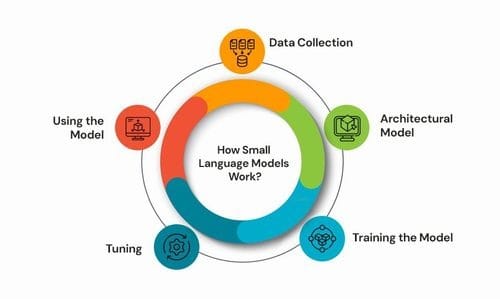
A small language model is built the same way as an LLM, using transformer-based architecture, but at a fraction of the scale, typically ranging from a few hundred million to around 10 billion parameters. The bigger shift isn't just size, it's what SLMs are trained on: smaller, carefully curated, often domain-specific datasets instead of a broad scrape of the internet. That "textbook-quality" data approach is a big part of why models like Microsoft's Phi-3, Google's Gemma, and Mistral 7B can perform surprisingly well on focused tasks despite their size.
Key characteristics of SLMs:
- Compact size - light enough to run on laptops, smartphones, and edge devices, not just data-center GPUs
- Low latency - SLMs can deliver noticeably faster responses, which matters for real-time, interactive use cases
- Domain specialization - fine-tuned to be experts in a narrow area rather than generalists across all of them
- Lower cost - dramatically cheaper to train, fine-tune, and run at scale
- On-premise and offline capability - sensitive data can stay inside a company's own infrastructure instead of hitting a third-party API
SLM vs LLM: the key differences at a glance
Cost and inference: the number actually driving the shift
If there's one number behind the entire SLM vs LLM conversation in 2026, it's inference cost, since that's the expense that scales with every single user query, unlike training, which is a one-time cost. Estimates put GPT-4-class LLM inference at roughly $0.09 per 1,000 tokens, compared to around $0.0004 per 1,000 tokens for a model like Mistral 7B, a gap that translates into 10 to 100 times lower cost in production at scale.
That difference compounds fast once a product has real usage. A support chatbot answering a few thousand queries a day behaves very differently on an LLM-sized inference bill than it does on an SLM-sized one, and for most companies, that difference shows up directly on next quarter's cloud invoice.
There's a second, less obvious cost driver too: sustainability. LLM data centers consume enormous amounts of energy, and as compute costs and environmental scrutiny both rise, SLMs are increasingly framed as the more sustainable default for high-volume, narrow tasks, not just the cheaper one.
When an SLM is the right call
SLMs tend to win whenever a task is narrow, repetitive, latency-sensitive, or tied to data that can't leave a private environment. Common scenarios include:
- On-device AI assistants smart replies, grammar correction, or voice commands where low latency matters more than broad reasoning
- Specialized customer support bots a chatbot trained only on a company's product catalog, FAQs, and return policy
- Document classification and data extraction pulling structured fields like invoice numbers or patient details from consistent document formats
- Code completion for a specific stack suggestions fine-tuned on a company's own codebase rather than every language and framework in existence
- Regulated industries healthcare, finance, and legal workloads where on-premise deployment simplifies compliance with regulations like HIPAA, GDPR, or CCPA
- Edge and IoT deployment smart devices, kiosks, and in-store tech that need to work offline or with unreliable connectivity
When you still need an LLM
LLMs remain the better choice whenever the task is genuinely open-ended, cross-domain, or requires nuanced judgment that a narrow model wasn't trained to make:
- General-purpose chatbots that need to handle unpredictable, wide-ranging user queries
- Cross-domain research and synthesis pulling context from multiple unrelated fields at once
- Creative content generation requiring nuanced tone, originality, and long-form coherence
- Complex reasoning tasks like multi-step problem-solving or reviewing legal contracts
- Teams with strong compute budgets who need a plug-and-play model without building specialized infrastructure first
The hybrid approach: why most companies aren't choosing sides
The honest 2026 answer to "SLM vs LLM" isn't a single winner, it's both, deployed in tiers. Most mature AI strategies now route simple, high-volume queries to a fast, cheap SLM, and escalate only the genuinely complex, ambiguous, or high-stakes requests to an LLM. This is often described as a router or Mixture-of-Experts pattern, and it's becoming the default enterprise architecture rather than the exception.
A typical tiered setup looks like this:
In practice, this means a simple where's my order query gets handled instantly and cheaply by an SLM, while a genuinely complex, comparative question gets routed to an LLM capable of nuanced reasoning. It's a smarter, more economically sustainable way to scale AI across an organization than betting everything on one model size.
Frequently asked questions
What is the main difference between an SLM and an LLM?
The core difference is scale and specialization. LLMs have tens of billions to trillions of parameters and are trained for broad, general-purpose reasoning. SLMs have far fewer parameters, usually under 10 billion, and are trained or fine-tuned on curated, domain-specific data to excel at narrower tasks.
Are SLMs as accurate as LLMs?
On domain-specific tasks, often yes. The performance gap between fine-tuned SLMs and general-purpose LLMs has reportedly narrowed to as low as 2% for specialized use cases, down from around 20% a few years ago. On broad, general-knowledge tasks, LLMs still have the edge.
Can an SLM run on a laptop or phone?
Yes. Many SLMs, including models like Microsoft's Phi-3, are specifically designed to run on standard CPUs, laptops, and smartphones without needing a constant cloud connection.
Which is cheaper to run, SLM or LLM?
SLMs are significantly cheaper at inference, often 10 to 100 times lower cost per 1,000 tokens than a large, general-purpose LLM. Training costs also tend to be far lower since SLMs use smaller, curated datasets instead of web-scale data.
What is the hybrid approach to AI models?
It's an architecture where fast, cheap SLMs handle routine, high-volume queries, and complex or ambiguous requests are escalated to a more powerful LLM. This lets companies optimize for both cost and capability instead of picking one model size for every task.
Which one should you actually use
There isn't a universal winner in the SLM vs LLM debate, and by 2026 that's a settled point rather than a hot take. If your task is narrow, repetitive, latency-sensitive, or tied to data that needs to stay on-premise, an SLM is almost always the more practical, cost-efficient choice. If your task genuinely needs broad reasoning, creative range, or the ability to handle unpredictable, cross-domain queries, an LLM is still worth the higher cost.
For most growing companies, the real answer is a hybrid stack: SLMs doing the heavy lifting on routine, high-volume work, with an LLM held in reserve for the complex edge cases that actually need it. Betting everything on model size alone was always the less efficient strategy, matching model capability to the problem is what's actually driving results in 2026.
If you're building the skills to work on this kind of AI infrastructure yourself, from fine-tuning specialized models to designing hybrid AI systems, that's exactly the kind of practical, in-demand skill set that's shaping AI and ML hiring right now.