
Artificial Intelligence and Data Science: how they work together

Artificial intelligence (AI) and data science are two closely linked but distinct fields. Data science is the discipline of collecting, cleaning, and analyzing data to extract insights, while AI, particularly machine learning, is a set of techniques that data scientists use to automate analysis, detect patterns, and make predictions. In short: data science supplies the structured, high-quality data that AI models need to learn, and AI, in turn, speeds up and scales what data scientists can do with that data.
The two terms get used almost interchangeably online, which causes real confusion for stud ents, career-switchers, and even hiring managers. This article breaks down exactly how AI and data science relate, where they diverge, and what it actually looks like to build a career that spans both.
What is the difference between AI and Data Science?
Data science is an interdisciplinary field focused on extracting insights from data using statistics, programming, domain knowledge, and visualization. A data scientist's job is to turn raw, messy data into a decision.
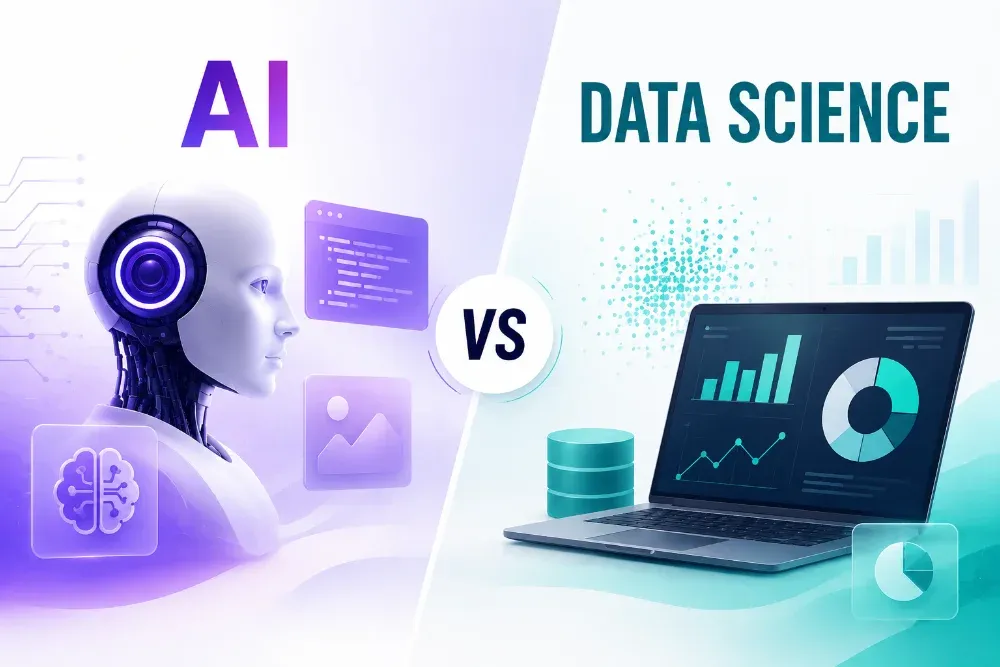
Artificial intelligence is a broader field focused on building systems that can perform tasks that normally require human intelligence recognizing images, understanding language, making predictions, or taking actions. Machine learning (ML), a subset of AI, is the specific set of techniques (regression, classification, neural networks, and so on) that data scientists use most often inside their workflow.
So the relationship isn't AI vs. data science it's closer to data science is the discipline, and AI/ML is one of its most powerful toolsets. A data scientist without any AI knowledge can still do useful statistical work. But a data scientist who understands AI can automate the repetitive 60-70% of the job (cleaning, feature engineering, first-pass modeling) and spend more time on the parts that actually require human judgment framing the right question, interpreting results responsibly, and communicating trade offs to stakeholders.
How AI fits into the Data Science workflow
Every data science project moves through roughly the same lifecycle: collect data, clean it, explore it, model it, deploy it, and monitor it. AI touches nearly every stage of that cycle now, not just the modeling step most people associate with it.
- Collection and preparation - AI-assisted tools flag missing values, duplicate records, and inconsistent formatting far faster than manual review, and can classify or tag unstructured data (text, images, PDFs) automatically.
- Exploration and pattern detection - Instead of manually testing every variable combination, ML models can surface correlations, clusters, and anomalies a human analyst might miss in a large dataset.
- Modeling - This is the most familiar overlap: regression, classification, and tree-based models are all "AI" in the technical sense, trained on the datasets data scientists prepare.
- Deployment and monitoring - Once a model is live, AI-driven monitoring tools track data drift and performance decay, alerting teams when a model needs retraining.
The result is a feedback loop: data scientists prepare and structure data, AI models generate insights and predictions from that data, and the outcomes of those predictions become new data that improves the next iteration.
Key ways AI enhances Data Science work
Automating Data Cleaning and Preparation
Data preparation is widely cited as the most time-consuming part of a data scientist's job some estimates put it at 60-80% of total project time. AI-assisted tools use pattern recognition to flag inconsistencies, standardize formats, and classify unstructured data automatically, which frees data scientists to spend more time on analysis and interpretation rather than manual cleanup.
Faster, more accurate predictive modeling
Predictive modeling estimates future outcomes (will this customer churn?), while prescriptive modeling recommends what to do about it (offer a discount, or don't?). AI allows data scientists to test many more model variations and feature combinations in the time it used to take to test one, which generally produces more accurate, better-calibrated predictions.
Pattern and anomaly detection at scale
Humans are good at spotting patterns in small datasets and bad at spotting them in millions of rows. AI techniques like clustering, feature extraction, and anomaly detection can surface relationships a fraud pattern, a customer segment, a supply chain bottleneck that would be effectively invisible to manual review.
Natural Language and Unstructured Data Analysis
A growing share of data isn't in neat rows and columns, it's support tickets, reviews, contracts, and PDFs. Generative AI and large language models (LLMs) let data scientists extract themes, summaries, and structured information from this unstructured data without building a custom pipeline for every use case.
Real-world applications of AI in Data Science
AI-driven data science shows up across nearly every industry today:
- Healthcare - Medical imaging models assist radiologists in spotting abnormalities earlier, while predictive models flag high-risk patients for early intervention and automate administrative work like claims processing.
- Finance - Banks and fintech firms use AI-driven data science for real-time fraud detection, credit risk scoring, algorithmic trading, and portfolio optimization.
- Retail and E-commerce - Recommendation engines, demand forecasting, and dynamic pricing all depend on models trained on continuously updated customer and inventory data.
- Marketing - Sentiment analysis on reviews and social posts, churn prediction, and customer segmentation all combine data science's analytical rigor with AI's ability to process unstructured, high-volume data.
- Education - Adaptive learning platforms adjust content difficulty in real time based on a learner's performance data, and intelligent tutoring systems identify specific knowledge gaps.
Common tools used in AI-driven data science
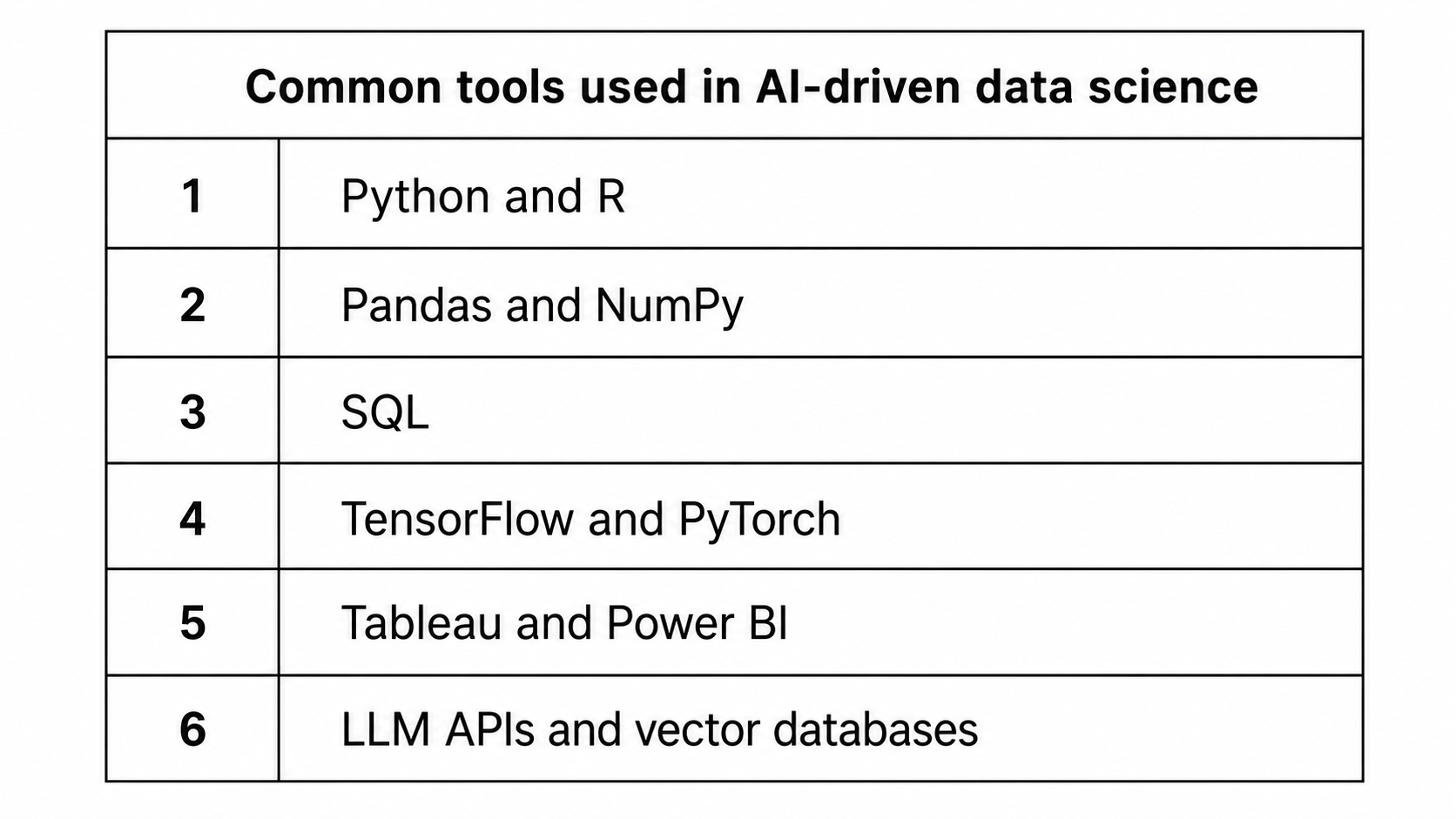
A working data scientist typically moves across several layers of tooling:
- Python and R - The core programming languages for data manipulation, statistical modeling, and building ML pipelines.
- Pandas and NumPy - The standard libraries for cleaning, transforming, and doing vectorized computation on tabular data.
- SQL - Still the primary way structured data is queried and joined out of relational databases before any modeling happens.
- TensorFlow and PyTorch - Open-source deep learning frameworks used to build and train neural network models at scale.
- Tableau and Power BI - Visualization tools that turn model output and analysis into dashboards non technical stakeholders can actually use.
- LLM APIs and vector databases - Newer additions to the stack, used for retrieval-augmented generation (RAG), semantic search, and building GenAI features on top of a company's own data.
Benefits and challenges of combining AI and Data science
Benefits:
- Faster time-to-insight. What used to take a data team weeks of manual analysis can often be compressed into days.
- Higher predictive accuracy, provided the underlying data is clean and representative.
- Continuous improvement. Well-built systems keep learning from new data rather than staying static after launch.
Challenges:
- Algorithmic bias. A model is only as fair as the data it's trained on incomplete or skewed datasets produce skewed predictions.
- The black-box problem. As models get more complex, it becomes harder to explain why a model made a specific decision, which matters a lot in regulated industries like finance and healthcare.
- Overreliance on automation. Teams that lean on AI output without understanding the statistical fundamentals underneath it risk building systems that look sophisticated but are quietly wrong.
The strongest data teams treat AI as a force multiplier for good statistical practice, not a replacement for it someone still has to ask whether the model's assumptions hold, whether the training data reflects reality, and whether the result is even the right thing to be optimizing for.
Is Data Science at risk from AI?
Not in the sense of being replaced. AI is automating the routine parts of the job data cleaning, first-pass exploration, boilerplate code which is shifting what "data scientist" means day to day. The professionals who struggle are the ones whose entire value was manual, repetitive execution. The ones who do well are the ones who move up the stack: framing better questions, validating model outputs critically, and translating results into decisions a business can actually act on. If anything, AI has raised the bar for what a good data scientist is expected to deliver, not lowered the need for one.
The future of AI and Data Science
Three shifts are already visible heading into the second half of 2026:
- Deeper integration across the workflow. AI is moving from "a tool data scientists sometimes use" to infrastructure baked into every stage of the pipeline from ingestion to monitoring.
- A stronger emphasis on responsible AI. Bias auditing, explainability, and governance are becoming standard project requirements, not optional add-ons, especially as regulation catches up with adoption.
- GenAI as a core data science skill, not a novelty. Prompt engineering, retrieval-augmented generation, and working with LLM APIs are increasingly expected skills for data science roles not a separate specialization.
How to actually build these skills
Reading about AI and data science and being able to do the work are two different things. The gap most self-taught learners hit isn't understanding the concepts individually it's the lack of a structured path that goes from I know what a neural network is to I can ship a working model and explain my decisions in an interview.
That structured path is exactly what a good program should give you, and it's the gap Masai's Certification in Data Science and Artificial Intelligence, delivered under E&ICT Academy, IIT Roorkee, is built to close.
A few things about how the program is put together are worth calling out specifically, because they map directly onto the workflow described above:
- It follows the same lifecycle this article does. The curriculum moves through Python and programming foundations, then NumPy/Pandas for data analysis, SQL and visualization for storytelling, applied statistics, machine learning (regression, classification, tree-based models, feature engineering), and finally a dedicated module on GenAI for data science prompt engineering, LLM APIs, embeddings, vector search, and RAG. It's the AI-and-data-science relationship covered earlier in this article, taught as a sequence rather than a list of buzzwords.
- The projects are built around real decisions, not toy datasets. One capstone has you training a CNN-based product-image classifier on an e-commerce dataset and producing a confusion-matrix breakdown a catalog team could actually act on. Another has you building a churn-prediction model with engineered RFM features, deploying it as a FastAPI endpoint, and writing a model card that addresses the ethical questions around retention targeting the exact kind of can you explain your model's trade-offs question that comes up in real interviews.
- It's a 6-month program, 8-10 hours a week, designed for people who are still in college or already working and can't drop everything to learn full-time.
- Instruction comes from a mix of IIT/industry faculty, including Professor Sanjeev Manhas (Principal Investigator, E&ICT Academy, IIT Roorkee) and industry mentors from companies like ByteDance and Simplismart, plus an optional 2-day campus immersion at IIT Roorkee.
- Certification carries the E&ICT Academy, IIT Roorkee name, and the program includes placement support resume reviews, career coaching, and interview prep for learners who meet the attendance and evaluation criteria.
If the sections above on data cleaning, predictive modeling, and GenAI-driven workflows sounded like the kind of work you'd want to be doing, that's essentially the syllabus. You can see the full curriculum, project briefs, and fee structure on the program page.
Frequently Asked Questions
Is AI a part of data science, or is data science a part of AI? Neither, strictly speaking they're overlapping fields. Data science is the broader discipline of extracting insight from data; AI (and specifically machine learning) is one of the toolsets data scientists use to do that work faster and at greater scale.
Do I need to know machine learning to be a data scientist? Not on day one, but most modern data science roles expect at least working knowledge of ML building, evaluating, and improving models is a core part of the job description at most companies today.
What's the difference between a data scientist and an AI engineer? A data scientist typically focuses on extracting insights and building models to answer specific business questions. An AI engineer typically focuses on building, deploying, and scaling AI systems (including LLM-based applications) as production software. The skill sets overlap heavily, especially around Python, ML fundamentals, and increasingly, GenAI tooling.
How long does it take to become job-ready in AI and data science? It depends on your starting point, but structured programs that combine foundational skills (Python, SQL, statistics) with applied ML and GenAI work like Masai's 6-month IIT Roorkee E&ICT program are built to take a learner from fundamentals to a portfolio-ready, interview-ready skill set in that window.