
AI visibility and GEO tracking tools in 2027: what they measure
AI visibility tools compared on vendor pages on 11 November 2026: what ten tools measure, what no tool can show, and a spreadsheet method with code.

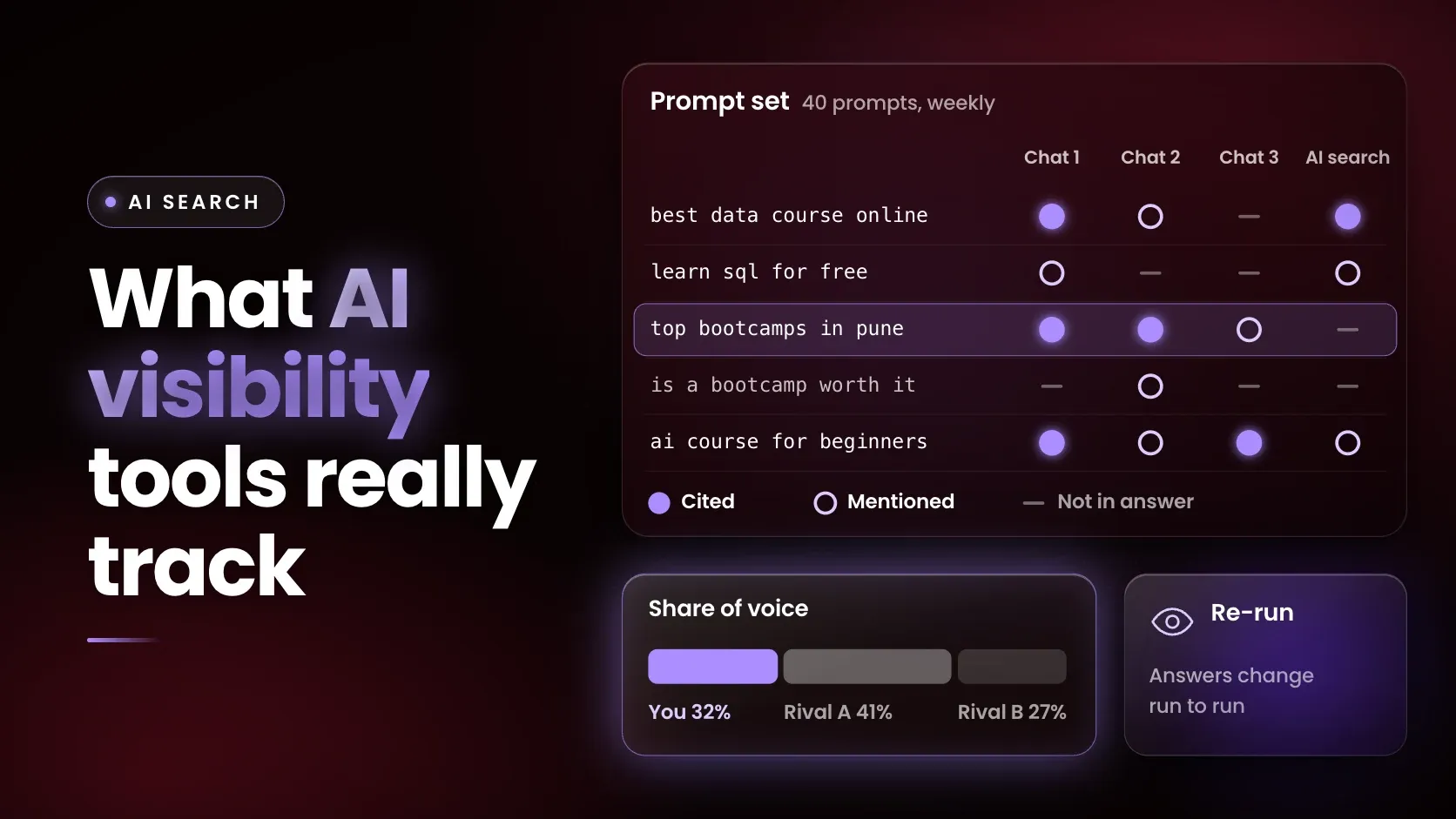
AI visibility tools measure how often a brand is mentioned or cited in answers from assistants and AI search, such as ChatGPT, Gemini, Perplexity, Google AI Overviews and AI Mode. They run a fixed set of prompts on a schedule and report mentions, citations and share of voice. Ten tools are checked as of 11 November 2026, and Semrush's own documentation says no platform can provide exact numbers.
Last updated: 11 November 2026.
What do AI visibility tools measure?
AI visibility tools measure mentions, citations and share of voice for a brand across a fixed prompt set, and each vendor defines the terms in its own way. Ahrefs defines a mention as the brand name appearing in answer text and a citation as the AI linking to the brand's pages. Peec AI draws the same line, counting a source citation when a site is used or cited even if the brand is not named.
Share of voice is where definitions diverge. Ahrefs counts the percentage of AI responses in a topic set that mention or cite the brand versus competitors, while Similarweb's Brand Mention Share is the brand's share of all brand mentions across tracked prompts. Similarweb scores each answer that mentions the brand as 1 and reports visibility as the mention rate. Bing's Citation Share is the percentage of citations attributed to a site out of all citations shown for the same grounding query.
What can AI visibility tools not measure?
No AI visibility tool can show exact numbers, because answers vary and the tools sample them. Semrush's documentation says AI search and LLM responses are fast-changing and highly personalized, so no platform can provide exact numbers, and it calls its own metrics directional signals. OpenAI's API documentation says Chat Completions are non-deterministic by default, so outputs may differ from request to request, which is one reason the same prompt can return different brands on different runs.
Tools also see a neutral view. Otterly.AI's help centre says it queries as a non-personalized user and that results often vary by region, so a tool's numbers are not what a logged-in person sees.
Access is not citation. Clarity's documentation says bot activity does not indicate that content was retrieved, grounded, cited or surfaced, and Bing says its citation counts do not indicate placement, ranking or page importance. Referral data has gaps too: Clarity says traffic from AI Overviews cannot be reliably separated from standard search because both share the same Google referrer, and Google Analytics places visits from sources like ChatGPT and Gemini in an AI Assistant channel that excludes AI Overviews and AI Mode.
Which first-party reports show AI visibility?
Google Search Console, Bing Webmaster Tools and Microsoft Clarity report on the vendor's own surfaces, and each comes from the search engine or analytics vendor itself.
Google Search Console
Google Search Console is Google's free service for monitoring a site's presence in Google Search, and its generative AI performance report shows impressions from AI Overviews and AI Mode by page, country, date and device. Google says it rolled the report out to all websites worldwide as of 31 August 2026. A site owner can see which pages were shown in AI features. The limit is scope: it counts impressions of links on Google's own features, not brand mentions in answer text.
Bing Webmaster Tools
Bing Webmaster Tools is Microsoft's webmaster service, and its AI Performance report, in public preview from February 2026, shows citations of a site's content across Microsoft Copilot, AI-generated summaries in Bing and select partner integrations. A June 2026 update added Citation Share. A publisher can see which pages are cited most. The limit is meaning: Microsoft says the counts do not indicate placement, ranking or page importance.
Microsoft Clarity
Microsoft Clarity is a behavioral analytics service, described by Microsoft Learn as free, with an AI Visibility area. Its Citations dashboard shows page citations, share of authority, query topics and queries, and its Bot Activity dashboard reads server-side logs from a connected CDN or server integration. A site owner can see which pages are cited and which bots visit. The limit is that bot access is not citation, and the Citations page does not list which assistants its data covers.
Which third-party tools track prompts across assistants?
Semrush, Ahrefs, Similarweb, Profound, Peec AI, Otterly.AI and Scrunch run a prompt set on a schedule and report what assistants say about a brand. Most list the assistants they cover on their own pages, and the lists differ.
Semrush
Semrush is an SEO platform, now part of Adobe after Adobe's acquisition completed on 28 April 2026. Its AI Visibility Toolkit offers an AI Visibility Score, competitor and prompt research, brand performance, prompt tracking and an AI search site audit. Semrush lists ChatGPT, Gemini, Google AI Mode and AI Overviews for visibility reports and adds Perplexity for brand performance. A team can track a fixed prompt set daily. The limit is Semrush's own: its metrics are directional signals.
Ahrefs
Ahrefs is an SEO platform whose Brand Radar reports mentions, citations, AI Share of Voice and estimated impressions across AI Overviews, AI Mode, ChatGPT, Perplexity, Gemini and Copilot, with Custom Prompts also covering Claude. A marketer can add the exact questions buyers ask and track them daily, weekly or monthly. The limit is coverage: Ahrefs says its index works best for established brands or topics with meaningful search demand and may have limited coverage for brands with little or no search volume.
Similarweb
Similarweb's AI Brand Visibility tracker covers ChatGPT, Google AI Mode, Gemini and Perplexity and updates daily, with prompt analysis, citation analysis and sentiment. A team can compare its Brand Mention Share with competitors on the topics it tracks. The limit is the platform list: the tracker covers four platforms for answers, while the page says the wider toolkit monitors AI-driven traffic from Grok, Claude and Microsoft Copilot.
Profound
Profound is an AI marketing platform whose home page lists ChatGPT, Perplexity, Claude, Gemini, DeepSeek, Google AI Overviews and Google AI Mode among the platforms it covers, and shows Answer Engine Insights, Citation Analytics, a visibility score by platform, sentiment and prompt volumes. A brand team can see which sources are cited in its category. The limit is breadth: measurement sits inside a wider platform with agents that draft content.
Peec AI
Peec AI is an AI search analytics platform that tracks brand mentions, position and sentiment, and its FAQ says each prompt runs once every 24 hours on every selected AI model. It exports through CSV, an API, a Looker Studio connector and MCP. An agency can report to clients from the exported data. The limit is a missing list: Peec AI's home page links tracker pages for ChatGPT, Gemini, Perplexity and AI Mode but publishes no full list of models on its home page or FAQ.
Otterly.AI
Otterly.AI is an AI search monitoring platform whose help centre says it queries ChatGPT, Google AI Overviews, Google AI Mode, Perplexity, Gemini, Claude and Microsoft Copilot daily for the prompts a team defines, and its public API exposes brand reports and citations. A brand team can check whether a prompt such as the best running shoes for a marathon mentions it. The limit applies to every tool here: Otterly.AI queries as a neutral user, so a person's own answer can differ.
Scrunch
Scrunch is an AI search platform whose home page presents AI Monitoring and Citations, with prompt monitoring, citations and signals, plus AI search trends. A team can see which sites are cited in answers to its prompts. The limit is that Scrunch's home page and its Monitoring and Citations page do not list which AI platforms the monitoring covers, so coverage should be confirmed before buying.
How do the ten AI visibility tools compare?
The table lists what each vendor says it covers and its main limit, as checked on 11 November 2026.
| Tool | Best for | Surfaces the vendor lists | Main limit |
|---|---|---|---|
| Google Search Console | AI Overviews and AI Mode impressions | AI Overviews, AI Mode | Impressions only, Google features only |
| Bing Webmaster Tools | Citations in Copilot and Bing | Copilot, Bing summaries, select partners | Counts do not show placement |
| Microsoft Clarity | Citations and bot access on your own site | Not listed on the Citations page | Bot access is not citation |
| Semrush | Prompt tracking beside SEO data | ChatGPT, Gemini, AI Mode, AI Overviews, Perplexity | Directional signals |
| Ahrefs | Mentions and share of voice by topic | AI Overviews, AI Mode, ChatGPT, Perplexity, Gemini, Copilot | Thin for low-search brands |
| Similarweb | Mention share against competitors | ChatGPT, AI Mode, Gemini, Perplexity | Four platforms for answers |
| Profound | Citations and visibility by platform | ChatGPT, Perplexity, Claude, Gemini, DeepSeek, AI Overviews, AI Mode | Measurement inside a wider platform |
| Peec AI | Daily prompt tracking and exports | ChatGPT, Gemini, Perplexity, AI Mode (no full list) | Model list unclear |
| Otterly.AI | Brand reports and citations | ChatGPT, AI Overviews, AI Mode, Perplexity, Gemini, Claude, Copilot | Neutral-user queries |
| Scrunch | Monitoring and citations | Not listed on its pages | Coverage unclear |
How can you track AI visibility with a spreadsheet?
A spreadsheet can track AI visibility with a fixed prompt list, a fixed set of assistants and a log of every answer. The method has four steps.
- Write a fixed list of prompts in the words a buyer would use.
- Run each prompt on each assistant on a set schedule, several times, because outputs differ from run to run.
- Log the date, the assistant, the prompt, the brands mentioned and whether the site was cited.
- Calculate the rates below and compare like with like over time.
The rates follow vendor definitions. Mention rate is the answers that mention the brand divided by all answers, as in Similarweb's score of 1 per mention. Citation rate is the answers that cite the site divided by all answers. Share of mentions is the brand's mentions divided by all brand mentions, as in Similarweb's Brand Mention Share. Take a hypothetical brand, Acme, with two prompts run three times each.
import csv, io
from collections import Counter

RUNS = """run,prompt,brands_mentioned,site_cited
1,best crm for startups,Acme|Rival|Other,1
2,best crm for startups,Rival|Other,0
3,best crm for startups,Acme|Rival,1
4,crm with whatsapp,Rival,0
5,crm with whatsapp,Rival|Other,0
6,crm with whatsapp,Acme|Rival,0
"""
rows = list(csv.DictReader(io.StringIO(RUNS)))
mentions = Counter(b for r in rows for b in r["brands_mentioned"].split("|"))
n = len(rows)
print("answers:", n)
print("mention rate:", round(mentions["Acme"] / n, 2))
print("citation rate:", round(sum(int(r["site_cited"]) for r in rows) / n, 2))
print("share of mentions:", round(mentions["Acme"] / sum(mentions.values()), 2))
for p in sorted({r["prompt"] for r in rows}):
    hits = sum("Acme" in r["brands_mentioned"].split("|") for r in rows if r["prompt"] == p)
    print(p, "-> Acme in", hits, "of 3 answers")
Running it with Python 3.9.6 printed the output below.
answers: 6
mention rate: 0.5
citation rate: 0.33
share of mentions: 0.25
best crm for startups -> Acme in 2 of 3 answers
crm with whatsapp -> Acme in 1 of 3 answers
Acme appeared in 2 of 3 answers to the first prompt and 1 of 3 to the second, with identical wording in every run. Six answers are far too few to conclude anything, so a real log needs many more runs per prompt and keeps every run.
Do you need a paid tool to measure AI search?
No paid tool is needed to start measuring AI search visibility. Google describes Search Console as a free service and Microsoft Learn describes Clarity as a free service, and a spreadsheet covers the other assistants. Paid tools add scheduling, competitor comparison and scale across assistants.
Google's guidance on third-party tools says they have no access to Google's internal ranking data and cannot promise performance, so none of the ten is claimed to improve rankings. Free plans change, so the vendor's page decides.
How do AEO, GEO and SEO relate to these tools?
Google's guide says AEO stands for answer engine optimization and GEO for generative engine optimization, and that from Google Search's perspective optimizing for generative AI search is optimizing for the search experience, and thus still SEO. Google's AI features page adds that there are no additional requirements to appear in AI Overviews or AI Mode.
Measurement is a separate task from optimisation. The post on AEO versus GEO versus SEO covers the approaches, and the post on SEO tools lists tools for the traditional side. What visitors do after they arrive is the subject of the post on product analytics tools and the post on UX research and prototyping tools.
Where does the digital marketing programme fit?
Marketers who want structured practice with SEO, analytics and generative AI tools can look at Certification Program in Digital Marketing with Applied AI. It is an online programme from IIM Ranchi, run with Masai as the implementation partner, taught in live online classes with an optional campus immersion at IIM Ranchi, covering SEO, social media, email, paid ads, analytics and generative AI tools such as ChatGPT, with a capstone project. Its modules include Creating Content and Getting Found on Google and Making Sense of Data and Predicting Trends.
Frequently asked questions
What is an AI visibility tool?
An AI visibility tool measures how often a brand is mentioned or cited in answers from assistants and AI search, such as ChatGPT, Gemini, Perplexity and Google AI Overviews. It runs a fixed set of prompts on a schedule and reports mentions, citations and share of voice. Semrush says no platform can provide exact numbers, so the results are directional.
Can you track whether ChatGPT mentions your brand?
Yes, within limits. Semrush, Ahrefs, Similarweb, Profound, Peec AI and Otterly.AI each list ChatGPT among the assistants they track, and a spreadsheet with a fixed prompt list can do the same by hand. Answers vary from run to run and by region, so the result is a rate across many runs, not a single answer.
Do you need a paid tool to measure AI search?
No paid tool is needed to start. Google Search Console reports impressions in AI Overviews and AI Mode, Bing Webmaster Tools reports citations in Copilot and Bing, Microsoft Clarity reports citations and bot access, and a spreadsheet with a fixed prompt list covers other assistants. Paid tools add scale, scheduling and competitor comparison.
Do AI visibility tools improve rankings?
No tool improves rankings by being installed. Google's guidance says third-party tools do not have access to Google's internal ranking data and cannot promise performance, and its AI features page says there are no additional requirements to appear in AI Overviews or AI Mode. These tools measure what assistants say, and acting on the findings is separate work.
Why do AI visibility numbers differ between tools?
AI visibility numbers differ because tools use different prompt sets, different assistants, different schedules and different definitions. Ahrefs and Similarweb define share of voice differently, Otterly.AI queries as a neutral user, and OpenAI's documentation says model outputs may differ from request to request. Compare numbers within one tool over time, not across tools.
Next step
Write ten prompts a buyer would ask, run them on the assistants that matter, and log the results in a sheet for four weeks before paying for a tool. For structured practice with SEO, analytics and generative AI tools, the Certification Program in Digital Marketing with Applied AI page lists the programme's modules and how it is delivered. A wider list sits in an earlier post on AI tools for digital marketers.