
AI coding agents for non-developers: what they do and where they fail
AI coding agents for non-developers: four types, what each can safely change and why checking matters, as BCG finds 47% spend more time directing AI.

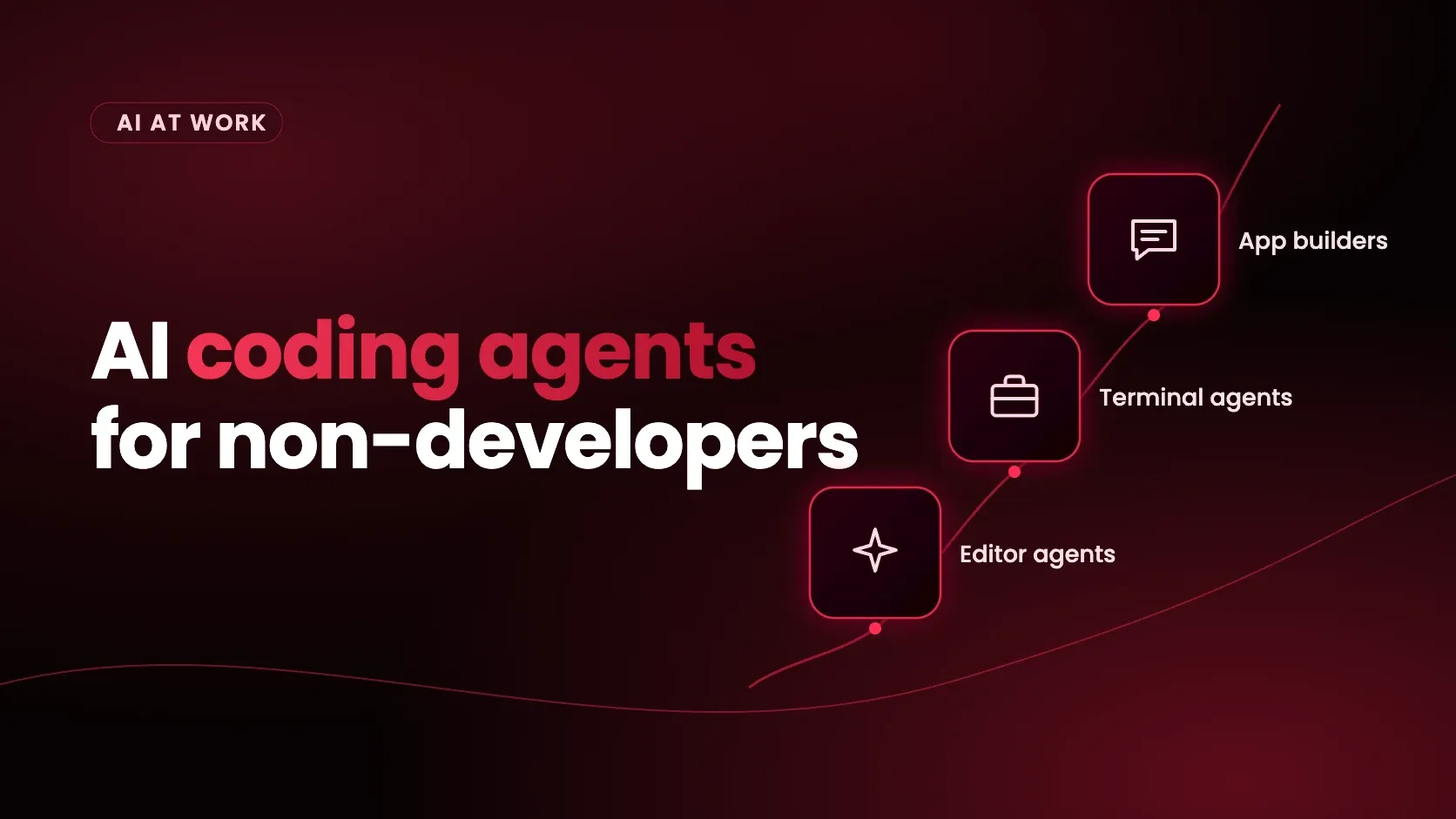
An AI coding agent is a tool that takes a written goal, writes and runs code in a project, reads its own errors and tries again, while a person approves or redirects the work. A non-developer can direct one without writing code. BCG's June 2026 survey found that 47% of respondents already spend more time managing and directing AI than doing the work themselves.
What is a coding agent, and how is it different from a chatbot?
A chatbot answers in a conversation and leaves the result for the person to copy somewhere. A coding agent acts on a project: it reads the files, makes a plan, edits several files, runs the program or its tests, and uses the error messages to try again. The person sets the goal, reviews what changed and decides whether to keep it.
That loop is why agents feel powerful to someone who has never programmed. It is also why they are risky, because a tool that can change many files and run commands can be wrong in many places at once. A beginner's guide to how AI agents work covers the mechanics.
Which type of coding agent suits a non-developer?
Product names change every few months, so the comparison below is by type. Each type differs in where it runs, what the user must be able to read and how easily a mistake is undone.
| Type | Where it works | What the user must read | Main risk |
|---|---|---|---|
| Editor-based agent | Inside a code editor, on files in a project folder | Code changes shown side by side | Large edits accepted without being read |
| Terminal agent | In a command window, on the user's own machine | Plans and command prompts in plain text | Commands that delete or overwrite files |
| Cloud agent | On a remote machine, returning a finished change for review | A summary and the proposed change | Waiting for a result that is wrong in a new way |
| App builder | In a browser, producing a hosted app from a description | The running app, not the code | Hidden data, permission and cost settings |
For a first build, an app builder or a cloud agent keeps the user away from the machine's own files, while an editor-based or terminal agent gives more control and asks for more care. Whichever type is used, the output is a draft to be checked. A person who wants to know whether coding itself is still worth learning can read is coding still worth learning after AI.
What does the evidence say about where AI help works and where it fails?
None of the strongest studies is about coding agents, so they are best read as evidence on how AI help behaves in general. The pattern is consistent: large gains on tasks inside AI's current ability, and quiet errors outside it.
Dell'Acqua and co-authors ran a preregistered experiment at Harvard Business School in 2023 with 758 BCG consultants. On 18 tasks inside AI's capability frontier, AI users completed 12.2% more tasks and 25.1% more quickly with higher quality. On a managerial task outside the frontier, AI users were 19% less likely to produce correct solutions. It was a GPT-4-era study.
Novices gained most in a field study. Brynjolfsson, Li and Raymond studied 5,179 customer support agents for the National Bureau of Economic Research, in a paper revised in November 2023, and found a generative AI assistant raised issues resolved per hour by 14% on average and by 34% for novice and low-skilled workers, with minimal impact on experienced workers. It covers one company's support staff, so it should not be stretched to managers or to every task.
A 2023 experiment reported by MIT News on 14 July 2023 gave 453 college-educated professionals occupation-specific writing tasks. ChatGPT access cut the time taken by 40% and raised quality, as rated by independent evaluators, by 18%. Those were 20 to 30 minute online tasks, not real jobs.
| Finding | Source and period | Figure | Limit |
|---|---|---|---|
| Tasks inside AI's frontier | Harvard Business School working paper, 2023 | 12.2% more tasks, 25.1% faster | 758 consultants, GPT-4 era |
| Task outside the frontier | Harvard Business School working paper, 2023 | 19% less likely to be correct | One managerial task |
| Novice workers | NBER, revised November 2023 | 34% more issues resolved per hour | One company's support staff |
| Directing AI | BCG, 3 June 2026 | 47% spend more time directing AI than doing the work | Survey of 11,749 workers in 14 markets |
Which roles and skills do employers list around coding agents?
Employers describe the work as design and delivery, not model research. Microsoft's India findings for its 2025 Work Trend Index say 92% of leaders are considering AI-specific roles and 57% expect teams to build multi-agent systems, naming roles such as AI Workflow Designer and Software Operator. These are intentions and Microsoft's own labels, not counted vacancies.
Naukri's AI at Work report of 16 July 2026 says recruiter searches increasingly look for people who can build, deploy and manage AI, with growing searches for AI Automation Engineer, Agent Builder and AI Product Manager. It gives no counts. In foundit's July 2026 tracker of AI-led fresher jobs, AI Operations made up 10% and AI QA and Testing 5%, and foundit says employers are buying "builders, not researchers".
Wider demand data is more modest. A PIB backgrounder of 12 February 2026, citing the World Bank South Asia Development Update, says 5.8% of India's white-collar job listings in 2025 required AI expertise, about 1 in 17, with Bangalore (11% of AI jobs), Hyderabad (9.57%), Pune (6.95%) and Chennai (6.62%) leading.
The same Naukri report found 77% of professionals use AI at work at least sometimes and 79% are upskilling in AI or plan to start soon. Use is wider than listings that name AI, though the two measures differ, and the same PIB backgrounder says demand is emerging for AI trainers and safety testers.
Postings show where the bar sits. Sarvam's Agent Engineer posting in Bengaluru, dated 20 August 2026, asks for evals that separate signal from noise and says what matters more than years is having shipped and run something real users depended on. It also asks for three or more years of experience and strong Python, so it is not an entry role.
Observe.AI's AI Agent Engineer posting in Hyderabad, dated 23 September 2026, is a delivery role covering prompt design, workflow configuration, API integrations and evaluation frameworks.
For a non-developer, the common thread is checking and shipping, which a coding agent helps with and does not replace. The wider list is in AI skills by job function.
Is it a problem if every line of code in a job came from an AI assistant?
Take a hypothetical graduate who has not written a single line of code by hand, because everything came from an AI assistant, and a hypothetical worker who started by asking an assistant for Python scripts and came to depend on it for most of the job. Neither position is a problem in itself. The problem is relying on code that nobody in the room can explain.
The test is whether the person can say what each part does, run it against known examples and say what happens when the input is wrong. That is the skill Sarvam's posting describes.
BCG's 2026 survey found 72% of respondents say AI has considerably changed skills expectations in their role. A Danish study by Humlum and Vestergaard, which linked adoption surveys to administrative records, found no earnings or hours effect larger than 2% two years after ChatGPT's launch, while employers created new tasks in content generation, AI oversight and AI integration. The change so far is in tasks, and oversight is one of the new ones.
A practical habit follows: after every AI-written change, ask the agent to explain it in plain words, then confirm the explanation by running the code on a case with a known answer.
What habits keep a non-developer out of trouble with a coding agent?
Version history comes first. A tool called Git records every state of a project, so any change can be undone. A non-developer should let the agent work on a copy, commit before each request, and read the list of changed files before accepting anything.
Permissions come second. An agent should be given only the folder it needs, never passwords or keys pasted into instructions, and no access to live customer data while it is being tried.
Tests come third: ask the agent to write checks from examples of correct output, and treat a test the agent wrote for its own code as weaker than one the person wrote from real cases. Small steps matter as well. One change per request is easier to review than a rewrite. Testing is covered in how to test an AI tool you built, and a first build in how to build an AI app without coding.
The AI Residency is a Leap by Masai programme for non-engineers who already use AI at work. It runs as an in-person residency, an online build phase and an in-person hackathon for qualifying participants. Each participant builds and deploys an AI product for their own work using coding agents, retrieval, MCP integrations, evaluations and security checks, with no prior coding experience needed. Learning on small reviewable builds, with or without a programme, keeps mistakes small enough to catch.
Frequently asked questions
What is AI coding?
AI coding means using an AI model to write, explain, test or fix code from instructions in ordinary language. It ranges from suggestions inside an editor to agents that plan and run a whole change. The person still decides what to build and whether the result is correct, which is the part that does not go away.
Can a non-developer use a coding agent safely?
Yes, on small builds that can be checked by hand and undone. Safe starting points are scripts that tidy a copy of a spreadsheet, internal calculators with known answers and prototypes shown to engineers. Anything that handles payments, sign-in or personal data, or sends messages to customers, needs an engineer's review first.
Where do people who cannot read code get stuck?
They get stuck when an error appears and the agent loops without fixing it, when a change breaks something that worked, and when the app depends on settings they never saw. Harvard Business School's 2023 experiment found AI users 19% less likely to be correct on a task outside AI's ability. Small steps and version history limit the damage.
Do coding agents replace developers?
The studies cited above do not show it. BCG's 2026 survey found 65% of managers and leaders believe agents will take over at least half of their job within three years, but that is a belief, not a measurement. Postings for applied AI roles still ask for shipped work and evaluation skills.
Which coding agent should a beginner start with?
No independent ranking of individual products is cited above, and they change quickly. A beginner can choose by type: an app builder or cloud agent for the least setup, an editor-based or terminal agent for more control. The better test is whether the tool shows what it changed and lets every change be undone.
Next step
The AI Residency, Leap by Masai page sets out the curriculum and how to apply.