
Agentic AI roadmap for 2027: skills, projects and learning order
A staged agentic AI roadmap for 2027: Python and APIs, LLM basics, tool calling, RAG, MCP, one framework, evaluation and deployment, each with a project.

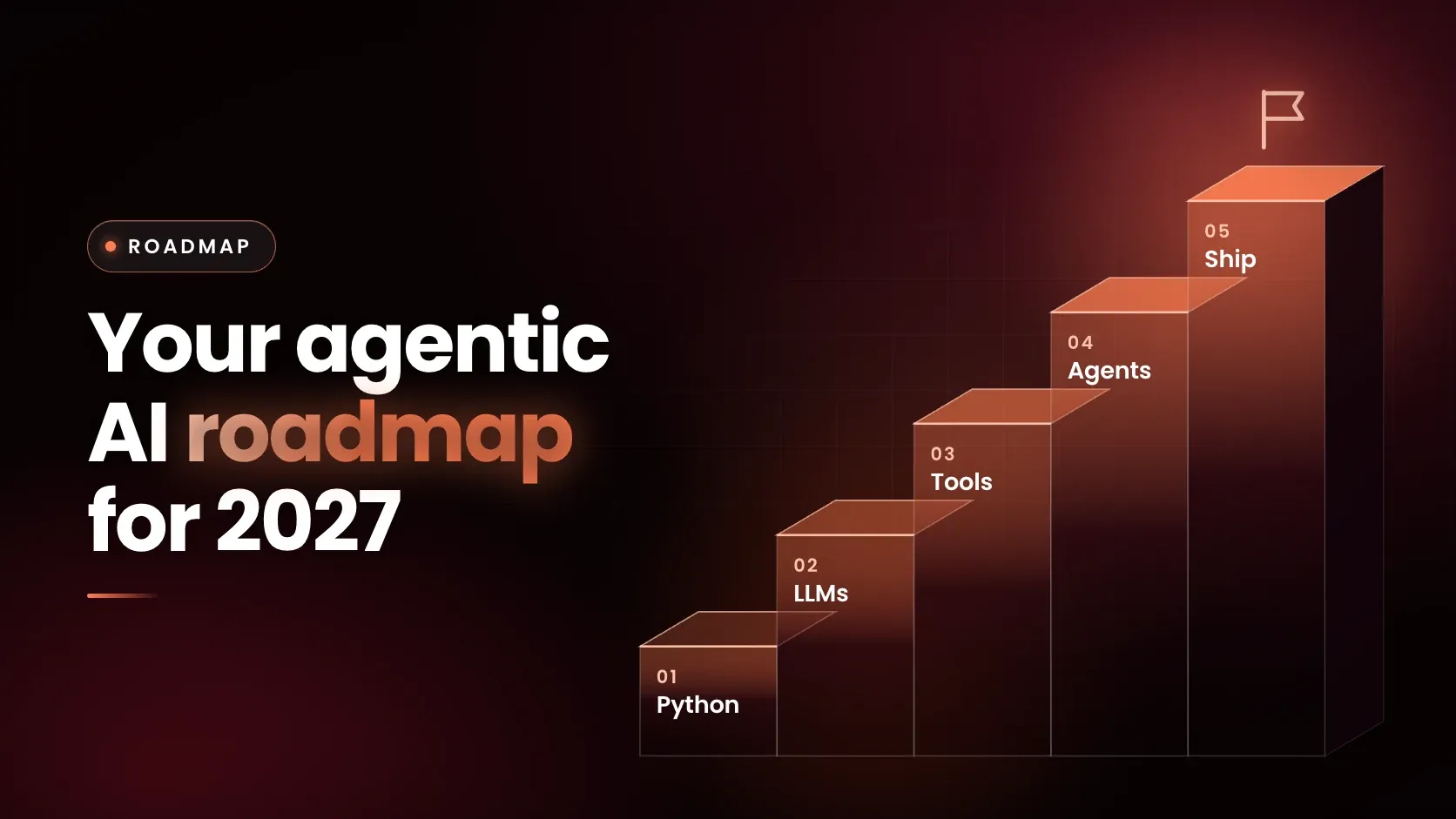
An agentic AI roadmap for 2027 runs through eight stages: Python and APIs, LLM basics and prompting, tool calling, retrieval, MCP, one agent framework, evaluation and deployment. Each stage below names the skill, one project and a check before moving on. Demand is visible but uneven: Naukri's JobSpeak for September 2026 put AI and ML roles 20% above a year earlier.
What is the learning order for agentic AI?
The order follows the dependency of each skill on the one before it, and it matches the order of Anthropic's free Building with the Claude API course: API basics, prompt evaluation, tool use, retrieval, MCP and finally agents and workflows. The table summarises the eight stages.
| Stage | Skill | Project | Check before moving on |
|---|---|---|---|
| 1. Python and APIs | Virtual environments, JSON, HTTP calls, secrets kept out of code | A command-line tool that calls a public API and prints a cleaned result | Runs in a fresh environment and handles a failed request |
| 2. LLM basics and prompting | Messages, system prompts, success criteria | An extractor prompt scored on 20 test cases | Two prompt versions compared on the same test set |
| 3. Tool calling | Tool schemas, the agent loop, stop conditions | An order assistant with two read-only tools and one tool that needs approval | The loop stops on a step limit and the approval cannot be skipped |
| 4. Retrieval (RAG) | Chunking, embeddings, keyword search, citations | Question answering over a few public documents | Retrieval scored on questions with known source passages |
| 5. MCP | Tools, resources and prompts served over a protocol | An MCP server around one small data source | A host connects, and write tools need approval |
| 6. One framework | State, handoffs and pausing in one library | The stage 3 assistant rebuilt in a framework | The framework's version is pinned and its role is explainable |
| 7. Evaluation and safety | Test sets, graders, risk rating of tools | A regression suite for the stage 6 agent | A score before and after every change |
| 8. Deployment | An API, a container, traces, cost limits | The agent behind an HTTP endpoint | A failed run can be diagnosed from its trace |
Is there demand for agentic AI skills in India?
Some, concentrated in experienced roles. Naukri's September 2026 JobSpeak reported AI and ML hiring up 20% year on year while overall white-collar hiring grew 2% and IT and software services hiring fell 4%. Its AI at Work analysis of 16 July 2026 says recruiters increasingly search for roles that include Agent Builder.
Named postings show the experience bar. Sarvam's Agent Engineer role in Bengaluru (20 August 2026) hires from 3+ years of experience. Rubrik's Senior Applied AI Engineer role in Bangalore (updated 21 October 2026) targets 8+ years of software engineering with 1 to 2 years shipping AI-agent features. Observe.AI's AI Agent Engineer role in Hyderabad (23 September 2026) is delivery-focused work on voice and chat agents, "not building foundational AI models". Bloomberry's analysis of about 1,000 forward deployed engineer postings, mostly from the United States, found AI agents named in 35% and Python in 66%.
What do the eight stages involve?
Stage 1: Python and APIs
Learn functions, virtual environments, JSON and HTTP calls. Python's documentation describes a virtual environment as a self-contained directory tree with its own Python installation and packages, and JSON as the lightweight interchange format that tool arguments and API responses use. Sarvam's posting asks for strong Python with range across backend, data pipelines, APIs and cloud, so this stage is a requirement and not a warm-up.
Stage 2: LLM basics and prompting
Learn messages, system prompts and structured output. Anthropic's prompt engineering overview says to begin with success criteria, a way to test against them and a first draft prompt, and notes that a different model can fix latency or cost more easily than prompt changes. Move on when two prompt versions can be compared on one fixed test set.
Stage 3: Tool calling
A tool is a function described by a JSON schema that the application runs on the model's request. Hugging Face's AI Agents Course frames the vocabulary as tools, thoughts, actions and observations, and the OpenAI Agents SDK turns a typed Python function into a tool with automatic schema generation. Write the loop by hand once, with a step limit, before any library does it for you.
Stage 4: Retrieval
Retrieval-augmented generation retrieves relevant passages and adds them to the prompt. Learn chunking, embeddings, keyword search such as BM25 and citations, all of which appear in Anthropic's course. Measure retrieval separately from answers, because a wrong passage leads to a wrong answer. Anthropic also notes that a knowledge base under 200,000 tokens can simply go into the prompt.
Stage 5: MCP
The Model Context Protocol lets a server expose tools, resources and prompts to any MCP-capable application. Build one small server and connect it to a host, starting with read-only tools. The Model Context Protocol guide covers the first server step by step. Keep write tools behind approval; the specification says there should always be a human able to deny tool calls.
Stage 6: One framework
Pick one library, such as LangGraph, the OpenAI Agents SDK or CrewAI, and rebuild the stage 3 assistant in it, adding a pause for approval. Pin the version and be able to say what the framework does that the hand-written loop did. Add more agents only when one fails: the multi-agent systems guide lists the patterns and their costs.
Stage 7: Evaluation and safety
Anthropic's agent evals guidance defines tasks, trials and graders, separates capability evals from regression evals and recommends running several trials because outputs vary. OWASP's Excessive Agency entry adds the safety half: fewer and narrower tools, minimum permissions and human approval for high-impact actions. Rate each tool low, medium or high risk and write down which approval each needs.
Stage 8: Deployment
Expose the agent as an API, for example with FastAPI, which its documentation describes as a web framework for building APIs with Python based on type hints. Package it in a container, which Docker's documentation defines as an isolated process with all the files it needs. The OpenAI Agents SDK enables tracing by default, and LangGraph lists durable execution so runs can resume after failures.
Which agentic AI projects are worth building?
Projects count when someone else can check them. The table above gives one project per stage. Grouped by difficulty, the strongest set for a portfolio is:
- Beginner: an order-status assistant with a step limit and one approval-gated action.
- Beginner: question answering over public documents with citations and a retrieval test set.
- Intermediate: an MCP server over one data source, used from an MCP-capable application.
- Intermediate: a research agent with a lead and parallel workers, compared against a single-agent baseline.
- Advanced: a deployed agent with traces, a regression suite and a written risk rating for every tool.
A project README should state what the agent may and may not do, show the test set and list failures found. Longer idea lists are in top 10 agentic AI project ideas for beginners and agentic AI project ideas by difficulty.
How long does it take to learn agentic AI?
No publisher gives an average, and the time depends on the starting point in Python. Published workloads give a floor for the learning material only. Hugging Face designs each chapter of its AI Agents Course for about 3 to 4 hours of work in a week, and LangChain Academy's LangGraph course has 6 hours of video. Microsoft's free course has 18 lessons.
Building the eight projects takes longer than watching lessons, and the evaluation and deployment stages are where most of the extra time goes. Plan by stages passed, not by weeks elapsed.
Do you need machine learning to build AI agents?
Not to build agents on hosted models. Observe.AI's AI Agent Engineer posting describes prompt design, workflow configuration, API integrations and evaluation frameworks, and says the role is not building foundational AI models. Sarvam's Agent Engineer posting asks for context engineering, tool use, structured outputs, memory and evals on top of strong Python.
Model training is a different job. Sarvam's ML Engineer posting for training infrastructure (7 October 2026) asks for distributed training experience with Megatron-LM, DeepSpeed or FSDP, GPU and CUDA knowledge and strong PyTorch internals. Machine learning knowledge helps with evaluation, but it is not the entry requirement for agent work.
What are the limits of this roadmap?
A roadmap does not replace experience. The postings above ask for 3+ and 8+ years, and within the IT sector Naukri's September 2026 data shows AI and ML hiring for 13 to 16 years of experience up 54% against 19% for freshers. The stage projects are proof of ability, not credentials.
Forecasts also warn against hype. Gartner predicted on 25 June 2025, as reported by W.Media, that more than 40% of agentic AI projects will be cancelled by the end of 2027 because of costs, unclear value or weak risk controls. That is a forecast, not a measured result, but it supports the evaluation stage.
AI coding tools can speed up practice, yet they can slow learning. Anthropic's randomised trial of 52 mostly junior developers found the AI-assisted group scored 50% on a comprehension quiz against 67% for hand-coders, and the people who asked follow-up questions kept more. Claude Code, Cursor, GitHub Copilot and Codex compares the tools; the habit to keep is explaining every generated line.
Where does this roadmap fit in an AI and ML programme?
Certification in Artificial Intelligence and Machine Learning is an online programme from Vishlesan i-Hub, IIT Patna, delivered on Masai's online platform, that covers Python, machine learning, deep learning, generative AI and LLMs, agentic systems and deploying models to production. Its modules run from Core Programming and Analytical Foundations to Generative AI, LLM Engineering and Agentic Systems and Production Deployment, MLOps and Capstone, which mirror the roadmap's first and last stages.
Frequently asked questions
How long does it take to learn agentic AI?
No publisher gives an average, and the time depends on prior Python skill. Hugging Face designs each chapter of its free AI Agents Course for about 3 to 4 hours a week, and LangChain Academy's LangGraph course has 6 hours of video. Building the projects takes longer than finishing the lessons.
Do you need machine learning to build AI agents?
No. Agent work on hosted models is mostly software engineering: Python, APIs, prompts, tools, evaluation and deployment. Observe.AI's AI Agent Engineer posting says the role is not building foundational AI models. Training and tuning models is a separate specialty with its own requirements.
What projects prove agentic AI skills?
Projects that others can check: an agent with typed tools and an approval step, retrieval with a test set, an MCP server, and a deployed agent with traces and a regression suite. Each should include a README listing what the agent may do, the test cases and the failures found.
Which programming language should you use for agentic AI?
Python is the safe default. Bloomberry's analysis of about 1,000 forward deployed engineer postings found Python in 66% and TypeScript in 35%, and DevRev's India posting lists TypeScript, JavaScript or Python. LangGraph and the OpenAI Agents SDK also have JavaScript and TypeScript versions, while CrewAI is Python only.
In what order should you learn agentic AI?
Learn Python and APIs, then LLM basics and prompting, tool calling, retrieval, MCP, one framework, evaluation and deployment. Build the tool-calling loop by hand before using a framework, and add evaluation before deployment. Anthropic's free API course follows a similar order from API basics to agents and workflows.
Next step
Start stage 1 this week and finish one project before opening the next stage. The Certification in Artificial Intelligence and Machine Learning page lists the modules on agentic systems and production deployment for readers who want a guided route through the later stages.