
15 Generative AI use cases transforming every industry in 2026 (with real examples)

Generative AI use cases have moved from experimental pilots to core business infrastructure. As of 2026, roughly two-thirds of organizations use generative AI in at least one business function, and over 80% are expected to have a genAI-enabled application in production by year's end, according to Gartner. That shift from "trying AI" to "running on AI" is why the question has changed from "what is generative AI?" to "which generative AI use case actually works?"
This guide answers that second question. Below are 15 real, verifiable generative AI use cases across 10 industries, each with a named company, a concrete example, and the data behind it not hypotheticals.
Quick Answer
Generative AI is currently delivering the most measurable value in: code generation (up to 55% faster development), customer service automation (50-70% faster resolution), content and marketing copy (used by roughly 85-89% of marketers), drug discovery (cutting research timelines from years to months), and financial reporting (Deloitte projects over half of standard financial reports will be AI-generated within two years). The industries seeing the highest documented ROI are financial services (4.2x) and media/telecom (3.9x).
Table of Contents
- What Is Generative AI?
- Generative AI Adoption: Key 2026 Stats
- 15 Generative AI Use Cases by Industry
- Generative AI Use Cases at a Glance (Table)
- Real-World Success Stories
- Generative AI vs. Predictive AI: What's the Difference?
- Benefits of Generative AI in Practice
- Challenges and Risks to Know Before You Deploy
- How to Start Using Generative AI in Your Work
- The Future of Generative AI
- FAQs
What Is Generative AI?
Generative AI is a category of artificial intelligence that creates new content text, images, audio, video, or code rather than just analyzing or classifying existing data. It works by training large neural networks (commonly Transformers or diffusion models) on massive datasets, allowing the system to learn patterns well enough to produce original outputs that resemble human-made work.
Tools like ChatGPT, Google Gemini, Claude, Midjourney, and GitHub Copilot are all generative AI applications. What separates generative AI from earlier "predictive" AI is simple: predictive AI tells you what's likely to happen next; generative AI actually creates the next thing itself a paragraph, an image, a block of code, a synthetic dataset.
Generative AI Adoption: Key 2026 Stats
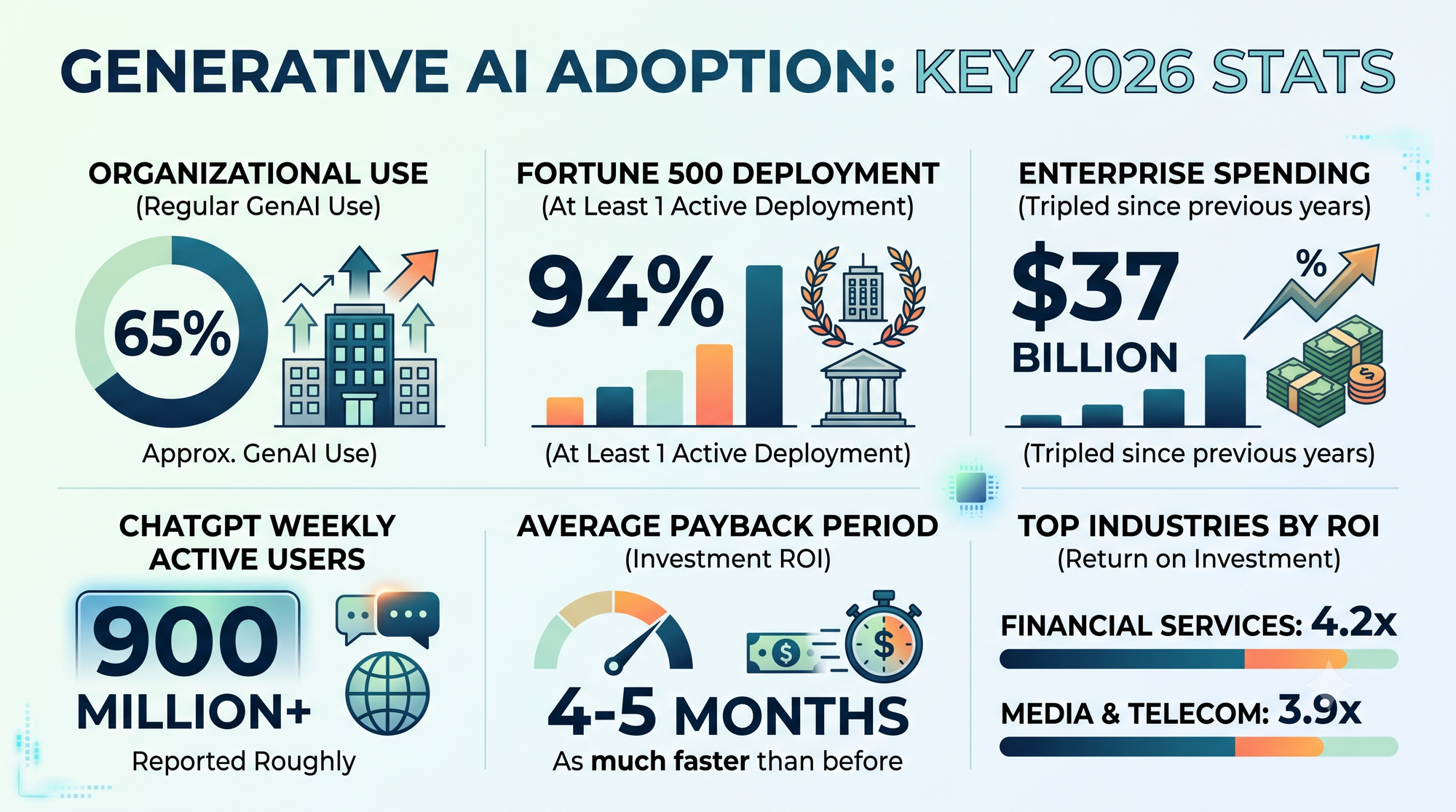
- The generative AI market has reached roughly $91.6 billion in 2026, with enterprise spending having tripled to around $37 billion.
- About 65% of organizations now use generative AI regularly in at least one business function nearly double the rate from ten months earlier.
- ChatGPT alone processes billions of queries and has surpassed 900 million weekly active users as of early 2026.
- 94% of Fortune 500 companies report at least one active generative AI deployment.
- Average payback period on genAI investment has compressed from around 18 months in 2024 to roughly 4-5 months in 2026 as tooling has matured.
- Financial services organizations report the strongest documented ROI at 4.2x, followed by media and telecom at 3.9x.
The pattern across nearly every industry report: the companies capturing real returns are the ones applying generative AI to a specific, high-volume, repeatable workflow not the ones handing employees a general chatbot and hoping for the best.
15 Generative AI Use Cases by Industry
1-2. Healthcare & Pharmaceuticals
Drug discovery and molecule design. NVIDIA and AstraZeneca built MegaMolBART to generate novel molecular structures and speed up early-stage drug discovery. Insilico Medicine used generative AI to identify a fibrosis treatment candidate in under 18 months, a process that traditionally takes years.
Clinical documentation and diagnostics support. Generative AI now drafts patient summaries, transcribes clinical notes, and can synthesize or enhance medical images (X-rays, MRIs) to help track disease progression over time.
3-4. Finance & Banking
Fraud detection. With deepfake-driven fraud reportedly surging since 2023, banks are replacing legacy signature-based fraud systems with generative models that simulate and detect novel fraud patterns in real time.
Automated financial reporting. Generative AI now drafts earnings summaries, risk reports, and regulatory filings from structured data. Deloitte's 2026 State of AI in the Enterprise report projects that more than half of standard financial reports will be AI-generated within two years. JPMorgan Chase separately uses generative AI to create synthetic transaction data for fraud-model training without exposing real client data.
5. Software Development
AI-assisted coding. GitHub Copilot and similar tools now suggest, complete, and debug code in real time. Reported gains range up to 55% faster development cycles, though independent research also flags a rise in duplicated code and security flaws in AI-generated code that still require experienced review speed without oversight just produces bugs faster.
6-7. Manufacturing & Supply Chain
Generative design. Siemens and BMW use generative design algorithms to produce lighter, stronger mechanical components while minimizing material waste often running thousands of design variations before selecting the optimal one.
Digital twins and predictive maintenance. Manufacturers now simulate production line changes virtually before making them physically, with some organizations reporting up to 70% reductions in assembly failure rates. Generative models also create synthetic sensor data for rare equipment-failure scenarios that real-world data doesn't capture often enough to train on.
8-9. Marketing, Advertising & Content
Personalized campaigns and creative generation. Coca-Cola's "Create Real Magic" campaign let users generate branded artwork using OpenAI's GPT and DALL·E. In 2026, roughly 85% of marketers use AI for content tasks brainstorming topics, drafting copy, and summarizing research.
SEO and content operations. Generative AI now assists with keyword research, content briefs, meta descriptions, and image alt text effectively compressing what used to be a multi-person content workflow into a single AI-assisted pass (which is, not coincidentally, exactly how this article was structured).
10. Media and Entertainment
AI-generated video and personalization. Netflix generates customized thumbnails based on viewer behavior. On the creation side, tools like Veo and Sora have made AI-generated video mainstream Google's Veo alone has been used to generate tens of millions of videos.
11. Retail and E-commerce
Virtual try-on and visual commerce. Nike and H&M use AI-driven virtual try-on tools to reduce return rates and improve online shopping confidence. The next frontier here is conversational commerce AI acting as a personal stylist rather than a simple recommendation widget.
12. Education and E-Learning
Adaptive tutoring. Duolingo's GPT-4-powered AI tutor runs personalized conversational practice sessions. EdTech platforms like upGrad use generative AI to build adaptive quizzes and performance feedback loops tailored to individual learners.
13. Legal
Contract review and drafting. Generative AI now drafts first-pass contracts, flags non-standard clauses, and summarizes case law cutting document review time significantly in high-volume legal workflows, one of the fastest-ROI categories reported across enterprise studies.
14. Human Resources
Job description and policy drafting, candidate screening support. HR teams use generative AI to draft job postings, summarize candidate profiles, and generate personalized onboarding materials at scale.
15. Customer Service
Conversational support automation. Generative AI-powered support agents are resolving customer issues roughly 14% faster per hour of agent time, with broader deployments reporting 50-70% improvements in resolution speed one of the most consistently profitable genAI use cases across every industry report.
Generative AI Use Cases at a Glance
Success stories
OpenAI and the ChatGPT effect. ChatGPT's rapid enterprise adoption now approaching 900 million weekly users turned conversational AI from a novelty into standard workplace infrastructure for coding, writing, and analysis within about three years of launch.
Adobe Firefly. Built directly into Photoshop and Illustrator, Firefly lets designers generate and modify visuals from text prompts inside their existing workflow, rather than switching tools a design choice that's become the template for how generative AI gets adopted inside creative teams.
BMW's SORDI.ai. BMW uses generative AI (built on Vertex AI and Gemini) to convert 2D product images into 3D models and run large-scale distribution simulations a use case that rarely makes headlines but represents where a lot of real manufacturing ROI is actually coming from.
Insilico Medicine. By using generative models to design and test candidate molecules virtually, Insilico compressed a multi-year drug discovery timeline for a fibrosis treatment down to roughly 18 months.
Generative AI vs. Predictive AI
The two aren't competitors. The best-performing teams in 2026 use predictive AI to decide what to act on and generative AI to produce the action a lead-scoring model that flags a high-value prospect, paired with a generative model that drafts the personalized outreach.
Benefits of generative AI in practice
- Speed: Cuts production time for content, code, and design iterations, often by 40-80% depending on the task.
- Cost reduction: Automates work that previously required dedicated headcount for first-draft creation.
- Personalization at scale: Tailors marketing, learning, and product experiences to individual users without manual effort per user.
- Synthetic data generation: Lets regulated industries (finance, healthcare) train models without exposing real customer or patient data a use case recent research has validated as statistically reliable at enterprise scale.
- Faster experimentation: Compresses design-and-test cycles in manufacturing, drug discovery, and software from months to weeks.
Challenges and Risks
- Security and misuse: A large majority of organizations have experienced at least one attack involving AI apps or services in the past year, and AI-generated code shows security flaws at a meaningfully higher rate than human-reviewed code.
- ROI is uneven, not universal: A significant share of enterprise AI projects still fail to show measurable financial return within six months the gap is almost always workflow design, not model quality.
- Bias and data privacy: Models trained on biased data reproduce that bias at scale; synthetic outputs still need privacy and compliance review.
- IP and authorship questions: Ownership of AI-generated content, code, and designs remains legally unsettled in many jurisdictions.
- Governance gap: Frontline teams are frequently using unsanctioned AI tools faster than leadership can formally approve and secure them.
How to Start Using Generative AI
- Pick one narrow, repeatable workflow not "AI across the company." Contract review, code completion, and customer ticket drafting all have proven, fast ROI.
- Get your data ready first. McKinsey's research found organizations seeing real returns were twice as likely to have redesigned the workflow before selecting a model.
- Start with an existing tool (ChatGPT, Gemini, Claude, Copilot) before building anything custom prompt design gets you most of the value at a fraction of the cost.
- Measure a before-and-after number resolution time, review hours, time-to-draft so you can prove impact, not just adoption.
- Build AI and prompt-design literacy across the team, not just in one "AI person." Organizations investing here see meaningfully shorter time-to-value on every use case after the first.
- Layer in governance (data privacy review, output auditing, RAG for factual grounding) as usage scales past the pilot stage.
As organizations continue integrating AI into everyday workflows, building practical skills has become just as important as understanding the technology itself. Exploring MBA in Generative AI can help learners develop hands-on expertise in AI tools, prompt engineering, data analytics, and real-world business applications, preparing them for the growing demand for AI-enabled roles.
The Future of Generative AI
- Agentic workflows are replacing single-prompt chatbots. Gartner projects that roughly 40% of enterprise applications will include task-specific AI agents by the end of 2026, up from under 5% a year earlier.
- Synthetic data goes mainstream in regulated industries. Recent research (arXiv, in collaboration with Harvard researchers) validated that LLM-generated synthetic data is now statistically reliable for training downstream models removing a major blocker for healthcare and finance.
- Video generation matures fast. With models like Veo and Sora now producing synchronized audio and dialogue, AI-generated video is shifting from novelty to a standard production tool.
- Hyper-personalization becomes the default, not a premium feature, across retail, education, and media.
- New career paths are opening up in prompt engineering, AI governance, and model evaluation as organizations move from pilots to production.
Conclusion
Generative AI use cases in 2026 aren't hypothetical they're documented, ROI-backed, and running in production at companies like JPMorgan Chase, Siemens, BMW, Netflix, and Insilico Medicine. The organizations winning with this technology aren't the ones with the flashiest chatbot; they're the ones that picked one high-volume workflow, fixed their data foundation first, and measured the result. That's the playbook, whether you're leading a team of 5 or 5,000.
FAQs
1. What are the most common generative AI use cases in 2026? The highest-adoption use cases in 2026 are content creation and copywriting, AI-assisted code generation, customer service automation, marketing personalization, and document summarization each used by well over half of enterprises actively deploying generative AI.
2. Which industry benefits most from generative AI? Financial services currently reports the highest documented ROI (around 4.2x), driven by fraud detection, automated reporting, and compliance monitoring high-volume, rules-based workflows where generative AI has the clearest before and after impact.
3. What's the difference between generative AI and predictive AI? Predictive AI forecasts outcomes from historical data (like a risk score); generative AI creates new content, code, or data from scratch. In 2026, the best-performing teams combine both rather than choosing one.
4. Is generative AI actually profitable for businesses, or is it hype? Both are true depending on the deployment. Task-level productivity gains are well-documented and often dramatic, but scaling that into organization-wide financial return is where most companies are still stuck success depends far more on workflow redesign than on model choice.
5. What are real examples of generative AI in healthcare? NVIDIA and AstraZeneca's MegaMolBART generates novel molecular structures for drug discovery, and Insilico Medicine used generative AI to identify a fibrosis treatment candidate in under 18 months, compared to a typical multi-year timeline.
6. How is generative AI used in marketing? Marketers use generative AI to draft campaign copy, generate on-brand visuals, personalize product recommendations, and support SEO content operations. Coca-Cola's "Create Real Magic" campaign is a widely cited example of consumer-facing generative AI marketing.
7. Can small businesses use generative AI, or is it only for enterprises? Small businesses can access the same underlying models (ChatGPT, Gemini, Canva AI, Jasper) that power enterprise deployments, typically at low or no cost, making tasks like content drafting and customer response automation accessible without a large AI budget.
8. What are the biggest risks of using generative AI? The most cited risks are data privacy exposure, algorithmic bias in outputs, unresolved intellectual property questions, and security vulnerabilities including a documented rise in security flaws within AI-generated code that require human review before deployment.
9. How is generative AI changing software development? Tools like GitHub Copilot suggest and complete code in real time, with reported development-speed gains of up to 55%. The tradeoff is a documented rise in duplicated code and security flaws, meaning experienced developer review remains essential.
10. What jobs is generative AI creating, not just replacing? New roles include prompt engineers, AI governance specialists, and model evaluators. Existing roles in design, marketing, and coding are shifting toward AI-assisted workflows rather than being eliminated outright.
11. How do I start using generative AI at work? Start with one narrow, repeatable task with a clear before-and-after metric like drafting first-pass customer replies or code completions using an existing tool like ChatGPT or Copilot, before investing in any custom-built solution.
12. What's the future of generative AI after 2026? The clearest trend is the shift from single-prompt chatbots to agentic systems that reason across multiple steps and take action with human oversight. Gartner projects a sharp rise in enterprise adoption of task-specific AI agents through the rest of the year.
13. Does generative AI require coding skills to use? No. Most generative AI tools (ChatGPT, Gemini, Canva AI) are usable through natural-language prompts with no coding required. Coding knowledge becomes relevant only when building custom integrations or fine-tuned models.
14. What's the difference between generative AI and AI agents? Generative AI produces a single output (text, image, code) in response to a prompt. AI agents go a step further they can plan, take multiple actions, and use tools autonomously to complete a broader task, often with a human reviewing the final result.
15. Which generative AI tools are considered the industry standard in 2026? ChatGPT holds the largest share of the generative AI application market, followed by Google Gemini and tools like Claude, Midjourney, and GitHub Copilot for text, image, and code generation respectively.