
What Is It Like to Study at IIT Mandi for 2 Months? A Real Look at the Himshikhar Experience

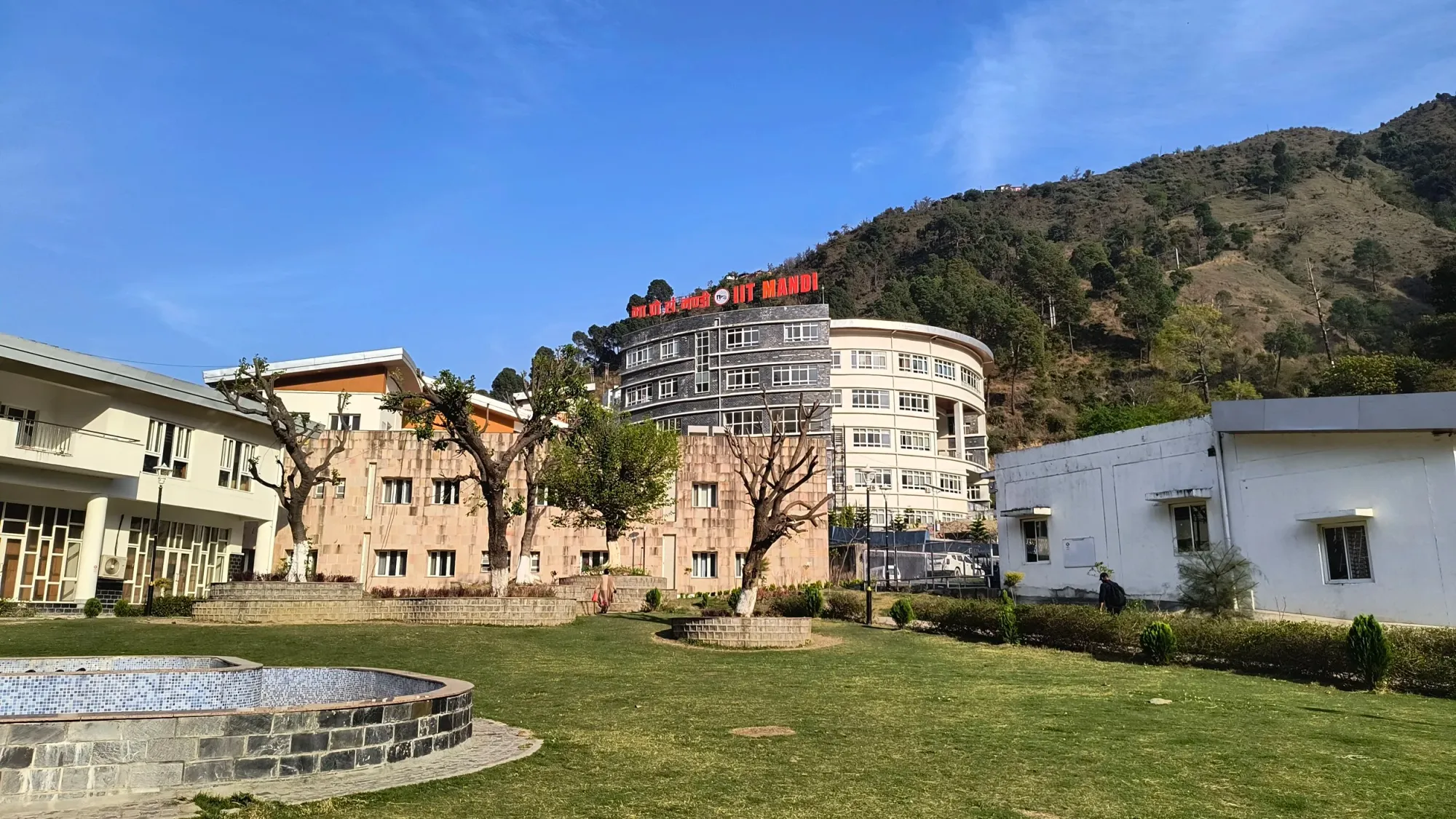
No JEE. No entrance rank. Just two months at an IIT campus in the Himalayas - and everything that comes with it.
Let's start with a feeling most students know but don't talk about enough.
You watch an IIT student explain something in a YouTube video - the way they break down a concept, the speed at which they move, the confidence when they're wrong and correct themselves mid-sentence - and somewhere in the back of your head, a thought appears: what would it have been like to be in that environment?
Not the brand. Not the placement package. The environment. The late-night sessions where someone across the table is working on something that makes your own problem look small. The faculty who respond to a question not with an answer but with a better question. The peer group that quietly raises the bar for what you consider "good enough."
For a long time, that environment was behind a wall called JEE. You either cleared it or you didn't, and if you didn't, that particular world stayed on the other side.
Himshikhar 2026 opens a door in that wall.
It's a 2-month fully residential summer program run by CCE, IIT Mandi in partnership with Masai. You live on the IIT Mandi campus in Kamand Valley, Himachal Pradesh - at roughly 1,000 metres above sea level, pine forests on every side, the Uhl river below. You sleep in the hostels. You eat at the mess. You learn from the same faculty who teach IIT Mandi's own students. And for sixty days, that environment is yours.
Here's what it actually feels like.
Day One: You Arrive, and It Hits Differently
Most students arrive expecting something that resembles a fancy coaching class. A classroom. Rows of chairs. A projector. Someone at the front going through slides.
What they get instead is a campus.
Wide open spaces. Mountain air that's noticeably cooler than anything they've breathed in a city. A hostel room that's small and spare and exactly right. A mess hall with the kind of no-frills food that tastes genuinely good after a morning of hard thinking. And everywhere - students. A thousand of them, from every corner of India, from different colleges, different backgrounds, different tracks, all of them here because they chose to be here when they could have just gone home for the summer.
That first evening, something shifts. The phone goes quiet. The usual mental noise - the city traffic, the family WhatsApp groups, the ambient anxiety of being perpetually reachable - starts to fade. You're in the Kamand Valley now. The mountains don't care about your notifications.
And very quickly, you realise: this is actually a place where you can think.
The Classroom: What "IIT Faculty" Actually Means Here
The phrase "learn from IIT faculty" gets used a lot in Indian ed-tech. It can mean a recorded lecture from a professor who taped it three years ago. It can mean a guest talk by someone who once visited an IIT campus. It can mean a curriculum "inspired by" IIT syllabuses.
At Himshikhar, it means something specific: you are in a live classroom with a full-time IIT Mandi professor, in real time, and you can raise your hand.
Dr. Aditya Nigam - Associate Professor, PhD IIT Kanpur, a decade of teaching deep learning - is at the front of the room. Not a recording of him. Him. When you don't understand something, you ask. When he introduces a concept that doesn't quite land, he finds three different ways to explain it until it does.
Dr. Indu Joshi, PhD IIT Delhi, postdoc at Inria France and TU Munich, President of India Silver Medalist - she's teaching your afternoon session and she's asking you a question before you've finished your chai.
What these professors share isn't just expertise. It's a particular attitude toward confusion. In a coaching centre, confusion is a problem to be solved quickly so the class can move on. In an IIT classroom - and this is genuinely different - confusion is treated as the most interesting thing that happened in the last ten minutes. Why are you confused? What assumption did you make that led you here? What would you need to believe for your wrong answer to have been right?
This is not a minor stylistic difference. It changes how you learn, permanently.
The Lab Sessions: Where Things Get Real
If mornings are where you absorb, afternoons are where you apply - and the gap between those two things is where most learning actually happens.
Lab sessions at Himshikhar are run by IIT Mandi PhD Teaching Assistants. These are researchers mid-way through their own advanced degrees, working on problems at the edge of their fields. They are not there to hand you the answer. They are there to watch you work, catch the moment you go wrong, and ask precisely the right question to make you find your own way back.
The first time a TA looks at your code and says "what were you trying to do here?" - not because they don't know, but because they want you to know that you don't know - it's uncomfortable. And then it becomes the most useful thing that's happened to you in years.
By week four, you stop waiting to be shown what to do. You start showing up with hypotheses. You start debugging before the TA even notices the bug. That shift from passive to active - from "show me" to "let me try" - is quiet, but it's the most important thing that happens at Himshikhar.
The Evenings: This Is Where the Real Stuff Happens
No one tells you this, but the best learning at any residential IIT program happens after dinner.
The structured day ends. The professors have gone. The TAs are in their own rooms. And the lab is still open, the problems are still unresolved, and your cohort - the people you've spent the last three weeks eating and debugging alongside - are sitting around trying to make something work.
These are the Night Owl sessions. Not organised, not mandatory, just the natural thing that happens when a group of genuinely curious people are stuck on something interesting and have nowhere to be.
Someone's ML model isn't converging and nobody can figure out why. Someone else's API is returning a response that doesn't match the documentation. A third person just found an approach that cuts their inference time in half and is explaining it to anyone who'll listen at 11 PM in a lab that smells like bad coffee and something close to momentum.
This is the hour that the online course version of your education never reaches. You can't replicate it with a Discord server. You can't schedule it. It just happens, when you put the right people in the same room for long enough.
The Weekends: You're in the Himalayas
Let's not pretend the location is incidental.
The IIT Mandi Kamand campus is surrounded by the kind of landscape that makes your brain do something it doesn't do behind a laptop screen: stop. Properly stop. The Uhl river, the pine and deodar forests, the peaks visible on a clear morning - it's the kind of scenery that people pay significant money to spend a weekend in. You're living inside it for two months.
Weekends are yours. Students organise treks into the surrounding hills. Some sit by the river and do nothing intentional for several hours, which turns out to be exactly what a week of intense focus requires. Some go into Mandi town. Some sleep. All of it is right.
The mountains are not a bonus feature. They're part of the design. The mental reset of a weekend in the Kamand Valley makes Monday's session land differently - with more energy, more curiosity, more capacity. The people who built this program knew that sixty days of high-intensity work requires sixty days of an environment that can sustain it.
The Capstone Project: Two Months of Building One Thing
Here's how most educational programs work: you learn things, you do small exercises to check understanding, you submit an assignment at the end, someone grades it, you move on.
Here's how Himshikhar works: from week one, you're building something.
Not a tutorial project. Not a guided walkthrough where you follow along and produce the expected output. A real capstone - a Public Grievance Portal, a Smart Energy Forecast model, a Personal Finance AI Agent, an IRCTC Travel Concierge with real API integrations - built from the ground up, facing the actual problems that real projects face: things that don't work, approaches that need to be abandoned, design decisions that turn out to be wrong and have to be revisited.
Faculty are involved throughout. Not just at the end, not just to grade you, but weekly - asking questions about your architecture, pushing back on your choices, pointing out what a production engineer would think of your current approach.
And at the end of sixty days, there is a boardroom demo.
Not a viva. Not a college presentation where you know the examiner already has the answers and is checking whether you do. A room with IIT Mandi faculty and industry panelists who have not seen your project before, who are going to ask you exactly what you chose to do, why you made that choice, what went wrong, and what you'd do differently.
The preparation for that room is where the deepest learning happens. And the experience of actually being in it - of defending something you built under real pressure, in front of people who are genuinely evaluating it - is something you carry into every professional room you enter afterward.
What You Walk Away With
Two documented capstone projects. Not coursework. Real applications with real architecture, built and presented under supervision.
A CCE, IIT Mandi Program Completion Certificate. Issued by an official IIT body. Carries genuine institutional weight in interviews, postgrad applications, and anywhere the IIT Mandi name means something - which is most places in Indian tech.
A Masai Project Completion Letter documenting your specific project, tech stack, and panel evaluation outcome.
A peer network of students who were selected through an entrance test, chose to spend their summer doing something demanding, and spent sixty days with you in the Kamand Valley. These are not passive connections. These are people forged in shared pressure.
And something harder to put on a resume: a recalibrated sense of what you're capable of. Having spent two months in an environment where the standard is high, the feedback is honest, and the work is real - you come back knowing what it feels like to actually build something. That knowledge changes how you work for a long time afterward.
Is This for You?
Himshikhar is for students who are genuinely curious - not just ambitious. Students who want the process, not just the certificate. Students who are willing to be uncomfortable for sixty days because they understand that discomfort is where the growth actually lives.
It's for students who've done the online courses and felt the gap between knowing something and being able to use it.
It's for students who look at an IIT campus and think - I want to know what it's like to be inside that.
If that's you, the answer to whether you should apply is already obvious.
Reporting: May 16, 2026 | Batch starts: May 18, 2026 | IIT Mandi, Kamand Valley, Himachal Pradesh Seats are limited by residential capacity - once full, the program moves forward.
For queries: WhatsApp +91 87929 74750 | info.cce@iitmandi.ac.in Official page: cce.iitmandi.ac.in/himshikhar-2026
Also read: