
What is a large Language Model (LLM)? How It Works, Training, Types & Real-World Uses


If you've typed a question into ChatGPT, Claude, or Gemini this week, you've already used a large language model (LLM) the technology quietly rewriting how humans talk to computers. But what is an LLM actually doing under the hood, how is it trained, and which types matter for real-world use in 2026? This guide breaks it down in plain English, backed by data from IBM, AWS, Cloudflare, Google Cloud, and Red Hat.
What is a Large Language Model (LLM)?
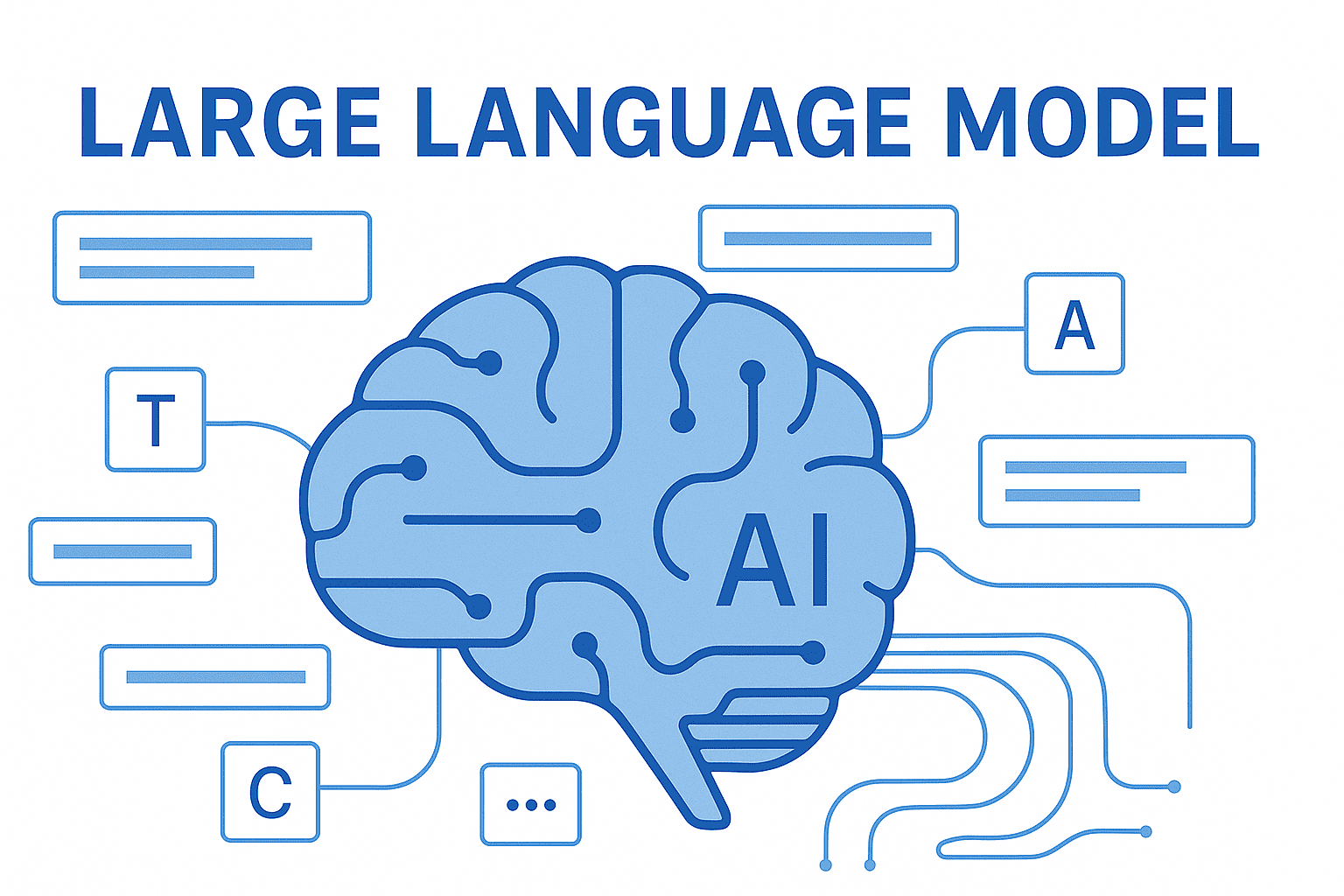
A large language model is a type of deep learning model, built on a transformer neural network, that's trained on massive volumes of text so it can understand, predict, and generate human language. In simple terms: an LLM is a giant statistical prediction engine. It repeatedly predicts the next most likely word (token) in a sequence, and after seeing trillions of examples, that simple trick produces writing, code, and reasoning that feels remarkably human.
This is the core definition behind every major explainer on the topic, from foundational AI concepts to cloud infrastructure guides and enterprise AI documentation, all of it converges on the same three pillars: huge datasets, deep learning, and transformer architecture.
Primary & Secondary Keyword Snapshot
How do Large Language Models Work?
Every LLM follows roughly the same pipeline, whether it's GPT, Claude, Gemini, or an open-weight model like Llama or DeepSeek.
How are Large Language Models Trained? (Step by Step)
There are three widely used training strategies, and most production LLMs combine all three:
- Zero-shot learning - the base model answers a brand-new request with no extra examples, relying purely on pretraining.
- Few-shot learning - a handful of examples in the prompt sharply improves accuracy on a specific task.
- Fine-tuning - the model's internal weights are further adjusted using a smaller, labeled dataset for a specific domain (legal, medical, customer support, etc.).
Reinforcement Learning from Human Feedback (RLHF) is layered on top of this to align outputs with human preferences making responses safer, more helpful, and more consistent with brand or ethical guidelines. Red Hat's overview also highlights Mixture of Experts (MoE), an architecture that routes each query to the most relevant expert sub-network, making inference faster at scale a trend accelerating heavily through 2026 as models grow larger but need to stay cost-efficient.
Types of Large Language Models
Not every LLM is built the same way. Here's how the major categories compare:
This LLM vs. SLM distinction is increasingly a trending long-tail search in 2026, as enterprises weigh massive cloud-hosted models against smaller, cheaper, locally deployable ones for privacy and latency-sensitive use cases.
Real-World Large Language Model Use Cases
LLMs have moved well past chatbots. Across IBM, AWS, and Google Cloud's documentation, the same core use cases keep showing up:
- Text generation - emails, blog posts, marketing copy, legal drafts
- Text summarization - condensing long reports, contracts, or research papers
- Code generation - writing, debugging, and translating code between languages
- Sentiment analysis - scoring customer feedback, reviews, and support tickets at scale
- Language translation - fluent, context-aware multilingual communication
- Conversational AI assistants - customer support, internal knowledge search, virtual agents, often paired with conversation intelligence for live call scoring
- Reasoning & planning - multi-step problem-solving, agentic task execution
When an LLM is connected to external tools, memory, and APIs, it becomes the reasoning engine behind an AI agent able to act, not just talk, by booking a meeting, querying a database, or executing a workflow.
LLM limitations you should know
No blog on LLMs is complete or accurate without covering the trade-offs:
Where LLMs are headed in 2026
The center of gravity in LLM development has shifted. Instead of chasing ever-larger parameter counts, the field is now optimizing for:
- Longer context windows - some models now hold well over a million tokens, reducing reliance on RAG for many tasks
- Cheaper, faster inference - techniques like Mixture of Experts and quantization are cutting cost-per-token dramatically. At larger production scales, teams may also evaluate distributed inference architecture patterns to spread model workloads across multiple GPUs, machines, or regions more efficiently.
- Reasoning-first models - chain-of-thought training is boosting multi-step accuracy on math, coding, and planning tasks
- Agentic capability - LLMs paired with tools (via protocols like MCP) are increasingly acting as autonomous task-completers, not just chat interfaces
- Open-weight competition - cost-efficient open models are closing the gap with closed frontier systems, giving developers more deployment flexibility
Key Takeaway
A large language model is, at its core, a transformer-based prediction system trained on enormous text datasets to understand and generate human language. What makes 2026's generation different isn't just raw scale it's smarter training (RLHF, reasoning traces), more efficient architectures (MoE, quantization), and tighter integration with real-world tools through agentic AI. Whether you're evaluating LLMs for a chatbot, a coding assistant, or an enterprise knowledge system, understanding this pipeline data, tokens, transformers, fine-tuning, inference is the foundation for making the right choice.