
MBA ROI calculator: how to work out payback and break-even
How to work out MBA ROI: total cost, loan instalment and payback. A hypothetical example run in Python gives 6.99 years, or 13.10 if pay is 20% lower.

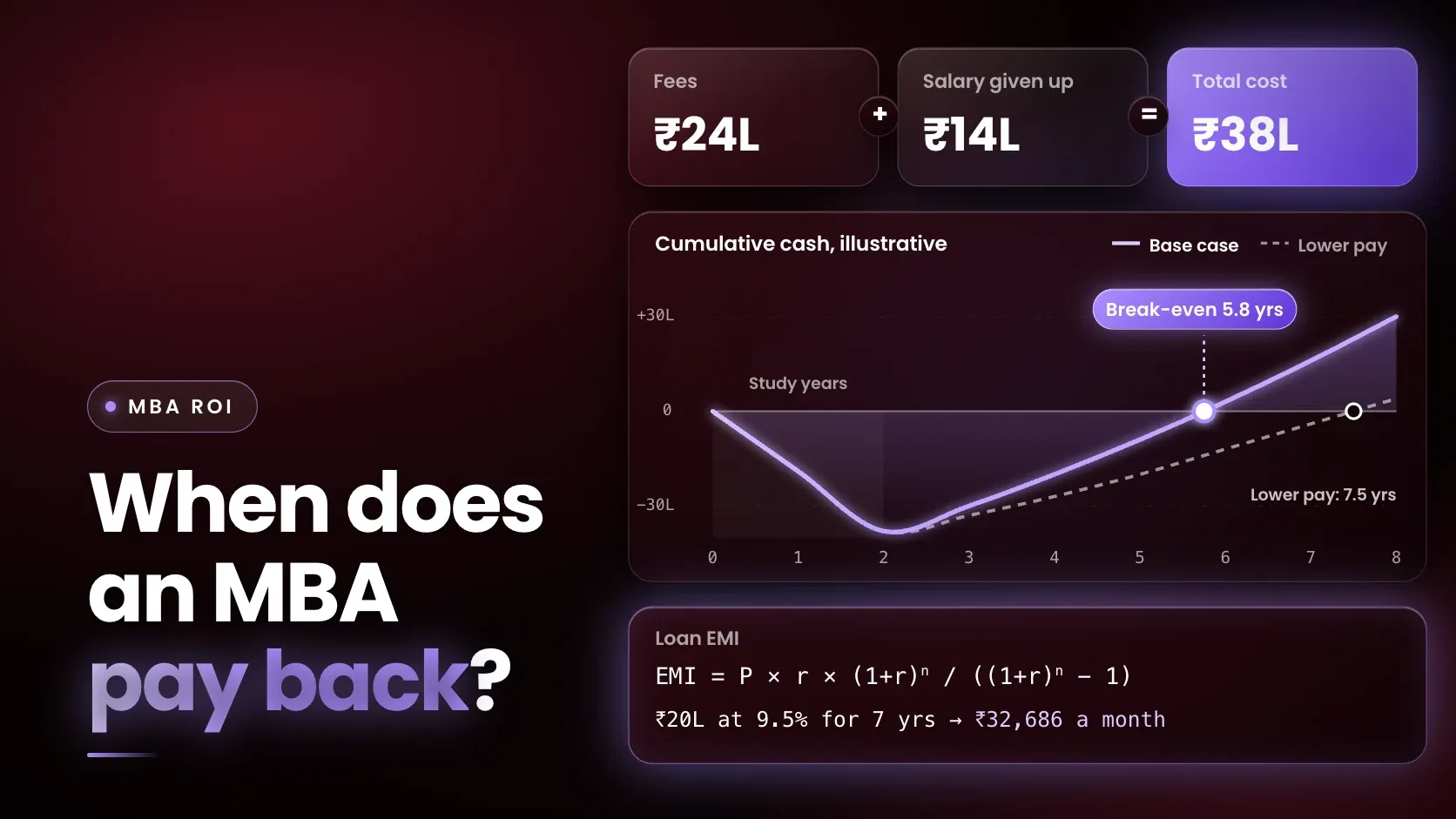
MBA payback is the total cost of the MBA divided by the extra pay it brings each year. Total cost is the fee, plus the pay given up during a full-time programme, plus any loan interest. In the hypothetical example below, a cost of Rs 41,91,749 and an extra Rs 6,00,000 a year give a payback of 6.99 years, and 13.10 years if the new pay is 20% lower.
Last updated: 11 November 2026.
How do you calculate MBA ROI?
MBA ROI can be worked out in four numbers: total cost, extra pay a year, payback in years and the same payback in a lower-pay case. MBA One Stop's ROI calculator page defines it this way: total cost is the fee, plus the salary you give up during a full-time programme, plus any loan interest, and break-even is that total divided by the extra pay a year, which is pay after the MBA minus pay now.
The table lists the steps, the input for each and the arithmetic.
| Step | What to find | Arithmetic |
|---|---|---|
| 1 | Programme fee | Total fee from the college's own page |
| 2 | Pay given up | Current pay a year multiplied by years out of work (zero for a part-time or executive format) |
| 3 | Loan interest | Monthly instalment multiplied by months, minus the loan amount |
| 4 | Total cost | Step 1 plus step 2 plus step 3 |
| 5 | Extra pay a year | Expected pay after the MBA minus current pay |
| 6 | Payback in years | Step 4 divided by step 5 |
| 7 | Lower-pay case | Repeat step 5 and 6 with pay 20% lower |
Every figure should be taken from the college's own admission and fee pages, since fees and packages change by batch.
How is the monthly loan instalment worked out?
The monthly instalment of a loan is fixed, and it covers both interest and principal. The standard formula is A = P x r x (1 + r)^n / ((1 + r)^n - 1), where P is the loan amount, r is the annual interest rate divided by 100 and then by 12, and n is the number of monthly payments. A general reference such as Wikipedia's page on the equated monthly instalment gives the same formula.
State Bank of India's student platform shows two cases for education loans. In one, interest is serviced during study and the moratorium, and in the other it is not. Its repayment calculators ask for loan amount, interest rate, course period and moratorium, and say the result is indicative only. The worked example below uses the simplest case, a loan that starts amortising at once, and ignores interest during study, so a real loan can cost more.
What does a worked example look like? (hypothetical)
The example below is hypothetical: the fee, pay and loan are invented to show the arithmetic and are not any college's figures. Take a candidate earning Rs 8 lakh a year who joins a full-time two-year MBA that costs Rs 20 lakh in total fees. The expected pay after the MBA is Rs 14 lakh, and Rs 15 lakh is borrowed at 10% a year over 7 years.
def emi(p, annual_pct, years):
    r = annual_pct / 100 / 12
    n = years * 12
    return p * r * (1 + r) ** n / ((1 + r) ** n - 1)

fee = 20_00_000          # hypothetical total fee
years_out = 2            # full-time programme, salary given up
pay_now = 8_00_000       # hypothetical current pay per year
pay_after = 14_00_000    # hypothetical pay after the MBA
loan, rate, tenure = 15_00_000, 10.0, 7

e = emi(loan, rate, tenure)
interest = e * tenure * 12 - loan
cost = fee + pay_now * years_out + interest
for label, after in [("base", pay_after), ("20% lower", pay_after * 0.8)]:
    extra = after - pay_now
    print(f"{label}: pay after {after:,.0f}, extra per year {extra:,.0f}, payback {cost / extra:.2f} years")
print(f"EMI {e:,.2f} per month, total interest {interest:,.2f}")
print(f"total cost {cost:,.2f}")
Run on Python 3.9.6, it printed:
base: pay after 1,400,000, extra per year 600,000, payback 6.99 years
20% lower: pay after 1,120,000, extra per year 320,000, payback 13.10 years
EMI 24,901.78 per month, total interest 591,749.19
total cost 4,191,749.19
The same arithmetic by hand shows what the script does. Pay given up is Rs 8,00,000 x 2 = Rs 16,00,000. Total cost is Rs 20,00,000 + Rs 16,00,000 + Rs 5,91,749 of interest = Rs 41,91,749. The monthly instalment is Rs 24,901.78, or about Rs 2,98,821 a year, which is the reason a loan and a post-MBA pay should be compared month by month rather than only in total.
| Case | Pay after the MBA | Extra pay a year | Payback in years |
|---|---|---|---|
| Base | Rs 14,00,000 | Rs 6,00,000 | 6.99 |
| Pay 20% lower | Rs 11,20,000 | Rs 3,20,000 | 13.10 |
Why does a lower-pay case matter?
A lower-pay case shows how fragile a payback figure is. A pay 20% lower in the example cuts the extra pay a year from Rs 6,00,000 to Rs 3,20,000, and the payback nearly doubles from 6.99 to 13.10 years. MBA One Stop's calculator page explains the reason it includes this case: placement figures are for the students who took part in placements, and a pay 20% below the median shows how much longer break-even takes if an offer is lower than typical.
Nothing in this arithmetic says what a good payback period is. No published standard exists, and the answer depends on the loan, the job, the family's finances and what else the same money could do.
What does the MBA One Stop ROI calculator do?
MBA One Stop's MBA ROI calculator takes a programme, current pay and any loan, and returns the total cost, the monthly loan instalment and the years until the MBA pays for itself, including a lower-pay case. The page says the profile is saved in your browser only. The MBA One Stop ROI calculator runs the same steps for a programme on its list.
Its starting pay is a default: the median package of the college's latest batch, or 92% of the average where no median is published, with a downward adjustment for colleges that the page says report packages on a different basis, and the page says a figure of your own can be typed instead. Its limits are stated on the page: it compares pay before tax and ignores raises you would have had anyway, so it is a guide to comparing programmes and not a forecast. Fees and packages should be checked with each college before relying on any result. The page says it uses the same profile as the MBA One Stop college predictor, which asks for scores, category, budget and current pay. Other predictors and their limits are compared in best MBA college predictor tools.
What are the common mistakes in MBA payback maths?
Most errors come from leaving a cost out or from using a pay figure that nobody has been offered.
- Leaving out the pay given up during a full-time programme, which can be the largest cost after the fee.
- Using an average package for a college as the expected pay, when placement figures cover only students who took part in placements.
- Ignoring interest during the study period, which the SBI calculators treat as a separate case.
- Comparing pay before tax with a loan instalment that is paid from after-tax income.
- Treating a 7-year payback as certain, when a 20% lower pay nearly doubles it.
State Bank of India's student loan calculator helps with the first step, the amount to finance: it takes annual tuition, hostel and other costs and books, subtracts gift aid and your own contributions, and calls the result indicative only.
What are the limits of this method?
The method ignores tax, raises, interest during study, other uses of the money and the value of the degree beyond pay. It compares one pay path with another, and the pay after the MBA is a guess. The worked example describes arithmetic only. It is not a recommendation to borrow, and loan terms come from the lender.
For the step before this one, best free CAT mock tests and free MBA entrance notes and PDFs cover preparation, and turning a CAT percentile into a college shortlist builds the list whose costs this page compares.
Where does an executive MBA fit in this?
Payback maths changes for a part-time or executive format, since step 2 can fall to zero when pay continues during study. Executive MBA Technology is a postgraduate management degree from IIT Jodhpur for working professionals, taught in live online sessions by IIT Jodhpur faculty with on-campus immersions, covering core management, AI in business, and specialisation pathways in Analytics and AI or Digital Product Management. Its programme page lists its own fee structure, which should be read there.
Frequently asked questions
How do you calculate MBA ROI?
Add the programme fee, the pay given up during a full-time programme and any loan interest to get the total cost, then divide it by the extra pay a year, which is pay after the MBA minus pay now. The result is the payback in years. A lower-pay case repeats the sum with a smaller pay.
How is the MBA loan instalment calculated?
The monthly instalment is P x r x (1 + r)^n / ((1 + r)^n - 1), where P is the loan, r is the annual rate divided by 100 and then by 12, and n is the number of monthly payments. In the hypothetical example, Rs 15 lakh at 10% over 7 years gives Rs 24,901.78 a month.
What is a good MBA payback period?
No standard payback period exists. In the hypothetical example the payback is 6.99 years, and a pay 20% lower stretches it to 13.10 years. A shorter payback is not automatically better, because it depends on assumed pay, loan terms and personal finances, so the result is best used to compare programmes.
What is MBA break-even salary?
Break-even is the point at which the extra pay earned after the MBA has repaid its total cost. MBA One Stop's calculator page defines it as total cost divided by the extra pay a year. A candidate can work backwards and ask what extra pay would give a chosen payback.
Does the MBA One Stop ROI calculator store your data?
The calculator page says its profile is saved in your browser only. It also says the result compares pay before tax and ignores raises, so it guides comparison and does not forecast. A candidate should still check fees and packages with each college before relying on any figure.
Next step
Run the sum for two programmes with the same assumptions, then run it again with pay 20% lower, and compare how the two payback figures move. Working professionals who want to see a programme where pay can continue during study can read the Executive MBA Technology page for its structure and fee details.