
What is a Forward Deployed Engineer? FDE vs Software Engineer vs Solutions Engineer

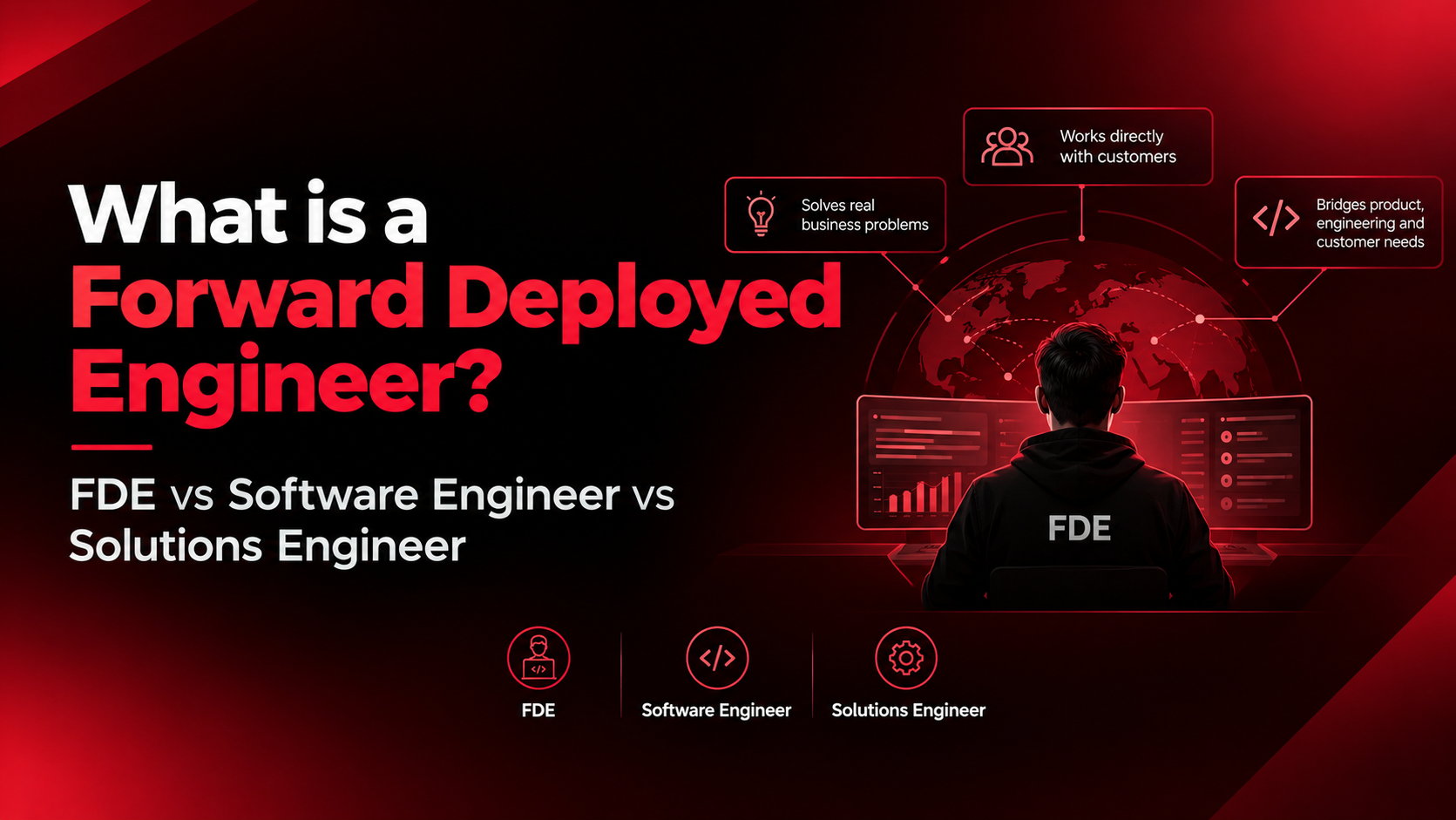
A forward deployed engineer (FDE) is an engineer who takes a company's product and makes it work inside one specific customer's systems, data and workflows. A software engineer builds the product for every customer. A solutions engineer helps a customer say yes before the deal is signed. The FDE steps in after the deal and owns the result, which means writing production code, working with the customer's team, and staying until people are actually using what was built.
The three titles overlap on paper, which is why job posts confuse everyone. The cleaner way to separate them is by when they enter the customer's story and what they are held responsible for.
What is a forward deployed engineer?
The role began at Palantir, where engineers were sent to sit with government and enterprise clients rather than build in isolation at headquarters. It has since spread to AI companies, because AI products have a stubborn problem: a demo that wows in a meeting often falls apart on a customer's messy data, legacy databases and security rules.
An FDE closes that gap. A typical project might involve pulling data from a customer's old SQL database, connecting it to an AI model, locking down who can see what, testing the output on real cases, and then training the first group of users. The Pragmatic Engineer newsletter has described the role as a blend of platform, software and solutions engineering, which is a fair summary of why it is hard to hire for.
The "forward" part is literal. These engineers work close to the customer, often on their site or inside their tools, rather than behind a product roadmap.
How do the three roles compare?
What does a software engineer do that an FDE does not?
A software engineer thinks about all customers at once. Their world is one codebase, a roadmap, test coverage and long-term maintenance. When they build an API, thousands of applications might depend on it.
Most of their week goes to features, code reviews and bugs. They usually meet a customer only through a product manager. That distance is a feature, not a flaw: a team interrupted by every individual request cannot ship a clean product, which is exactly why companies hire FDEs to absorb customer-specific work.
What does a solutions engineer do that an FDE does not?
A solutions engineer, sometimes called a sales engineer, supports the sale. They run demos, set up proofs of concept, answer security questionnaires and field technical doubts on calls. Their job is to remove hesitation before the contract.
Once the deal closes, they typically move on to the next prospect. Someone still has to connect, configure and roll out the product for the customer who just signed. That gap is the FDE's territory.
What does the same customer request look like to each role?
Imagine a hospital group that wants an AI assistant to summarise insurance pre-authorisation cases for its nurses, using data from its case management system.
- The solutions engineer runs a demo on sample cases, answers the privacy questionnaire, and helps the buyer trust the product enough to sign.
- The software engineer receives a roadmap ticket weeks later to build a generic case-management connector that will serve every customer.
- The forward deployed engineer sits with the nursing lead, maps the real case fields, builds and secures the connector, tests on live cases and trains the first nurse group.
All three are doing valuable work. Only the third decides whether the nurses actually use the tool.
What skills does an FDE need that the others lean on less?
Strong coding is the entry ticket, but the differentiators sit around it:
- Working in systems you did not build: reading an unfamiliar codebase, legacy SQL databases and old APIs, and shipping safely inside them.
- Production AI engineering: retrieval pipelines, agents, evaluations, guardrails and cost control, not just a working prototype.
- Security and deployment: access control, monitoring, cloud deployment, handling sensitive data.
- Client handling: scoping a vague brief, delivering bad news, answering compliance questions and discussing pricing.
That last group is where many strong engineers hit a wall. Writing good code and defending a design to a worried client are different muscles.
Which route gets an engineer FDE-ready?
There are three common paths, and none is universally best:
- On the job: Move into customer-facing integration work at your current company. Slowest, lowest risk, and it depends on such a role existing.
- Self-directed: Build side projects, study AI deployment and security on your own. Cheapest, but it is hard to generate real client pressure or credible proof alone.
- Structured programme: Join a cohort-based program built around the role, with practitioners, deadlines and a real-company problem to solve.
The sticking point for most engineers is not knowledge but evidence. Hiring managers want proof that you have owned a messy problem under deadline, and a side project rarely shows that.
Programs that try to fill this gap exist. Leap by Masai is Masai School's residential plus online program series for founders, AI builders and engineers, and its AI Forward Deployed Engineer track runs 12 weeks: five days in Vietnam to learn the role and build a live product, ten weeks online covering data pipelines, cloud deployment, retrieval, agents, security and client-engagement sessions, and a three-day hackathon in Bangalore where qualifying participants take a real partner company's problem and ship a solution. It requires at least a year of hands-on technical experience, is taught by practitioners from companies including Microsoft, Google, PayPal and Intuit, and Masai is clear that it builds readiness for FDE roles rather than guaranteeing a placement.
The bottom line
The sticking point for most engineers is not knowledge but evidence. Hiring managers want proof that you have owned a messy problem under deadline, and a side project rarely shows that.
Programs built specifically around this gap are starting to appear. The AI Forward Deployed Engineer program by Leap by Masai is a 10-weeks cohort for engineers who can code but have never owned a problem with a client. It opens with four days in Goa, where participants learn what the FDE role involves, ship a live product in a pod, and commit to a capstone. Ten weeks of online weekend sessions follow, covering data pipelines and secured APIs, cloud deployment, retrieval and agents, and security and cost control, alongside client-engagement sessions on stakeholder management, objections, compliance and pricing. Participants who score at least 45% and attend at least 65% of sessions then spend three days in Bangalore on a hackathon, taking a real partner company's problem and presenting the solution to that company.
It needs at least a year of hands-on technical experience, is taught by practitioners from companies including Microsoft, Google, PayPal and Intuit, and Masai is clear that it builds readiness for FDE roles rather than promising a placement.
Frequently asked questions
Is a forward deployed engineer the same as a solutions engineer?
No. A solutions engineer works before the sale, running demos and proofs of concept to build technical trust. A forward deployed engineer works after the sale, writing production code inside the customer's systems and owning deployment until users are live. Their skills overlap, but their timing and accountability differ.
What is a forward deployed engineer vs. software engineer?
A software engineer builds and maintains a product used by all customers. A forward deployed engineer adapts and integrates that product for one customer, working directly with that customer's team. Both write code; the difference is whether you own the shared product or one customer's outcome.
Is FDE a software engineer?
An FDE is a type of software engineer with a customer-facing remit. The core skills are the same: programming, APIs, databases, testing and debugging. What changes is the scope of ownership, which is a specific customer deployment rather than a shared product.
Is forward deployed engineer a good career?
It can be, for engineers who like ambiguous problems, varied systems and direct customer contact. The trade offs are real: more client pressure, less time on one codebase, and sometimes travel. Demand is rising as AI products move from demos to production, but check what a specific role actually expects before you decide.
Do forward deployed engineers write production code?
Yes. They build integrations, data pipelines and customer specific features to production standards and monitor them after release. Coding is only part of the week; the rest goes to meetings, requirements and adoption.
Is a forward deployed engineer a sales role?
No. FDEs are engineers measured on delivery and adoption, not on closing deals. They do speak with customers often, which is why communication matters, but their output is working software.
Do you need years of experience to become an FDE?
Most employers expect solid engineering fundamentals first, and programs such as Leap's FDE track ask for at least one year of hands-on technical experience. Beyond that, the useful experience is anything that involved integrating systems or owning something in production.
Can a software engineer become a forward deployed engineer?
Yes, and it is the most common path. A software engineer already has the coding base and can add cloud deployment, security, integration and client-communication skills, ideally through a project where someone else's real problem is on the line.