
What are the core elements of an AI agent? Why LLMs aren't enough

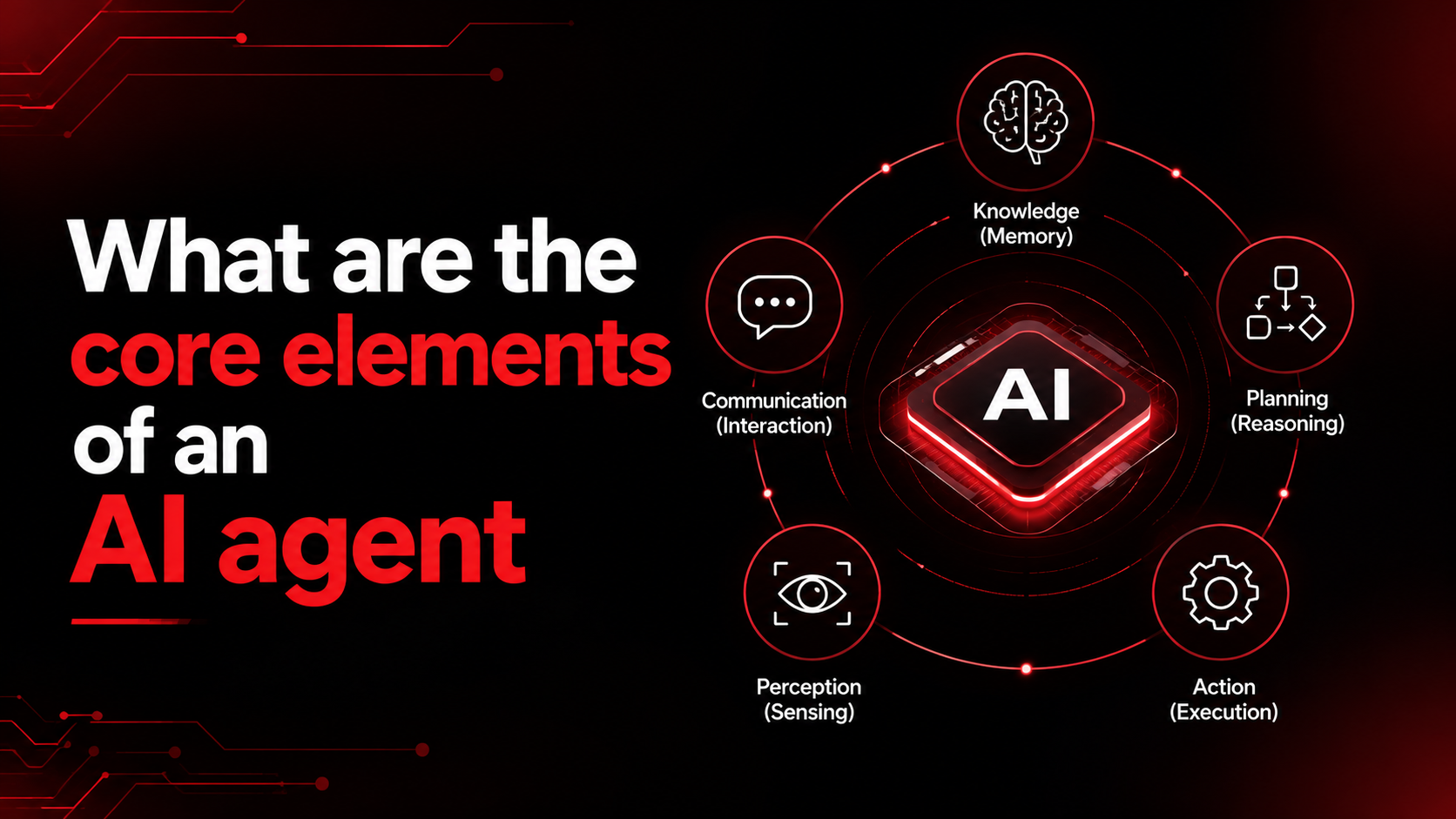
If you ask ChatGPT to write a poem or summarize a PDF, it does a great job. But if you ask it to book a flights itinerary, update your calendar, and send confirmation emails to your group, a standard Large Language Model (LLM) falls flat.
Why? Because an LLM is just an engine for predicting text it isn't an AI agent.
An AI agent is an autonomous system that doesn't just talk; it perceives its environment, makes plans, uses external software tools, and learns from its mistakes. Whether you are studying computer science, preparing for an exam, or building your very first AI project, understanding what are the core elements of an AI agent is the cheat code to mastering modern artificial intelligence.
Let's break down the core components of an AI agent in plain English with clear diagrams in words, real-world examples, and zero confusing academic jargon.
How an AI agent works: The continuous feedback loop
Before diving into individual parts, it helps to see the big picture. Traditional software follows strict "if/then" rules written by human programmers. An AI agent, on the other hand, operates in a continuous loop:
- Perceive: It gathers raw input from users or connected software.
- Reason: It breaks down the problem using its internal LLM "brain".
- Remember: It checks past memory to retain context.
- Act: It runs external tools (like search engines or code interpreters).
- Learn & adapt: It evaluates the result and refines its next step.
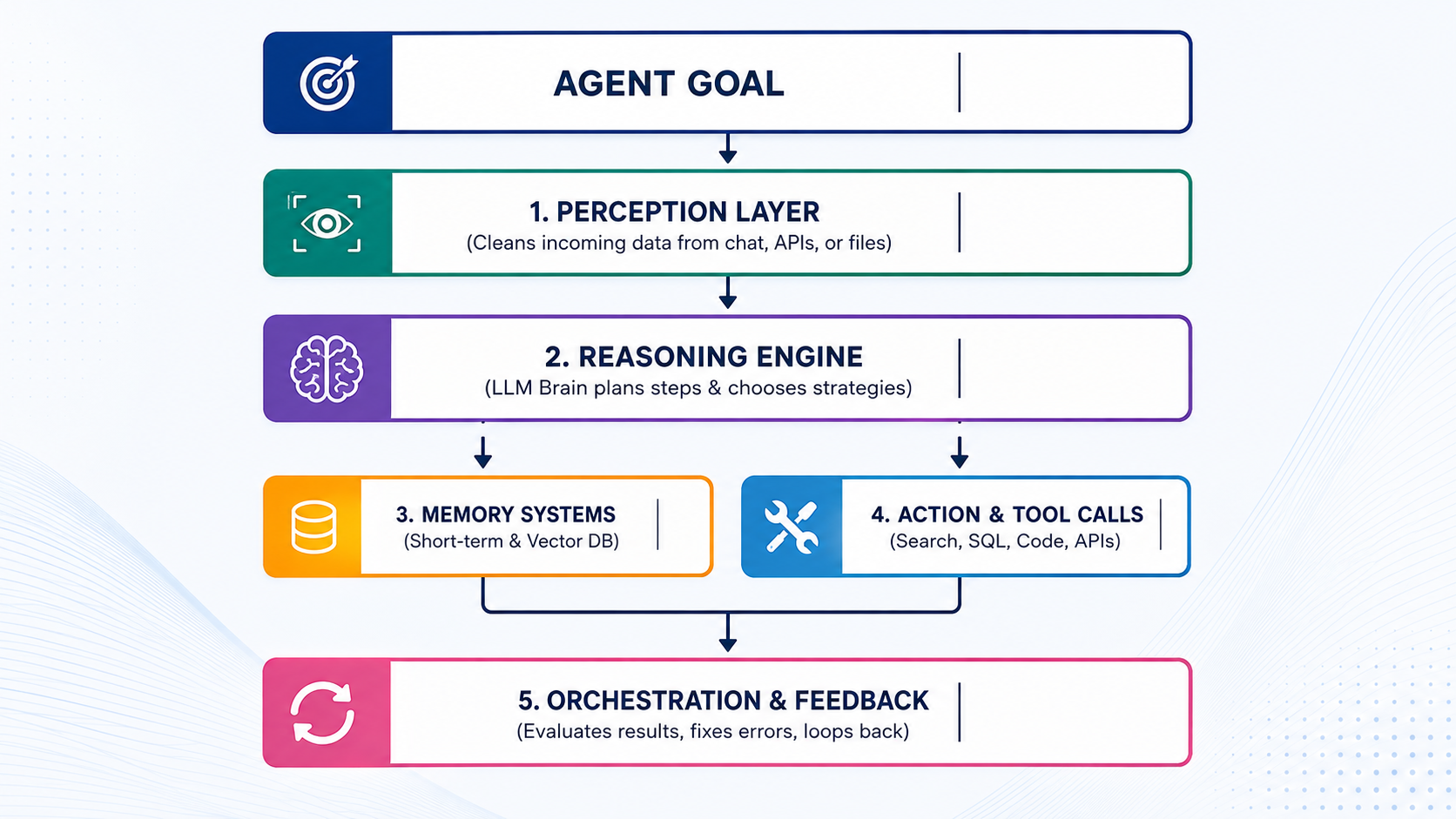
1. Goal definition and perception: How agents ingest the world
An AI agent cannot act until it knows two things: what it is supposed to do (its goal) and what is happening around it (perception).
Goal definition
The goal acts as the anchor for the agent's purpose. For instance, "Find the cheapest flight under $500 with zero layovers." A well defined goal specifies performance metrics, guardrails, and termination rules (e.g., "stop after 5 retries if no flight is found").
Perception and input sanitization
The perception layer acts like the agent's eyes and ears. It collects raw input from channels like Slack messages, API endpoints, uploaded documents, or web forms. Before passing data to the brain, it cleans and validates the input:
- Input sanitization: Removes malicious code or hidden prompt injection attacks designed to trick the AI.
- Data normalization: Converts messy inputs (PDFs, voice transcriptions, JSON feeds) into structured text the AI model understands.
2. Reasoning engine and planning: The LLM brain
The reasoning component is the central processing unit of the AI agent. While a simple LLM generates text all at once, an AI agent uses task decomposition breaking big, complex queries into small, logical steps.
Popular reasoning frameworks include:
- ReAct (Reasoning + Acting): The agent alternates between thinking ("I need to find yesterday's sales figures") and acting ("Run SQL query"), observing the result before deciding its next move.
- Plan-and-execute: The agent drafts a complete multi-step plan upfront, executes each step, and revises the plan only if an error occurs.
- Tree-of-thought: The agent explores multiple logical paths simultaneously and selects the most promising path.
3. Memory systems: Short-term working memory vs long-term recall
Just like humans, AI agents need memory to hold a coherent conversation and remember past facts. Without memory, an AI would forget your name every time you hit "Enter".
- Short-term memory (working memory): Stores immediate context, such as the current chat history or variables needed for a single task. It uses the model's context window.
- Long-term memory (persistent recall): Uses external vector databases (like Pinecone, FAISS, or Chroma) to store historical interactions, user preferences, and enterprise documents. Using semantic search (retrieval-augmented generation, or RAG), the agent pulls relevant facts when needed.
4. Action and tool utilization: Connecting to the real world
What converts an AI from a talker into a doer is tool execution. Tools are external APIs or software programs that give the agent superpowers beyond text generation:
- Read tools: Web search utilities, database queries, and document parsers.
- Write tools: API integrations that post messages, send emails, or create Jira tickets.
- Code execution tools: Python interpreters that run code in secure sandboxes to solve math problems or manipulate data sheets.
For safety, high-risk tools (like sending payment transfers) often require a human-in-the-loop guardrail for manual approval.
5. Orchestration and feedback: The control system
The orchestration layer acts as the system manager. It controls step limits, error recovery, token costs, and multi-agent coordination.
When a tool fails (e.g., an API returns a 500 error), the orchestration layer prevents infinite loops, handles retries, or reroutes the task to another specialized sub-agent. Through learning and adaptation (like reinforcement learning or self-reflection), the agent updates its internal prompt strategy to avoid making the same mistake twice.
Quick comparison table: Core AI agent components at a glance
Here is how all five core architectural layers fit together:
Key takeaways for building your first AI agent
- LLMs are brains, agents are bodies: An LLM generates words, but an agent uses memory, tools, and perception to accomplish real work, this same agent architecture is starting to show up in marketing use cases, like AI agents for SEO.
- Start simple: When building agents using frameworks like LangChain, LangGraph, or CrewAI, start with a single tool and short-term memory before scaling to complex multi-agent setups.
- Safety matters: Always add input validation and iteration limits to prevent unexpected behaviors or high API bill costs.