
Product Manager vs. Project Manager: The Complete Breakdown

If you've ever told someone you want to become a Product Manager and they responded with "Oh, so like a Project Manager?" you already know the confusion is huge.
It happens constantly. In college placements, in LinkedIn bios, in job descriptions written by HR teams who aren't quite sure themselves. The two titles sound similar, the work sometimes overlaps, and both roles have "manager" in the name. So it's understandable that people mix them up.
But here's the thing if you're trying to build a career in either of these fields, or if you're working in a company and trying to figure out which role fits you better, the difference matters enormously. Because the skills are different. The mindset is different. The way you measure success is different.
Start Here: What's the Difference Between a Product and a Project?
Before we compare the people, we need to understand the things they manage because product and project are not the same word used differently. They mean genuinely different things.
A product is something your company creates to serve a customer's needs. It could be a physical thing, like a water bottle or a laptop, or it could be digital, like a mobile app, a SaaS platform, or a subscription service. The key characteristic of a product is that it has a continuous lifecycle: it lives, it evolves, it gets updated, it eventually gets retired. There's no hard "done" date.
A project, on the other hand, is a specific set of tasks designed to achieve a defined outcome. It has a beginning, a middle, and an end. "Launch a new onboarding flow by Q3" is a project. "Redesign the checkout page" is a project. Projects are finite. They succeed or fail based on whether they were completed on time, within budget, and to the required standard.
This distinction is the foundation. Keep it in mind as we go.
Who is a Product Manager?

A Product Manager often shortened to PM is the person responsible for a product's success across its entire lifetime. They set the vision. They decide what gets built and why. They represent the user's needs inside the organization and translate business strategy into product decisions.
Think of them as the person answering the questions: What should this product do? Who is it for? What problem does it solve? Is it working? What should it become next?
A product manager's job never really ends because a product never really ends until it's officially retired. Their work is ongoing, iterative, and deeply tied to both business outcomes and user experience.
Here's what a product manager typically does day to day:
- Defines what success looks like for the product through clear, measurable metrics
- Researches the market, competitors, and user behavior to find opportunities
- Works closely with engineering, design, and business teams to shape what gets built
- Maintains and prioritizes the product roadmap the strategic plan of what comes next and why
- Makes calls on trade-offs: what to build now, what to delay, and what to drop entirely
- Monitors how the product is performing after launch and decides what to fix or improve
Notice what's not in the list:
Managing timelines, tracking task completion, or making sure budgets are being spent correctly. That's not their primary job and this is where the distinction starts to get interesting.
Who is a Project Manager?
A Project Manager is the person responsible for taking a plan and making sure it actually gets executed on time, within scope, and within budget. While the product manager decides what to build and why, the project manager focuses on how it gets done and when.
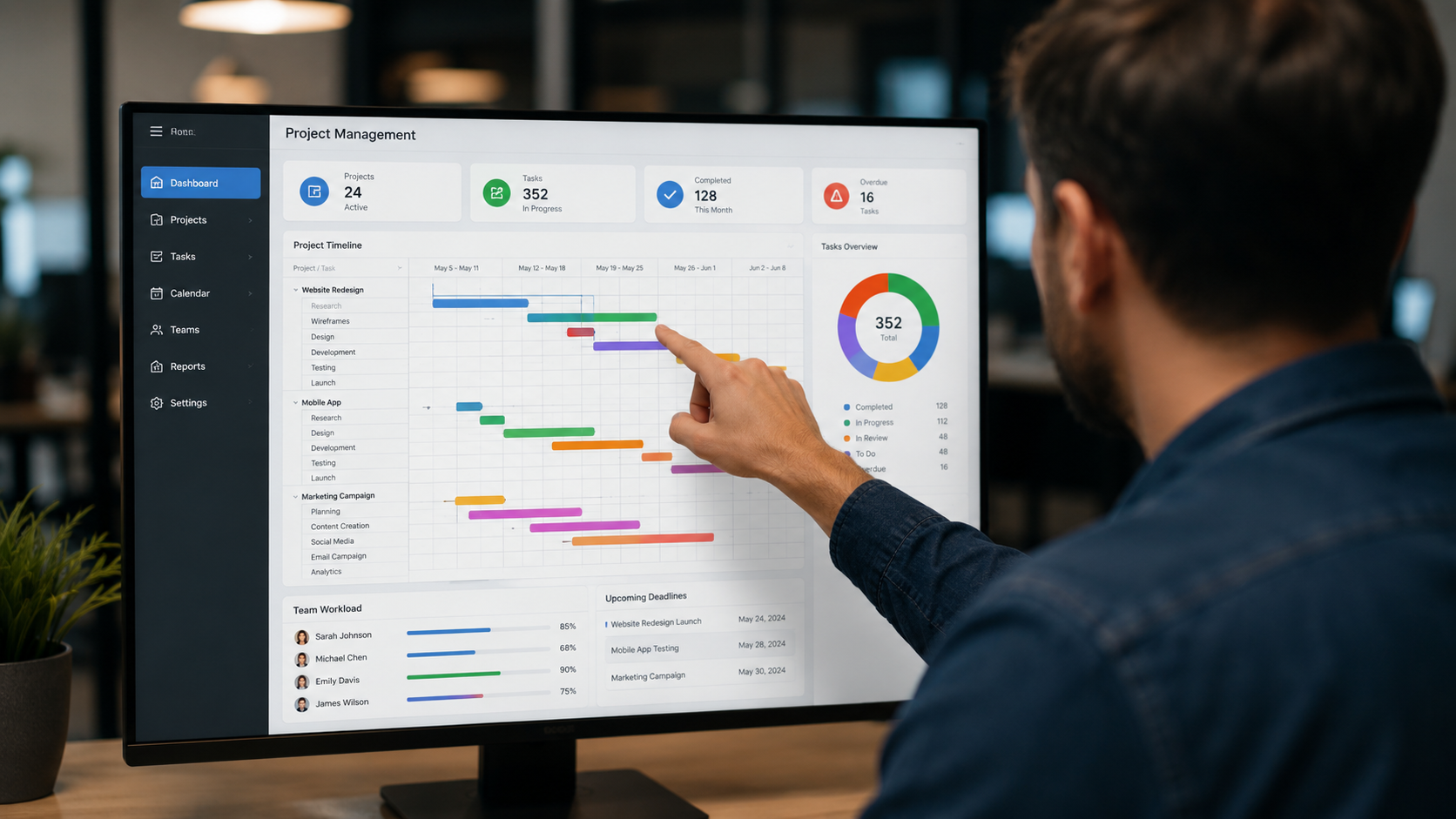
Project managers are fundamentally operational. They break large goals into actionable tasks. They set timelines. They coordinate the people doing the work. They monitor progress, flag risks early, and make sure that when something threatens to delay the project, someone is already solving it.
Here's what a project manager typically does:
- Defines the project scope, timeline, and budget at the outset
- Breaks the work into tasks, assigns ownership, and sets milestones
- Runs standups, status checks, and team syncs to keep everyone aligned
- Identifies blockers and resolves them before they become crises
- Communicates progress to leadership and stakeholders
- Ensures the project closes successfully on time and to spec
If the product manager is the strategist asking "what are we building and why," the project manager is the executor asking "how do we get this built and by when."
Product Manager vs Project Manager
Here's a clean comparison that makes the distinction easy to remember:
This isn't a hierarchy. Neither role is more important than the other. They're simply different functions and in most healthy product organizations, both roles exist and work together.
How Do They Actually Work Together?
Here's where it gets practical. Let's use a real example.
Imagine a fintech company wants to add a "split payment" feature to their app. The product manager has been tracking user feedback for months, sees a strong demand signal in the data, and decides this feature should be on the roadmap for Q2. They write a detailed product brief: who the feature is for, what problem it solves, what success looks like in terms of adoption and retention, and what the core requirements are.
Now the project manager comes in. They take that brief and build a plan around it, who on the engineering team handles what, what the dependencies are, when design needs to be finalized, when testing begins, and what the release date looks like. They run the sprint reviews. They make sure the team isn't blocked. They flag it early if the timeline slips.
When the feature launches, the product manager watches the data is it being used? Is it driving the expected outcomes? Is there anything to improve? Meanwhile, the project manager has already closed out the project and may have moved to the next initiative.
They are complementary roles running in parallel one looking at the long-term direction, the other keeping the short-term execution on track.
The Skills Gap What Each Role Actually Demands
This is what's important for you if you're early in your career and deciding which direction to pursue.
Product managers need:
- Strong analytical thinking and comfort with data
- Deep user empathy understanding why people behave the way they do
- Strategic clarity the ability to make prioritization decisions with incomplete information
- Cross-functional communication translating between business, tech, and design
- Market and business awareness understanding the competitive landscape and unit economics
Project managers need:
- Precise organizational skills and attention to detail
- Strong process thinking building systems that keep complex work moving
- Risk management anticipating what can go wrong before it does
- Stakeholder communication keeping many different people informed and aligned
- Proficiency in project management software tools like ProofHub, Jira, Asana, Monday, or Trello
There is genuine overlap. Both roles require leadership without formal authority meaning you have to influence people who don't report to you. Both require excellent communication. Both require problem-solving under pressure.
But the fundamental orientation is different. Product managers orient toward outcomes. Project managers orient toward delivery. One without the other produces either a beautifully envisioned product that never ships, or a perfectly executed delivery of the wrong thing.
The Startup Reality:
Can One Person Do Both?
In early-stage startups and small companies, the answer is often yes by necessity. A single person wearing both hats is not unusual when teams are small and resources are tight. You'll find plenty of job descriptions that blend both responsibilities into a single role.
But this is a pragmatic constraint, not an ideal state. As organizations grow, the roles diverge for good reason. Product management becomes more complex more data to interpret, more user segments to serve, more stakeholders to align. Project management becomes more layered, more teams, more dependencies, more moving parts.
Understanding the difference even in a combined role helps you do both parts better and as you grow in your career, knowing which one energizes you more will help you specialize in the right direction.
Now who is a Product Owner?
If you've started exploring Agile or Scrum frameworks, you've probably come across the term Product Owner. People often ask: is that the same as a Product Manager?
Not exactly though the two can overlap. In Agile teams, the Product Owner is a specific role focused on managing the product backlog the prioritized list of tasks a development team works from. They ensure the team is working on the right things in the right order, and they make day-to-day decisions about what goes into each sprint.
A product manager typically operates at a higher strategic level thinking about market positioning, user research, roadmap planning, and long-term product vision. In many organizations, the product manager also acts as the product owner, especially in smaller teams. In larger organizations, these may be distinct roles with different responsibilities.
Which Role Is Right for You?
The clearest way to think about this: product management is the right direction if you're comfortable with ambiguity, enjoy working with data and user behavior, and want to own outcomes rather than processes. It suits people who like asking "should we even build this?" before asking "how do we build it?"
Project management fits better if you're someone who thrives on structure, gets satisfaction from bringing order to complexity, and wants clear measures of success on time, on budget, done. It suits people who are energized by execution, not just strategy.
One honest signal: if the idea of sitting with an unsolved user problem and figuring out what product decision to make next excites you that's a PM instinct. If the idea of taking a defined goal and building the most efficient path to deliver it excites you that's a project management instinct.
Neither is a stepping stone to the other. They're parallel career tracks, each with their own growth path from APM to Senior PM to Product Lead on one side, and from Project Coordinator to Project Manager to Program Director on the other.
Where Do You Go From Here?
Understanding the difference between these two roles is the first step. The next is building the skills that make you genuinely competitive for the one you're pursuing.
If product management is the direction you're leaning, the gap between knowing about it and being ready to do it comes down to one thing: hands-on practice. Reading frameworks is useful. Actually applying product thinking to real problems writing PRDs, analyzing user research, practicing prioritization decisions, doing product teardowns is what interviewers and hiring managers look for.
If you're a fresher, a recent graduate, or someone in an internship who wants to make a focused move toward product management, the Certification in Product Management with Generative & Agentic AI offered by Masai in collaboration with BITSoM and PwC Academy is built for exactly where the industry is heading. The curriculum goes beyond traditional PM frameworks and takes you directly into the skills companies are now hiring for: building AI-driven products, working with agentic AI systems that can reason and act autonomously, advanced prompt engineering, and LLM-driven prototyping. Product management in 2026 also includes knowing how to work with AI

and this is the program that prepares you for exactly that.
The Short Version
Product managers own the product and its outcomes: they're strategic, ongoing, focused on what gets built and why.
Project managers own the execution: they're tactical, time-bound, focused on how something gets delivered and when.
Both roles matter. They work together. And knowing the difference is not just trivia, it's the foundation of a career that makes sense.