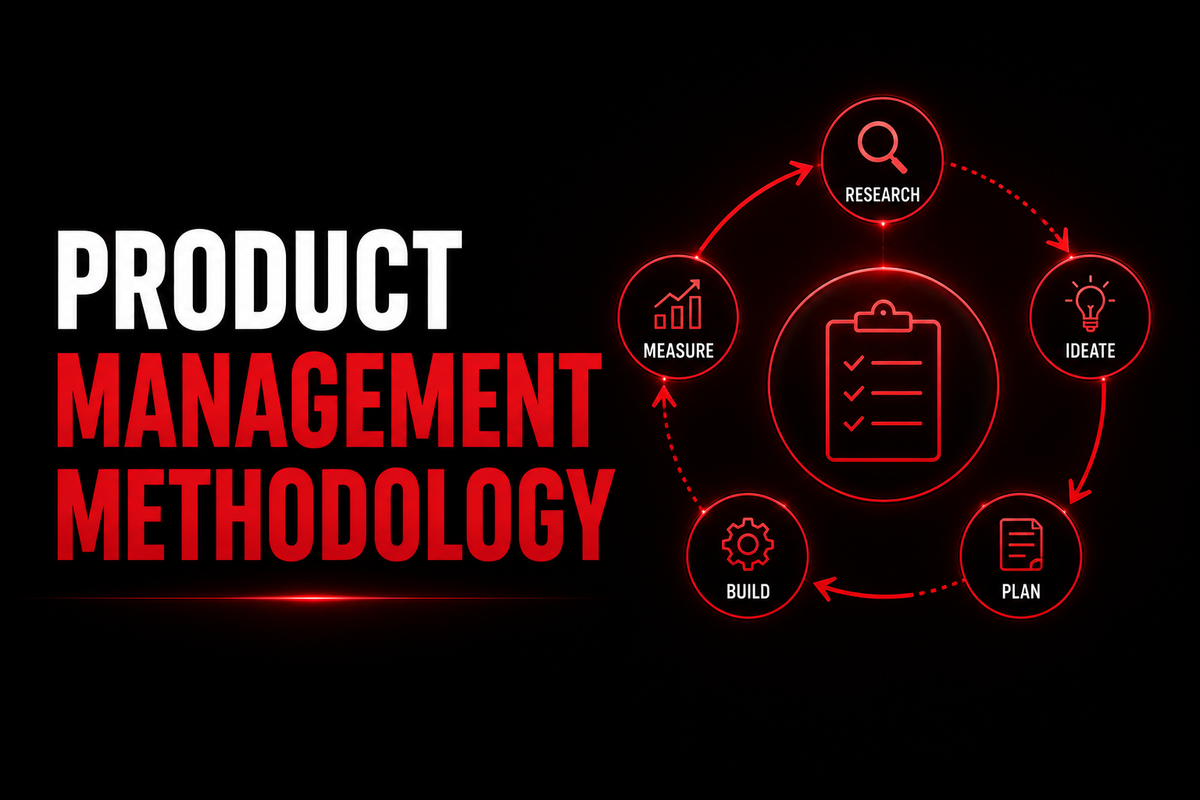
IIM Trichy Product Management Program: Built for the agentic AI era


Open LinkedIn on any given week and you'll find the same argument playing out in the comments section. Someone posts that AI agents are about to write PRDs, run experiments, and ship features on their own. Someone else replies that product management was always about judgment, not tickets, so it's fine. Both sides post with total confidence. Neither side has any actual data.
Meanwhile, a smaller and much quieter group of product managers isn't arguing about it at all. They're the ones already using AI agents to do the analyst work, the documentation, the A/B test math and spending the time they saved on the one thing that was never automatable: deciding what to build and why.
That gap, between the PMs who are debating AI and the PMs who are already managing it, is the entire story of where product management careers are headed in 2026. And it's exactly the gap that IIM Tiruchirappalli's Product Management in the Agentic AI Era programme, delivered in partnership with Masai, is built to close.
This isn't a course that bolts one AI module onto a traditional PM syllabus. It's built around a harder, more honest question: if agentic AI can already draft your roadmap and analyse your funnel, what is a product manager actually for now and how do you become the kind that AI makes more valuable, not less?
Why this debate keeps happening
For the last two years, "AI will replace product managers" has been one of the most searched, most argued, most clickbaited claims in tech careers content. It's not entirely wrong, and it's not entirely right either.
What's actually happening is narrower and more specific. Agentic AI, AI that can plan, use tools, and execute multi-step tasks on its own instead of just answering a prompt is very good at the parts of product management that were always mechanical: summarising user interviews, drafting first-pass PRDs, running competitive scans, building dashboards, even suggesting A/B test variants.
It is not good at the parts of the job that were never really "tasks" in the first place: deciding which problem is worth solving, negotiating trade-offs between engineering, design, and business, reading a room in a stakeholder meeting, or knowing when a metric is lying to you.
So the honest version of "will AI replace product managers" is this: it will replace product managers who only ever did the mechanical half of the job. It will make product managers who can direct AI agents, evaluate their output, and still own the judgment calls dramatically more valuable because now one PM with agentic AI can do the analytical work of an entire junior team.
That's the shift companies hiring for product roles in 2026 are already screening for. Job descriptions that used to ask for "SQL and wireframing" now ask for "experience working with AI tools in the product workflow." The title hasn't changed. The job underneath it has.
What the IIM Trichy agentic AI product management course actually covers
This is a 6-month, live online programme delivered by IIM Tiruchirappalli, structured around roughly 3 hours a week so it works alongside a full-time job. Classes run on weekends. It's organised into four phases that move from PM fundamentals to agentic AI specifically, rather than starting with AI and hoping the PM basics show up along the way.
Phase 1: Product foundations (4 weeks) This is where the base gets built product thinking, the product lifecycle, PM roles and responsibilities, and the core frameworks that define how product decisions get made. It also covers managing and scaling live digital products, including experimentation and data-driven iteration. Companies like Flipkart, Amazon, Swiggy, and Razorpay hire specifically for these fundamentals.
Phase 2: Platforms and strategy (3 weeks) Here the focus moves to platform thinking, network effects, and multi-sided marketplaces the strategic layer that separates a PM who can manage a feature from one who can manage a business. Monetisation models, competitive strategy, and product differentiation inside a platform economy are core here. This is the thinking behind how companies like Uber, Zomato, Meesho, and PhonePe compete.
Phase 3: AI for product managers (6 weeks) This is the bridge phase foundational AI concepts translated specifically into how PMs use them: in roadmapping, prototyping, analytics, and decision-making. It's not a data science crash course. It's AI literacy built for the person who has to decide what AI should do inside a product, not the person building the model.
Phase 4: Agentic AI and capstone (7 weeks) The final phase is where the programme earns its name. It covers how autonomous, proactive AI agents are actively reshaping ideation, personalisation, optimisation, and workflow automation inside product teams. It closes with a team-based capstone: design and pitch a real digital product powered by agentic AI, using the same tools OpenAI, Figma, Notion, Miro, Lovable that product teams are actually using right now.
Across all four phases, the throughline is consistent: this isn't "AI awareness." It's AI as the operating environment every future product decision gets made inside.
What you actually walk away with
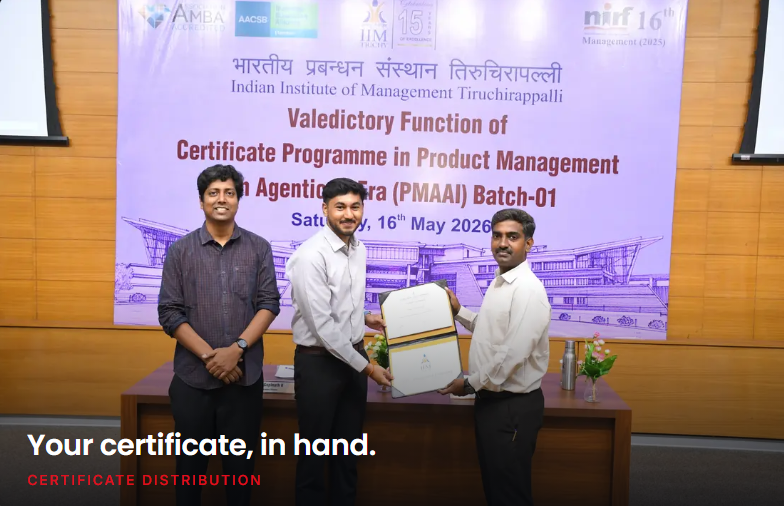
The credential is a verifiable Certificate of Completion from IIM Tiruchirappalli shareable on LinkedIn and your résumé, backed by IIM Trichy faculty and taught by professors specialising in information systems, analytics, and AI in business decision-making.
But the credential is only part of what makes this programme different from a self-paced AI course you'd do alone at 11 p.m. after work:
- Live CXO masterclasses 2 to 3 sessions with founders and CEOs from companies like Paytm, Pine Labs, Instamojo, and ShareChat, on the actual AI decisions they're making right now, not case studies from five years ago.
- A dedicated career coach to build your career roadmap, backed by mentors who've worked in product at Walmart, Flipkart, Uber, Microsoft, and Google.
- A one-day on-campus immersion at IIM Tiruchirappalli faculty interaction, peer networking, and capstone discussions in person.
- Build Week, a hands-on sprint where you take a real company's problem statement and ship a working proof of concept, ending in a demo day.
- The Applied AI Conference, a four-day residency on the Goa coast with keynotes and labs free for learners in the top 10 percentile of the cohort.
It's a small, selective cohort of 100 seats, not an open-enrolment video library. Admission is invite-based after a selection process, which is part of why the network, peers, alumni, faculty tends to actually be useful after the programme ends, not just a LinkedIn group that goes quiet in month two.
How it compares to other AI product management courses
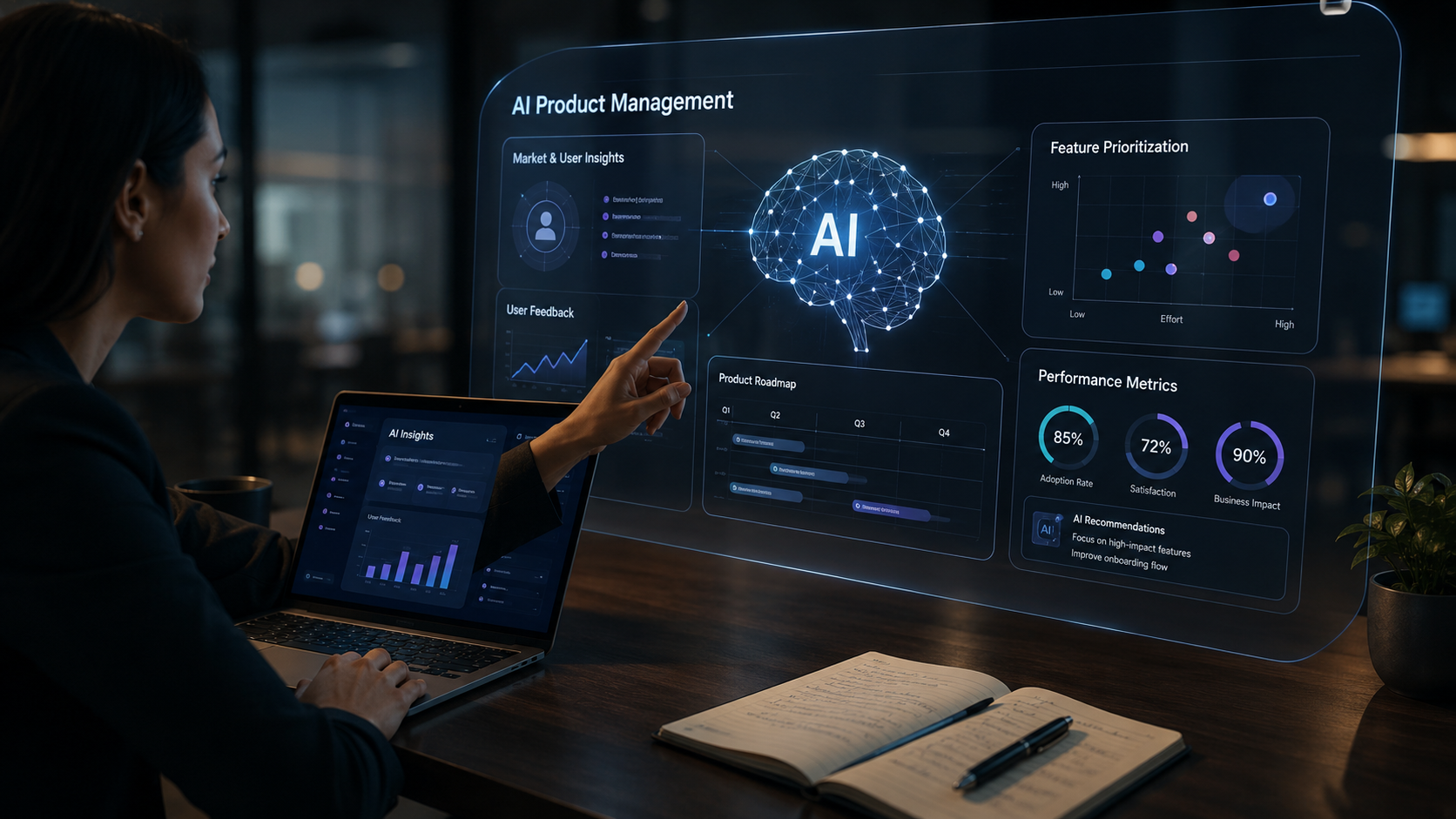
There is no shortage of "AI for product managers" content right now, from $3,000 international cohorts to six-week bootcamp certificates. Here's how the landscape actually breaks down, and where this programme sits in it.
Generic self-paced AI-for-PM certificates (the kind you'll find on most course marketplaces) are usually built around watching pre-recorded videos on prompt engineering and GenAI tools, with a certificate at the end that few recruiters have heard of. They're cheap and flexible, but there's no faculty, no live cohort, and no institutional credential doing the talking for you in an interview.
International cohort-based programmes run by individual AI practitioners can be genuinely deep on the technical agent stack multi-agent systems, RAG pipelines, tool-use frameworks but they're priced for a US market (often $2,500-3,000+), taught in US time zones, and built for people who already have a strong PM base and just want the AI layer.
IIM Trichy's Product Management in the Agentic AI Era sits in a different lane from both. It doesn't assume you already have deep PM fundamentals, it builds them, from product lifecycle basics through platform strategy, before layering AI and agentic AI on top. And it pairs that with what a self-paced course structurally cannot offer: a real IIM faculty credential, live CXO access, a career coach, an on-campus immersion, and a peer cohort that was selected, not just enrolled.
At a total fee of ₹95,000 plus 18% GST (with EMI options starting around ₹13,813/month over 9 months), it's positioned as a serious mid-career investment rather than an impulse course purchase priced closer to a certification than to a full MBA, but backed by an IIM name that MBA applications and hiring managers both recognise.
Who this programme is actually built for
This isn't built for one type of learner. It's designed for four fairly distinct profiles:
Working product managers who are already doing the job but want to move from "PM" to "AI-native PM" before that distinction becomes the difference between getting promoted and getting automated around.
Engineers, analysts, and designers looking to move into product management, who want a structured, credentialed path rather than trying to piece together frameworks from blog posts and YouTube.
Early-career professionals who want to enter product management directly with AI fluency built in from day one, instead of learning "traditional PM" first and bolting AI on later.
Founders and early-stage operators who are making product decisions without a formal PM background, and want the frameworks and AI judgment to make those calls with more confidence.
The admission process
Step 1: Submit your application. Share who you are and what you'd want to build the programme uses this to shortlist, not just collect names.
Step 2: Selection call. Shortlisted candidates go through a call before an offer is made. This keeps the cohort small and serious, not first-come-first-served.
Step 3: Offer and enrolment. Accept your seat and choose your payment plan upfront, in two instalments, or EMI over 9 months via NBFC partners.
Step 4: Classes begin. The next cohort starts 17 October 2026, with your first live session that day.
Total programme fee: ₹95,000 + 18% GST, split across a ₹99 application fee, ₹4,000 registration fee, and ₹91,000 programme fee.
Apply for IIM Trichy's Product Management in the Agentic AI Era →
Next cohort: 17 October 2026 | Format: Live weekend classes + on-campus immersion | Seats: Limited to 250
The bigger picture
Most "AI for product managers" content right now is either fear-based AI is coming for your job, panic or dismissively reassuring don't worry, judgment can't be automated, relax. Both versions let you off the hook from actually doing anything about it.
The more useful and more honest framing is the one this programme is built around: agentic AI is not a threat to product management, it's a filter. It's going to make the mechanical half of the job disappear, and it's going to make the strategic half of the job the part that decides what agents should even be doing the highest-leverage skill a product person can have.
The product managers who get replaced won't be replaced because AI became smarter than them. They'll be replaced because they kept doing the parts of the job that were always replaceable, and never built the parts that weren't.
The ones who don't will be the ones who spent 2026 learning to lead agents instead of competing with them.
For queries: WhatsApp +91 87929 74750 | iimt.programs@masaischool.com
Frequently asked questions
Will AI actually replace product managers? AI agents are automating the mechanical parts of product management research synthesis, documentation, analytics, first-draft roadmaps. They are not replacing the judgment-heavy parts: prioritisation, stakeholder alignment, and deciding what's worth building. PMs who only did the mechanical work are at the highest risk; PMs who can direct AI agents and own the decisions become more valuable, not less.
Who is eligible for IIM Trichy's Product Management in the Agentic AI Era programme? The programme is open to working professionals, engineers, analysts, designers, and early-career candidates looking to move into or advance within product management. Admission is selective, based on an application and a shortlisting call.
How long is the programme and what is the fee? It runs for 6 months at roughly 3 hours a week, on a live weekend format. The total fee is ₹95,000 plus 18% GST, payable upfront, in two instalments, or via EMI over 9 months.
What makes this different from other AI product management courses? It combines a full PM fundamentals curriculum with a dedicated agentic AI phase and capstone, taught by IIM Trichy faculty, alongside CXO masterclasses, a dedicated career coach, an on-campus immersion at IIM Tiruchirappalli, and a selective, small cohort - elements a self-paced or purely online-only course doesn't offer.
Also Read:
 Sadia T
 Sadia T
 Sadia T