
Product Management Methodology: Process, Frameworks & Best Practices (2026)

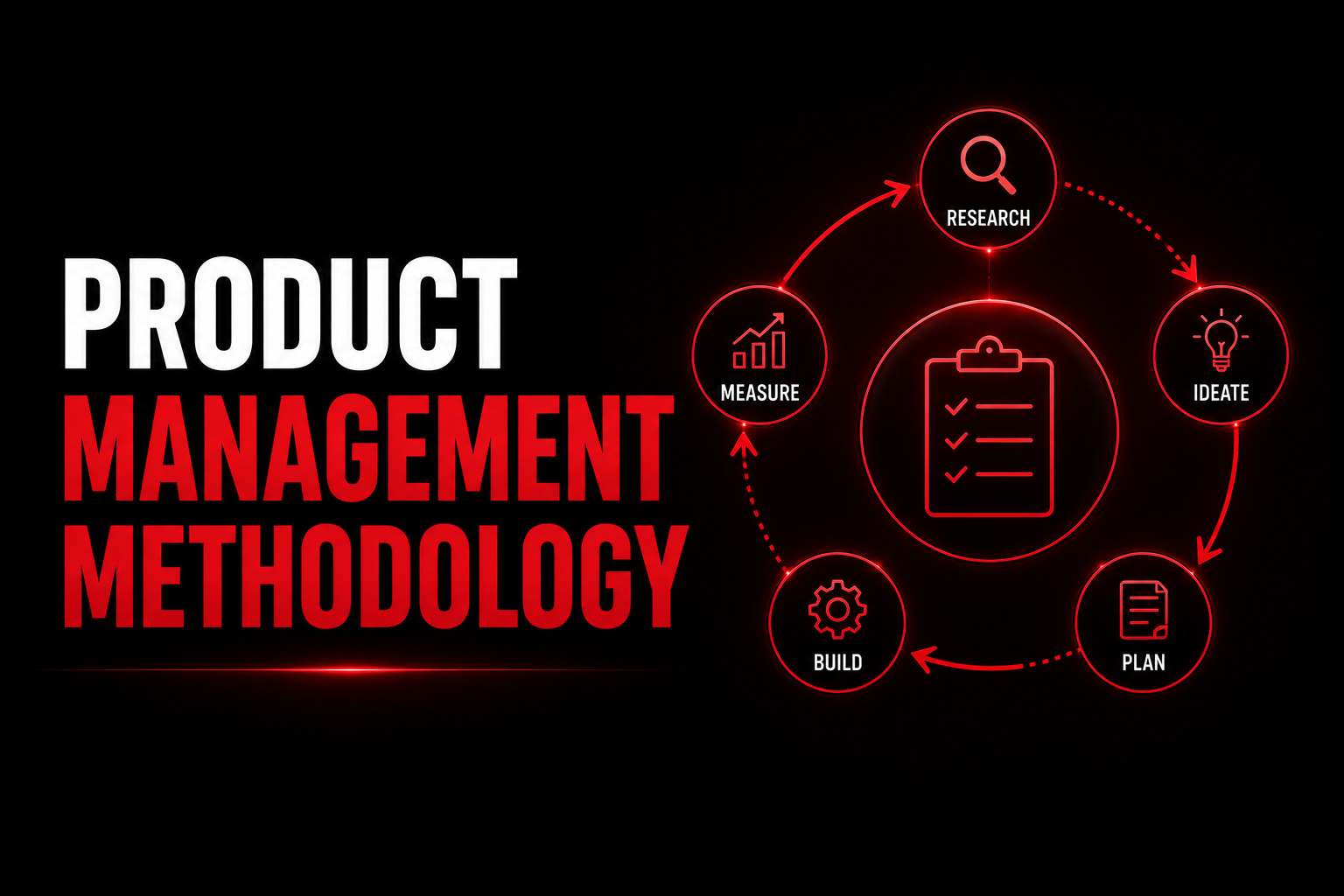
Table of Contents
- What Is the Product Management Process?
- Why the Product Management Process Matters
- The Key Stages of the Product Management Process
- Top Methodologies Used in the Product Management Process
- How to Choose the Right Product Management Process for Your Team
- Tools That Power the Product Management Process
- Common Challenges in the Product Management Process (and How to Fix Them)
- Skills You Need to Run the Product Management Process Well
- How AI Is Changing the Product Management Process in 2026
- Master the Product Management Process with BITSoM's Product Management with Agentic AI Programme
- Conclusion
- FAQs
If you've ever typed "product management process" into Google, you've probably landed on ten different diagrams, none of which quite agree with each other. That's because the product management process isn't one fixed thing it's a framework that every team bends to fit their product, their market, and their pace of change.
This guide pulls that framework apart. You'll get a clear breakdown of every stage in the product management process, a side-by-side comparison of the methodologies teams actually use to run it (Agile, Scrum, Kanban, Waterfall, Lean), the tools that support it, and the skills that separate people who can talk about the product management process from people who can actually run one.
What is the product management rocess?
The product management process is the structured set of stages a team follows to take a product from idea to market and keep improving it once it's there. It typically spans discovery, strategy, development, launch, and growth, with continuous feedback loops running through every stage.
At its core, the product management process exists to answer three questions, repeatedly, at every stage:
- Are we building something people actually want?
- Are we building it in a way the business can sustain?
- Are we learning fast enough to course-correct before it's expensive to?
A well-run product management process doesn't eliminate uncertainty — it just makes sure you're never more than one cycle away from finding out if you're wrong.
Why the product management process matters
Skip a structured product management process and you get one of two failure modes: teams that ship fast but build the wrong thing, or teams that plan meticulously and ship nothing on time. A defined product management process protects against both by forcing explicit checkpoints research, prioritization, validation before resources get committed.
Here's what a strong product management process actually buys you:
- Customer focus. Every stage of the process routes back to real user needs and feedback, not internal assumptions.
- Business alignment. The product management process ties features and releases directly to revenue, retention, and strategic goals not just engineering convenience.
- Cross-functional clarity. Engineering, design, marketing, and sales all know what's happening and why, because the process makes decisions visible instead of tribal knowledge.
- Faster, safer iteration. A repeatable product management process shortens the distance between "we have an idea" and "we know if it worked."
- Lower risk. Structured validation at each stage of the product management process catches expensive mistakes before they reach production.
The key stages of the product Management process
Regardless of which methodology a team layers on top, the product management process almost always moves through the same core stages.
1. Discovery and ideation
The product management process begins with identifying real problems worth solving not just interesting ones. Teams gather insight through customer interviews, market research, competitive analysis, and usage data, then translate raw observations into concrete product concepts.
- Collect signals through surveys, interviews, and support tickets
- Study competitor products and industry reports
- Run structured brainstorming and design-thinking sessions
- Score ideas against feasibility, desirability, and business viability
2. Strategy and roadmapping
Once a direction is chosen, the product management process moves into defining why this product matters, who it's for, and how success will be measured. This is where product strategy and the roadmap take shape the connective tissue between company goals and what actually gets built.
- Define target users and the core value proposition
- Set measurable goals (adoption, retention, revenue)
- Sequence initiatives into a prioritized roadmap
- Align stakeholders around the plan before development starts
3. Design and development
This stage of the product management process turns strategy into something tangible wireframes, prototypes, and eventually working software. Teams build MVPs, test early and often, and refine based on what real usage reveals rather than what was assumed at the whiteboard.
- Create wireframes and clickable prototypes
- Build a Minimum Viable Product (MVP) to test core assumptions
- Run usability and functional testing before wider release
- Iterate based on early user feedback, not just internal opinion
4. Launch and Go-to-Market
A launch is where the product management process meets the market. Positioning, pricing, channel selection, and sales enablement all get finalized here, and the goal is a controlled rollout that generates real signal without unnecessary risk.
For B2B launches, AI GTM tools can add a real-time context layer - company and contact data plus buying signals - so sales and marketing can prioritize the right accounts and run coordinated outreach during rollout.
- Define positioning, pricing, and target segments
- Prepare marketing and sales enablement materials
- Consider a phased or beta rollout to de-risk the full launch
- Set up support channels before customers arrive, not after
5. Growth, Iteration, and Retirement
The product management process doesn't end at launch this is arguably where most of it happens. Teams track adoption, refine features, expand into new segments, and eventually decide when a product (or feature) has run its course.
- Monitor adoption, retention, and engagement metrics
- Prioritize the next round of improvements based on real usage data
- Expand into new markets or customer segments as traction builds
- Sunset features or products that no longer earn their keep
Top methodologies used in the Product Management process
The stages above stay fairly constant what changes is how a team moves through them. That's where methodology comes in. Choosing the right operating model is one of the highest-leverage decisions in the entire product management process.
| Methodology | Best For | Strength | Watch-Out |
|---|---|---|---|
| Agile | Fast-changing products, startups, SaaS | Rapid iteration, constant customer feedback | Requires heavy, consistent stakeholder involvement |
| Scrum | Teams needing structured, time-boxed delivery | Clear roles, predictable sprint cadence | Can feel rigid for teams with shifting priorities |
| Kanban | Continuous-flow work like support or IT ops | Visual clarity, no fixed sprints, easy to adopt | No built-in timeboxing can dilute urgency |
| Waterfall | Regulated, safety-critical, fixed-scope projects | Predictable, well-documented, easy to manage | Inflexible once a phase is signed off |
| Lean | Resource-constrained teams optimizing for value | Waste reduction, fast feedback loops, cost efficiency | Requires a company-wide cultural shift to work well |
Agile treats the product management process as a series of short, iterative cycles rather than one long build. Teams ship small increments, gather feedback, and adjust which is why Agile dominates fast-moving software and SaaS companies where requirements shift constantly.
Scrum, a structured subset of Agile, breaks the product management process into fixed sprints (usually 2-4 weeks) with defined roles Product Owner, Scrum Master, and the development team plus rituals like sprint planning, daily standups, and retrospectives that keep everyone aligned.
Kanban manages the product management process visually, using a board to track work-in-progress and limit how much a team takes on at once. It suits teams handling a continuous stream of requests support, IT, and ops-heavy product teams more than teams shipping big, planned releases.
Waterfall runs the product management process as a strict, sequential pipeline: each phase requirements, design, build, test, release must finish before the next begins. It's less common in software today but still used where requirements are stable and compliance matters more than speed (construction, aerospace, regulated healthcare).
Lean strips the product management process down to whatever creates the most customer value with the least waste fewer unnecessary features, faster feedback loops, tighter cost control. It's a natural fit for early-stage startups validating an idea on a limited runway.
Most mature teams don't run one methodology in isolation they blend them. It's common to see Agile development wrapped around a Lean discovery phase, or Scrum sprints tracked on a Kanban board for visibility. The right product management process is rarely a single framework; it's whichever combination actually fits how your team works.
How to choose the right product management Process for your team
There's no universally "correct" product management process only the one that fits your product's stage, your team's structure, and how fast your market moves. A few questions help narrow it down:
- How volatile are your requirements? Frequent change favors Agile or Kanban; stable, well-defined scope favors Waterfall.
- How big is your team, and how cross-functional is the work? Larger, multi-discipline teams often benefit from Scrum's defined roles and cadence.
- What's your regulatory environment? Heavily regulated industries often need Waterfall's documentation-first rigor.
- How constrained are your resources? Lean is built for teams that need maximum value from minimum spend.
Don't treat your product management process as fixed forever the right approach for a five-person startup team rarely survives unchanged once that team is fifty people managing three product lines.
Tools that power the product management process
The right tools don't define your product management process, but they make it far easier to execute consistently. A few categories worth knowing:
| Category | Examples | Use in the Process |
|---|---|---|
| Roadmapping & Backlog | Jira, ProductBoard, Aha! | Prioritize and sequence work across the roadmap |
| Design & Prototyping | Figma, Miro | Turn concepts into testable wireframes and flows |
| Task & Workflow Boards | Trello, Asana, Jira | Track Agile/Scrum/Kanban work visually |
| Analytics & Metrics | Mixpanel, Amplitude, Google Analytics | Measure adoption, retention, and engagement post-launch |
| Customer Feedback | Qualtrics, HubSpot, in-app surveys | Feed real user input back into the next cycle |
Common challenges in the product management rocess (and how to fix them)
Even a well-designed product management process runs into predictable friction points.
Predicting market trends. Markets shift fast, and teams relying purely on gut instinct often build for a moment that's already passed. Fix: build a lightweight trend-review habit into your product management process quarterly competitive scans plus ongoing customer conversations.
Managing costs across stages. Budget overruns tend to show up late, once a feature is deep in development. Fix: track cost against value at every stage of the product management process, not just at the planning phase.
Balancing customer needs with business goals. Customers want everything; the business can't fund everything. Fix: use a shared prioritization framework (RICE, MoSCoW, Kano) so trade-offs in the product management process are explicit, not political.
Stakeholder misalignment. Different teams optimize for different things engineering for stability, sales for speed, leadership for revenue. Fix: make roadmap decisions visible and revisit them on a fixed cadence so the product management process stays a shared reference point, not a document nobody reads.
Skills you need to run the product management process well
Owning the product management process end-to-end takes a mix of analytical and interpersonal skills:
- Customer empathy translating raw feedback into product decisions
- Strategic thinking connecting day-to-day execution to long-term goals
- Data analysis reading metrics and using them to prioritize, not just report
- Cross-functional collaboration keeping engineering, design, and business aligned
- Communication and negotiation managing stakeholders without formal authority
- Prioritization frameworks RICE, MoSCoW, Kano, and knowing when to use which
How AI is changing the product management process in 2026
AI has moved from a feature teams build to a capability embedded directly into the product management process itself. A few shifts worth tracking:
- Faster discovery. AI tools can summarize thousands of support tickets, reviews, and interview transcripts in minutes, compressing a research phase that used to take weeks.
- AI-assisted prototyping. No-code and LLM-driven tools let product managers build working prototypes without waiting on a full engineering sprint, shortening the design stage of the product management process.
- Predictive prioritization. Machine learning models increasingly forecast which features will move retention or revenue, adding a data layer to prioritization decisions that used to rely purely on intuition.
- Agentic AI in the product itself. Beyond internal workflows, more product managers now own AI-native features recommendation engines, AI copilots, and autonomous agents which means the product management process increasingly includes prompt design, model evaluation, and responsible-AI review as standard steps.
Companies are hiring accordingly. Product management roles that combine core PM skills with AI fluency are commanding a meaningful salary premium over generalist PM roles, and demand for AI-literate product managers has grown sharply over the past year.
Master the product management process with BITSoM's product management with Agentic AI programme
If you want to run the modern product management process not just the pre-AI version of it BITSoM's Product Management with Agentic AI programme, delivered in partnership with Masai, is built specifically around this shift.
- 6-month programme, 8-10 hours/week designed for working professionals and career starters alike (eligibility: 12th pass and above).
- Six structured modules covering the full product management process: product thinking and opportunity discovery, design and MVP, building with agentic AI (prompt engineering, agent frameworks, LLMOps), Agile project execution with Scrum, go-to-market strategy, and data-driven decision-making.
- Hands-on capstone project design and build an AI-enhanced product end-to-end, applying the entire product management process from discovery through launch.
- Real-world projects, including an onboarding funnel audit and a full AI feature specification defended in a live panel review.
- BITSoM certification plus campus immersion at the BITS Pilani ecosystem for direct faculty and industry mentorship.
- Career outcomes spanning Product Manager (₹15-62 LPA), AI Product Manager (₹16-62 LPA), Data Product Manager (₹20-60 LPA), and Growth Product Manager (₹12-23 LPA), with placement support including resume building and mock interviews.
If you're serious about owning the product management process from discovery to AI-native features
Conclusion
The product management process isn't a fixed template you copy from a diagram it's a set of stages (discovery, strategy, development, launch, growth) that every team runs through their own choice of methodology, whether that's Agile, Scrum, Kanban, Waterfall, or Lean. What separates teams that consistently ship great products isn't which framework they picked; it's how disciplined they are about running the product management process end-to-end, with real customer feedback at every stage.
As AI increasingly becomes part of the product itself not just a tool product teams use the product management process is expanding to include new skills: prompt design, model evaluation, and AI-native feature ownership.
FAQs
1. What is the product management process? It's the structured sequence a product team follows discovery, strategy, design/development, launch, and growth to take a product from idea to market and keep improving it based on real feedback.
2. What are the main stages of the product management process? Most teams move through five core stages: discovery and ideation, strategy and road mapping, design and development, launch and go-to-market, and post-launch growth and iteration.
3. Which methodology is best for the product management process? It depends on your product and team. Agile and Scrum suit fast-changing software products; Kanban fits continuous-flow work; Waterfall suits regulated, fixed-scope projects; Lean suits resource-constrained early-stage teams.
4. What's the difference between Agile and Scrum in the product management process? Agile is the broader philosophy iterative, customer-driven, adaptive. Scrum is a specific Agile framework that adds structure: fixed sprints, defined roles, and set ceremonies like standups and retrospectives.
5. What tools are used in the product management process? Common tools include Jira and ProductBoard for roadmapping, Figma for design and prototyping, Trello or Asana for workflow tracking, and Mixpanel or Amplitude for post-launch analytics.
6. How is AI changing the product management process? AI is speeding up discovery through faster data synthesis, enabling AI-assisted prototyping without full engineering cycles, and adding new steps like prompt design and model evaluation for teams building AI-native features.
7. What skills do you need for the product management process? Core skills include customer empathy, strategic thinking, data analysis, cross-functional collaboration, communication, negotiation, and fluency with prioritization frameworks like RICE or MoSCoW.
8. Can a small team run a full product management process? Yes. Small teams often run a leaner version combining Lean and Kanban principles — focusing on the same core stages without heavy documentation or ceremony overhead.
9. How long does one cycle of the product management process take? It varies widely: a Scrum sprint might run 2-4 weeks, but a full cycle from discovery to launch can take anywhere from a few weeks for a small feature to several months for a new product.
10. Do product managers need to learn AI to run the modern product management process? Increasingly, yes. As more products embed AI features directly, product managers who understand prompt engineering, model evaluation, and responsible AI are better positioned to own the full product management process and tend to command higher salaries for it.