
How to win an AI Hackathon in 2026 (Full Guide)

How do you win an AI hackathon in 2026? You read the judging rubric before the problem statement, scope your idea down until it can be finished in the first 25% of the clock, use AI coding agents deliberately instead of constantly, and script your 90-second demo before you write a meaningful line of code. Everything else the tech stack, the sponsor prizes, the all-nighter is secondary to those four moves.
That's the one-paragraph answer. The rest of this guide breaks down exactly how consistent winners apply it from vibe coding etiquette to what judges are actually scoring on a rubric so you can walk into your next 4-hour, 24-hour, or 48-hour sprint with a real plan instead of just vibes.
Key Takeaways
- Hackathon outcomes are decided in the first quarter of the clock, not the last teams that ship a rough, working skeleton early consistently beat teams with stronger raw technical skill.
- AI hackathon judging in 2026 typically weighs technical implementation and problem-solving impact more heavily than raw innovation one widely-used 2026 rubric splits scoring as 20% innovation, 25% technical implementation, and 25% problem-solving impact, with the rest going to presentation.
- Vibe coding describing what you want in plain language and letting an AI agent generate the code is now the default hackathon workflow. Over 90% of developers report using AI coding tools daily in 2026, but the teams that win still hand-write the 20% of logic that makes their project different.
- A balanced 3-person team (frontend, backend/AI integration, one strong presenter) consistently beats a 4-person team of specialists who can't explain what they built.
- Judges see 30-100 demos in a single day. The teams that win spend real time on the problem statement and the first 30 seconds of the pitch, not just the build.
Why AI Hackathons are a different game in 2026
A regular hackathon and an "AI hackathon" look similar on the surface a problem statement, a clock, a stage. But the tools and the judging bar have both shifted hard in the last two years.
By 2026, the large majority of developers report using AI coding tools daily, and a meaningful share of shipped code is AI-generated. That shift changes what "technical skill" even means at a hackathon. Nobody is impressed that you wrote a REST API by hand anymore they're impressed by what you built with the four extra hours that gave you.
The result: AI hackathons in 2026 reward judgment and orchestration picking the right problem, prompting well, and knowing which 20% of the code to write yourself over raw typing speed. That's good news if you're newer to coding, and it's a trap if you assume the AI will carry the whole project for you. Judges can tell the difference within the first two questions of Q&A.
Before you register: 3 moves that decide the outcome early
1. Read the judging rubric before the problem statement
The rubric tells you what gets rewarded. The problem statement only tells you what to build. These are not the same document, and most teams only read one of them.
A rubric that weights "innovation" heavily rewards a clever, narrow angle on a simple problem. A rubric weighted toward "technical implementation" rewards depth of build over polish and enterprise hackathon judging frameworks increasingly ask judges to score against a fixed, published weighting rather than gut feel, precisely to avoid this kind of mismatch. One recent AI Builders Hackathon rubric on Devpost split scoring as roughly 20% innovation and creativity, 25% technical implementation, and 25% problem-solving and impact, with the remainder going to presentation quality. If you don't know the split, you're optimizing blind.
Rubric weights vary by event and always confirm the exact split with organizers before you scope your idea.
2. Build your team around skill gaps, not friend groups
The most common losing lineup at an AI hackathon is three or four backend-leaning engineers who can wire up an agent pipeline beautifully and then freeze during Q&A because nobody owns the story. A team that consistently places has, at minimum:
- One person who can ship a usable frontend fast (even with an AI UI generator)
- One person comfortable gluing APIs, models, and backend logic together
- One person who owns the pitch, the slides, and the demo script from hour one
Two to three people is the sweet spot. Beyond four, coordination overhead eats more time than extra hands save you.
3. Pick a problem you can finish, not one you want to solve
Ambition is what kills most AI hackathon teams not bad prompting. A team that sets out to "build an autonomous agent that automates legal contract review" at a 4-hour sprint will spend three hours on the agent framework and discover in hour four that it breaks on a real contract.
A problem you can actually finish has three traits: the demo works without depending on a flaky third-party API or a specific person being online, a judge can understand what it does in under 30 seconds, and the "aha" moment lands inside the first minute.
During the build: how to use AI coding agents without losing the plot
This is the part that's genuinely different from a 2019-era hackathon guide.
Ship a rough skeleton in the first quarter of your time. By the 25% mark of a 4-hour sprint, that's roughly the one-hour mark you should have something that takes one input and produces one output, even if every screen is a placeholder. This is the single strongest pattern separating winning teams from teams that plan all day and build all night.
Use vibe coding for the 80% that doesn't differentiate you. Let an AI coding agent (Claude Code, Cursor, Replit Agent, v0, or whatever your team already knows) handle boilerplate, UI scaffolding, and standard API integration the same intent-to-code workflow developers are converging on across the industry in 2026. That's exactly what it's built for, and it's the fastest way to get to a working skeleton.
Hand-write the 20% that is your actual idea. The specific prompt chain, the unique data pipeline, the logic that makes your project different from the ten other teams solving the same problem statement write that yourself, or at minimum understand every line of it. Judges ask pointed questions about the part of the build that looks novel. If you can't explain how it works, that's the moment you lose the round, not the moment your code breaks.
Mock what isn't core to your idea. If your product depends on a live payments API or a third-party data feed that isn't the point of your project, fake it. Judges don't penalize a mocked dependency. They do penalize a demo that dies mid-pitch because a sandbox API rate-limited you.
Keep your main branch demo-safe. Push anything risky to a feature branch. A working, embarrassing app beats a half-finished ambitious one every single time a judge is watching a clock.
AI tools Hackathon teams are actually using in 2026
The Demo: Where AI Hackathons are actually won or lost
Judges at a mid-size hackathon can sit through 30 to 100 demos in a single day. Research on hackathon evaluation patterns backs up what every experienced judge already knows: early impressions dominate scoring far more than raw technical merit does. You are not being judged on your code quality. You are being judged on whether the judge remembers your problem statement by the time the next team starts talking.
Write your 90-second demo script before you write meaningful code. It should fit on one page and cover five things in order:
- The problem, in one sentence, framed around a specific person
- What that person does today, without your tool
- The trigger that starts your demo
- The "aha" moment you want the judge to remember
- Why this matters if it scaled beyond the demo
Spend roughly 30% of your pitch time on the problem and 70% on the solution. Most losing teams invert that ratio they spend five seconds on the problem and the rest showing off features nobody asked for.
Demo mistakes that quietly cost teams the prize
Where to actually build these skills before fight night
None of the tips above are useful if the first time you're prompting an AI agent under pressure, wiring up an API, or pitching to strangers is also the first time you're doing it, period. The teams that look calm on stage usually aren't naturally calm; they've just done a scaled-down version of this exact pressure test before.
That's the gap Masai's project-based, cohort-driven programs are built around. Instead of learning AI development through isolated tutorials, Masai's learners work in teams on real, timed builds, shipping working prototypes, presenting them to mentors, and getting pushed on the same kind of "why did you build it this way" questions a hackathon judge would ask. It's the same muscle: scoping a problem fast, using AI tools deliberately instead of blindly, and defending your build out loud.
I build with AI championship: A Real Place to test this guide
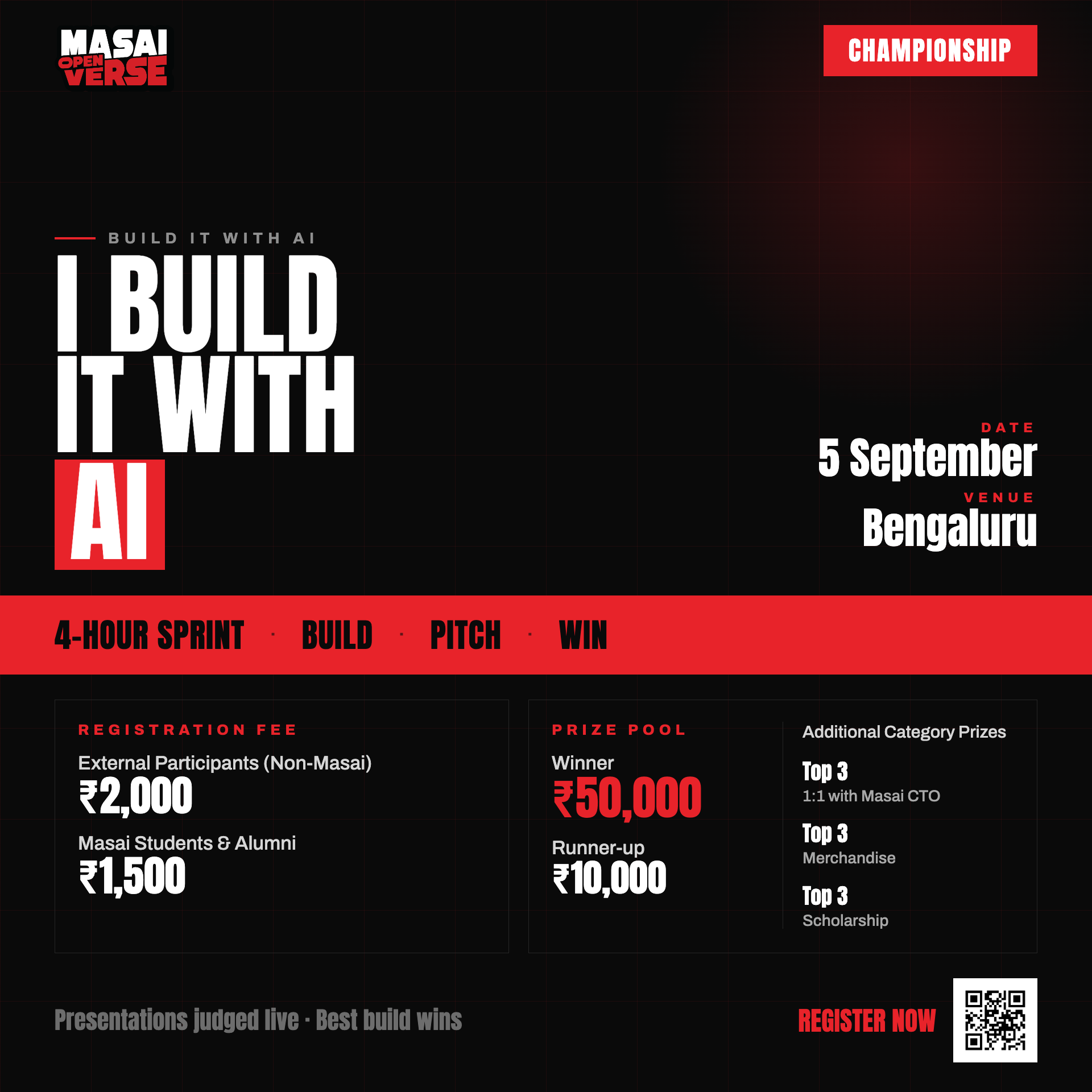
If you're in or around Bengaluru, you don't have to take any of this advice in the abstract. Masai's I Build with AI Championship is a live, 4-hour AI build sprint where the problem statement is revealed on the spot everything in this guide (rubric-first thinking, rapid scoping, a scripted demo) applies directly.
What it's about: You get a surprise problem statement, then have 4 hours to build a working solution using whatever AI tools you choose vibe coding included before pitching it live to a panel of industry judges.
Who's judging: This isn't a panel of student volunteers it's a five-person expert bench pulled from both industry and Masai's own leadership:
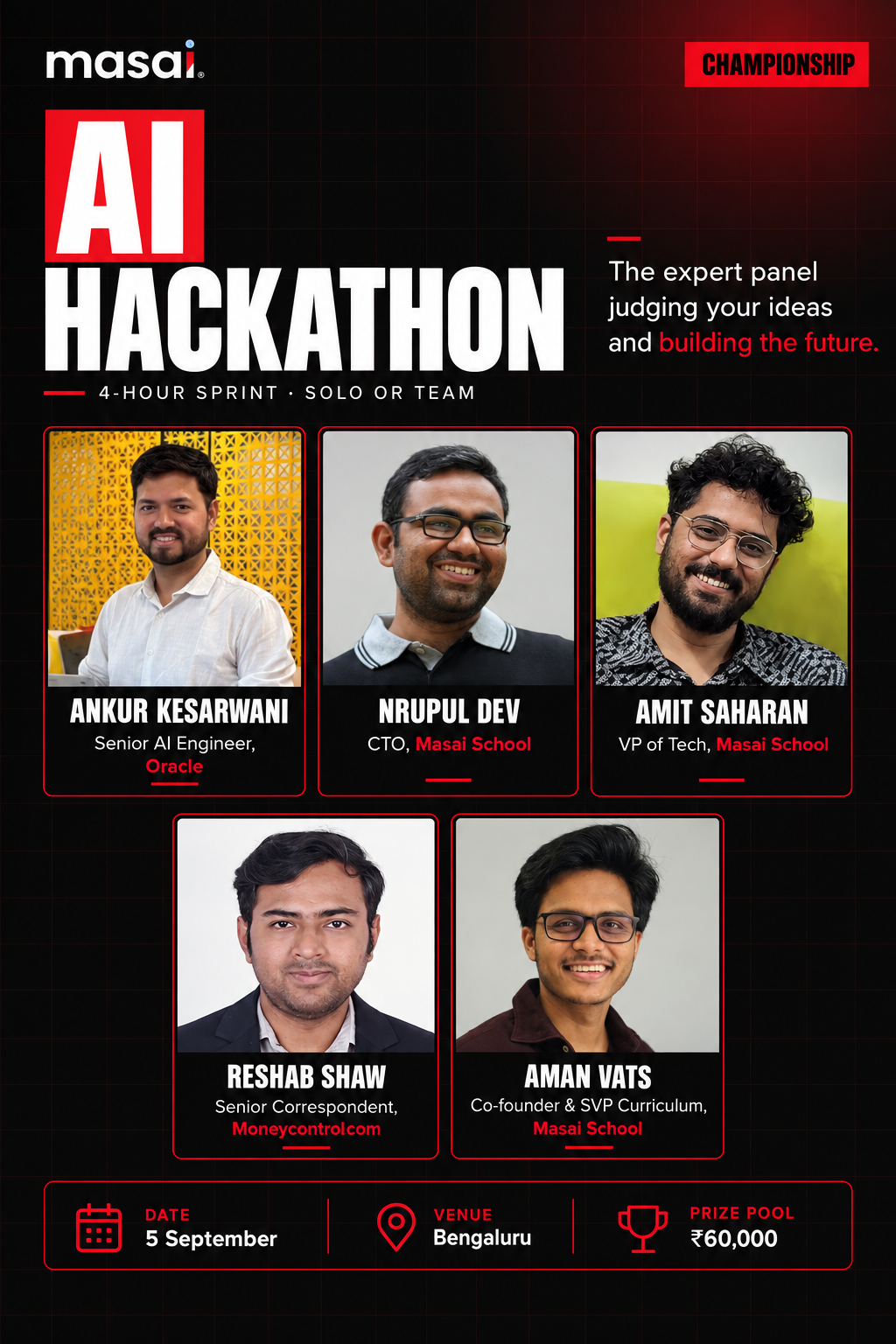
Ankur Kesarwan - Senior AI Engineer, Oracle
Nrupul Dev - CTO, Masai School
Amit Saharan - VP of Tech, Masai School
Reshab Shaw - Senior Correspondent, Moneycontrol.com
Aman Vats - Co-founder & SVP of Curriculum, Masai School
you're being evaluated on technical depth by engineers who ship AI systems for a living, on product judgment by people who've built curriculum and companies from zero, and on how well your story lands with someone who covers tech and business for a national audience. It's the closest thing to a real investor-and-engineering review most participants will get outside an actual job.
Who it's for: Solo builders or teams of up to 3, open to both Masai students and alumni as well as external participants who've never taken a Masai course. If you're a beginner leaning on AI coding agents, an experienced dev who wants a proper pressure test, or a student trying to build a portfolio piece, the format works for all three the earlier "beginners can win too" logic in this guide applies here directly.
What you'll get:
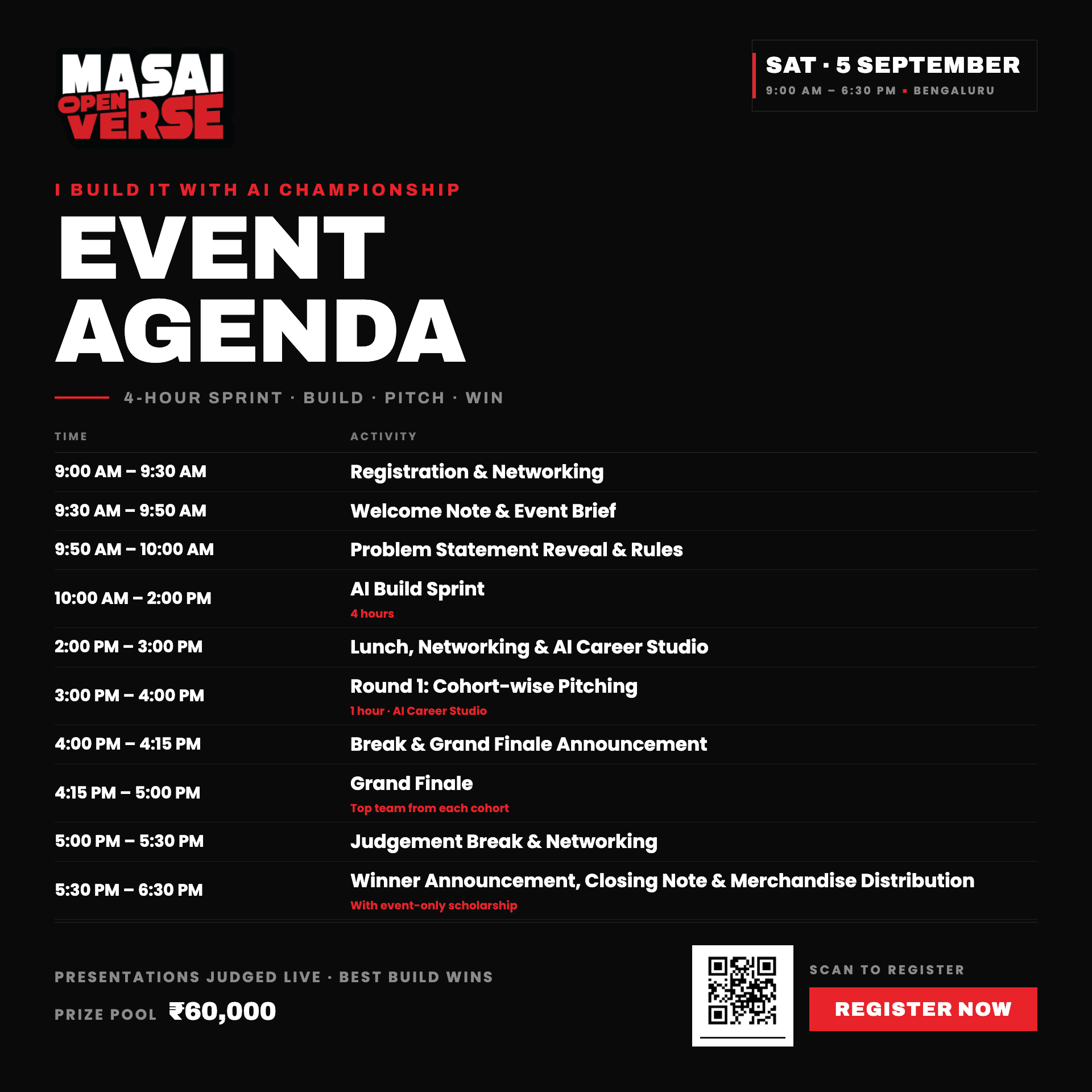
Event basics: 5th September 2026, 9:30 AM - 6:30 PM, Bengaluru (exact venue shared after seat approval). Registration is ₹1,500 for Masai students/alumni and ₹2,000 for external participants, capped at 60 total participants Register here.
Whether or not this specific event is on your calendar, the underlying point holds: the fastest way to get good at winning AI hackathons is to practice building under a clock, with a team, in front of people who will ask you hard questions repeatedly, not just once every few months.
Frequently Asked Questions
How do I pick a winning AI hackathon idea?
Pick a problem you can finish in the time allotted, not the most ambitious idea in the room. A winning AI hackathon idea passes three tests: the core demo works without depending on an unreliable third-party API, a judge can understand what it does in under 30 seconds, and the "aha" moment happens in the first minute of your pitch. If your idea fails any of these, cut scope until it passes you can always layer on stretch features once the core works end to end.
What makes a good AI hackathon team?
A good team is built around skill gaps, not friendships. The minimum effective lineup is one person who can ship a usable frontend fast, one person comfortable integrating AI models and backend logic, and one strong presenter who owns the pitch from day one. Two to three people is usually the sweet spot a team of four AI-focused engineers with no dedicated presenter routinely loses to a leaner, better-rehearsed team.
Should I use AI coding tools during a hackathon?
Yes, but selectively, not constantly. Use vibe coding and AI agents for boilerplate, UI scaffolding, and standard API integration the 80% of the build that doesn't differentiate your project. Write or deeply understand the 20% that is your actual idea, because judges will ask pointed questions about exactly that part, and teams that can't explain their own differentiator lose on technical Q&A even when the demo runs perfectly.
How important is the demo compared to the code?
The demo is usually the single biggest factor in who wins. Judges can see 30 to 100 demos in one day and form an opinion in the first 30 seconds, well before they see any code. Hardcoding your demo path, caching API responses as a fallback, and rehearsing your 90-second script matter more to your final placement than shipping production-grade, fully resilient code no judge will ever read.
Can beginners with little coding experience win an AI hackathon?
Yes, more than in previous years. Because AI coding agents now handle a large share of boilerplate and scaffolding, the bottleneck has shifted from "can you type fast" to "can you scope a problem, prompt well, and explain your build clearly." Beginners who partner with someone slightly more technical and own the problem-framing and pitch often outperform strong solo coders who can't communicate what they built.
How long before the deadline should I submit my project?
At least 30 minutes before the deadline, never 30 seconds. Treat the last portion of your build time as a separate phase: lock the codebase, record your demo video (twice, as a backup), walk through the live demo several times to find where it breaks, and write a short README so judges who don't catch your live pitch can still evaluate the project fairly.
What if my team thinks it bombed should we still submit?
Always submit. Teams frequently misjudge how they did, because the rubric weighting they assumed dominant often isn't the one judges actually applied. Beyond the placement chance, the submission becomes a portfolio piece, an interview talking point, and proof you can ship under real pressure which matters well beyond the day of the event itself.
Final Takeaways
- Winning an AI hackathon is decided early: read the rubric, scope a finishable idea, and get a rough skeleton working in the first quarter of your time.
- Use AI coding agents for the boring 80% of the build and hand-own the 20% that makes your project different judges test exactly that boundary in Q&A.
- The demo and the pitch decide more outcomes than code quality does. Script it before you build, spend real time on the problem, and rehearse the punchline.
- Build a lean, skill-diverse team with a dedicated presenter not a pile of specialists who all do the same job.
- The fastest way to get good at this is repeated practice under a real clock, with real feedback not another article.
Building toward your next AI hackathon? Masai runs project-based, cohort learning built around exactly this kind of real-world, timed, feedback-heavy building and hosts the I Build with AI Championship in Bengaluru for anyone who wants to test these tips live.