
How to validate a startup idea: a step-by-step method before you build
How to validate a startup idea in 6 steps: problem interviews, willingness to pay, a landing-page test and a concierge test, with the pass mark set first.

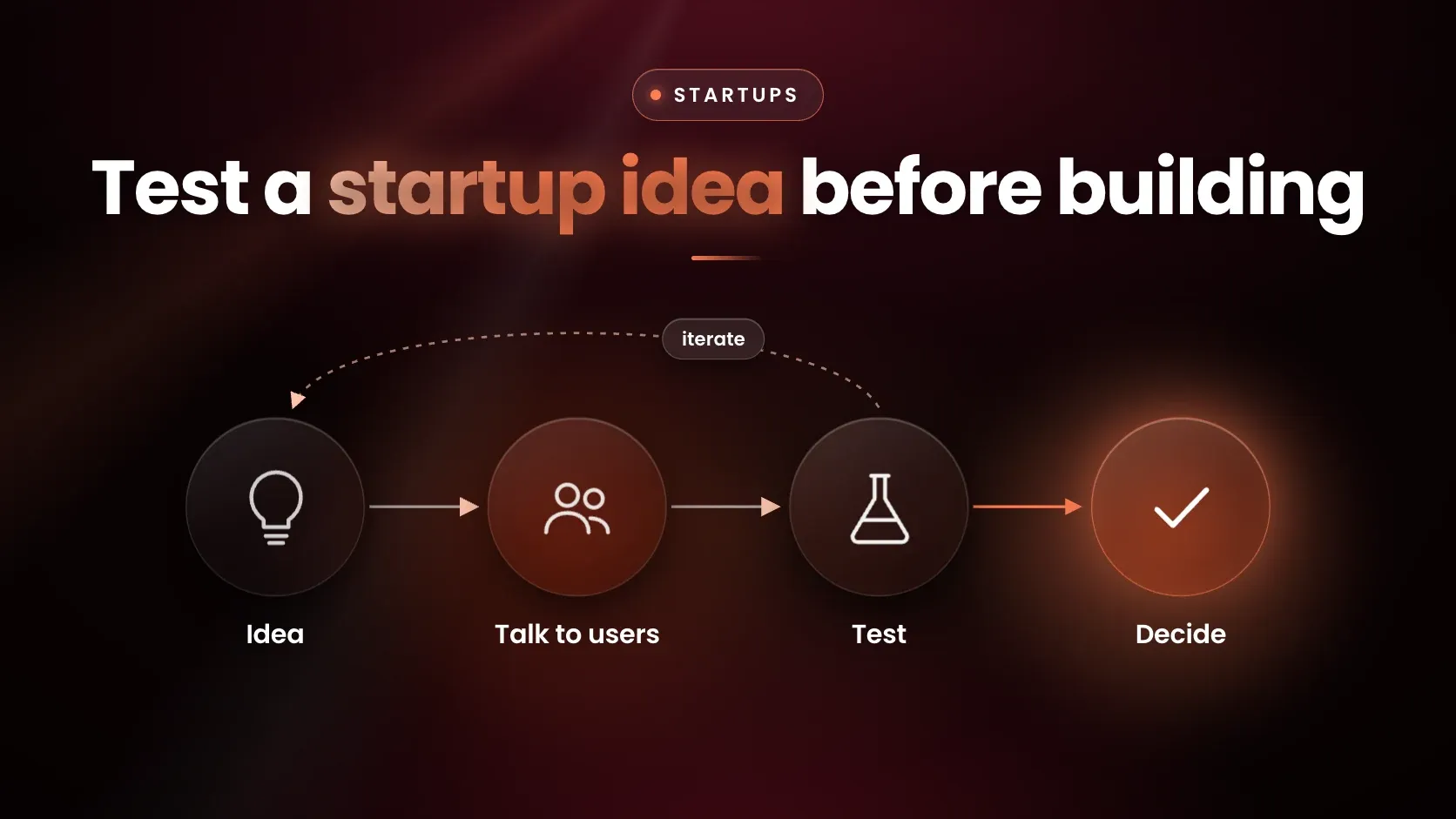
To validate a startup idea, write down the riskiest assumptions and test the problem in customer interviews. Then look for willingness-to-pay signals such as a pre-order or a paid pilot, and run the cheapest test that could prove the idea wrong. Set the pass mark before the test starts. Eric Ries's Lean Startup asks whether a product should be built, not whether it can be.
How do you validate a startup idea?
Validation is a short run of small tests, each aimed at one assumption, ordered from cheapest to most costly. CB Insights' report of 5 March 2026 shows why it matters. Among 385 venture-backed companies that shut down since 2023 and had identifiable reasons, 43% cited poor product-market fit. Many cited several reasons, and running out of capital topped the list at 70%. Those are venture-backed shutdowns in CB Insights' data, not an Indian sample, so the figure is a warning and not an Indian failure rate.
The table below lays out six steps, with what each one tests and what a pass could look like. The pass signals are examples of the kind of mark to set, not benchmarks.
| Step | What you do | Example pass signal (hypothetical) |
|---|---|---|
| 1. Write hypotheses | State who has the problem, how often and what they do about it today | Three written assumptions, each testable in a week |
| 2. Interview customers | Ask about past behaviour, not opinions of your idea | 8 of 15 describe the problem in the last month and a workaround they already use |
| 3. Look for payment signals | Ask for a commitment of time, an introduction or money | 5 people agree to a paid pilot |
| 4. Run a landing-page test | Show the offer to targeted visitors and count sign-ups | 10 sign-ups from 200 targeted visitors |
| 5. Run a concierge or prototype test | Deliver the result by hand or with a mock-up | Customers use it again without being chased |
| 6. Decide | Compare results with the marks set in advance | Continue, change the idea or stop |
How do you test the problem with customer interviews?
Start with hypotheses written as plain sentences, for example that small coaching-centre owners lose track of fee payments every month. Each sentence names a customer, a problem and a current workaround. Ash Maurya, author of Running Lean and creator of Lean Canvas, advises prioritising problems before solutions and learning root causes through carefully unscripted customer interviews.
Rob Fitzpatrick's The Mom Test is a handbook on talking to customers. His site describes it as a guide to learning whether a business is a good idea when everyone is lying to you. His teaching guide centres on turning bad questions into good ones and on the three major causes of bad and biased data.
The venture firm Unusual Ventures summarises its rules as talking about the customer's life instead of your idea, asking about specifics from the past, and talking less and listening more. A usable question is therefore "How did you handle the last time a fee was missed?", not "Would you use an app for fee reminders?"
How many interviews are enough is a question with no startup-specific rule. A 2006 paper in Field Methods by Guest, Bunce and Johnson analysed 60 in-depth interviews with women in two West African countries. No new themes appeared after the first 12, and the basic elements of the main themes were present by the sixth. That study looked at one specific group, so each customer segment needs its own round, and the practical stopping point is when new interviews stop adding new answers.
What counts as a willingness-to-pay signal?
A willingness-to-pay signal is a commitment that costs the customer something, because compliments cost nothing. Fitzpatrick's teaching guide points to commitment and advancement as the way to validate early customer interest. Unusual Ventures' summary lists three forms of commitment: time, such as a booked follow-up meeting; reputation risk, such as an introduction to a colleague or decision-maker; and cash.
In order of strength, a signed pilot or pre-payment beats a booked follow-up, and a follow-up beats a compliment. A pass mark can be written in those terms, for example that 5 of 15 interviewees agree to a paid pilot before any product exists. The figure is a hypothetical example, and each founder should set one that fits the price and the market.
How does a landing-page smoke test work?
A landing-page smoke test shows a clear offer to targeted visitors and counts how many take a defined action, such as joining a waiting list or paying a deposit. Eric Ries wrote in 2009 that a simple AdWords smoke test would have shown a team that nobody wanted a feature they had spent two weeks building. Ash Maurya describes the offer as a unique value proposition, a demo and a call to action.
The pass mark has to be fixed first. Take a hypothetical founder who decides that 10 sign-ups from 200 targeted visitors, a 5.0% rate, means the offer is worth pursuing. An outcome of 7 sign-ups from 180 visitors is 3.9% and falls below the mark. An outcome of 12 from 190 is 6.3% and passes. Writing the number down before the results arrive stops the mark from drifting towards whatever the data show.
When should you run a concierge or prototype test?
A concierge test delivers the service by hand to a few customers before any software exists. A note on Eric Ries's blog defines the concierge model as building a front end or offering a service that appears automated and then doing the work by hand behind the scenes. The same blog describes Wizard-of-Oz-style MVPs that use manual workarounds. A hypothetical founder testing the fee tool could collect fee data from five coaching centres on a shared sheet and send reminders manually for a month.
This test answers a different question from the landing page: whether the customer gets enough value to keep using the result and to pay for it. Ries defines the minimum viable product as the version of a new product that lets a team collect the maximum validated learning about customers with the least effort, and adds that it is not about making minimal products. Software founders who build a prototype can describe it in a repository README, as in the guide to a GitHub profile README.
What counts as a pass, and what is problem-solution fit?
A pass is a result that meets a mark written down before the test, and problem-solution fit is the point at which those marks show real demand. Ash Maurya defines problem-solution fit as sufficient and repeatable demand, shown through sales, for a product the founder knows how to build at a price that makes the business model work. He calls it the first significant milestone of a startup, ahead of product-market fit.
The Lean Startup site treats a failed test as information. A result that misses the mark is a sign to pivot or make a structural course correction, and progress is measured as validated learning. Use actionable metrics, meaning numbers that show cause and effect, such as sign-ups after a specific message, not page views alone. A founder who learns new skills during this stage can use a guide to free online courses with certificates.
Which traps spoil early validation?
The common traps come from asking people who want to be kind, or from measuring the wrong thing.
- Interviewing only friends and family, whose compliments are weak evidence of demand.
- Pitching the idea in the interview, which invites compliments instead of facts.
- Asking about the future, such as whether someone would buy, instead of what they did last time.
- Treating a compliment as a commitment.
- Counting page views or likes instead of actionable metrics.
- Building first, as Ries's two-week feature shows.
- Moving the pass mark after seeing the results.
- Applying 12 interviews from one customer segment to every segment.
A pass does not promise demand later, a funding outcome or a profitable business. Validation lowers one kind of risk, building something nobody wants, and leaves cost, competition and execution untouched.
Where does validation fit in a founders programme?
Validation is the first stage of building, so a founders programme treats it as early work.
The Founders Cohort, Leap by Masai is a Leap by Masai programme for aspiring founders that moves from an in-person start in Goa through an online build phase to an in-person pitch event in Bangalore for teams that meet the benchmarks, covering problem discovery, building a live MVP, talking to users, finding distribution, pricing and investor pitching, with sessions led by founders and practitioners.
Readers who want the wider path can start with the guides on how to start a startup in India from idea to first customer and how to pick a business idea and validate it.
Frequently asked questions
How do you validate a startup idea?
Write the riskiest assumptions as testable sentences, interview customers about past behaviour, look for commitments such as pre-orders or paid pilots, and run a cheap test such as a landing page or a hand-delivered service. Decide the pass mark before each test and compare the result with it.
How many customers should you talk to before building?
No startup rule fixes a number. A 2006 Field Methods study of 60 interviews found no new themes after the first 12 in one specific group, and its basic themes appeared by the sixth interview. Each customer segment needs its own round, and the practical stopping point is when new interviews add nothing.
What is problem-solution fit?
Ash Maurya, author of Running Lean, defines it as sufficient and repeatable demand, shown through sales, for a product the founder knows how to build at a price that makes the business model work. It is an early milestone that comes before the later question of product-market fit.
What is a minimum viable product?
Eric Ries defines it as the version of a new product that lets a team collect the maximum amount of validated learning about customers with the least effort. He notes that despite the name it is not about making minimal products, and that deciding what to include takes judgement.
What is the difference between a concierge test and a landing-page test?
A landing-page test measures interest in an offer by counting sign-ups or deposits from visitors. A concierge test delivers the service by hand to a few customers, so it measures whether they get value and keep using it. The first tests demand, and the second tests whether the service works.
Can friends and family validate a startup idea?
Rarely. Fitzpatrick's Mom Test is built on the premise that customer answers are unreliable unless the questions are designed carefully, and it pushes towards questions about past behaviour and commitments. Compliments from people who know the founder are weak evidence of demand.
Next step
Pick one assumption, write its pass mark today and run the cheapest test that can fail, which is usually a handful of customer interviews or a one-page offer. The Founders Cohort, Leap by Masai page lists the phases and sessions for founders who want to take validation through to a live MVP.