
Future of Jobs in India: Best careers, high-salary skills & what to expect

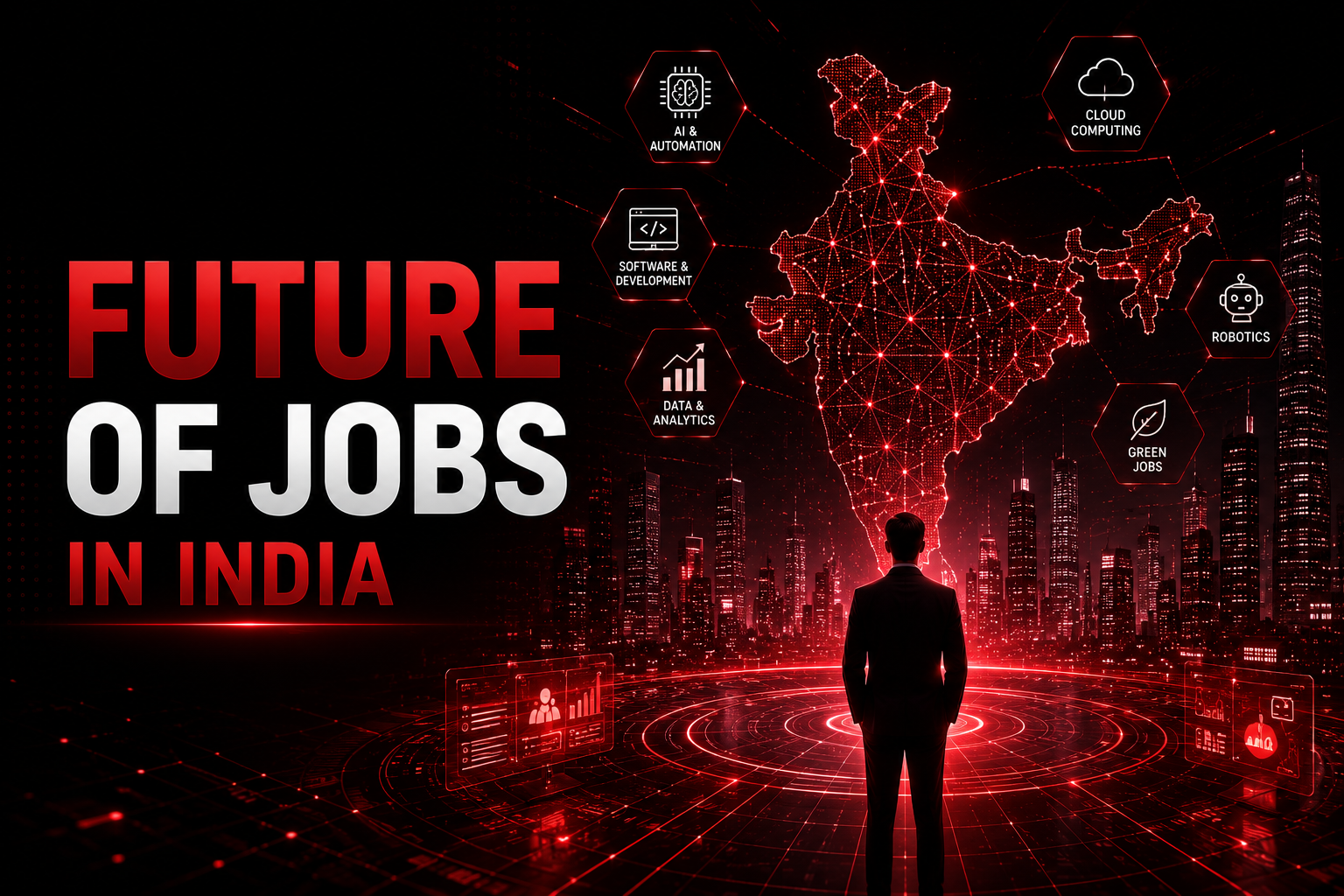
India isn't running out of jobs. It's running out of the right skills for the jobs that are actually growing. This piece breaks down exactly where the Indian job market is headed by 2030, which sectors are booming, which are shrinking, and what you can realistically do about it whether you're a student picking a stream or a working professional wondering if your job survives the next five years.
Why everyone's suddenly talking about the future of Jobs in India
Three forces are colliding at once in India's economy right now, and that's why this conversation feels so urgent.
First, AI adoption is accelerating faster than hiring plans can adjust. Reports tracking graduate employability have found that over 30% of Indian organisations are actively planning to reduce fresher hiring as AI tools take over tasks like data processing, basic coding, market research, and report generation the exact entry-level work that used to be a graduate's first job. The old "hire in bulk, train on the job" model that Indian IT and services companies ran for two decades is quietly disappearing.
Second, India's workforce is exploding in size. The country is projected to add tens of millions of people to its working-age population by 2030. That's an enormous opportunity if the economy creates enough quality jobs and a serious risk if it doesn't.
Third, and this is the part most people miss: it isn't unskilled jobs that are most exposed to AI. Research on AI exposure consistently shows that highly skilled, cognitive-heavy roles software developers, analysts, consultants, junior lawyers, researchers are more exposed to automation than physically-grounded work like construction, caregiving, hospitality, and skilled trades. That flips the old assumption that a "safe" career simply means a white-collar desk job.
The big picture: What's actually happening to Jobs in India by 2030
Strip away the noise, and the data tells a fairly consistent story across every major research report on India's labour market:
- India will remain a net job creator through 2030 but the composition of jobs is changing faster than colleges, training institutes, and even parents can keep up with.
- The skills gap is the real crisis, not a jobs gap. India is short an estimated 1.4 million tech workers even as graduate unemployment sits above 40% in some cohorts. The problem isn't a shortage of people it's a mismatch between what degrees teach and what companies actually need.
- Mid-career professionals aged 30-45 working in routine IT, banking operations, or manufacturing roles face the sharpest disruption risk, with the window to proactively reskill closing around 2026–2028.
- Roughly 63 in every 100 Indian workers will need retraining by 2030, according to the World Economic Forum's Future of Jobs Report and a meaningful share of them may not get access to that training unless companies and policy step in.
None of this means panic. It means direction matters more than it used to.
Which sectors are shrinking and which are booming

Automation risk in India isn't spread evenly. It's heavily concentrated in a handful of sectors, while others are seeing some of the strongest hiring tailwinds in a decade.
Under the most pressure:
- Routine IT services boilerplate coding, manual software testing, tier-1 tech support
- Banking and insurance back-office operations
- Traditional accounting and bookkeeping
- Customer service roles now being replaced by AI chatbots and voice agents
- Repetitive manufacturing and assembly-line work
Strong tailwinds through 2030:
- Healthcare and life sciences India's doctor-to-patient ratio is still below WHO recommendations, meaning structural, decades-long demand
- Renewable energy and green infrastructure, driven by India's clean energy targets
- Cybersecurity, where demand is projected to nearly 5x current headcount
- AI/ML engineering, data science, and cloud architecture
- FinTech, thanks to India's UPI-led digital finance boom
- Education and edtech, backed by a young, growing population
The takeaway: it's not "tech jobs are dying" or "tech jobs are the only future." It's that routine tasks whether in a factory, a call centre, or a coding bootcamp graduate's first job are being automated, while judgment-heavy, creative, and human-facing work across every sector is becoming more valuable, not less.
Best career options in India for high salary and long-term growth
If you're choosing a career path (or rethinking one) with 2030 in mind, here's where the money and the demand both point.
A few of these deserve a closer look:
AI and machine learning isn't just a buzzword career anymore India currently has an estimated 400,000-plus AI/ML practitioners against a demand projected to nearly triple by 2030, making it one of the widest talent gaps in the entire economy.
Cybersecurity is arguably the most under-the-radar high-growth career in India right now. As more of the economy digitises banking, healthcare records, government services the attack surface grows with it, and India is nowhere close to having enough trained professionals to defend it.
Product management keeps showing up on "best career in India" lists for a good reason: it sits at the intersection of business strategy, technology, and design three skills that are genuinely hard for AI to replicate together, which is exactly why it commands a premium.
The skills that will actually matter by 2030
Chasing a specific job title is a losing strategy when job titles themselves keep changing. What doesn't change as fast is the underlying skill set employers are willing to pay for.
1. Analytical and critical thinking consistently ranked the single most in-demand core skill worldwide, and by a wide margin.
2. Creative thinking rising in importance faster than almost any other skill category, precisely because it's the hardest thing for AI to fake convincingly.
3. AI and data literacy not necessarily becoming an AI engineer, but knowing how to use AI tools effectively in your field, whatever that field is.
4. Human and interpersonal skills leadership, empathy, negotiation, and communication are becoming premium capabilities, not soft "extras."
5. Domain expertise plus a tech layer the strongest career move for anyone already working isn't starting over. It's adding a technology or data skill on top of what you already know. A banking professional who understands fintech products. A supply chain manager who can read analytics dashboards. A HR professional who understands AI-enabled recruitment tools. The domain knowledge is the moat; the tech fluency is the bridge.
What this means for you: students vs. working professionals
If you're a student or recent graduate: stop optimising for a single job title and start choosing a domain with genuine structural demand healthcare, climate, technology, financial services, education then build transferable skills inside it. Interdisciplinary combinations (tech + healthcare, tech + finance, tech + climate) are consistently commanding premium salaries because they're rare and hard to automate.
If you're mid-career (28-45): this is the moment to act, not wait. Professionals who reskill before their role is disrupted have a significantly better chance of protecting their income than those who wait until after a layoff. You don't need a full degree restart a focused 50-100 hours of targeted learning over six months to a year is often enough to move into an adjacent, higher-demand role.
Frequently Asked Questions
Will AI take away most jobs in India by 2030? No. The evidence points to task automation, not mass job elimination. AI is removing specific routine tasks within jobs which forces those jobs to evolve rather than wiping out entire professions. The real risk is a skills mismatch, not a shortage of work.
Which is the best career option in India right now for high salary and future security? Cybersecurity, AI/ML engineering, and product management currently offer the strongest combination of high pay, low automation risk, and acute talent shortages in India.
Is IT still a good career choice in India in 2026 and beyond? Yes, but with a catch. Routine coding, manual testing, and BPO-style roles are under real pressure. Roles built around AI/ML, cloud architecture, cybersecurity, and product thinking remain in strong demand.
What should I study to be future-ready for jobs in India? Prioritise a domain you're genuinely interested in, then layer analytical thinking, data literacy, and communication skills on top these compound across almost every fast-growing career path.
Final Insights
The future of jobs in India isn't a story of decline it's a story of redistribution. Routine, repetitive work across every sector is losing ground. Judgment, creativity, technical fluency, and human connection are gaining it. The people who come out ahead by 2030 won't necessarily be the ones with the fanciest degree they'll be the ones who read the shift early and kept building the right skills, one deliberate step at a time.