
MBA for Engineers: The fast-track guide to product management and tech leadership

If you're a software engineer, data analyst, or technical professional in India right now, you probably know the feeling.
You've shipped complex products. You've led sprints, owned systems, mentored juniors. You're good at what you do genuinely good. But somewhere around the 5-7 year mark, something shifts. The promotions slow down. The career ceiling becomes visible. And the roles you're being considered for start looking exactly like the ones you already have.
The traditional response to this has always been: go do an MBA. Take the CAT, leave work for two years, spend ₹25-40 lakhs at a top B-school and come out on the other side as a management professional.
That path still works for some people. But for most working engineers in 2026, it comes with trade-offs that don't add up to a two-year career break, a fee structure that takes years to recover, and a curriculum built around business frameworks that were designed for a world without AI, cloud infrastructure or data-driven decision making at every level.
There's a different conversation happening now. And it starts with understanding why the gap between technical and management careers exists in the first place and how to close it without the traditional cost.
Why technical careers hit a ceiling and what actually causes it
The invisible ceiling most engineers hit isn't a skill problem. It's a language problem.
As you move up in any organisation, the conversations change. The questions stop being how do we build this? and start being why are we building this, what will it cost, how do we take it to market, and how do we know it worked? These are not technical questions. They're business questions.
Most engineering training is excellent at the first question. It rarely touches the others.
The result is what hiring teams call the executive communication gap, the point where a technically capable professional can explain what they built but struggles to connect it to gross margin, customer retention, competitive positioning, or organisational strategy. That gap is what the ceiling is made of.
According to the WEF Future of Jobs Report 2025, the fastest-growing leadership capabilities globally are analytical thinking, strategic decision-making and AI literacy not pure technical execution. The professionals who move into leadership roles are those who can move fluently between technical understanding and strategic judgment. The ones who can't stay where they are.
Why a traditional MBA often isn't the answer for engineers
This isn't an argument against MBAs. It's an argument against the wrong MBA.
The core problem with a general MBA for an engineer isn't the quality of the education, it's the context mismatch. General MBA programmes spend significant time on traditional supply chains, industrial era corporate finance, and consumer marketing models built for offline businesses. These have historical value. But they don't map cleanly onto the operational reality of a professional who has spent their career in distributed systems, cloud infrastructure, product development, or data pipelines.
An engineer who goes through a traditional MBA often finds themselves having to unlearn the technical vocabulary they built over years, while learning a business vocabulary that doesn't quite fit the companies they actually want to lead.
According to McKinsey's State of AI 2025, 78% of organisations now use AI in at least one business function. The leaders making decisions about those AI deployments are not choosing between technical and business thinking. They're doing both simultaneously. A programme that treats them as separate is preparing you for a world that no longer exists.
What employers actually want from technical leaders in 2026
If you look closely at what senior roles at product companies, consulting firms, and tech-forward enterprises are actually screening for, a clear pattern emerges.
They want professionals who can do three things that most engineers and most MBAs can only do one of:
1. Translate technical decisions into business outcomes Not just we should migrate to the cloud but migrating will reduce infrastructure cost by 18%, improve uptime to 99.9% and support 3x traffic growth here's what it means for our gross margin and customer retention numbers.
2. Lead cross-functional teams without relying on authority Engineers, designers, marketers, finance all working toward the same product outcome, under a leader who speaks all their languages.
3. Make strategic decisions in conditions of genuine uncertainty Not following a framework. Actually weighing incomplete data, competing priorities, and unclear timelines to make a call and own it.
These capabilities don't come from technical experience alone. They don't come from a traditional MBA alone either. They come from an education that treats business and technology as two dimensions of the same thing which is exactly how they operate in practice.
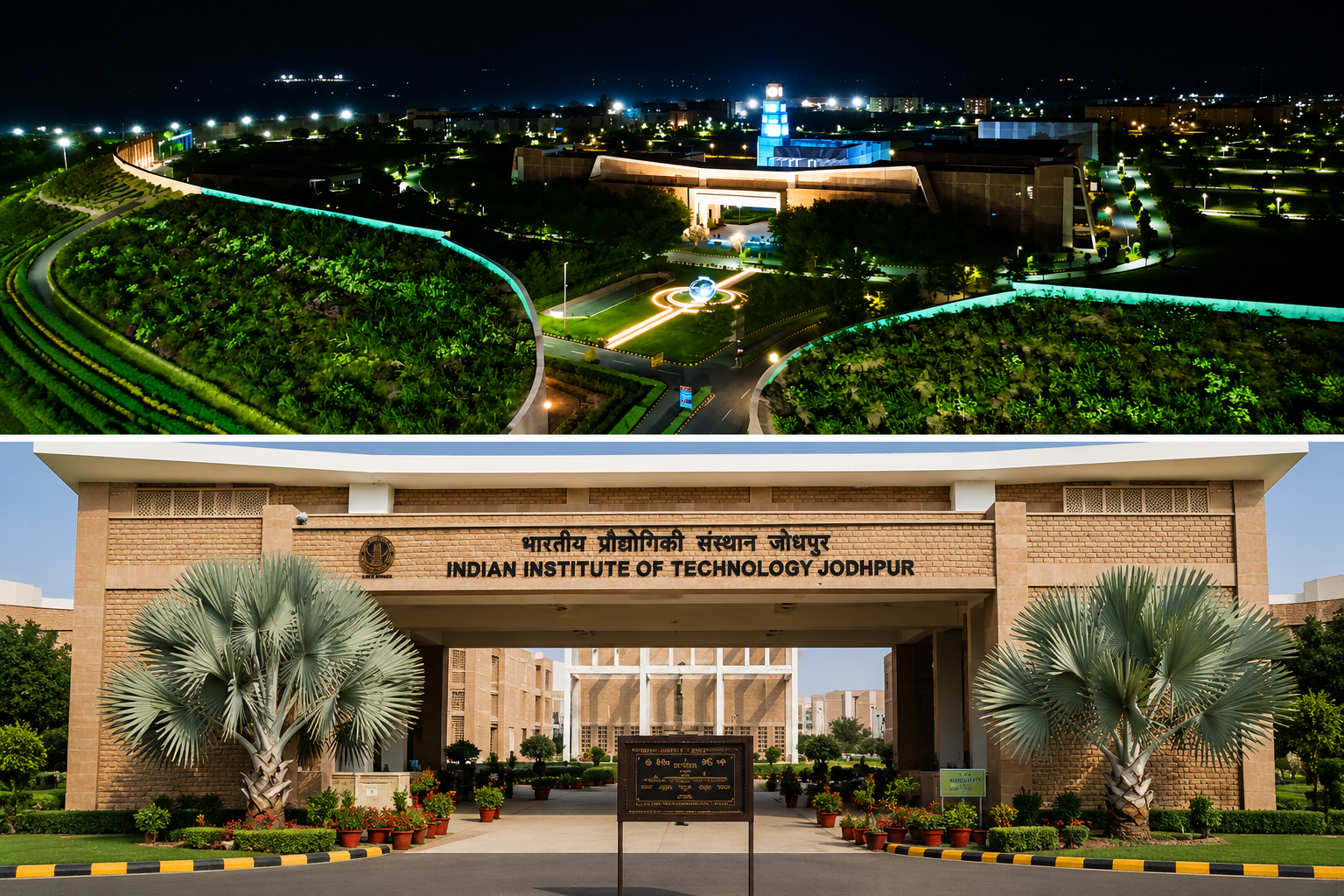
The IIT Jodhpur MBA Technology: what it actually is
The MBA Technology from IIT Jodhpur's School of Management and Entrepreneurship is a 2-year, 66-credit postgraduate management degree, a full MBA, not a diploma or certificate delivered in an executive hybrid format designed specifically for working professionals.
It is built around a single insight, stated clearly by Prof. Avinash Kumar Agarwal, Director of IIT Jodhpur:
The professionals who will lead the next decade are those who can move fluently between technical understanding and strategic judgment who see these not as different skills, but as two dimensions of the same capability.
Programme at a glance:
What the curriculum actually covers
The programme is structured across two years management foundations first, applied AI and specialisation second.
Year 1 - Business and technology foundations
Courses: Business Statistics, Corporate Finance, Fundamentals of Marketing, Digital Enterprise Management, Business Economics and Macroenvironment, Operations Management, Human Behaviour and Organization Dynamics, New Venture Planning, Fundamentals in Accounting, Strategic Management.
The focus is on building genuine business acumen, analytical decision making, financial literacy, strategic thinking grounded in the context of modern digital enterprises. Not industrial-era case studies.
Year 2 - Advanced technologies and specialisation
Courses: Artificial Intelligence in Business, Legal and Taxation Aspects of Business, Work-Integrated Project, Industry focused electives, specialisation electives.
Year 2 is where the technical depth comes back in now with the business foundation to apply it strategically.
Two specialisation pathways choose based on where you're heading
Analytics and AI For professionals who want to lead in data-intensive and AI-driven business environments.
Courses include: Business Storytelling with Data Visualisation and ML, Supply Chain Analytics, Deep Learning Applications for Business, HR Technology and Talent Analytics, Big Data and Cloud Computing, Human-AI Collaboration at Work, Business Process Analytics, Technology Forecasting and Assessment.
Best for: engineers, data professionals, and operations managers who want deep AI and analytics capability in a strategic leadership context.
Digital product management for professionals who want to lead digital products, go-to-market strategy, and customer-facing technology.
Courses include: Creating Digital Products and Services, Digital Marketing Analytics and Optimisation, Digital Business Models, Consumer Behaviour, Design Thinking and Innovation Strategy, Marketing Research and Analysis, Go-to-Market Strategies, Market Structure and Strategy.
Best for: engineers moving into product roles, product managers wanting strategic depth, or professionals in marketing and growth who want the IIT credential behind their product thinking.
How the format works for working professionals
The programme is hybrid, not full-time residential, not purely self-paced.
Live online sessions with IIT Jodhpur faculty run weekly, built around real case discussions and peer learning not recorded videos you watch alone. Dr. Deepak Kumar Saxena, Head of the School of Management and Entrepreneurship, describes the approach:
The most pressing challenges in organisations today are not purely technical, nor purely managerial they sit at the boundary of both. The MBA Technology prepares professionals to lead precisely at that boundary.
Campus immersions at IIT Jodhpur happen twice per academic year 5 to 7 days each. These are structured sessions with workshops, peer collaboration, faculty interaction, and direct access to the IIT ecosystem. One immersion per year is mandatory.
Work-integrated project in Year 2 connects your learning directly to your professional context not a generic case study, but applied work drawn from the real environment you're already operating in.
You keep earning. You keep building your career. You apply what you're learning to your actual job as you go.
Career paths this degree opens with real salary data
The roles that benefit most directly from the IIT Jodhpur MBA Technology are those sitting at the intersection of business understanding and technology fluency which also happen to be among the fastest-growing and highest-compensating roles in India's 2026 market:
Source: Glassdoor India, AmbitionBox, LinkedIn Salary Insights FY 2026-27
These aren't roles that require leaving your technical background behind. They're roles where your technical background becomes a strategic asset once you've built the management layer on top of it.
Admission process, fees, and key dates
Eligibility:
- 3-year or 4-year undergraduate degree from a recognised institution
- Minimum 60% aggregate marks
- At least 2 years of relevant full-time work experience
- Note: Internships, part-time roles, articleships, and training programmes do not count as eligible work experience
Entrance test format:
- 60 MCQs across 120 minutes
- 3 sections: Logical Reasoning (20 Q / 40 min), Verbal Ability (20 Q / 40 min), Numerical Ability (20 Q / 40 min)
- Covers aptitude, analytical thinking, communication, and basic quantitative ability no advanced mathematics
- Negative marking applies
- No CAT score required
Key dates:
Fee structure:
Refund policy: 100% refund before classes begin | 50% within first month | No refund after one month
Traditional MBA vs IIT Jodhpur MBA Technology: an honest comparison
Who this programme is built for
MBA Technology isn't for everyone. It's specifically built for:
- Software engineers and developers who want to move into product, strategy, or leadership roles without a career break
- Data analysts and ML professionals who want the business context to convert technical output into organisational value
- Engineering managers who are managing people effectively but want structured management and strategic decision-making frameworks
- Product and tech consultants who want an IIT credential behind their client-facing work
- Professionals with 2+ years of experience in any industry where technology is central to operations fintech, SaaS, e-commerce, healthcare tech, manufacturing tech, logistics
The common thread: professionals who already have technical depth and want the strategic layer that converts that depth into leadership capability.
Frequently asked questions
Q: Is this MBA equivalent to a full-time on-campus IIT Jodhpur MBA? Yes. The programme holds the same academic value, credits, and recognition as a regular on-campus degree from IIT Jodhpur, delivered in an executive hybrid format. Graduates receive a physical degree certificate from IIT Jodhpur and full alumni status.
Q: Can I apply without a CAT score? Yes. Admission is through the programme's own entrance test 60 MCQs covering logical reasoning, verbal ability, and numerical aptitude. No CAT, GMAT, or prior management exam score is required.
Q: Does internship experience count toward the 2-year work experience requirement? No. Only full-time, post qualification professional work experience is counted. Internships, training programmes, articleships, part-time roles, and apprenticeships are not eligible.
Q: Is the campus immersion mandatory? One campus immersion per academic year is mandatory. The second may be waived in genuine cases such as medical emergencies with approval from programme directors.
Q: How is the entrance test structured? 60 MCQs, 120 minutes. Three sections of 20 questions each: Logical Reasoning, Verbal Ability, and Numerical Ability. No advanced mathematics. Negative marking applies.
The bottom line
The ceiling most engineers hit isn't because they ran out of technical skills. It's because technical skills alone don't answer the questions organisations need answered at the leadership level.
The IIT Jodhpur MBA Technology is built precisely for that gap not as a replacement for your technical background, but as the management and strategic layer that makes it work at an entirely different scale.
Two years. ₹9,15,000 total. No career break. A full MBA degree from IIT Jodhpur. Faculty from one of India's leading technical institutions. Two specialisation pathways aligned with where AI and digital leadership are actually heading.
The programme starts 16th August 2026.