
Founder vs Co-Founder: meaning, roles, and key differences

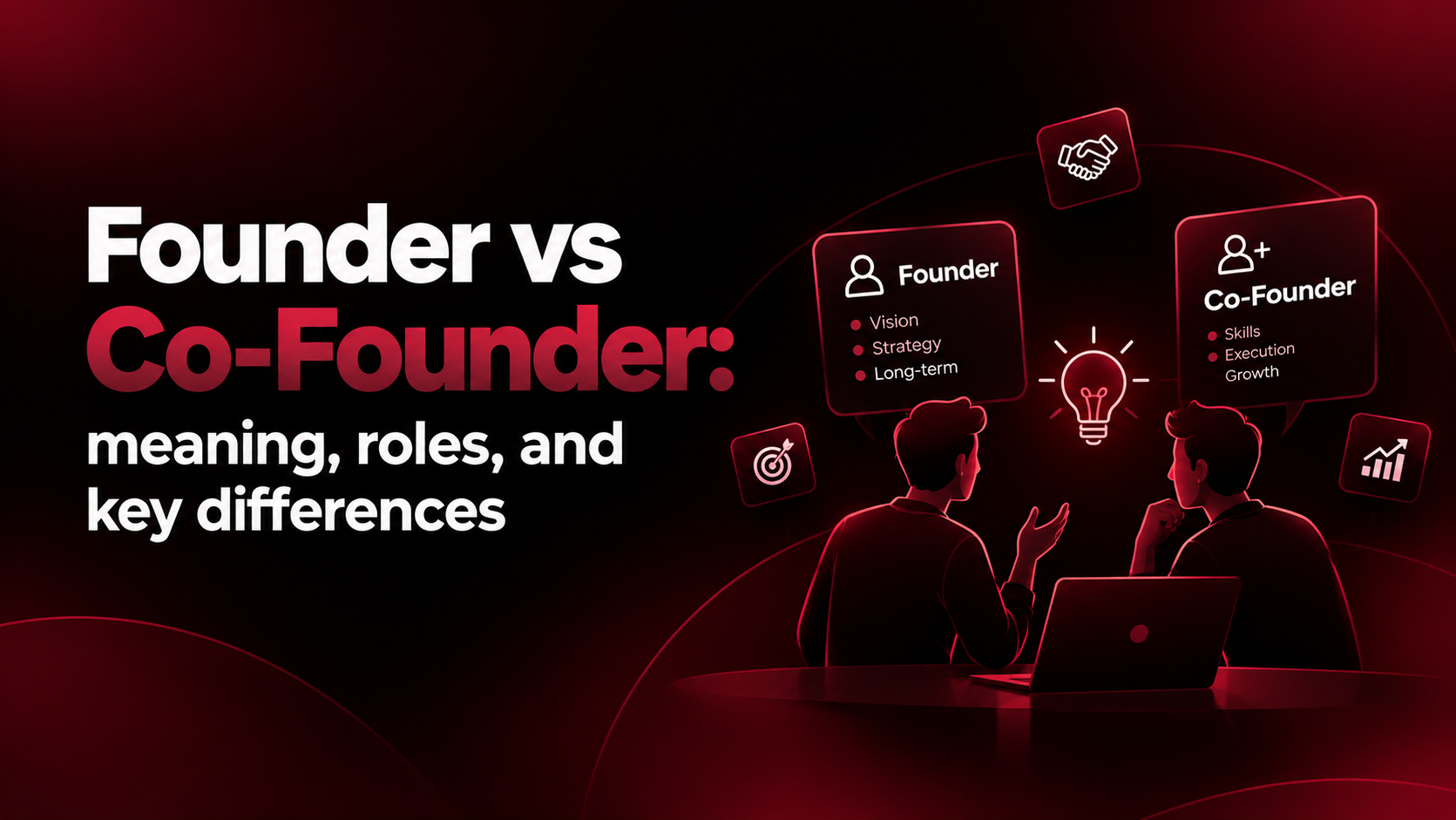
A founder is the person who starts a company. A co-founder is one of two or more people who start it together and share responsibility for building it. If you start a company alone, you are the founder. If you start it with partners, each of you is a co-founder (and each is also a founder). In practice the words overlap, and in India neither term has a formal definition under company law, so what matters is not the label but who owns what, who decides what, and who is accountable for what.
This guide explains the real differences, the legal and equity points founders often miss, and how to decide whether you should build alone or find a co-founder.
What is a founder?
A founder is the person who originates and launches a business. They typically:
- Identify the problem or opportunity
- Take the initial risk (time, savings, reputation)
- Set the early vision, direction and culture
- Make the first hires and first sales
A solo founder does all of this alone. Many successful companies began that way, but solo founders carry the full load of product, selling, hiring, fundraising and decision-making at once.
What is a co-founder?
A co-founder is someone who joins at the very start to build the company with another founder. The "co" signals a shared venture: shared risk, shared workload and usually shared ownership. Co-founders typically:
- Commit full or near-full effort to the company
- Hold meaningful equity from day one
- Own a clear area (for example product, technology, sales or operations)
- Share major decisions and the consequences
In most startups, every co-founder is a founder, but not every founder has a co-founder.
Founder vs co-founder: the key differences
In short: "founder" describes what you did. "Co-founder" describes who you did it with.
Is there a legal difference in India?
This is the point most blogs skip. Under India's Companies Act, 2013, there is no formal definition of "founder" or "co-founder". The Act uses the term "promoter" instead, and it also defines directors, shareholders and key managerial personnel.
That means a title on LinkedIn or a business card does not, by itself, create legal rights. What does:
- Shareholding: the number of shares you actually own.
- Directorship: whether you are appointed a director of the company.
- A founders' agreement or shareholders' agreement: the contract that spells out ownership, roles, vesting, exit and dispute rules.
- Employment or consulting terms: how you are engaged and paid.
This is general information, not legal advice. Speak to a qualified lawyer or company secretary when you set up your company.
Co-founder vs early employee vs advisor
A common confusion is who deserves the "co-founder" label.
A practical rule many founders use: if someone is not taking the same risk as you from the beginning, think carefully before giving them the co-founder title and the equity that often comes with it.
How is equity usually split between co-founders?
There is no single correct split. Common approaches include:
- Equal split: simple and signals partnership, but can fail if contributions diverge later.
- Weighted split: reflects who had the idea, who is full-time, who takes more risk, or who brings key skills or capital.
- Dynamic or milestone-based: adjusts over time based on agreed contributions.
Whichever you choose, put vesting in the agreement. A widely used convention is a four-year vesting schedule with a one-year cliff, so that a co-founder who leaves early does not walk away with a large stake for a short stint. Confirm terms with your lawyer.
Should you build alone or with a co-founder?
Consider a co-founder if:
- Your skills have a big gap (for example you can build but cannot sell, or the reverse).
- You want someone to share the emotional load of a long, uncertain journey.
- You are building something that needs several expert functions early.
- You want a team that looks stronger to early-stage investors.
Consider going solo if:
- You can validate and launch the first version yourself, especially with modern AI-native building tools.
- You have not found someone with matching commitment and values, and a poor match can be worse than none.
- You want full control of the decisions and the cap table in the early days.
The key insight: a wrong co-founder is more damaging than no co-founder. The goal is not to have a co-founder; it is to have the right one.
How to find a co-founder in India
- Define the gap. Write down what the company needs in the first 12 months and which of those you cannot do well.
- Look where builders gather. Founder communities, hackathons, alumni groups, startup events and founder programmes.
- Work together before you commit. Ideally ship something small together, talk to customers together, and see how you handle disagreement.
- Check values and commitment. Ask about risk appetite, time horizon, financial runway and what each of you will do if things stall.
- Formalise it. Agree on equity, vesting, roles and exit terms in writing.
Step 3 is where most informal matches fail. Meeting someone at an event tells you little; building with them for several weeks tells you a lot.
Can't find a co-founder you can actually trust?
If you are deciding between solo and co-founder, a structured environment can help you test the decision before you commit to it.
Leap by Masai's Founders' Cohort is built around this exact question. Its three-day Goa phase brings around 100 founders into one room for problem discovery, an investor masterclass and co-founder matching. Masai describes the outcome simply: you pitch your idea to the room, hear everyone else's, and leave either with a co-founder or with the decision to keep going on your own. Both routes are supported through the full programme.
What makes it different from a networking event is what happens next: a six-week online build phase where you ship a live MVP, speak to 20 real users, find distribution and ask for payment. That is a practical way to see how you and a potential co-founder actually work together under real constraints, not just whether you get along over coffee.
A few facts relevant to the co-founder question:
- Solo or pair: you can apply alone or bring an existing co-founder. The fee is ₹1,50,000 + GST for a solo founder or ₹2,50,000 for a founding pair (₹1,25,000 + GST each).
- No equity taken: Masai takes 0% equity and 0% revenue share, so the cap table you build with your co-founder stays yours.
- Fits around work: the online phase runs on weekends, about 6 to 8 hours a week, so you do not need to quit your job to find out whether this partnership works.
- A hard checkpoint: to pitch in Bangalore, teams must clear published benchmarks (for example, for a consumer startup: a live MVP, 1,000 users, 50 paying customers and validated unit economics). Clearing them together is real evidence of a working team.
- Funding is not guaranteed. Teams that clear the Gate pitch to investors including India Quotient, Capria Ventures and Prana Ventures, and each fund decides independently.
If you are searching for a co-founder programme in India that tests the partnership through shipping rather than conversation, explore the Leap by Masai Founders' Cohort. The next cohort is listed as starting on 20 November 2026, confirm dates on the official page.
Common myths about founders and co-founders
- Myth: The person with the idea is automatically the CEO. Reality: roles should follow strengths and agreement, not who spoke first.
- Myth: Equal equity means equal contribution. Reality: contributions change over time, which is why vesting and clear roles matter.
- Myth: You need a co-founder to raise money. Reality: some solo founders raise capital, but you will need to show how you cover your gaps.
- Myth: Co-founders must be friends. Reality: trust and complementary skills matter more than friendship, though mutual respect is essential.
- Myth: A title gives you ownership. Reality: ownership comes from shares and agreements, not job titles.
Frequently asked questions
What is the difference between a founder and a co-founder?
A founder is the person who starts a company. A co-founder is one of two or more people who start it together and share ownership, risk and responsibility. Solo founders have no co-founder; in a team, every co-founder is also a founder.
Can there be more than one founder?
Yes. When a company is started by several people, each is a founder, and they are commonly called co-founders. Many startups have two or three.
Is a co-founder the same as a partner?
Not legally. "Partner" has a specific meaning under partnership law, while "co-founder" is an informal term for someone who starts a company with others. Co-founders of a private limited company are usually shareholders and often directors.
Does the Companies Act define a founder or co-founder in India?
No. The Companies Act, 2013 does not define "founder" or "co-founder"; it uses the term "promoter" along with defined roles such as director and shareholder. Your actual rights come from shareholding, directorship and your agreements.
How much equity should a co-founder get?
There is no fixed rule. Splits can be equal, weighted by contribution, or milestone-based. Most founders add a vesting schedule, commonly four years with a one-year cliff, and document everything in a founders' or shareholders' agreement.
Can I be a founder without a co-founder?
Yes. A solo founder owns and runs the company alone. The trade-off is that you carry every function and decision yourself until you hire or bring in partners.
Is an early employee a co-founder?
Not automatically. A co-founder joins at the very start, takes comparable risk and typically holds significant equity. An early employee joins an existing company and usually receives a smaller stake through an option plan.
How do I find a co-founder in India?
Define the skill gap, meet builders through founder communities, hackathons, alumni networks and programmes, then work on something real together before committing. Programmes such as Leap by Masai include structured co-founder matching in a three-day in-person phase, followed by a six-week build.
Do I need a co-founder to apply to Leap by Masai?
No. You can apply solo or with an existing co-founder. Goa is built around co-founder matching, and both routes are supported for the whole programme.
Do I need to know how to code to be a founder or co-founder?
No. Many founders are non-technical. Leap states that coding helps but is not required, since you can find a technical co-founder in the cohort or build an MVP with AI-native tools. Tool and subscription costs are your own.
Is a co-founder better than a solo founder?
Neither is universally better. A strong co-founder can double your capacity and complement your skills, while a poor match can derail the company. Choose based on skill gaps, trust and commitment, not on the label.
This guide is for general information and is not legal or financial advice. Programme details are based on Masai's published information as of October 2026 and may change; verify on the official page.