
Best AI research tools for students and researchers in 2027
10 AI research tools for students, from Perplexity to Google Scholar Labs, with each one's limit and a tested script that checks citations by DOI.

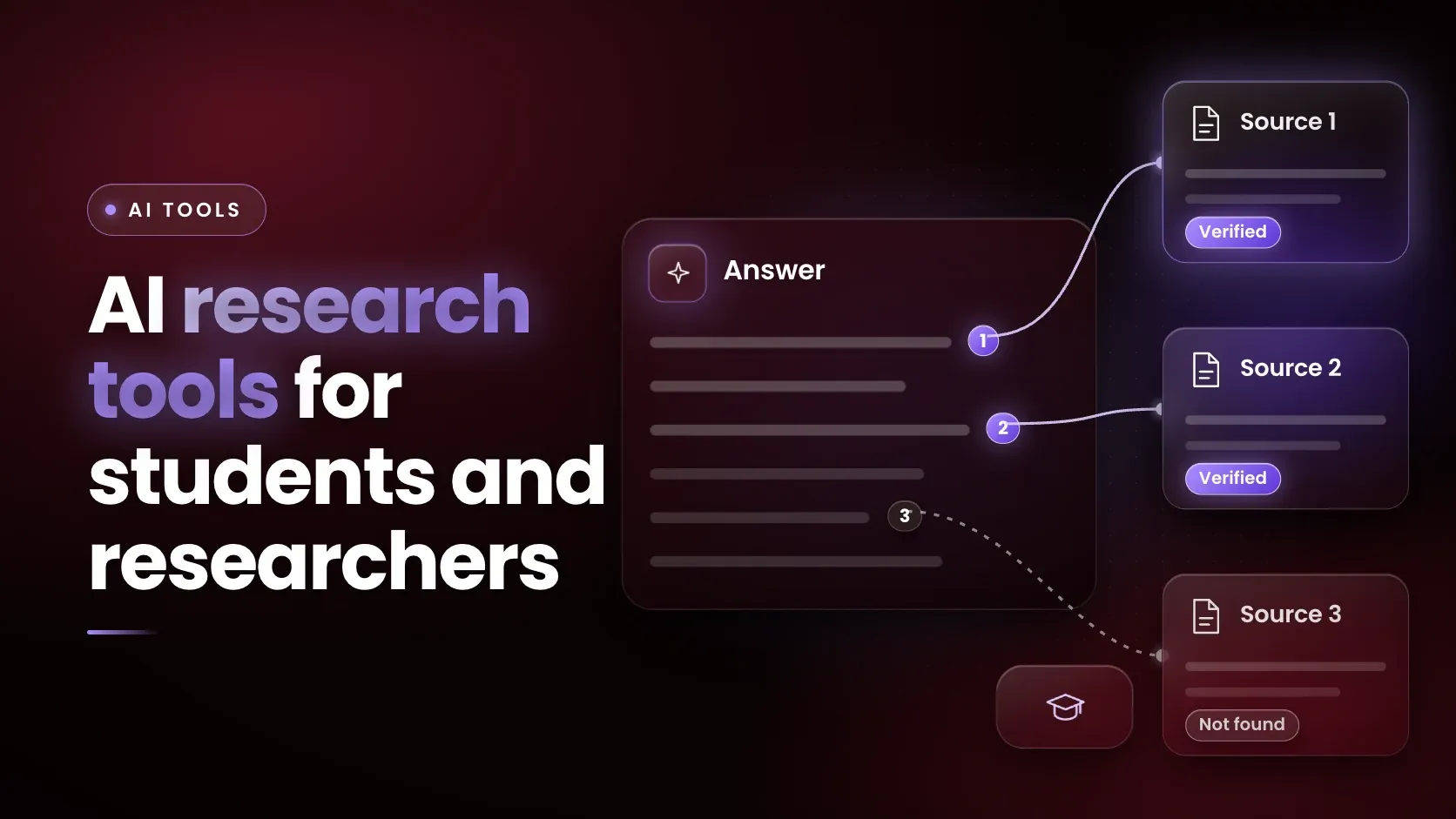
AI research tools are programs that find, read and summarise scholarly sources. Perplexity answers questions from the web with citations, Consensus, Elicit, Semantic Scholar and Google Scholar Labs search papers, and Gemini Notebook, ChatGPT deep research and Claude Research work from uploaded or retrieved sources. Each one still needs the researcher to open the cited paper, because a summary is not evidence.
Last updated: 11 November 2026.
Which AI research tools search the literature?
Five tools are built to find papers or answer a question from the web or from scholarly indexes. "Best" here means the job each tool is built for, checked on the vendor's own page on 11 November 2026.
Perplexity
Perplexity is an AI-powered search engine that searches the web and gives conversational answers with citations and links to original sources, so the reader can verify the information. Its Help Center lists Search, Deep Research and file creation among its capabilities.
A student can use it to get a first map of an unfamiliar topic and then open each cited page. The limit is scope: it searches the open web, and its own page describes the sources as including news organisations as well as academic publications, so a cited page may not be a peer-reviewed paper.
Consensus
Consensus is an AI search engine for scientific and academic research. According to its FAQ of 23 June 2025, it retrieves the most relevant papers first and then writes a synthesis with citations, from an index built on Semantic Scholar, OpenAlex, its own crawl of the scholarly web and publisher partnerships. A researcher can filter by study design and date range, and the Consensus Meter shows where studies agree or disagree.
The limit comes from the vendor: its guide for teachers says it is not a shortcut around reading, because summaries point to sources that still need evaluating.
Elicit
Elicit is an AI research assistant whose home page lists a search over more than 138 million academic papers and 545,000 clinical trials, plus a research agent that produces cited reports, tables and figures. A graduate student can use its report feature, described as based on a process inspired by systematic reviews, to draft a structured overview of a question. The limit is in Elicit's own wording: for systematic reviews it can automate screening and data extraction "while partially supporting search and report generation", so the review protocol remains the researcher's work.
Semantic Scholar
Semantic Scholar is a free academic search engine from Ai2 (the Allen Institute for AI) that indexes over 200 million papers drawn from publisher partnerships, data providers and web crawls. Its TLDR feature gives a short AI-generated summary of a paper, an alternative to the abstract that helps a reader decide what to open. The limit, stated in its FAQ, is that TLDRs are currently limited to computer science and biomedical papers, and that finding a paper is not permission to reuse it.
Google Scholar Labs
Google Scholar Labs is a search mode inside Google Scholar that helps answer detailed research questions. Google's Scholar Blog of 3 June 2026 says it identifies the key topics in a question, searches Scholar, and describes how each paper might be helpful; it is open to all logged-in users. On 25 August 2026 Google added Quick Read, which summarises a paper under Answers, Approach and Considerations. The limit is access: Quick Read links appear only for papers the reader has access to, and the feature is limited to English articles.
Which AI research tools read sources, write reports and check citations?
Five more tools work on a body of sources: a student's own uploads, a connected library, a citation network or the open web.
Gemini Notebook
Gemini Notebook is Google's AI research assistant for uploaded sources. Google renamed NotebookLM to Gemini Notebook on 16 July 2026 and described it as the same standalone product. A student can upload PDFs, websites, YouTube videos or Google Docs, ask questions and get answers with in-line citations, and turn the sources into study guides or audio overviews. The limit is also the feature: its FAQ says it answers from the uploaded sources and, if the answer is not in them, it will not provide a response, and some answers arrive without citations.
ChatGPT deep research
ChatGPT deep research is OpenAI's feature for multi-step research reports inside ChatGPT. According to OpenAI's feature page, a user picks Deep research from the plus menu, approves a set of URLs or private files that it prioritises over general web results, and reviews a proposed plan before work starts. A researcher can use that plan step to narrow the scope and exclude weak sources. The limit is that the page describes control of sources and scope, not a promise that every citation is accurate, so each source still needs to be opened.
Claude Research
Claude Research is the research mode in Anthropic's Claude. Anthropic's Help Center says it is available on paid Claude plans on the web, desktop and mobile, needs web search switched on, and researches the web plus any connected tools such as Google Workspace. A researcher can point it at a team's own documents alongside the web. The limit is practical: Anthropic notes that research sessions can use up usage limits faster, and that research started on mobile searches the web only and does not use connectors.
Scite
Scite is an AI-powered platform that evaluates scientific literature through Smart Citations, which show whether later research has supported, challenged or discussed a paper. A reader can use it to check whether a finding cited in a draft was later contradicted. Its home page cites agreements with 44+ publishers and states that every answer is grounded in real papers, never generated or hallucinated. That is Scite's own claim and should be tested: it offers a free trial rather than a free plan.
ResearchRabbit
ResearchRabbit is a literature-mapping tool that analyses papers a user likes and finds related research. A student can start from one paper and follow connected papers and authors to build a reading list. Its home page says sign-up is free, and its 20 October 2025 release note credits a partnership with Litmaps for the rebuilt version. The limit is that it surfaces connected papers but does not write answers, so it does not replace reading or a search of a subject database.
How do the ten AI research tools compare?
The table gives each tool's best use and the limit stated by the vendor on 11 November 2026.
| Tool | Best for | Main limit |
|---|---|---|
| Perplexity | First map of a topic from the web | Sources include non-academic pages |
| Consensus | Evidence questions across papers | Summaries do not replace reading |
| Elicit | Structured reviews and extraction | Search only partly supported |
| Semantic Scholar | Free paper search and TLDRs | TLDRs limited to computer science and biomedical |
| Google Scholar Labs | Detailed questions in Google Scholar | Quick Read limited to papers you can access |
| Gemini Notebook | Questions on your own sources | Answers only from uploaded sources |
| ChatGPT deep research | Multi-step reports with approved sources | Citations still need checking |
| Claude Research | Web plus connected documents | Paid plans; uses limits faster |
| Scite | Checking how a paper was later cited | Vendor claim of no hallucination is untested |
| ResearchRabbit | Mapping related papers | Finds papers, does not answer questions |
How should a student choose an AI research tool?
Match the tool to the stage of the work. A student with a question and no sources starts with Consensus, Semantic Scholar or Google Scholar Labs, because their indexes are scholarly. A student who already holds a set of PDFs uses Gemini Notebook, which stays inside those sources. A student checking a draft opens Scite or the DOI check below.
Free options change, so read the vendor's page before relying on one. Semantic Scholar describes itself as free, ResearchRabbit says sign-up is free and Google Scholar Labs is open to logged-in users, but limits can change without notice. Data handling differs by vendor: OpenAI's Help Center says data sharing for model improvement is on by default on personal ChatGPT Free, Plus and Pro plans, and Anthropic's Privacy Center says consumer Claude chats are used to improve models if the user allows it. Unpublished data and confidential material belong only in tools the institution has approved. For other free tools see the list of free AI tools for work and study and the list of AI tools for college students.
Can AI tools invent citations, and how can they be checked?
Yes, any large language model can produce a reference that looks real and does not exist. A paper by Kalai, Nachum, Vempala and Zhang, submitted to arXiv on 4 September 2025, says language models sometimes guess when uncertain, producing plausible yet incorrect statements instead of admitting uncertainty. Tools that retrieve real papers first, such as Consensus and Elicit, narrow that risk but do not remove it, because the summary can still misstate a paper.
A fast check is to look up each DOI in Crossref, whose free REST API returns metadata for content registered with Crossref. The script below, run with Python 3.9.6, checks one real DOI against two claimed titles and one invented DOI. The invented reference is a hypothetical example.
import json, urllib.request, urllib.error, urllib.parse

refs = [
    ("10.1038/nature14539", "Deep learning"),
    ("10.1038/nature14539", "Deep learning in neural networks for crop yield"),
    ("10.1234/jair.2021.0457", "Attention patterns in student reading"),
]

for doi, claimed_title in refs:
    url = "https://api.crossref.org/works/" + urllib.parse.quote(doi)
    try:
        with urllib.request.urlopen(url, timeout=20) as r:
            real = json.load(r)["message"]["title"][0]
        match = claimed_title.lower() == real.lower()
        print(f"{doi}: FOUND, registered title: {real!r}, title matches claim: {match}")
    except urllib.error.HTTPError as e:
        print(f"{doi}: HTTP {e.code}, DOI not found in Crossref")
The run printed this output.
10.1038/nature14539: FOUND, registered title: 'Deep learning', title matches claim: True
10.1038/nature14539: FOUND, registered title: 'Deep learning', title matches claim: False
10.1234/jair.2021.0457: HTTP 404, DOI not found in Crossref
The second line shows a real DOI attached to the wrong title, which a model can produce by mixing two references. The third shows a 404. A 404 is a reason to look further, not proof of fabrication: Crossref is one DOI registration agency and DataCite is another, so a DOI registered elsewhere will not be found. After the metadata matches, the claim itself still has to be checked in the paper.
Is it allowed to use AI for a literature review?
Often yes, with disclosure, but the rule belongs to the institution, supervisor or journal. The International Committee of Medical Journal Editors (ICMJE) Recommendations, updated in January 2026, say authors should disclose AI-assisted technologies and how they were used, that chatbots should not be listed as authors, that authors must review AI output because it can be incorrect, incomplete or biased, and that referencing AI-generated material as the primary source is not acceptable.
Nature Portfolio's editorial policy says accountability for scholarly content cannot be delegated to AI systems and that AI may support but must not replace scholarly judgement. A university in India may set stricter rules for theses and assignments, so a student should read the policy and ask the supervisor before submitting. For background on how students use AI for homework and research, see an earlier post on AI, homework and research, and for tools beyond research see the list of AI presentation and design tools and the list of AI video generation tools.
Where does the AI Residency fit?
The research tools above find and read what already exists. Professionals who use AI at work and want to build their own tool can look at the Leap AI Residency.
It is a Leap by Masai programme for non-engineers who already use AI at work, run as an in-person residency in Sri Lanka, an online build phase and an in-person hackathon in Bangalore for qualifying participants, in which each participant builds and deploys an AI product for their own work using coding agents, retrieval, MCP integrations, evaluations and security checks, with no prior coding experience required. Its modules include retrieval, MCP and reliability, and evaluation, security and deployment.
Frequently asked questions
Which AI tool is best for academic research?
No single tool is best, because the tools do different jobs. Consensus, Elicit, Semantic Scholar and Google Scholar Labs search scholarly sources, Gemini Notebook answers from uploaded papers, and Scite shows how later research cited a paper. The criterion is the job: finding papers, reading a set of sources or checking a claim. Pick by job and open every source.
Can AI tools invent citations?
Yes. Language models can produce references that look real but do not exist, because they sometimes guess when uncertain. Tools that retrieve real papers first reduce the risk without removing it. Every reference should be looked up by DOI or title in a database such as Crossref, and the claim should be checked in the paper itself.
Is it allowed to use AI for a literature review?
It depends on the institution, supervisor or journal. The ICMJE Recommendations, updated in January 2026, ask authors to disclose AI-assisted technologies and how they were used, and say chatbots cannot be authors. A student should read the course or university policy and disclose any AI help in the way the rule requires.
Are AI research tools free for students?
Some have free access. Semantic Scholar describes itself as free, ResearchRabbit says sign-up is free, and Google Scholar Labs is open to logged-in users. Claude Research needs a paid Claude plan, and Scite offers a free trial. Vendors change plans and limits, so the vendor's current page decides what is free.
What is the difference between Perplexity and Consensus?
Perplexity is a general AI search engine that searches the web and cites news, academic and other pages. Consensus is an AI search engine for scientific and academic research that retrieves papers from an index built on Semantic Scholar, OpenAlex and publisher partnerships. Perplexity suits a quick overview of a topic, while Consensus suits a question about published evidence.
Is NotebookLM the same product as Gemini Notebook?
Yes. Google renamed NotebookLM to Gemini Notebook on 16 July 2026 and called it the same standalone product. Gemini Notebook is Google's AI research assistant that answers questions from uploaded sources such as PDFs, websites, YouTube videos and Google Docs, with in-line citations. Many students still search for the old name.
Next step
Pick one real question from a current assignment, run it through two of the tools above, and check every reference with the DOI script before using it. For people who want to move from using AI at work to building with it, the Leap AI Residency page lists how the programme is run and what each participant builds.