
Best Agentic AI project ideas for 2026-2027: beginner to advanced guide with tech stacks:

If your portfolio in 2026 only features simple wrapper apps or basic Retrieval-Augmented Generation (RAG) chatbots, recruiters and tech leads will scroll right past it. The industry has shifted rapidly from simple prompt-response interactions to autonomous systems that can plan, reason, invoke APIs, execute code, and self-correct errors.
Whether you are preparing for high-impact AI engineering roles, looking to automate real-world business workflows, or leveling up your software development skills, building functional AI agents is the ultimate proof-of-work.
This guide breaks down 10 industry-grade agentic AI project ideas - categorized from beginner to advanced, complete with architectural workflows, recommended tech stacks, and implementation blueprints to help you stand out.
What is Agentic AI (and why does it matter in 2026)?
Agentic AI refers to autonomous software systems designed to achieve specific goals by iteratively combining reasoning, multi-step planning, tool utilization, and dynamic execution loops.
Unlike a conventional chatbot that simply predicts text based on user input, an AI agent operates via a continuous feedback loop: Observe Plan Act Reflect.
Core Components of an Agentic System
- Reasoning & Task Decomposition: The agent breaks down an ambiguous, high-level goal into structured micro-tasks.
- Tool Calling & Function Execution: The ability to dynamically interact with external environments - such as REST APIs, SQL databases, bash shells, and web scrapers.
- State & Persistent Memory: Managing both short-term conversational context and long-term episodic or procedural memory.
- Self-Correction & Reflection: Evaluating intermediate task results, detecting syntax or logical errors, and adapting the workflow without human intervention.
- Human-in-the-Loop (HITL) Guardrails: Built-in validation checkstops that pause execution for user consent prior to critical or destructive actions.
Agentic AI vs. Traditional Chatbots: The Architectural Shift
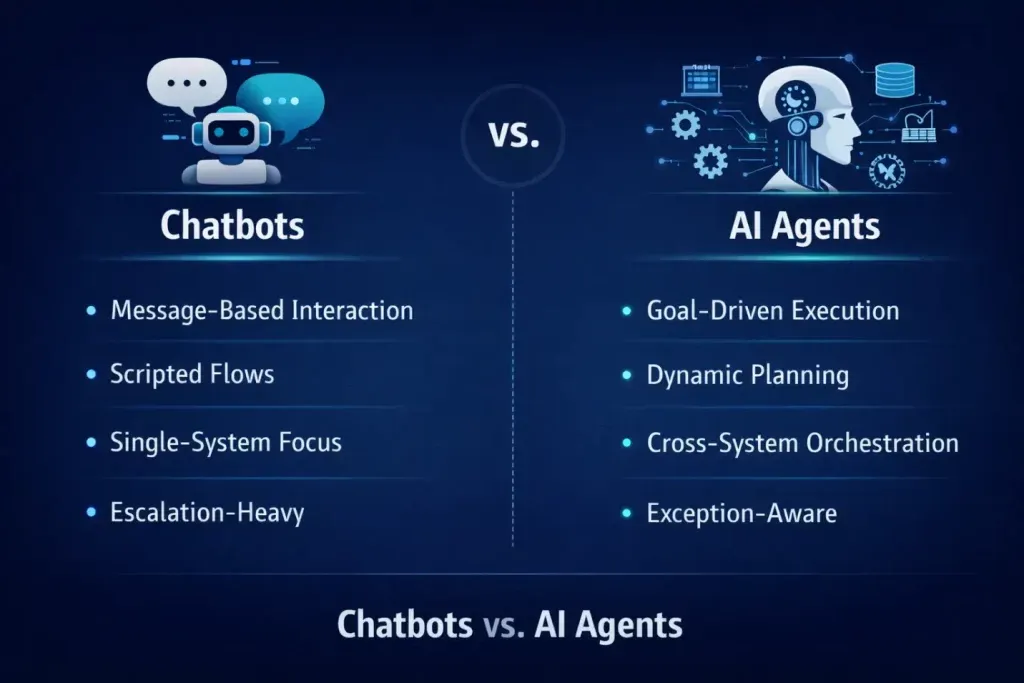
To build meaningful projects, it helps to understand how agent architecture fundamentally differs from traditional conversational AI:
10 Practical Agentic AI Project Ideas for Your Portfolio
Beginner-Level Projects (Build the Foundations)
1. Autonomous AI Research Agent
- Difficulty: Beginner to Intermediate
- Target Roles: Junior AI Engineer, Prompt Engineer, Full-Stack Developer
- The Problem: Traditional search engines require manual clicking, skimming, and fact-checking across multiple browser tabs.
- What It Does: Takes an open-ended research question (e.g., "Compare the performance of open-source LLMs on edge devices in 2026"), decomposes it into search queries, scrapes verified sources, extracts quantitative claims, and compiles an executive Markdown report with cited footnotes.
- Core Agentic Concepts: Dynamic query generation, web tool calling, citation validation, hallucination checking.
- Recommended Tech Stack: Python, LangGraph, Tavily Search API, Pydantic, ReportLab / Markdown.
2. Personal Productivity & Schedule Optimizer Agent
- Difficulty: Beginner
- Target Roles: Backend AI Developer, Automation Specialist
- The Problem: Unstructured notes, action items, and calendar links are scattered across emails and messaging apps.
- What It Does: Parses unstructured daily notes or meeting transcripts, extracts actionable to-dos with implicit deadlines, cross-checks availability via calendar tools, resolves scheduling conflicts, and stages events for approval.
- Core Agentic Concepts: Structured entity extraction, external API integration, human-in-the-loop review.
- Recommended Tech Stack: Python, FastAPI, Google Calendar API, SQLite, OpenAI / Anthropic API, LangGraph.
3. Autonomous AI Tutor & Interactive Code Coach
- Difficulty: Beginner to Intermediate
- Target Roles: EdTech AI Developer, Software Engineer
- The Problem: Standard AI tutors give away direct answers rather than encouraging critical problem-solving and algorithmic thinking.
- What It Does: Serves as a Socratic coding mentor. It analyzes a student's code submissions, identifies logical bottlenecks, provides targeted hints instead of solutions, tracks recurring mistakes across sessions, and dynamically scales challenge difficulty.
- Core Agentic Concepts: State tracking over time, adaptive curriculum planning, rubrics-based grading.
- Recommended Tech Stack: Python, Streamlit, LangGraph, PostgreSQL (state storage), ChromaDB.
Intermediate-Level Projects (Tool Calling & Enterprise Workflows)
4. Natural Language Data Analyst & BI Agent
- Difficulty: Intermediate
- Target Roles: Data Analyst, Analytics Engineer, AI Application Developer
- The Problem: Business stakeholders frequently need ad-hoc data insights without having to wait on engineering to write custom SQL queries.
- What It Does: Connects directly to an analytical database, inspects schemas, translates natural language questions into optimized SQL queries, runs the queries in a sandboxed runtime, validates results, and renders interactive charts.
- Core Agentic Concepts: Schema inspection, SQL generation with self-healing syntax retries, deterministic data verification.
- Recommended Tech Stack: Python, DuckDB / PostgreSQL, SQLAlchemy, Plotly, Streamlit, LangGraph.
5. AI Customer Support & Tier-1 Resolution Agent
- Difficulty: Intermediate
- Target Roles: Solutions Architect, AI Product Engineer
- The Problem: Traditional rule-based bots frustrate customers because they cannot resolve transactional issues or initiate backend actions.
- What It Does: Ingests incoming support tickets, determines customer sentiment, pulls real-time order data from CRM/ERP APIs, resolves routine fulfillment questions, and safely hands off edge cases with comprehensive audit logs.
- Core Agentic Concepts: Semantic routing, authenticated API operations, fallback mechanisms, ticket escalation.
- Recommended Tech Stack: Python, FastAPI, Pinecone, LangGraph, SendGrid / Zendesk sandbox API, PostgreSQL.
6. AI Career Navigator & Technical Resume Tailor
- Difficulty: Intermediate
- Target Roles: Full-Stack AI Engineer, Product Developer
- The Problem: Job seekers struggle to identify concrete skill gaps across hundreds of job descriptions.
- What It Does: Ingests a candidate’s resume and target job listings. The agent maps explicit and implied requirements, scores alignment, flags missing technical proficiencies, suggests portfolio projects to bridge gaps, and produces customized, factual cover letters.
- Core Agentic Concepts: Semantic matching, structured gap analysis, bias & fabrication guardrails.
- Recommended Tech Stack: Python, LlamaIndex, PostgreSQL, Qdrant, React (Frontend).
7. E-Commerce Inventory & Price Intelligence Agent
- Difficulty: Intermediate to Advanced
- Target Roles: Enterprise AI Developer, Full-Stack Engineer
- The Problem: Retailers lose revenue from stockouts and mispriced items due to sluggish operational updates.
- What It Does: Monitors inventory depletion rates against competitor pricing trends and historical sales seasonality. When stock dips or margins shift, it runs predictive forecasting models and prepares automated purchase-order drafts.
- Core Agentic Concepts: Scheduled agent loops, real-time data ingestion, multi-factor decision logic.
- Recommended Tech Stack: Python, Pandas, Statsmodels, LangGraph, Supabase, Celery / Redis.
Advanced-Level Projects (Multi-Agent Systems & Sandboxes)
8. Autonomous AI Software Engineer (Junior Dev Agent)
- Difficulty: Advanced
- Target Roles: Core AI Engineer, Systems Developer, Tech Lead
- The Problem: Writing boilerplate code, setting up testing fixtures, and fixing broken unit tests consumes significant engineering bandwidth.
- What It Does: Accepts a GitHub issue description, navigates the repository codebase, isolates relevant modules, creates an implementation plan, modifies files, runs local test suites via a Docker container, and submits a pull request with an audit log.
- Core Agentic Concepts: Sandboxed code execution, iterative debugging loops, repo-wide AST code navigation.
- Recommended Tech Stack: Python, Docker SDK, LangGraph, Git/GitHub API, Pytest, Claude 3.7 / GPT-4o.
9. Multi-Agent Project Management & Delivery System
- Difficulty: Advanced
- Target Roles: AI Architect, Senior Software Engineer
- The Problem: Complex software initiatives fail when tasks are siloed without dynamic coordination.
- What It Does: Deploys a team of role-specific agents to plan and execute technical briefs:
- Product Manager Agent: Breaks PRD documents into epics and engineering stories.
- Architect Agent: Defines database schemas, APIs, and design systems.
- QA/Reviewer Agent: Validates completed stories against acceptance criteria and flags edge cases.
- Core Agentic Concepts: Inter-agent communication protocols, task dependency graphs, distributed consensus.
- Recommended Tech Stack: CrewAI or LangGraph, FastAPI, Redis (message broker), PostgreSQL, Next.js.
10. AI Security Incident Investigation & Triage Agent
- Difficulty: Advanced
- Target Roles: DevSecOps Engineer, Cybersecurity Analyst, AI Systems Engineer
- The Problem: SOC analysts suffer alert fatigue from sorting through millions of disparate server and authentication logs.
- What It Does: Ingests anomalous event alerts, gathers SIEM logs, correlates IP addresses across threat intelligence APIs, reconstructs attack timelines, and suggests isolation procedures to human security leads.
- Core Agentic Concepts: Anomaly correlation, timeline reconstruction, strict read-only execution boundaries.
- Recommended Tech Stack: Python, LangGraph, Elasticsearch, AbuseIPDB API, Pandas, Pydantic.
Technical Comparison: Selecting the Right Project
Use this quick-reference matrix to pick the right build based on your current skill level and target tech stack:
Step-by-Step Architecture: How to Build Your First Agent
To build an agent that behaves reliably, follow this standardized 6-step engineering pattern:
1.Define Scope and Deterministic Success Metrics: Avoid open-ended or unbounded problem statements.
Choose one narrow task rather than attempting to build an all-purpose assistant. Clearly define your expected outputs, schema, error margins, and latency requirements before writing orchestrator logic.
2.Equip the Agent with Guarded Tools: Never grant raw bash or write access without validation.
Expose tools as strictly typed functions using libraries like Pydantic. If your agent writes SQL, use read-only database credentials. If it runs generated code, isolate execution inside a Docker container.
3.Build the ReAct Loop (Reason + Act):Implement a bounded plan-observe-evaluate loop.
Set explicit iteration boundaries (e.g., maximum 5 tool calls per user turn). Program the model to examine tool output, evaluate whether the result answers the sub-task, and determine next steps.
4.Separate State from Context Memory: Differentiate application data from chat history.
Persist execution state (task status, tool outputs, pending tasks) in a relational database like PostgreSQL. Keep chat context clean by summarizing older turns to prevent context window bloat and runaway API token costs.
5.Add Human-in-the-Loop Verification: Mandatory for production readiness.
Create conditional interrupt nodes. For any consequential action - such as executing financial transactions, sending external emails, or dropping tables, pause execution and await manual human confirmation.
6.Benchmark and Evaluate Edge Cases:Unit test your prompts and agent trajectories.
Test your agent against edge cases: broken URLs, empty database queries, conflicting user commands, and adversarial injections. Track your task completion rate and latency metrics.
Best Tech Stacks for Agentic AI in 2026
- Programming Language: Python remains the industry gold standard due to deep ecosystem integration (LangGraph, PyTorch, Pandas, FastAPI).
- Workflow Orchestration:
- LangGraph: Best for fine-grained cyclic state machines, conditional branches, and enterprise applications requiring deterministic control.
- CrewAI: Best for role-based multi-agent collaboration and high-level team simulations.
- Validation & Schemas: Pydantic is non-negotiable for enforcing strict JSON schemas on model outputs.
- Storage & Memory: PostgreSQL (application state and checkpoints) paired with pgvector or Qdrant (semantic long-term memory).
- Evaluation & Observability: LangSmith, Arize Phoenix, or Trulens to log token consumption, latency, and agent reasoning traces.
How to Showcase Agentic AI Projects on Your Resume
Recruiters don't just look for repository links, they look for engineering depth and measurable outcomes. When adding an agentic project to your portfolio or resume:
- Highlight the Architecture, Not Just the Model: State the orchestration framework, the memory model, and how tools were interfaced (e.g., "Engineered an autonomous research agent using LangGraph, Celery, and PostgreSQL").
- Quantify Reliability & Guardrails: Include numbers on task success rates, token cost optimization, and test accuracy (e.g., "Implemented sandboxed code execution loop achieving 78% passing rate on automated test suites").
- Include System Design Diagrams: Embed clear architectural flowcharts and sequence diagrams in your repository README.
- Deploy a Working Demo: Host a lightweight frontend on Streamlit, Vercel, or Hugging Face Spaces so hiring managers can test live outputs without setting up local environment variables.
Frequently Asked Questions (FAQs)
What is the easiest agentic AI project for beginners?
The Autonomous AI Research Agent is the best starting point. It requires only single-agent orchestration, clean tool-calling to a search API, and structured output formatting via Pydantic without requiring complex multi-agent synchronization.
Do I need to fine-tune an LLM to build agentic AI systems?
No. Over 90% of production-grade agent systems rely on pre-trained frontier models via APIs or open-weight models running on vLLM/Ollama. The core engineering value lies in prompt chaining, state management, tool integration, and deterministic guardrails.
LangGraph vs. CrewAI: Which should I learn first?
If you want granular control over production workflows, state machines, and human-in-the-loop logic, learn LangGraph. If you want to experiment quickly with persona-based multi-agent collaboration (e.g., researcher + writer + reviewer teams), start with CrewAI.