


For individuals
- Build practical AI fluency, without needing a coding or engineering background
- Stay relevant as AI becomes a core professional capability
- Earn MIT Open Learning credentials as they progress
Learn from MIT faculty and domain experts across 20+ modules built around real-world AI applications. No coding background required.
For students, professionals, managers, entrepreneurs, and
decision-makers navigating an AI-first world.
AI is already transforming how organizations operate, compete, and hire. The advantage increasingly belongs to professionals who understand how to apply it.
of organizations will grapple with AI
skills shortages by 2026
McKinsey, State of AI, November 2025
wage premium for AI skills, comparing workers in the same job
PwC, Global AI Jobs Barometer, June 2025
of organizations reported using AI in some capacity within their business
McKinsey, State of AI, November 2025
of enterprise leaders report a lack
of appropriate AI education
IDC Analyst Brief, February 2025
Learn to understand AI, evaluate its possibilities, apply it in real-world contexts, and make better decisions with it without needing a coding or engineering background.
Build core AI understanding first, then explore how AI is applied across business, climate, energy, biology and other domains.
Understand complex AI concepts through practical examples and recognizable real-world situations.
Designed for professionals across functions and industries. No coding or engineering background required.
AskTIM, integrated into MIT Learn, helps answer questions, clarify concepts and guide you through challenging topics.
Learn the technology shaping tomorrow. Become the person shaping what comes next.
Build the fluency to evaluate AI, make informed decisions and apply it across real-world contexts, across functions, industries and career paths. No prior coding experience required.
Universal AI is a flexible curriculum designed for individual learners, universities, and companies.
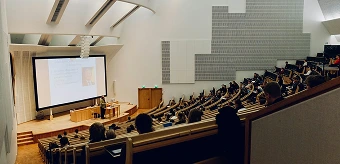
Learn at your own pace through short lectures, guided exercises, assessments, and AI-powered support designed to help you understand and apply concepts.
AskTIM helps clarify concepts, answer questions, and guide you through challenging topics while encouraging independent thinking.
Built-in knowledge checks and assignments help you test your understanding and track your progress.
Apply concepts through exercises developed by MIT teaching teams, with supporting code provided where required.
Each module combines lectures, knowledge checks, guided exercises, and assignments into a clear learning journey.
Progress at your own pace, revisit concepts when needed, and fit learning around your work and other commitments.
16 foundational modules build core AI understanding. Industry specific modules show how AI is applied in specific domains. Complete individual modules to earn credentials and stack your learning toward a broader MIT Open Learning certificate.
Select the field most relevant to your work, interests, or career goals. Complete an industry specific vertical module to earn a certificate.

How AI reads imaging and patient data to tailor diagnosis and treatment to the individual.
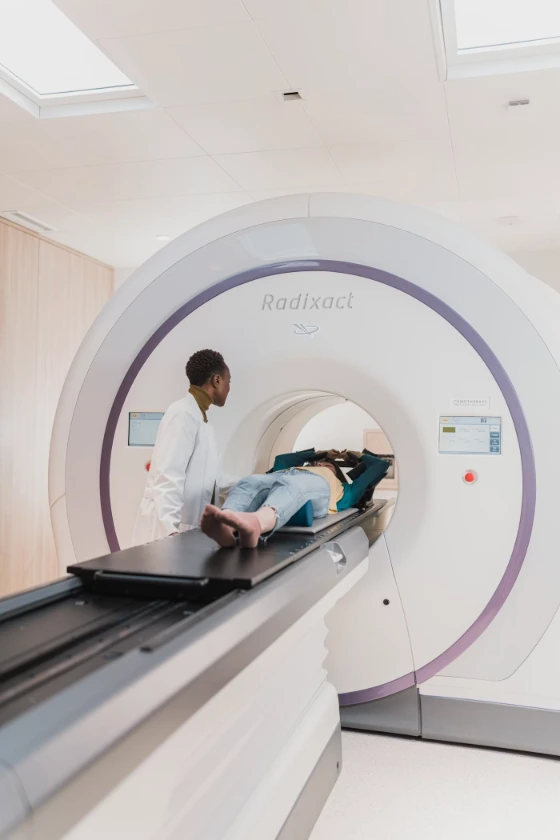
AI across the whole care pathway — where it helps, where it must not decide alone.

Routing, demand forecasting, and network design for moving people and goods.

Cutting emissions and waste across freight, transit, and last-mile networks.

Forecasting demand, balancing grids, and integrating renewables at scale.

Using AI to find the opportunity, test it fast, and build a venture around it.

Risk, pricing, fraud, and portfolio decisions — and where models mislead.

Governance, accountability, and the judgment calls AI cannot make for you.
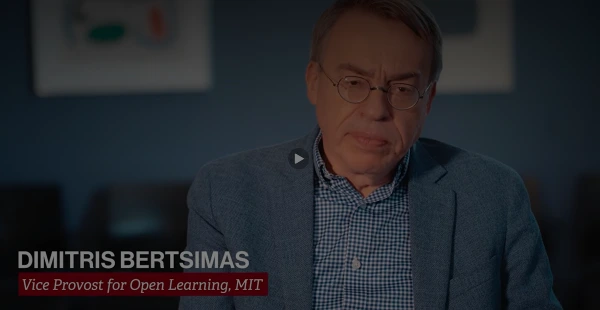
Learn from MIT instructors bringing expertise across AI, data, technology, and industry applications.
Vice Provost for Open Learning, MIT Open Learning
Dimitris Bertsimas is the Vice Provost for Open Learning at MIT, the Associate Dean of Business Analytics, the Boeing Leaders for Global Operations Professor of Management, and a Professor of Operations Research at MIT Sloan School of Management. At MIT Open Learning, he oversees Open Learning’s product offerings, new initiatives, infrastructure, finances, and operations.
Vice Provost for Open Learning, MIT Open Learning
Professor Guttag is the Dugald C. Jackson Professor at MIT, leading the Data Driven Medical Research Group. They apply computational techniques to medicine, focusing on predicting medical events and patient responses. He has researched data networking, sports analytics, and software engineering. Guttag earned his bachelor's in English and master's in applied mathematics from Brown University, and his doctorate from the University of Toronto. He was Head of MIT’s Electrical Engineering and Computer Science Department from 1999 to 2004 and is a Fellow of the ACM.
Professor of Medical Engineering and Computer Science
W. Eric L. Grimson is a Professor of Computer Science and Engineering and the Bernard M. Gordon Professor of Medical Engineering. He was Chancellor of MIT from 2011 to 2014. A faculty member since 1984, he has served as head of the Electrical Engineering and Computer Science Department and as its education officer. Grimson is known for his research in computer vision, particularly in medical image analysis. He has developed techniques for activity recognition, object recognition, image indexing, and image-guided surgery. He has taught over 10,000 undergraduates and supervised nearly 50 PhDs. Grimson is from Saskatchewan, Canada, and received his BSc from the University of Regina and his PhD from MIT. He has received the Bose Award for Excellence in Teaching and is a fellow of AAAI and IEEE.
Senior Lecturer, Computer Science and Electrical Engineering
I am a part of the EECS department at MIT, where I've been teaching introductory computer science since 2013. I received my Bachelor in Applied Science from the University of British Columbia in Vancouver, Canada. I received my MA and PhD from Princeton University, where I did research in computational biology. I discovered my passion for teaching after being appointed as a teaching assistant for two semesters for Introduction to Computer Science, at Princeton University. Since then, I've sought any opportunity to introduce students to the wonderful world of computer science
Research Scientist, FutureTech Lab
Ana Trisovic is a Research Scientist at MIT's FutureTech Lab, focusing on the economic impact of computing trends, applications of graph neural networks in social sciences, and the reproducibility of research methods. She earned her Ph.D. in Computer Science from the University of Cambridge and CERN, contributing to the LHCb Experiment and Open Data initiatives. Prior to MIT, she worked as a Research Associate at Harvard School of Public Health and held postdoctoral positions at the Institute of Quantitative Social Science and the University of Chicago, collaborating with EPIC and the University Library. Her work has been published in journals like Nature Physics and Harvard Data Science Review.
Professor of the Practice, AI/ML, MIT Sloan School of Management.
Rama Ramakrishnan’s teaching, research, and advisory interests center on the application of AI/ML techniques to problems and opportunities in industry. Rama is a passionate AI/ML educator and was awarded Sloan's most prestigious teaching award, the Jamieson Prize for Excellence in Teaching, in 2025 and MIT's Teaching with Digital Technology Award in 2024. He strongly believes that AI knowledge should be accessible to everyone and shares his expository work at https://ramakrishnan.com.
Maurice F. Strong Career Development Associate Professor, Associate Professor of Operations Research and Statistics, MIT Sloan School of Management.
Alexandre Jacquillat’s research focuses on data-driven decision-making, spanning stochastic optimization, integer optimization, large-scale optimization, and machine learning. In particular, his research develops scalable optimization models and algorithms to support more efficient, equitable, and sustainable operations—with a particular interest in air traffic management, urban mobility, decarbonization, and other social good applications.
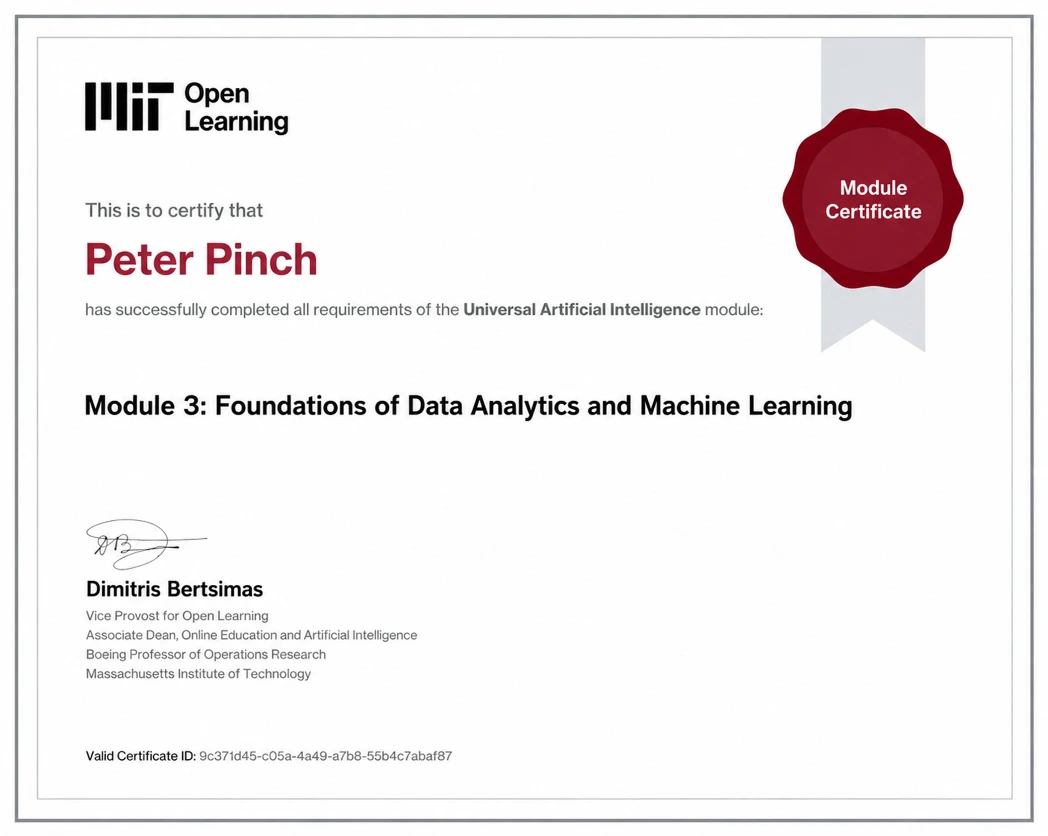
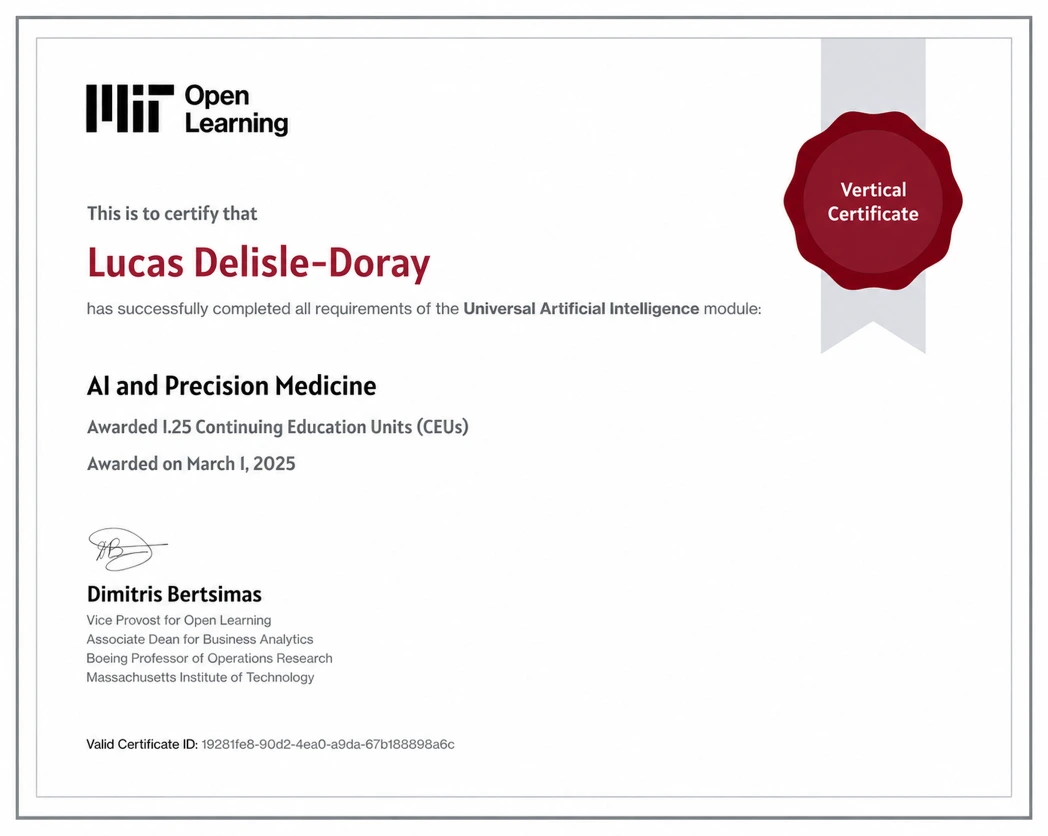
Earn recognition at every stage of your learning journey. Complete individual modules, build the full AI foundation, and add an industry specific module to earn progressively broader MIT Open Learning credentials.




We're here to help you make the most
of your Universal AI journey.
For inquiries about enrolment and general assistance.
For colleges looking to enrol their students for the program.
For MIT Learn platform-specific technical or content issues only