
Why Study Management in Mumbai, India's Financial Capital
Quick answer
Why Mumbai suits a management degree: RBI, SEBI, BSE and NSE are based here, and IIM Mumbai's weekend MBA-PGPM sits in Powai. A practical, fact-checked guide.

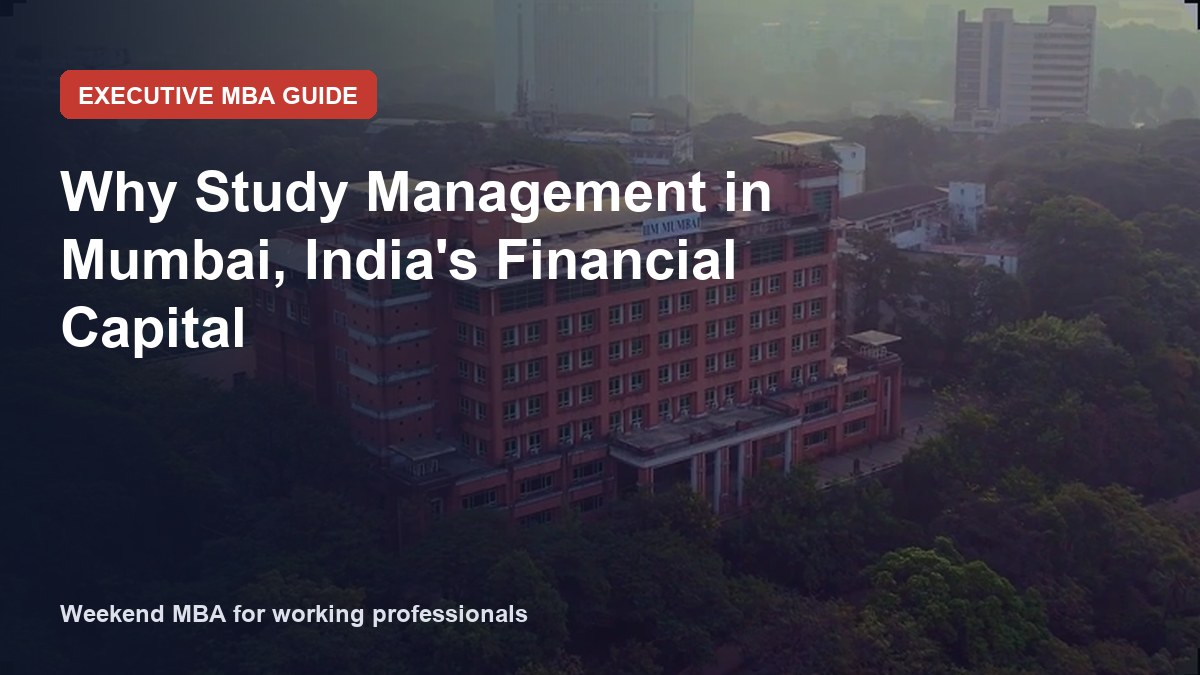
Mumbai is where a large share of India's regulators, exchanges and corporate headquarters are concentrated, which makes it a natural place to study management. But a good city does not make a good programme, so it helps to separate what Mumbai offers from what it does not.
Here are seven reasons the city is relevant for a working professional weighing an executive MBA, with every institutional claim checked against official or established sources.
1. The central bank is based here
The Reserve Bank of India was established on 1 April 1935. Its Central Office was first set up in Kolkata and was permanently moved to Mumbai in 1937, according to the RBI's own history page. For anyone studying economics, banking or finance, that proximity matters in a practical way: policy changes, circulars and market reactions play out a short distance from where you live and work.
2. The securities regulator is in Bandra Kurla Complex
SEBI's directory lists its offices as SEBI Bhavan BKC and SEBI Bhavan II BKC in Mumbai. A regulator close to the markets it oversees shapes the local professional community: compliance, legal, audit and investment roles cluster around it.
3. Two major exchanges operate from Mumbai
BSE was founded in 1875 and is generally described as Asia's oldest stock exchange, with its headquarters on Dalal Street. NSE's headquarters, Exchange Plaza, is in Bandra Kurla Complex, according to news reports from 2025, which also mention a plan to move to a new site in the same area within a few years. Treat the relocation as a plan, not a finished move.
4. Professionals from many industries live here
A weekend programme is only as good as the people in the room. Mumbai has professionals from banking, markets, consulting, media, manufacturing, logistics and technology. That mix is helpful in case discussions, where one person's finance background and another's operations experience produce a better analysis. No official cohort data is published for IIM Mumbai's programme, so this is a reasonable expectation rather than a quoted figure.
5. IIM Mumbai's history is in this city
IIM Mumbai was formerly NITIE, the National Institute for Training in Industrial Engineering, established in 1963 in Mumbai. It became an IIM under the IIM (Amendment) Act, 2023. Its main campus is in Powai, in Mumbai's north-eastern suburbs. The executive education page lists its strengths as operations, supply chain, analytics and industrial management, which fit a city with strong trade, logistics and manufacturing links as well as finance.
6. The weekend format fits a working city
The MBA-PGPM runs on Saturday and Sunday for 2 years, offline at the Powai campus, so weekday work stays intact. Eligibility is a graduate degree in any discipline plus at least 2 years of relevant post-graduation work experience. Selection is through the home-proctored IMAT, or a valid CAT, GRE or GMAT score, followed by a personal interview if shortlisted.
For someone who lives within reach of Powai, this removes the need to relocate or take a career break.
7. You do not have to live in Mumbai
If Mumbai is not your base, the MBA-ePGPM offers the same curriculum through live interactive virtual classes at outreach centres in Pune, Chennai, Bengaluru, Hyderabad and Delhi NCR. So the city's influence on the programme does not depend on your postcode.
How to make the most of studying in Mumbai
If you are in or near the city, a few practical points can improve the experience:
- Plan the Powai commute for weekends, since travel time is a real cost over 2 years.
- Use weekday evenings for study groups with classmates who live nearby.
- Look for industry talks and events in your own field, which tend to be easier to attend in a large city.
- Ask the programme office about campus access and logistics, as the public page does not list them.
- Keep your employer in the loop, particularly if your work involves weekend duties or travel.
The same logic applies if you join through an outreach centre. Your local city then becomes your learning base, with the same curriculum delivered live.
What Mumbai does not decide for you
A city's reputation will not do your assignments. Before choosing, compare these on any programme:
| Factor | Question to ask |
|---|---|
| Curriculum | Does it cover finance, operations, strategy, analytics and AI? |
| Format | Weekend, online or blended, and does it match your job? |
| Cost | What is the total fee, including taxes and deposits? |
| Evaluation | How much is continuous assessment versus exams? |
| Commute | Realistically, how long is your weekend journey? |
As listed on the official page (verify before applying), the campus plan is ₹18,00,000 on the annual plan or ₹19,00,000 module-wise, including taxes. The ePGPM is ₹14,50,000 annually or ₹15,00,000 module-wise.
Key takeaways
- RBI (central office in Mumbai since 1937), SEBI, BSE and NSE are all based in Mumbai.
- IIM Mumbai, formerly NITIE (established 1963), has its campus in Powai.
- The MBA-PGPM is a Saturday-Sunday programme; the MBA-ePGPM delivers the same curriculum virtually in five other cities.
- Location helps with exposure, but curriculum, format and fees should drive the decision.
- IIM Mumbai ranked 6th in NIRF 2025 for management.
Frequently asked questions
Why is Mumbai called India's financial capital?
Mumbai hosts the headquarters of the Reserve Bank of India, SEBI, BSE and NSE. The RBI was set up in 1935 and its central office moved permanently to Mumbai in 1937, and BSE, founded in 1875, is generally described as Asia's oldest stock exchange.
Does studying in Mumbai matter for a weekend MBA?
It can help with convenient access to the campus and to professionals from many industries, but the programme quality depends on curriculum, faculty and cohort. The MBA-ePGPM also lets people outside Mumbai study the same curriculum at outreach centres.
Where is IIM Mumbai located?
IIM Mumbai, formerly NITIE, is located in Powai, in Mumbai's north-eastern suburbs.
Can I join the programme if I do not live in Mumbai?
Yes. The MBA-ePGPM follows the same curriculum through live interactive virtual classes at outreach centres in Pune, Chennai, Bengaluru, Hyderabad and Delhi NCR.
Is IIM Mumbai ranked?
IIM Mumbai was ranked 6th in the NIRF 2025 management category, according to the official NIRF release as reported by Careers360.
Conclusion
Mumbai gives a management student proximity to regulators, exchanges and a wide mix of industries. Still, the best reason to choose a programme is whether its curriculum and format fit your career. The IMAT for the current cycle is on 22 November 2026, with the batch starting in January 2027. To see the full curriculum, eligibility and dates, visit the IIM Mumbai MBA-PGPM page, and speak to the programme office if you are unsure which format suits you.