
What is SEO in digital marketing: Meaning, Types & 2026 Guide

Quick answer: SEO (Search Engine Optimization) in digital marketing is the practice of improving a website's content, structure, and authority so it ranks higher in organic (unpaid) search results driving free, targeted traffic from people actively searching for what you offer. In 2026, effective SEO in digital marketing also means optimizing for AI-driven answer engines like Google AI Overviews, ChatGPT, and Perplexity a shift known as AEO (Answer Engine Optimization) and GEO (Generative Engine Optimization).
What is SEO in digital marketing?
SEO in digital marketing stands for Search Engine Optimization, the process of shaping your website's technical setup, content relevance, and backlink profile so search engines like Google can find, understand, and rank your pages for the queries your audience actually types in. Unlike paid ads, SEO doesn't charge you per click; instead, you invest in content and site quality once, and it keeps earning organic traffic long after publication.
At its core, SEO answers one question search engines constantly ask: does this page genuinely satisfy what the searcher wants? Pages that do through clear structure, useful information, and credible sourcing get rewarded with higher SERP rankings (Search Engine Results Page rankings).
Internal link tip: connect this section to your own [beginner's guide to digital marketing] and [keyword research guide] pages once published internal linking is one of the strongest on-page SEO signals.
How does SEO work in digital marketing?
Search engines work in three stages, and understanding them is the foundation of any SEO strategy:
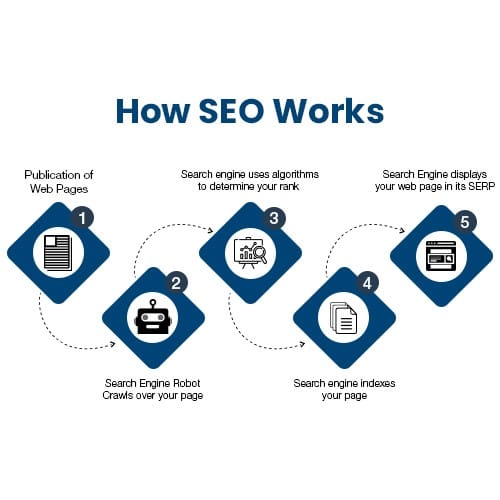
- Crawling - Bots (like Googlebot) scan the web, following links from page to page.
- Indexing - Discovered pages are stored in a massive database, tagged by topic, keywords, and quality signals.
- Ranking - When someone searches, an algorithm scores indexed pages against hundreds of factors and displays the best matches.
Getting this right requires aligning three interconnected pillars, which most authoritative guides including Coursera's and upGrad's breakdowns of SEO agree form the backbone of the discipline.
Types of SEO in digital marketing (o n-page, off-page, technical)
Each pillar reinforces the other two a technically fast site with weak content still won't rank, and great content on a slow, unindexed site is invisible. This three-part model is echoed across major SEO resources, including Coursera's explainer on SEO marketing, which breaks the discipline into the same on-page, off-page, and technical categories.
Why is SEO important for digital marketing in 2026?
- Organic traffic is (nearly) free - once a page ranks, clicks don't cost you per visitor, unlike PPC.
- It builds long-term compounding value - content published today can keep ranking and earning traffic for years.
- It targets high-intent users - people actively searching are closer to a decision than someone scrolling social media.
- It builds credibility - users trust organic results more than labeled ads.
- It's now tied to AI visibility - the same E-E-A-T (Experience, Expertise, Authoritativeness, Trustworthiness) signals that win rankings also make you more likely to get cited inside AI Overviews and chatbot answers.
Data-Driven Snapshot: SEO vs. Paid Search
Short-tail vs. long-tail keywords: Building your keyword cluster
A strong SEO strategy balances broad, high-volume short-tail keywords with specific, lower-competition long-tail keywords. This is where keyword clustering grouping a primary keyword with related secondary and semantic terms makes content easier for both search engines and AI answer engines to understand.
Primary keyword cluster: SEO in digital marketing, search engine optimization, SEO strategy Secondary keyword cluster: on-page SEO, off-page SEO, technical SEO, organic traffic, SERP ranking, backlinks, keyword research, E-E-A-T Emerging 2026 cluster: AEO (answer engine optimization), GEO (generative engine optimization), AI Overviews, AI search visibility
How is AEO and GEO different from traditional SEO?
This is the biggest shift in the field this year. As AI search tools like Google AI Overviews, ChatGPT, and Perplexity answer queries directly often without a click brands now need to be citable, not just rankable.
Industry analysis from HubSpot and Writer.com notes that AEO and GEO increasingly run together as one playbook: structured answers, clear entities, tables, and citation-worthy data now matter as much as backlinks did in the old SEO era. The takeaway for any 2026 content strategy including this one is to write answer-first, use tables and bullet points liberally, and back claims with credible, linkable sources.
Core SEO ranking factors to prioritize in 2026
A simple 5-Step SEO workflow
- Research - Identify your primary keyword and build a cluster of related long-tail and short-tail terms around it.
- Create - Write answer-first, well-structured content with headers, tables, and bullet points that satisfy search intent.
- Optimize - Add keywords naturally to titles, meta descriptions, headers, alt text, and internal links.
- Earn authority - Build backlinks through digital PR, guest content, and genuinely useful resources.
- Measure & refine - Track rankings and organic traffic in Google Search Console and Analytics, then update underperforming pages.
Internal link tip: link this workflow to your [on-page SEO checklist] and [link-building guide] pages to strengthen topical authority through internal linking, a tactic both upGrad and Coursera highlight as central to sustainable SEO in digital marketing.
Common SEO challenges in 2026
- Frequent algorithm updates that can shift rankings overnight
- Balancing UX and SEO - fast, mobile-friendly design now directly affects rankings
- Duplicate or thin content diluting relevance
- Adapting to AI Overviews reducing raw click-through rates even for top-ranking pages
- Keeping keyword research current as search behavior shifts toward conversational, question-based queries
Key Takeaways
Mastering SEO in digital marketing today means thinking beyond the traditional ten blue links it means building content that search engines can rank, users can trust, and AI engines can confidently cite.
Frequently asked questions
1. How long does it actually take to see SEO results after publishing a page? Most sites see early movement (indexing, minor keyword visibility) within 4-8 weeks, but meaningful ranking gains typically take 3-6 months, and competitive keywords can take 9-12 months. Brand-new domains take longer since they first need to build domain authority.
2. Is SEO really free, or does it require budget? SEO has no per-click cost like PPC, but it isn't free you're investing in content creation, tools (like Ahrefs, Semrush, or Screaming Frog), and often a writer's or SEO specialist's time. Think of it as an upfront and ongoing investment rather than a recurring ad spend.
3. What's the real difference between SEO and SEM? SEM (Search Engine Marketing) is the umbrella term that includes both SEO (organic) and PPC (paid search ads). SEO earns rankings; SEM often refers specifically to the paid side bidding on keywords via platforms like Google Ads.
4. Can a beginner do SEO without hiring an agency? Yes, for basics like keyword targeting, meta tags, and content structure, these are learnable. But technical work like site architecture, structured data, and large-scale link building usually benefits from specialist expertise once your site scales.
5. What tools do I actually need to get started with SEO? At minimum: Google Search Console and Google Analytics (both free) for tracking, plus one keyword research tool (Ubersuggest, Semrush, or Ahrefs) and a technical crawler like Screaming Frog for site audits.
6. Do I need to change my whole strategy every time Google updates its algorithm?No. Algorithm updates mostly reward sites already following fundamentals helpful content, good UX, technical health. Panic-driven overhauls after every update usually do more harm than good; monitor traffic in Search Console and adjust only if there's a clear, sustained drop.
7. How often should I update old blog content? As a rule of thumb, revisit high-traffic or high-potential pages every 6-12 months refresh statistics, add new sections, fix outdated links. Google favors "freshness" for topics that evolve quickly, like AI, marketing, or finance.
8. What is local SEO, and does every business need it? Local SEO optimizes your visibility for geographically specific searches ("digital marketing agency near me") using tools like Google Business Profile. It's essential for businesses with a physical location or service area, but less relevant for purely online, global brands.
9. Does posting on social media directly improve my SEO rankings? Not directly social signals aren't a confirmed Google ranking factor. But social sharing increases content visibility, which can indirectly lead to backlinks and brand searches, both of which do help SEO.
10. Besides ranking position, what other SEO KPIs should I track? Organic traffic growth, click-through rate (CTR) from search results, average time on page, bounce rate, conversion rate from organic visitors, and increasingly in 2026 AI citation frequency (how often your content is referenced in AI Overviews or chatbot answers).
11. Is SEO different for an e-commerce store versus a blog or service site? Yes. E-commerce SEO focuses heavily on product-page optimization, structured data for pricing/reviews, category-page architecture, and site speed at scale. Blog/content SEO leans more on topical depth, keyword clusters, and internal linking between articles.
12. What is keyword cannibalization, and why does it hurt rankings? It happens when two or more pages on your own site target the same keyword, splitting ranking signals and confusing search engines about which page to rank. The fix is consolidating content or clearly differentiating search intent between pages.
13. If my content is already high quality, do I still need backlinks? Generally yes. Quality content earns backlinks more easily, but for competitive keywords, backlinks remain one of the strongest trust signals search engines use great content alone rarely outranks well-linked competitors in crowded niches.
14. How much content do I need to publish before seeing SEO traction?There's no fixed number, but consistency matters more than volume publishing 2-4 well-researched, keyword-clustered pieces a month tends to outperform sporadic bursts of 20 thin articles.
15. What career paths exist in SEO within digital marketing? Common roles include SEO Analyst/Executive, SEO Content Strategist, Technical SEO Specialist, and SEO Manager often progressing into broader Digital Marketing Manager or Growth Marketing roles as skills expand into paid media and analytics.