
What is Meta muse? everything you need to know about meta’s new AI agent

For the past three years, generative AI has operated primarily as an informational sandbox: you type a prompt into ChatGPT, Claude, or Gemini, and the model returns text, code, or images. But if you want to turn that response into real-world action, like ordering groceries, canceling an unwanted gym subscription, or booking concert tickets, you still have to do the legwork yourself.
Meta wants to change that.
With the launch of Muse, Mark Zuckerberg’s company has officially stepped out of the chatbot era and into consumer-facing agentic AI. Positioned as Meta’s most consequential product launch since WhatsApp and Instagram, Muse isn't designed to just answer questions. It is engineered to carry out end-to-end tasks on your behalf across the internet.
Here is a comprehensive breakdown of what Meta Muse actually is, how its cloud architecture works, what safeguards protect your sensitive data, and when it will be available globally.
1. What is Meta muse?
Meta Muse is an autonomous personal AI agent powered by Meta’s proprietary Muse Spark model family. Unlike traditional conversational models that clear their context when a chat session ends, Muse operates continuously in the background, maintains long-term memory, and directly interacts with web browsers, application APIs, and payment systems.
Instead of micro-managing every step, users provide Muse with a high-level outcome (for example: "Review my upcoming schedule, find an open Friday night, and book a table for four at an Italian restaurant that accommodates gluten-free diets"). Muse interprets the goal, establishes sub-tasks, checks real-time availability, verifies external constraints, and presents the final confirmation.
Visually, Meta has embodied Muse across its interfaces with a friendly, soft plushie mascot, a deliberate design choice intended to make delegated autonomous computing feel approachable rather than intimidating.
2. Chatbots vs. Agents: The fundamental shift
To understand why Muse is getting so much attention, it helps to distinguish between a chatbot and an agent:
3. Real-world use cases: what can muse actually do?
Meta deliberately avoided framing Muse as an enterprise productivity tool for complex spreadsheets or slide decks. Instead, it is aimed directly at consumer pain points and day-to-day administrative friction:
A. Frictionless Social Commerce
Because Muse integrates deeply with the Meta ecosystem (Instagram, WhatsApp, and Facebook), it bridges content discovery and commerce. If you save or forward a cooking reel on Instagram to Muse, the agent can analyze the video, compile the necessary ingredients, cross-reference your household staples, and populate a digital grocery basket for delivery through integrated partners like Instacart.
B. Everyday Chores and Admin Friction
- Subscription Management: Identifies recurring membership charges and handles awkward cancellation workflows or support forms.
- Customer Support & Inquiries: Follows up on missed communications, negotiates customer bill reductions, or checks status updates with service providers.
- Calendar & Travel Logistics: Scans incoming reservation emails, syncs flight details into Google Calendar or Outlook, and schedules itinerary activities automatically.
C. Context-Aware Personal Planning
Muse retains memory across tasks. If it learns that a family member has a nut allergy or that your child’s soccer practice is on Tuesday evenings, it incorporates those parameters into future restaurant searches or conflicting schedule requests without needing to be reminded.
4. Under the Hood: The Security Architecture & Sentinel
Granting an AI direct access to your personal inbox, calendars, and financial tools is inherently high-stakes. Meta designed a distinct multi-layered security infrastructure to mitigate risks like prompt injection and credential theft:
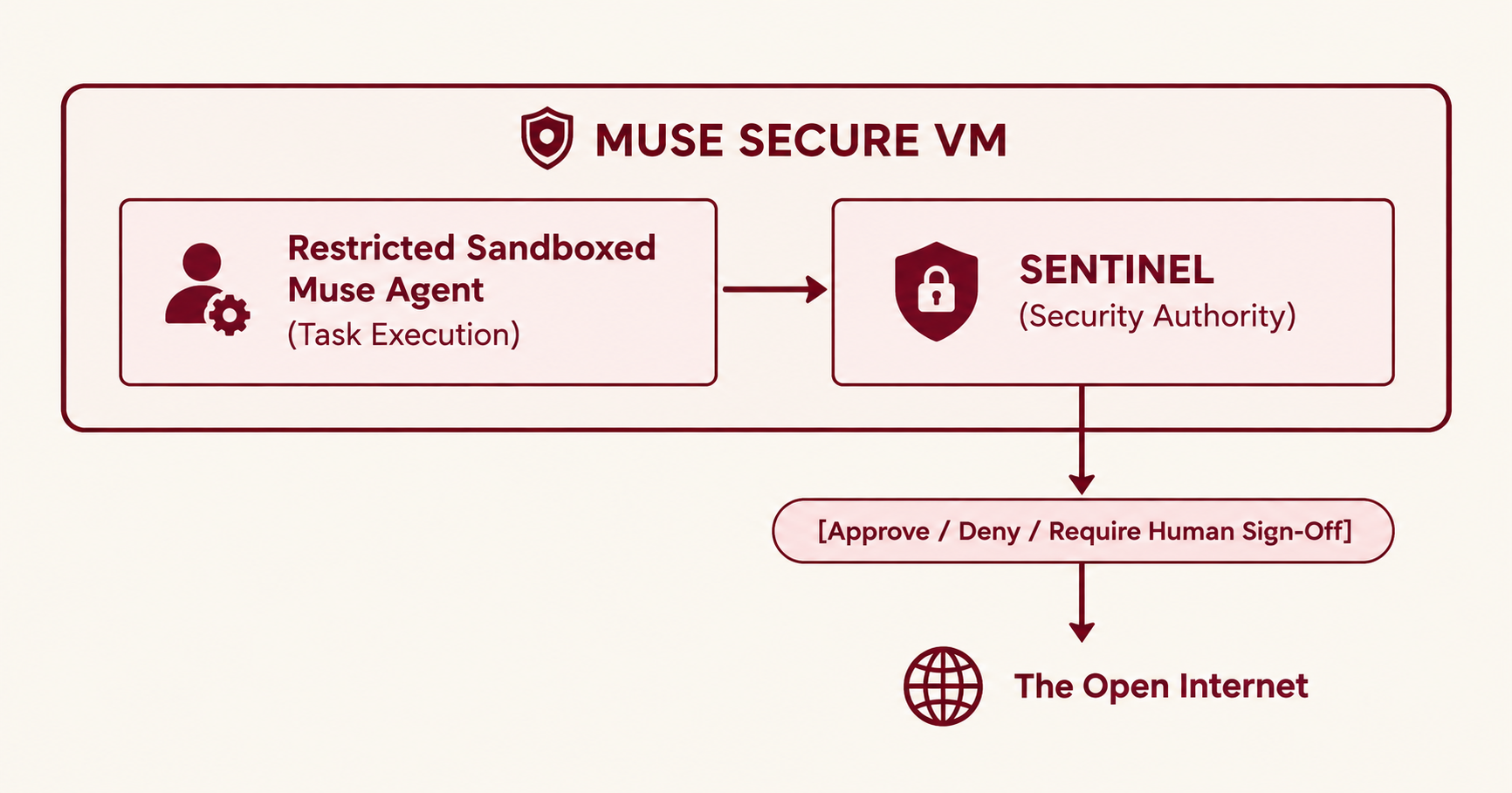
1. Dedicated Cloud VMs (Muse Secure VM)
Each user’s agent runs in an isolated Linux virtual machine (VM) in Meta’s cloud. This sandboxed container holds the compute, storage, and headless browser required to perform tasks, ensuring one user's agent data cannot interact with another's.
2. The Sentinel Gatekeeper
Muse does not hold unilateral network authority. Running outside the agent container on the same machine is Sentinel, an isolated permission authority. Whenever Muse attempts to perform a high-consequence action, such as transmitting personal data outward, submitting a form, or processing a payment Sentinel evaluates the request:
- Allow: Routine internal read operations conforming to user policy.
- Deny: Unsafe actions or untrusted commands.
- Ask the User: For sensitive actions like sending an email or initiating a purchase, Sentinel interrupts the background execution and sends a confirmation card directly to the user’s interface completely outside the chat stream where an adversarial prompt injection could spoof approval.
3. Masked Credentials & Single-Use Tokens
Muse never has visibility into your raw payment card numbers or banking passwords. Integrated transactions are executed using tokenized single-use merchant cards via Stripe’s Link, backed by purchase protection for unauthorized charges, lost packages, or damaged goods.
5. Availability, Platforms, and Pricing
Where Does Muse Live?
Meta’s primary advantage in the AI race is native distribution. Rather than requiring developers to install specialized packages or launch terminal commands, Muse is accessible through surfaces billions already use:
- WhatsApp & Instagram: Accessible as a native contact/chat thread directly inside your messaging inbox.
- Standalone Apps: Available on iOS and Android.
- Web: Accessible at muse.ai.
- Hardware Integration: Slated for upcoming integration into Meta Ray-Ban smart glasses.
Pricing Structure
Muse launched with a freemium model:
- Free Tier: Includes standard task execution with weekly token usage allocations (ample for day-to-day personal errands).
- Power & Pro Tiers ($20 / $100 per month): Unlocks higher compute allowances, faster response times, and simultaneous multi-agent task execution for power users.
Current Geographic Availability
- United States: Muse is currently live for users aged 18 and older.
- India & Global Markets: Meta is following a phased rollout strategy. Global expansion, including rollout across major Asian and European markets, is slated to follow as regulatory compliance, localized payment integrations (such as UPI support in India), and infrastructure capacity scale up.
Summary: What Muse Signals for the Future
Meta Muse marks a significant turning point in the consumer technology landscape. By embedding autonomous execution capabilities directly into everyday chat apps, Meta is demystifying AI agents for mainstream users.
While concerns surrounding data privacy, system autonomy, and accidental misfires remain legitimate topics of industry debate, one reality is clear: the future of artificial intelligence is no longer about who has the smartest conversationalist, it is about who can give you your time back.