
What a Weekend at IIM Mumbai Actually Looks Like
Quick answer
What to expect from a weekend MBA at IIM Mumbai: Saturday-Sunday classes, case and simulation learning, modules, attendance rules and the Powai campus.

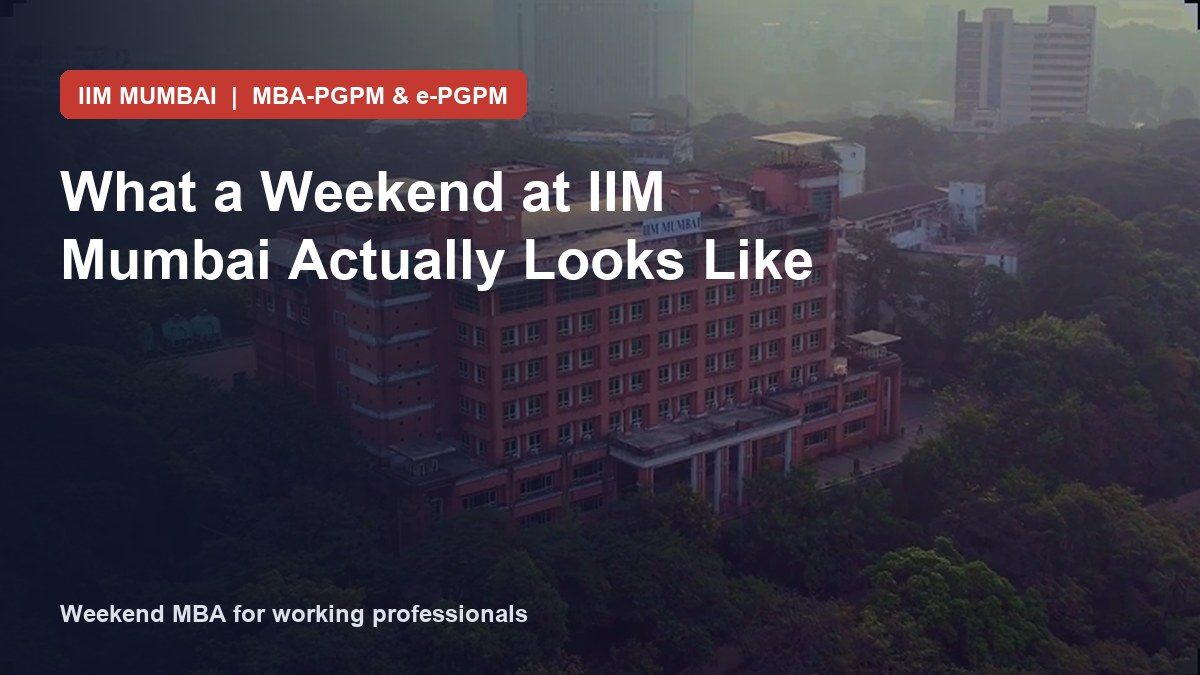
Anyone considering a weekend MBA eventually asks the same practical question: what does a Saturday or Sunday on campus really involve? Since weekend learners give up their only free days, it is worth knowing what to expect before committing.
This post sticks to what the official programme information supports. It is a "what to expect" guide, not a diary of a particular student's experience, and it flags where details such as class hours need to be confirmed with the programme office.
1. The format: Saturday and Sunday, for 2 years
The MBA-PGPM at IIM Mumbai is a weekend programme with classes on Saturday and Sunday across 2 years. The official name for the campus version is MBA-PGPM, delivered offline at the Powai campus. A second version, the MBA-ePGPM (often searched as "EPGPM"), uses the same curriculum with live interactive virtual classes at outreach centres in Pune, Chennai, Bengaluru, Hyderabad and Delhi NCR.
The public page does not list daily class hours. That is a detail to confirm directly (execed@iimmumbai.ac.in) rather than assume.
2. The campus: Powai, Mumbai
IIM Mumbai was formerly NITIE, an institute based in Powai, in Mumbai's north-eastern suburbs. For campus-based students, that means weekend commuting to Powai. If you live elsewhere in the Mumbai region, plan your route and timing in advance, since weekend traffic and local trains behave differently from weekdays.
For an idea of the surroundings, the programme page offers an "Explore the IIM Mumbai Campus" video. Details such as hostel access or on-campus facilities for weekend students are not stated publicly, so ask before you assume.
3. How classes are taught: cases, simulations and industry input
According to the official page, the programme is case-driven. It combines case studies, simulations, industry interactions and capstone projects. In practice, case-based classes usually reward preparation: you read the case beforehand, form a view, and then defend or revise it in discussion. A simulation asks teams to make a series of decisions and see their effects.
What this means for you:
- Reading before the weekend makes classroom discussion far more useful.
- Your own work experience becomes classroom material, which is a genuine advantage of an experienced cohort.
- Group work is likely to be part of the learning, so schedule teammates' availability early.
4. The module structure behind each weekend
The programme has 6 modules and 75 credits, including 17 core courses, 8 electives and 3 projects. A quick look at how it unfolds:
| Stage | What it covers (from the official page) |
|---|---|
| Module 1 | Marketing Management, Managerial Communication, Financial Reporting and Accounting, Microeconomics, Optimisation and Decision Techniques |
| Module 2 | Operations Management, OB and HRM, Corporate Finance, Macroeconomics, B2B Marketing |
| Module 3 | Business Applications of AI and ML, Sustainable Business Management, Supply Chain Management, Marketing Research and Customer Analytics, Action Learning Project |
| Modules 4-6 | Strategic Management, ESG/Corporate Governance/Ethics, Innovation and Entrepreneurship, electives, and a two-part Capstone |
Electives (8 in all) come in Year 2 across modules 4 to 6.
5. Assessment: steady work, not a single exam
Evaluation is 40% continuous assessment, 20% mid-term and 40% module-end. So the weekends are not only lectures; they are part of a rhythm of submissions, discussion and exams. Continuous assessment in particular means regular effort pays off.
6. Attendance: the rule that shapes your weekends
A minimum of 75% attendance is mandatory. Attendance between 65% and 75% attracts a one-grade reduction, 50% to 65% a two-grade reduction, and below 50% an F. For a working professional, this is the number to keep in mind when accepting a weekend project, a client trip or a family function.
7. The people in the room
The programme is designed for graduates in any discipline with at least 2 years of relevant post-graduation work experience. That generally means classmates who bring operational problems from different industries. The official page does not publish batch size or cohort composition, so avoid relying on figures you see elsewhere.
8. How to prepare before your first weekend
A few low-effort steps make the first module smoother, and none of them depend on details beyond the official page:
- Revisit basic accounting and economics, since Module 1 includes Financial Reporting and Accounting and Microeconomics.
- Agree with your manager which weekends are protected, so work does not eat into the 75% attendance requirement.
- Set up a quiet study corner and a fixed weekday reading slot.
- If you are joining the MBA-ePGPM, test your internet connection and audio set-up at your outreach centre or home well before the first class.
- Keep the programme office's contact (execed@iimmumbai.ac.in) handy for timetable and logistics questions.
The current cycle has the IMAT on 22 November 2026, personal interviews from 25 to 27 November, and a tentative result on 1 December 2026. Seat confirmation runs from 2 to 11 December, and the full fee deadline is 20 December 2026.
Key takeaways
- Classes are held on Saturday and Sunday for 2 years; daily timings are not on the public page.
- The campus MBA-PGPM is at Powai; the MBA-ePGPM runs live virtually at outreach centres.
- Learning is case and simulation based, with industry interactions and capstones.
- Attendance of 75% is mandatory, with grade penalties below that.
- Evaluation mixes continuous assessment (40%), mid-term (20%) and module-end exams (40%).
Frequently asked questions
Which days are classes held in IIM Mumbai's weekend MBA?
Classes are held on Saturday and Sunday over 2 years. The campus MBA-PGPM is offline at the Powai campus, while the MBA-ePGPM offers the same curriculum through live interactive virtual classes at outreach centres.
What are the class timings on a weekend?
The public programme page does not state daily class hours. Contact the programme office at execed@iimmumbai.ac.in for the current timetable before planning travel or work around it.
How is learning delivered in the classroom?
The programme is case-driven, with case studies, simulations, industry interactions and capstone projects, according to the official page.
How strict is attendance?
A minimum of 75% attendance is required. Between 65% and 75% leads to a one-grade drop, 50% to 65% to a two-grade drop, and below 50% results in an F.
Where is the IIM Mumbai campus?
The campus is in Powai, in Mumbai's north-eastern suburbs. IIM Mumbai was formerly NITIE, and it is one of the places where the MBA-PGPM is delivered offline.
Conclusion
A weekend at IIM Mumbai is built around cases, simulations and steady assessment, not passive lectures. The current cycle's IMAT is on 22 November 2026 and the batch begins in January 2027. If the format sounds workable, read the full details and fee structure on the official MBA-PGPM page, and ask the programme office about timings before you apply.