
Stuck in Middle Management? 7 Signs You Need to Upskill
Quick answer
Plateaued in middle management? Seven honest signs it is time to upskill, plus practical steps and a weekend MBA option from IIM Mumbai.

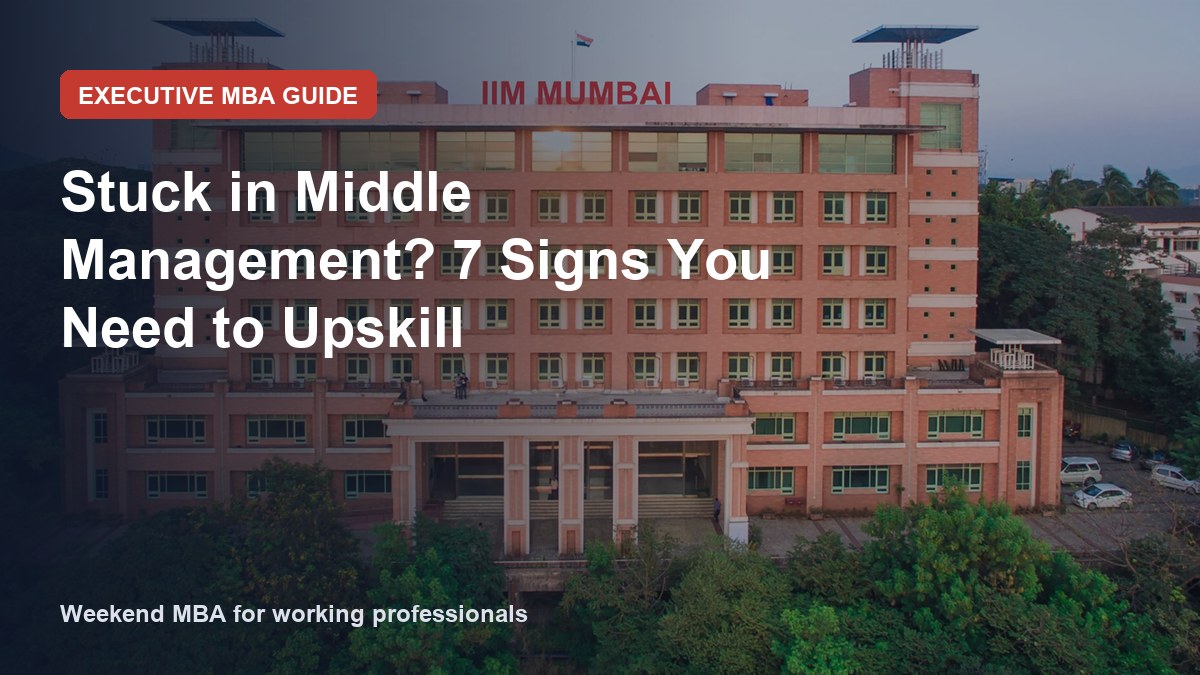
Middle management can feel like a comfortable room with no doors. You are trusted, busy and reasonably paid, yet the next role never quite opens up. Sometimes the cause is the organisation. Sometimes it is a skills gap you can fix. These seven signs help you tell the difference and decide whether to upskill.
1. Your promotions have turned into lateral moves
If the last two or three role changes added a new team or a bigger title but no budget, no P&L and no strategic decision, you are growing in width, not height. Leaders at the next level are usually asked to own outcomes across functions, and that needs a different set of skills.
2. You are strong at execution but quiet in strategy discussions
Ask yourself how often you are invited into planning conversations on pricing, market choices or capital allocation. If your role is mostly "deliver what was decided", gaps in strategy, finance or market thinking may be holding you back. Courses like Strategic Management and Corporate Finance exist to close precisely this gap.
3. You cannot read the financials that drive decisions
Reading a balance sheet and understanding unit economics is a baseline for senior roles. If you rely on finance partners to explain your own function's numbers, that is a sign to learn financial reporting and corporate finance properly.
4. Data and AI are becoming part of your function, and you are on the sidelines
Whatever your function, dashboards, analytics and AI tools are entering it. Managers who can frame questions, evaluate models and work with data teams stand out. If you depend entirely on others to interpret data, build that skill before it becomes a barrier.
5. Your network is mostly inside one company
Look at your contacts. If nearly all of them work with you today, you have limited visibility into other industries and opportunities. A structured programme with peers from diverse sectors can widen that circle, as can industry events and communities.
6. You lead people but have no formal management training
Many managers learn by trial and error. If you handle performance reviews, hiring and conflict without a framework, formal learning in organisational behaviour and HR management can raise your effectiveness and your confidence.
7. The job market is changing around your role
Roles evolve, and some tasks are automated or shifted. If your function is changing faster than your skills, that is a signal to act early. The World Economic Forum's Future of Jobs Report 2025 says employers expect around 39% of workers' core skills to change by 2030. Upskilling before you need to is easier than after a reorganisation.
Not every sign means you need an MBA
Before enrolling in a two-year programme, try cheaper steps for three to six months:
- Volunteer for a cross-functional project with budget exposure.
- Take a short course in finance for non-finance managers or analytics.
- Find an internal mentor at director level and ask for honest feedback.
- Write down the three skills your next role needs and rate yourself.
If the gaps remain broad (finance, strategy, operations, analytics, people), a structured programme saves time compared with piecing together courses.
When a weekend MBA fits
For managers who want to keep their job, IIM Mumbai's MBA-PGPM is a 2-year weekend programme on the Powai campus. The MBA-ePGPM (often searched as EPGPM) delivers the same curriculum through live interactive virtual classes at outreach centres in Pune, Chennai, Bengaluru, Hyderabad and Delhi NCR.
It has 75 credits across 6 modules. Year 1 covers areas such as Marketing Management, Financial Reporting, Operations Management, Corporate Finance, Business Applications of AI and ML, Supply Chain Management and an Action Learning Project. Year 2 adds Strategic Management, ESG and Corporate Governance, Innovation and Entrepreneurship, eight electives and a two-part Capstone. Teaching uses cases, simulations and industry interactions. IIM Mumbai, formerly NITIE, is ranked 6 in management in NIRF 2025.
You need a graduate degree in any discipline and at least 2 years of relevant work experience. Admission is through the home-proctored IMAT or a valid CAT, GRE or GMAT score, followed by an interview. The current cycle's IMAT is on 22 November 2026, with the batch starting in January 2027.
Count the commitment
Attendance of at least 75% is expected, and falling below that reduces grades. The listed annual plan including taxes is ₹18,00,000 for the MBA-PGPM and ₹14,50,000 for the MBA-ePGPM, with module-wise plans on the official page (verify before applying). Speak to your manager and family before you sign up.
A quick self-audit
Rate yourself from 1 to 5 on each area: finance, strategy, data and AI, people leadership, cross-functional influence and external network. Anything below 3 in two or more areas, combined with two or more of the signs above, is a reasonable cue to act this year and not next. Repeat the audit every six months so that your plan responds to evidence and not to mood.
Key takeaways
- Lateral moves, silence in strategy rooms and weak finance or data skills are common middle-management warning signs.
- Test cheaper options first: projects, short courses and mentoring.
- A structured programme helps when your gaps are broad.
- IIM Mumbai's weekend MBA requires 2 years of experience and accepts the IMAT or a valid CAT, GRE or GMAT score.
- Check attendance and fee terms before committing.
FAQ
How do I know if I am stuck in middle management?
Common signs are repeated lateral moves without added scope, exclusion from strategy conversations and a skills gap in finance, analytics or strategy. If several apply for a year or more, plan an upskilling step.
Is an MBA the only way to move beyond middle management?
No. Targeted courses, cross-functional projects and mentoring also help. An MBA suits those who need structured general-management training, a wider network and a recognised credential.
Can I study while working in a senior role?
Yes, weekend formats exist. IIM Mumbai's MBA-PGPM and MBA-ePGPM run on Saturdays and Sundays for 2 years, with at least 75% attendance required.
What work experience does IIM Mumbai's executive MBA need?
A graduate degree in any discipline and at least 2 years of relevant post-graduation work experience.
Should I talk to my manager before enrolling?
Yes. Discuss the weekend schedule, any sponsorship possibility and how the learning will apply at work.
Conclusion
Feeling stuck is information, not failure. Identify your gaps, try small experiments, and then decide whether a structured programme fits. If you are ready to look at an IIM option, read the MBA-PGPM and MBA-ePGPM details and reach out to execed@iimmumbai.ac.in before the current cycle's dates pass.